In the intricate symphony of the human body, the heart’s rhythm is the fundamental beat that sustains life. This rhythm, a carefully orchestrated sequence of electrical impulses, is captured visually on an electrocardiogram (ECG or EKG). Among the many waves and intervals on this diagnostic tracing, one, in particular, holds a potent and often silent danger: the QT interval. When this interval is prolonged—a condition known as QTc prolongation—it signifies a delayed repolarization of the heart’s ventricles, creating a vulnerable period that can precipitate a catastrophic, life-threatening arrhythmia known as Torsades de Pointes (TdP). This arrhythmia can degenerate into ventricular fibrillation and sudden cardiac death, often without warning.
For clinicians, identifying QTc prolongation is a critical risk mitigation strategy. For medical coders, accurately representing this condition in the patient’s health record is a task of equal importance, carrying significant clinical, financial, and legal implications. The ICD-10-CM code for this finding, R94.31, serves as a crucial linchpin connecting a diagnostic observation to the broader narrative of the patient’s health. It is not merely a bureaucratic requirement; it is a data point that fuels public health research, informs quality care initiatives, and ensures appropriate reimbursement for the complex management these patients often require.
This extensive article is designed to be the definitive guide for healthcare professionals, medical coders, students, and anyone involved in the patient care continuum who seeks a profound understanding of QTc prolongation from a coding perspective. We will embark on a detailed journey, beginning with the fundamental physiology of the heart, navigating the precise application of the ICD-10 code R94.31, exploring the complex clinical scenarios in which it appears, and concluding with the vital compliance considerations that underpin modern healthcare delivery. Our goal is to transform the simple act of assigning a code into an exercise in clinical understanding and administrative precision.
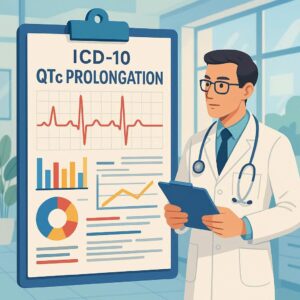
ICD-10 code for QTc prolongation
2. The Heart of the Matter: Understanding the QT Interval and QTc Prolongation
To code a condition accurately, one must first understand its clinical essence. QTc prolongation is not a disease in itself but a manifestation of an underlying disturbance in the heart’s electrical system.
The Cardiac Electrical Cycle: A Primer
The heartbeat is governed by a sophisticated electrical conduction system. It begins in the sinoatrial (SA) node, the heart’s natural pacemaker, which generates an electrical impulse. This impulse spreads across the atria, causing them to contract and push blood into the ventricles. The impulse then pauses briefly at the atrioventricular (AV) node before traveling down the Bundle of His and its branches (the bundle branches), and finally through the Purkinje fibers to the ventricular muscle, causing a synchronized, powerful contraction that ejects blood to the lungs and the rest of the body.
The ECG is the graphical representation of this electrical activity:
-
P Wave: Atrial depolarization (contraction).
-
QRS Complex: Ventricular depolarization (contraction).
-
T Wave: Ventricular repolarization (recharging for the next beat).
Defining the QT Interval: From Depolarization to Repolarization
The QT interval is measured from the beginning of the QRS complex to the end of the T wave. It represents the total time taken for the ventricles to depolarize and then fully repolarize. During this period, particularly during the latter phase corresponding to the T wave, the cardiac cells are electrically unstable. A prolonged QT interval signifies a lengthening of this vulnerable period.
Correcting for Heart Rate: The Critical Role of QTc
The heart rate directly influences the QT interval; faster heart rates shorten it, and slower heart rates lengthen it. To make meaningful comparisons across different heart rates, the measured QT interval is mathematically corrected, resulting in the Corrected QT interval, or QTc. Several formulas exist for this correction, with Bazett’s formula (QTc = QT / √RR) being the most common, despite its limitations at extreme heart rates. Other formulas, like Fridericia’s (QTc = QT / ∛RR), are also used, and modern ECG machines often calculate and report the QTc automatically.
What Constitutes Prolongation? Clinical Thresholds and Definitions
There is no single absolute value that defines QTc prolongation, as it can vary slightly by sex and age. However, well-established clinical thresholds are used:
-
For Adult Males: A QTc > 450 milliseconds (ms) is generally considered borderline, and > 470 ms is clearly prolonged.
-
For Adult Females: A QTc > 460 ms is borderline, and > 480 ms is clearly prolonged.
These thresholds are critical. When a clinician documents “QTc prolongation,” they are implicitly stating that the measured value has exceeded these accepted limits, triggering a clinical response.
3. The ICD-10-CM Code for QTc Prolongation: A Deep Dive into R94.31
Within the ICD-10-CM system, every diagnosis, symptom, and reason for encounter has a specific alphanumeric code. For QTc prolongation, the designated code is R94.31.
Code Structure and Placement: Why “Abnormal Electrocardiogram [ECG]”?
The code R94.31 is found in Chapter 18 of ICD-10-CM, which covers “Symptoms, signs, and abnormal clinical and laboratory findings, not elsewhere classified.” More specifically, it is under the subcategory R94 – Abnormal results of function studies.
-
R94.3: Abnormal results of cardiovascular function studies
-
R94.31: Abnormal electrocardiogram [ECG] [EKG]
The placement of the code for QTc prolongation under “abnormal ECG” is logical. QTc prolongation is, first and foremost, an electrocardiographic finding. It is a sign, not a definitive diagnosis. This classification is fundamental to understanding its proper use.
Parent Code Notes and Exclusions: Navigating the Coding Hierarchy
It is essential to review the parent code notes for R94.3. The ICD-10-CM guidelines state that this category can be used to identify abnormalities found in the course of performing diagnostic tests, even when a definitive diagnosis has not been established.
Crucially, the note for R94.3 includes an Excludes1 note for certain specific diagnoses. An Excludes1 note means that the two codes should not be coded together, as they are mutually exclusive. For example, if a patient has a confirmed diagnosis of Congenital long QT syndrome (I45.81), you would code I45.81 and not R94.31. The congenital syndrome is the underlying disease, of which a prolonged QT is a defining feature. Coding both would be redundant and incorrect.
Code First, Use Additional, and Clinical Responsibility
A pivotal instruction often associated with codes in Chapter 18 is “Code first.” For R94.31, this means that if the QTc prolongation is due to a known, underlying cause, that underlying cause should be sequenced as the principal diagnosis, followed by R94.31 as a secondary code to provide additional detail.
For instance:
-
If a patient has hypokalemia (low potassium) which is causing QTc prolongation, you would code E87.6 (Hypokalemia) first, and then R94.31.
-
If a patient is on a medication like amiodarone that is known to cause QTc prolongation, and it is documented as such, you would code the reason for the amiodarone (e.g., I48.91 – Atrial fibrillation) first, and then R94.31.
The coder’s responsibility is to reflect the physician’s documentation accurately. The coder cannot assume a cause-and-effect relationship unless it is explicitly stated in the medical record.
4. The Clinical Landscape of QTc Prolongation: Etiologies and Risk Stratification
Understanding the myriad causes of QTc prolongation is essential for accurate coding, as it directly impacts the “code first” instructions and the need for additional codes.
Congenital Long QT Syndrome (LQTS): The Genetic Underpinnings
This is a group of rare, inherited channelopathies caused by genetic mutations that affect the heart’s ion channels, leading to a inherent predisposition to QTc prolongation and TdP. It is coded with I45.81 – Long QT syndrome. As per the Excludes1 note, R94.31 is not used with I45.81.
Acquired QTc Prolongation: A Ubiquitous Clinical Challenge
This is far more common than the congenital form and is the primary scenario where R94.31 is utilized. The causes are diverse.
Pharmacological Causes: The Minefield of QT-Prolonging Medications
This is the most frequent cause of acquired QTc prolongation. Hundreds of medications across numerous drug classes can prolong the QT interval. The website www.crediblemeds.org maintains a comprehensive, updated list.
Common Drug Classes Include:
-
Antiarrhythmics: Amiodarone, Sotalol, Dofetilide, Quinidine
-
Antibiotics: Macrolides (Erythromycin, Azithromycin), Fluoroquinolones (Levofloxacin, Moxifloxacin)
-
Antipsychotics: Haloperidol, Quetiapine, Ziprasidone
-
Antidepressants: Citalopram, Escitalopram, Amitriptyline
-
Antiemetics: Ondansetron, Droperidol
When coding for drug-induced QTc prolongation, an additional code from the T36-T50 series is required to identify the drug. The 7th character for poisoning and adverse effect codes is critical.
-
Adverse Effect (7th character ‘A’): Used when the drug was taken correctly as prescribed, but an unintended, harmful reaction occurred. (e.g., T46.2XA for an adverse effect of amiodarone).
-
Poisoning (7th characters D, S): Used for overdose, wrong substance given, or wrong drug taken in error.
Metabolic and Electrolyte Imbalances
Electrolytes like potassium, magnesium, and calcium are crucial for proper cardiac repolarization. Their deficiency can directly prolong the QT interval.
-
Hypokalemia: E87.6
-
Hypomagnesemia: E83.42
-
Hypocalcemia: E83.51
Cardiovascular and Structural Heart Disease
-
Myocardial Ischemia/Infarction: I21.-
-
Heart Failure: I50.-
-
Cardiomyopathies: I42.-
-
Bradycardia: R00.1
Other Systemic Causes
-
Hypothyroidism: E03.9
-
Intracranial hemorrhage: I60.-I62.-
-
Anorexia Nervosa: F50.0
5. The Coder’s Crucible: Bridging Clinical Documentation and Accurate Code Assignment
This is where theoretical knowledge meets practical application. The coder’s role is to be a meticulous interpreter of the clinical record.
The Power of Specificity: What Must the Documentation State?
The single most important element for assigning R94.31 is clear and unambiguous documentation from a physician or qualified healthcare provider. The ideal documentation will explicitly state “QTc prolongation” and include the numerical value (e.g., “QTc measured at 510 ms”).
Acceptable documentation includes:
-
“Prolonged QTc”
-
“QTc prolongation”
-
“Abnormal QT interval correction”
-
“Markedly prolonged QT interval”
Less specific terms like “abnormal ECG” or “repolarization abnormality” are insufficient on their own to assign R94.31. The coder must look for explicit mention of the QT or QTc interval.
Clinical Scenarios and Coding Exercises: From ECG Report to Final Code
Let’s apply our knowledge to realistic patient cases.
Scenario 1: The Clear-Cut Case
-
Documentation: “75-year-old female admitted for community-acquired pneumonia. ECG shows sinus rhythm with QTc of 495 ms. Started on Azithromycin. Will monitor ECG given QTc prolongation and use of macrolide antibiotic.”
-
Analysis: The physician explicitly documents “QTc prolongation.” The cause is likely multifactorial (infection, possibly the medication). The reason for encounter is pneumonia.
-
Correct Coding:
-
J15.9 – Unspecified bacterial pneumonia (Principal Diagnosis)
-
R94.31 – Abnormal electrocardiogram [ECG] [EKG] (Secondary Diagnosis)
-
T36.8X5A – Adverse effect of other systemic antibiotics, initial encounter (for Azithromycin)
-
Scenario 2: The Underlying Cause
-
Documentation: “Patient presents with severe vomiting and diarrhea. Lab work reveals potassium of 2.8 mEq/L. ECG obtained shows sinus tachycardia with significant QTc prolongation to 520 ms. Diagnosis: Hypokalemia secondary to gastroenteritis.”
-
Analysis: The QTc prolongation is explicitly documented and is a direct result of the hypokalemia.
-
Correct Coding:
-
E87.6 – Hypokalemia (Principal Diagnosis – “code first” the cause)
-
R94.31 – Abnormal electrocardiogram [ECG] [EKG] (Secondary Diagnosis)
-
A09 – Infectious gastroenteritis and colitis, unspecified
-
Scenario 3: The Insufficient Document
-
Documentation: “ECG performed: Shows nonspecific T-wave abnormalities. Patient has a history of CAD.”
-
Analysis: The physician does not mention the QT or QTc interval. The phrase “nonspecific T-wave abnormalities” is not synonymous with QTc prolongation.
-
Correct Coding: R94.31 is NOT assigned. The coder may need to assign R94.39 – Other abnormal cardiovascular function study or, if no other findings are coded, may not assign a code from R94.3 at all. A query to the physician for clarification would be appropriate.
The Perils of Assumption: Avoiding Common Coding Pitfalls
-
Coding from the ECG Report Alone: The coder should never assign R94.31 based solely on the numerical value in the ECG machine’s automated report. The code must be supported by the physician’s interpretation and diagnosis in the patient’s record. The machine can be wrong, and the physician’s overread is the definitive source.
-
Double-Coding with Congenital LQTS: Remember the Excludes1 note. I45.81 and R94.31 are not used together.
-
Ignoring the “Code First” Instruction: Failing to sequence the underlying cause (e.g., hypokalemia, drug effect) before R94.31 can lead to inaccurate data and potential reimbursement issues.
6. Compliance, Reimbursement, and the Importance of Precision
Accurate coding is not an academic exercise; it has real-world consequences.
The Link Between Accurate Coding and Quality Metrics
Codes like R94.31 contribute to risk stratification models and quality reporting. For example, reporting a drug-induced QTc prolongation can feed into drug safety surveillance programs. Inaccurately coding (or failing to code) this condition can skew hospital quality metrics and performance ratings.
Risk Adjustment and Hierarchical Condition Categories (HCCs)
In value-based care models like Medicare Advantage, HCCs are used to predict future healthcare costs for patients. While R94.31 itself is not a major HCC, the underlying conditions that cause it often are (e.g., heart failure, chronic kidney disease). Accurate coding of all chronic conditions, including significant findings like QTc prolongation that complicate management, ensures that the patient’s risk profile is accurately captured. This leads to appropriate capitated payments to the health plan and, ideally, better resources for managing the patient’s complex care.
Audits and Denials: Protecting Your Practice from Financial and Legal Risk
Incorrect coding is a primary target for audits by payers like Medicare Recovery Audit Contractors (RACs). If an auditor finds that R94.31 was used without proper physician documentation, or that the “code first” rule was violated, the claim will be denied, and the provider will have to return the payment. In severe cases, a pattern of inaccurate coding can lead to allegations of fraud and abuse, with significant financial penalties and legal repercussions.
7. Beyond the Code: The Role of the Healthcare Team in Management and Documentation
Optimal patient care and accurate coding are a team sport.
The Physician’s Responsibility: Clear and Unambiguous Documentation
The physician is the cornerstone. Their notes must be precise. Instead of “abnormal ECG,” they should write “ECG shows QTc prolongation to 490 ms.” They should explicitly link findings to causes when known: “QTc prolongation is likely secondary to hypomagnesemia.” This clarity is the raw material for accurate coding and safe patient care.
The Pharmacist’s Role: Medication Review and Risk Mitigation
The pharmacist plays a vital role in identifying patients on multiple QT-prolonging drugs or those with other risk factors (e.g., electrolyte disturbances). They can alert the clinical team, recommend alternative medications, and suggest ECG monitoring, all of which should be documented in the record, providing further context for the coder.
The Coder’s Role: Query, Clarify, and Assign Accurately
When documentation is unclear, the coder’s most powerful tool is the physician query. A formal, compliant query such as, “The ECG report indicates a QTc of 505 ms. Can you please clarify if the patient has a diagnosis of QTc prolongation?” bridges the gap between clinical intent and administrative data integrity. A skilled coder is an active participant in creating a accurate and complete health record.
8. Conclusion: Synthesizing Knowledge for Clinical and Coding Excellence
-
QTc prolongation, coded as ICD-10-CM R94.31, is a significant electrocardiographic finding that signals an increased risk of life-threatening arrhythmias.
-
Accurate coding demands a partnership between clinicians, who must provide explicit documentation of the finding and its cause, and coders, who must apply coding guidelines with precision and query when necessary.
-
Mastering the nuances of R94.31—its placement, excludes notes, and “code first” instructions—is essential for ensuring data integrity, supporting quality care, and maintaining compliance in an increasingly complex healthcare landscape.
9. Frequently Asked Questions (FAQs)
Q1: Can I code R94.31 if the ECG machine’s automated report says “QTc Prolonged” but the physician’s interpretation does not mention it?
A: No. The physician’s interpretation overrides the automated report. The code assignment must be based on the physician’s final diagnosis and documentation. If there is a discrepancy, a query is necessary.
Q2: How do I code a patient with congenital Long QT syndrome? Do I use R94.31?
A: No. You must use I45.81 – Long QT syndrome. The Excludes1 note under R94.3 prohibits the use of R94.31 with I45.81, as the congenital syndrome is the definitive diagnosis.
Q3: What if the documentation says “borderline prolonged QTc” or “QTc at the upper limits of normal”?
A: This is a gray area. “Borderline” typically means it does not meet the full clinical criteria for a definitive finding. It is generally not appropriate to code R94.31 based on “borderline” documentation. If this finding is impacting clinical decision-making (e.g., holding a medication), a query to the physician for clarification is the best course of action.
Q4: Are there any specific CPT codes for an ECG that is performed specifically to monitor the QT interval?
A: The CPT code for a standard 12-lead ECG with at least 10 seconds of recording is 93000 (the global code including tracing, interpretation, and report). There is not a unique CPT code for a “QTc monitoring ECG.” The reason for the test and the findings are captured in the ICD-10 codes (e.g., R94.31, Z79.899 for long-term drug therapy, etc.).
Q5: A patient has a prolonged QTc due to a medication. The medication is stopped, and a follow-up ECG shows a normal QTc. Do I still code R94.31?
A: Coding reflects the patient’s condition during the encounter. If the prolonged QTc was documented and was part of the reason for the encounter (e.g., monitoring after discontinuing the drug), you would code it. For a subsequent encounter where the QTc has normalized and is no longer a clinical concern, you would not code R94.31. The history of this event can be captured with a Z-code, such as Z91.89 – Other specified personal risk factors, not elsewhere classified, if the provider feels it is relevant to future care.
10. Additional Resources
-
Official ICD-10-CM Guidelines: CDC.gov – ICD-10-CM – The definitive source for coding rules and conventions.
-
American Heart Association (AHA) Scientific Statement: “Prevention of Torsades de Pointes in Hospital Settings.” A key clinical document outlining best practices.
-
CredibleMeds® Website: www.crediblemeds.org – An essential, frequently updated database of QT-prolonging drugs, maintained by the Arizona Center for Education and Research on Therapeutics (AZCERT).
-
American Health Information Management Association (AHIMA): www.ahima.org – Provides resources, training, and best practices for clinical documentation integrity and coding.
-
American Association of Professional Coders (AAPC): www.aapc.com – Offers certification, education, and networking for medical coders.
Date: October 24, 2025
Author: The Clinical Coding Specialist
Disclaimer: This article is intended for informational and educational purposes only. It is not a substitute for professional medical advice, coding guidance, or clinical judgment. Medical coding should always be based on the most current official code sets and guidelines, and in consultation with a qualified healthcare provider or certified coder. The author and publisher are not responsible for any errors or omissions or for any outcomes related to the use of this information.