In the intricate world of medical coding, few diagnoses carry the weight of urgency and clinical significance quite like a Transient Ischemic Attack (TIA). Often colloquially labeled a “mini-stroke,” this term belies the profound gravity of the event. A TIA is not a minor incident; it is a critical warning sign, a harbinger of a potential future, devastating cerebrovascular accident. For healthcare providers, it triggers a rapid and comprehensive diagnostic workup to prevent a catastrophic outcome. For medical coders, it presents a unique challenge that demands precision, a deep understanding of clinical nuance, and a meticulous approach to documentation.
Accurate ICD-10 coding for TIA is far more than an administrative exercise. It is a vital link in the chain of patient care, epidemiological tracking, and healthcare economics. A correctly assigned code ensures appropriate reimbursement for the often resource-intensive evaluations required. It contributes to robust population health data, enabling researchers and public health officials to identify trends, assess risk factors, and develop effective prevention strategies. Conversely, an inaccurate code can lead to claim denials, skewed clinical data, and a failure to capture the true burden of cerebrovascular disease. This comprehensive guide is designed to be your definitive resource, delving deep into the code G45.9, its appropriate application, the common pitfalls that ensnare even experienced coders, and the critical connection between precise documentation and optimal patient outcomes. We will move beyond the basic code assignment and explore the complex scenarios that define real-world coding, empowering you with the knowledge to navigate this domain with confidence and expertise.
ICD-10 Code for Transient Ischemic Attack
Chapter 1: Understanding the Transient Ischemic Attack – A Clinical Foundation for Coders
To code a TIA effectively, one must first understand what it is from a clinical perspective. This foundational knowledge is what separates a proficient coder from a mere code-lookup technician.
What is a TIA? Pathophysiology and Key Differences from a Stroke
At its core, both an ischemic stroke and a TIA are caused by a disruption of blood flow to a part of the brain. This is typically due to a blockage in a cerebral artery, often caused by a blood clot or atherosclerotic plaque.
-
Ischemic Stroke (I63.-): The blockage is persistent, leading to prolonged ischemia (lack of oxygen) and subsequent death of brain tissue (cerebral infarction). The resulting neurological deficits are, in many cases, permanent or long-lasting.
-
Transient Ischemic Attack (G45.9): The blockage is temporary. It resolves on its own—through dissolution of the clot or other mechanisms—before significant, irreversible brain cell death occurs. The blood flow is restored, and the symptoms resolve completely.
The classic teaching was that TIA symptoms had to resolve within 24 hours. This temporal definition has been largely superseded by a more sophisticated, tissue-based definition.
The “T” in TIA: Defining Transience and the New Tissue-Based Definition
The 24-hour rule was a useful but imperfect clinical guideline. We now know that some events lasting only a few minutes can cause infarction, while others lasting longer may not. The American Heart Association (AHA) and the American Stroke Association (ASA) now advocate for a tissue-based definition of TIA:
“A transient episode of neurological dysfunction caused by focal brain, spinal cord, or retinal ischemia, without acute infarction.”
The critical differentiator is the absence of an infarct on neuroimaging. In practice, this means that if a patient presents with stroke-like symptoms that have resolved, but an MRI with Diffusion-Weighted Imaging (DWI) shows a new, small infarct corresponding to the symptoms, the event is classified as an ischemic stroke, not a TIA, even if the symptoms lasted only 30 minutes. This has profound implications for coding, as we will explore in Chapter 5.
Common Causes and Risk Factors of TIA
Understanding the etiology of a TIA is crucial for comprehensive coding, as these underlying conditions often need to be coded alongside G45.9.
-
Embolism: A clot that travels from another part of the body to the brain. Common sources include:
-
The heart (e.g., in Atrial Fibrillation, I48.-)
-
The carotid or vertebral arteries (from atherosclerotic plaque, I65.-, I63.0-I63.2)
-
-
Thrombosis: A clot that forms locally in a brain artery.
-
Other Causes: Arterial dissection, vasculitis, hypercoagulable states, and severe hypotension.
Key risk factors that are frequently documented include Hypertension (I10), Diabetes Mellitus (E08-E13), Hyperlipidemia (E78.5), Smoking (Z87.891), and Obesity (E66.-).
Recognizing the Symptoms: The Sudden Neurological Deficit
TIA symptoms are identical to those of a stroke but are transient. They appear suddenly and can include:
-
Facial drooping on one side
-
Arm or leg weakness or numbness, often on one side of the body
-
Speech difficulties (slurred speech, inability to find words, or understanding speech)
-
Visual disturbances in one or both eyes (e.g., temporary blindness, double vision)
-
Dizziness, vertigo, or loss of balance and coordination
The mnemonic F.A.S.T. (Face, Arms, Speech, Time) is a public health tool to identify a potential stroke or TIA and seek immediate medical attention.
Chapter 2: The ICD-10-CM Code for TIA – Deconstructing Category G45
The ICD-10-CM classification system places TIA within Chapter 6: Diseases of the Nervous System, under the block of Episodic and Paroxysmal Disorders (G40-G47).
The Primary Code: G45.9 – A Closer Look
The default and most commonly used code for a Transient Ischemic Attack is:
-
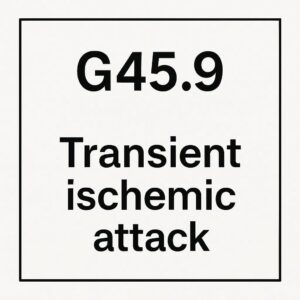
G45.9 – Transient cerebral ischemic attack, unspecified
This code is used when the documentation states “TIA,” “Transient Ischemic Attack,” or “mini-stroke” without providing further detail about the specific type of TIA syndrome.
Understanding the “Unspecified” Designation and Its Implications
Many coders are hesitant to use “unspecified” codes, fearing denials. However, for TIA, G45.9 is often the correct and only choice. The “unspecified” in this context does not mean the diagnosis is uncertain; it means the clinical documentation does not specify a particular subtype of TIA syndrome (e.g., vertebrobasilar artery syndrome). In the vast majority of clinical encounters, the physician will diagnose simply “TIA,” making G45.9 perfectly appropriate.
Related Codes in the G45 Family: When a TIA Has a Specific Manifestation
While G45.9 is the workhorse, there are more specific codes within the G45 category that should be used when the documentation supports them.
-
G45.0 – Vertebrobasilar artery syndrome: Used when the TIA involves the vertebrobasilar circulation, which supplies the brainstem, cerebellum, and occipital lobes. Symptoms may include vertigo, diplopia (double vision), dysphagia (trouble swallowing), and bilateral visual loss.
-
G45.1 – Carotid artery syndrome (hemispheric): Used when the TIA is attributed to the carotid artery circulation, typically causing unilateral symptoms like weakness/numbness on one side of the body (hemiparesis/hemianesthesia) or speech problems (aphasia).
-
G45.2 – Multiple and bilateral precerebral artery syndromes: For TIAs affecting multiple vascular territories.
-
G45.3 – Amaurosis fugax: This is a specific type of TIA involving transient monocular blindness, often described as a “shade coming down” over one eye. It is frequently caused by an embolus in the retinal artery.
-
G45.4 – Transient global amnesia [TGA]: A distinct clinical syndrome characterized by a sudden, temporary episode of memory loss without other neurological symptoms. Its relationship to ischemia is debated, but it is classified within this category.
-
G45.8 – Other transient cerebral ischemic attacks and related syndromes: A catch-all for other specified syndromes not listed above.
Coding Tip: Always default to G45.9 unless the physician’s documentation explicitly describes a syndrome fitting one of the more specific codes. Do not assume the vascular territory based on symptoms alone.
Chapter 3: The Cornerstone of Accuracy – Clinical Documentation Requirements
The physician’s documentation in the medical record is the legal source of truth for code assignment. Clear, precise documentation is non-negotiable for accurate TIA coding.
Key Phrases That Support Code G45.9
Coders should look for definitive diagnostic statements such as:
-
“Diagnosis: Transient Ischemic Attack (TIA)”
-
“The patient was evaluated for and found to have a TIA.”
-
“The event was consistent with a transient ischemic attack.”
-
“TIA confirmed by neurologist consultation.”
Documenting Laterality: Is It Required for TIA?
Unlike codes for cerebral infarction (I63.-), the codes in the G45 category do not specify laterality. There is no fifth or sixth character to indicate left, right, or bilateral. Therefore, it is not a coding requirement, though it is good clinical practice for the physician to document the side of the body affected by the symptoms.
The Role of Diagnostic Findings: MRI DWI Lesions and the Coding Conundrum
This is one of the most critical areas in modern TIA coding. As per the tissue-based definition:
-
If the MRI DWI is negative (shows no acute infarct), and the symptoms have resolved, code G45.9 is correct.
-
If the MRI DWI is positive (shows a new, restricted diffusion lesion correlating to the symptoms), the diagnosis is, by definition, an ischemic stroke (I63.-), not a TIA, even if the symptoms have completely resolved.
The coder must be vigilant. If the physician’s final diagnosis is “TIA” but the MRI report indicates an acute infarct, a query to the provider is essential. The discrepancy must be resolved to ensure accurate code assignment.
Inadequate Documentation: Ambiguous Terms and Their Impact
Vague or uncertain documentation makes accurate coding impossible. Terms like:
-
“Rule out TIA”
-
“Possible TIA”
-
“TIA vs. migraine”
These do not support the assignment of G45.9. In such cases, the coder should report the symptoms (e.g., R55 Syncope and collapse, R27.8 Other lack of coordination, R47.9 Unspecified speech disturbances) while the condition is being ruled out. Only code a confirmed diagnosis.
Chapter 4: Sequencing and Combination Coding – Navigating Complex Encounters
Patients rarely present with a TIA in isolation. Correctly sequencing diagnosis codes is vital for reflecting the reason for the encounter and ensuring proper reimbursement.
Coding TIA as a Manifestation of an Underlying Disease
Certain underlying conditions can cause a TIA. In these cases, coding rules may require a combination of codes.
-
Example – Atrial Fibrillation: If a patient with known A-fib presents with a TIA that is deemed to be cardioembolic, you would code both. The sequencing depends on the reason for the encounter. If the admission is for the acute management of the TIA, G45.9 would be the principal diagnosis, followed by I48.91 (Unspecified atrial fibrillation).
-
Example – Carotid Stenosis: If a TIA is attributed to severe carotid stenosis, code G45.9 (or G45.1 if specified) along with I65.21- (Occlusion and stenosis of carotid artery).
The Use of Z86.73 – Personal History of TIA
This code is used for a patient who has a past history of TIA but is not currently being treated for an acute event. It is relevant for:
-
Routine follow-up visits.
-
Encounters for other reasons where the history is relevant to patient care.
-
Risk Adjustment (HCC) modeling, as it signifies a higher-risk patient.
Crucially, Z86.73 is not used during the same encounter where G45.9 is reported for an acute TIA.
Sequencing for Symptoms vs. Diagnosis
If a patient presents to the Emergency Department with ongoing neurological symptoms that are suspected to be a TIA, code the symptoms. Once a physician makes a definitive diagnosis of TIA, you then code G45.9.
Common TIA Coding Scenarios and Rationale
| Clinical Scenario | Documentation | Correct Code(s) & Sequencing | Rationale |
|---|---|---|---|
| Acute TIA Encounter | “Patient presents with resolved left-sided weakness and slurred speech. Diagnosed with TIA.” | G45.9 | A definitive diagnosis of TIA is made. |
| TIA with Positive MRI | “Diagnosis: TIA. MRI DWI report: ‘Small acute infarct in the right frontal lobe.'” | Query Provider. Likely I63.9 (Cerebral infarction, unspecified) | The imaging finding contradicts the TIA diagnosis per tissue-based definition. |
| TIA due to A-fib | “Admitted for management of acute TIA, likely secondary to known paroxysmal atrial fibrillation.” | G45.9, I48.0 (Paroxysmal atrial fibrillation) | The acute TIA is the reason for admission. |
| R/O TIA Encounter | “Patient with transient dizziness. Rule out TIA vs. vertigo. Will obtain neurology consult.” | R42 (Dizziness and giddiness) | No definitive diagnosis has been established. |
| Follow-up for Past TIA | “Patient here for 3-month follow-up. History of TIA 4 months ago. No new symptoms.” | Z86.73 (Personal history of TIA) | The encounter is for surveillance of a resolved past condition. |
| TIA with Residual Weakness | “Patient had a TIA 2 weeks ago. Now presents for physical therapy due to residual mild left hand weakness.” | I69.398 (Other sequelae of cerebral infarction), G45.9 (as secondary) | Neurological deficit persists, requiring sequelae code. The TIA code provides context. |
Chapter 5: Avoiding Common Pitfalls and Denials – A Proactive Approach
Understanding where errors commonly occur is the first step to preventing them.
Pitfall #1: Confusing TIA with Acute Ischemic Stroke (I63.-)
This is the most significant error. As reinforced throughout this guide, the presence of an acute infarct on imaging changes the diagnosis to stroke. Using G45.9 in this scenario is clinically and factually incorrect and will likely lead to denials if the insurer reviews the imaging reports.
Pitfall #2: Misusing the Sequelae Code (I69.3-)
Code I69.3- (Sequelae of transient cerebral ischemic attack) is used to describe a residual neurological deficit that persists after the acute TIA has resolved. This is rare, as by definition, TIA symptoms resolve completely.
-
Incorrect: Using I69.3- for the acute TIA encounter.
-
Correct: Using I69.3- for a follow-up encounter where the patient has a lasting neurological impairment (e.g., a foot drop) that is a direct result of the TIA. In this case, you would also code the residual condition itself.
Pitfall #3: Overlooking Associated Conditions (Atrial Fibrillation, Hypertension, etc.)
Failing to code significant comorbidities like A-fib (I48.-), carotid stenosis (I65.2-), or diabetes (E11.9) can lead to inaccurate representation of patient complexity, affect DRG assignment, and negatively impact risk-adjusted payment models.
Pitfall #4: Incorrectly Coding “Ruled Out” TIA
As stated earlier, coding a definitive diagnosis without physician confirmation is a compliance risk. Always code signs and symptoms when a condition is “probable,” “suspected,” or “ruled out.”
Chapter 6: Beyond the Diagnosis – Linking TIA to Medical Necessity
Accurate diagnosis coding validates the medical necessity of the services provided.
Common Procedures and Tests for TIA (CPT/HCPCS Codes)
A TIA workup is extensive. Common associated procedures include:
-
Neuroimaging: CT Head without contrast (70450), MRI Brain without and with contrast (70553).
-
Vascular Imaging: Carotid Ultrasound (93880), CT Angiography Head and Neck (70547, 70548), MR Angiography (70544).
-
Cardiac Monitoring: Echocardiogram (93306), Holter Monitor (93224), ECG (93000).
-
Lab Tests: Lipid Panel (80061), HbA1c (83036), Hypercoagulability panel.
The code G45.9 in the diagnosis field of the claim form links directly to these procedures, justifying why they were necessary.
DRG Implications: How TIA Coding Affects Reimbursement
Under the MS-DRG system, a principal diagnosis of G45.9 typically maps to:
-
MS-DRG 069: Transient Ischemia – This DRG has a relatively lower weight compared to stroke DRGs (e.g., MS-DRG 061-066). This is a key financial reason why confusing a stroke with a TIA is problematic; it would result in significant underpayment.
The Role of Risk Adjustment and Hierarchical Condition Categories (HCCs)
In value-based care and Medicare Advantage plans, diagnosis codes are used to calculate a risk score for each patient. While G45.9 itself is not a significant HCC, the chronic conditions that cause it (e.g., I48.- A-fib, I25.10 CAD) often are. Accurate and complete coding of all chronic conditions is essential for appropriate capitated payments and demonstrating the true acuity of a patient population.
Chapter 7: A Look to the Future – ICD-11 and the Evolution of Cerebrovascular Coding
The World Health Organization’s ICD-11, which has been adopted by some countries and may influence future US updates, offers a more refined structure for cerebrovascular diseases. In ICD-11, TIA is found under 8B01 Transient cerebral ischaemic attack. It allows for greater specificity, with extensions for specifying the affected artery and the presence of associated symptoms like aphasia or monocular blindness. While the US will not transition to ICD-11 for several years, understanding this direction highlights the ongoing trend towards greater clinical detail in classification systems.
Conclusion
Accurate ICD-10 coding for Transient Ischemic Attack hinges on a deep synergy between clinical knowledge and coding expertise. The code G45.9 serves as the cornerstone, but its correct application requires understanding the tissue-based definition of TIA, scrutinizing diagnostic imaging results, and meticulously reviewing physician documentation. By avoiding common pitfalls such as confusing TIA with cerebral infarction, correctly applying sequelae codes, and comprehensively capturing all contributing comorbidities, healthcare organizations can ensure data integrity, support appropriate reimbursement, and, most importantly, contribute to a care continuum that recognizes a TIA as the critical warning sign it truly is.
Frequently Asked Questions (FAQs)
Q1: Can I use code G45.9 if the patient’s symptoms lasted less than an hour?
A: Yes, absolutely. The duration of symptoms is less important than the absence of infarction. If the physician diagnoses TIA and imaging shows no acute infarct, G45.9 is correct, regardless of whether symptoms lasted 5 minutes or 5 hours.
Q2: What is the difference between G45.9 and I69.3-? When do I use each?
A: G45.9 is for the acute diagnosis of a TIA, during or immediately after the event. I69.3- is for the late effects or sequelae of a TIA, meaning a residual neurological deficit (e.g., lasting weakness, speech impairment) that persists after the acute event has resolved. The use of I69.3- is rare.
Q3: The physician documented “crescendo TIA.” What code should I use?
A: “Crescendo TIA” refers to repeated TIAs occurring with increasing frequency. There is no unique ICD-10-CM code for this. You would assign G45.9. Ensure you also code any underlying cause being addressed.
Q4: How do I code a patient who is admitted for TIA and the workup reveals a previously undiagnosed condition, like severe carotid stenosis?
A: The principal diagnosis would be G45.9, as that was the reason for admission. The newly diagnosed carotid stenosis (I65.21- or I65.23-) would be coded as an additional diagnosis. The sequencing reflects the fact that the patient was admitted for the acute symptoms of the TIA.
Q5: Is a diagnosis of “TIA” enough to support an inpatient admission from a coding perspective?
A: From a pure coding and DRG assignment perspective, yes, G45.9 is a valid principal diagnosis for an inpatient admission. However, medical necessity for the inpatient level of care (vs. observation) is determined by hospital-specific criteria, the intensity of services, and the patient’s overall instability and risk, often guided by tools like the ABCD² score.
Additional Resources
-
Official ICD-10-CM Guidelines FY 2025: [Link to CMS.gov]
-
American Health Information Management Association (AHIMA): [Link to AHIMA.org]
-
American Heart Association/American Stroke Association: [Link to Heart.org]
-
Centers for Disease Control and Prevention (CDC) – Stroke Division: [Link to CDC.gov]
-
ICD-10-CM Code Set, FY 2025: [Link to CMS.gov ICD-10]