The world of dentistry is evolving faster than ever before. Gone are the days when a dental visit meant solely a cleaning, a filling, or a root canal. Today, a growing number of dental professionals are expanding their skill sets to include facial aesthetics, specifically the administration of Botox and dermal fillers.
This integration, often called “cosetic dentistry” or “facial esthetics in dentistry,” makes a lot of sense. Dentists are, after all, experts in the head and neck region. They have an intricate understanding of the facial muscles, nerve pathways, and underlying bone structure. Who better to gently relax a hyperactive muscle causing a gummy smile or to smooth away the deep lines of bruxism (teeth grinding)?
However, for both the dental professional and the patient, one of the most confusing aspects of this service is the billing process. How do you bill for a cosmetic procedure in a dental office? What code do you use for a medical necessity like bruxism? This confusion is where the conversation about the “dental code for Botox” begins.
This guide is designed to be your definitive resource. We will cut through the jargon, explore the specific codes used for different scenarios, and help you understand how these procedures are classified, billed, and justified. Whether you are a dentist looking to navigate the insurance landscape or a patient curious about the costs involved, you are in the right place.
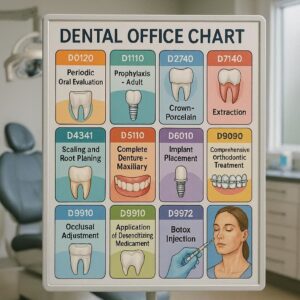
Dental Codes for Botox
What You Will Learn in This Guide
-
The fundamental difference between dental and medical billing for aesthetics.
-
The specific Current Dental Terminology (CDT) codes used for Botox and fillers.
-
When to use medical codes (CPT) instead of dental codes.
-
A breakdown of common treatment scenarios, from gummy smiles to TMJ disorders.
-
The real-world costs and why insurance coverage can be tricky.
-
A look into the future of this fast-growing field.
Let’s begin by tackling the most important question head-on: Is there a simple, one-size-fits-all dental code for Botox? The answer, as you might suspect, is more nuanced than a simple yes or no.
Understanding the Billing Landscape: CDT vs. CPT
Before we dive into specific numbers, it is crucial to understand that there are two different coding languages in the healthcare world. Your dentist may use one or both, depending on the reason for your treatment.
The Two Main Coding Systems
-
CDT Codes (Current Dental Terminology): These codes, published by the American Dental Association (ADA), are used exclusively for dental procedures. They are the language of dental insurance claims. They typically start with the letter “D” (e.g., D9210, D9920). You would use a CDT code when billing a dental insurance plan for a procedure that is primarily dental in nature.
-
CPT Codes (Current Procedural Terminology): These codes are maintained by the American Medical Association (AMA) and are used to describe medical, surgical, and diagnostic services. They are the language of medical insurance claims. They are five-digit numbers (e.g., 64611, 21073). You would use a CPT code when billing a medical insurance plan for a procedure that addresses a medical condition.
The choice between a CDT and a CPT code is the single most important factor in determining if and how a claim will be paid. It all comes down to one thing: medical necessity versus cosmetic desire.
Key Takeaway for Patients
If you are seeking Botox to simply “look better” (purely cosmetic), you should expect to pay out-of-pocket. Dental insurance will not cover it, and medical insurance will likely deny the claim. If you are seeking treatment for a functional problem like jaw pain, headaches, or difficulty eating, there is a path to explore with your insurance provider, though it often requires significant documentation.
Dental-Specific Codes (CDT) for Adjunctive Services
When a dentist provides Botox or filler as part of a dental treatment plan, they will typically look to the CDT manual. However, there is no single code that says “Botox.” Instead, dentists use codes that describe the nature of the service provided. These are often found in the “Adjunctive General Services” section of the CDT code set.
Here are the most relevant CDT codes used in this context:
D9920: The Workhorse Code for “Behavior Management”
For years, this has been one of the most commonly used codes for Botox in a dental setting.
-
What it is: This code is technically described as “Behavior Management.” Historically, it was used to account for extra time and skill needed to manage a patient with severe anxiety.
-
How it’s used for Botox: Many dentists use D9920 to bill for the time and expertise required to administer Botox for therapeutic reasons, such as for bruxism or a gummy smile. They pair it with a narrative and photos explaining why the procedure was medically necessary for the dental treatment.
-
The Challenge: Because it is a “time-based” code and not specific to the procedure, some insurance companies scrutinize it heavily or deny it outright. They may argue it is inclusive in the primary procedure code.
D9999: The Catch-All Code
-
What it is: This is the “Unspecified Adjunctive Procedure” code. It is used for a service that is not described by any other specific CDT code.
-
How it’s used for Botox: When a dentist feels that D9920 doesn’t quite fit, or they want to be more transparent that they are performing a unique service, they might use D9999. This is often accompanied by a detailed written explanation, or a “narrative,” and the specific tooth numbers or areas treated. This code almost always triggers a manual review by the insurance company, as it is a “flag” for a non-standard procedure.
D9210-D9215: Anesthesia Codes
-
What they are: These codes are for the administration of local anesthesia (e.g., D9210 – Local anesthesia not in conjunction with operative or surgical procedures).
-
How they are misused (or used): Botox is not an anesthetic. It is a neuromodulator. However, in the early days of dental Botox, some providers may have attempted to use these codes incorrectly. This is not considered best practice and can lead to fraud charges. It is vital to use the correct code for the correct substance. We mention this here only as a point of information about the evolution of coding practices.
The Limitations of Using CDT Codes
Relying solely on CDT codes for Botox has significant limitations.
-
Denial Rates: Most dental insurance plans explicitly exclude coverage for cosmetic procedures and many “adjunctive” services.
-
Low Reimbursement: Even if a code like D9920 is approved, the reimbursement rate is often very low (sometimes $30-$50), which does not reflect the cost of the product or the expertise required to administer it.
-
Lack of Specificity: A code like D9920 or D9999 does not tell the payer what drug was used, how many units were injected, or into which specific muscles.
This is why many forward-thinking dental practices are now also learning to navigate the world of medical coding.
Medical Codes (CPT) for Dental-Related Procedures
When Botox is used to treat a true medical condition that manifests in the oral and maxillofacial region, the appropriate course of action is often to bill a medical insurance plan using CPT codes. This is where reimbursement potential is higher, but the administrative burden is also greater.
Here are the most common CPT codes used by dentists for neuromodulators (like Botox, Xeomin, Dysport) and dermal fillers.
64611: The Key Code for Bruxism and Clenching
This is perhaps the most important code for dental professionals offering therapeutic Botox.
-
What it is: Chemical denervation of the parotid and submandibular salivary glands. Wait, salivary glands? Yes, but this code is also commonly and successfully used for injecting the masseter muscles.
-
How it’s used for Dentistry: The masseter muscles are large chewing muscles. When they become hypertrophied (enlarged) from chronic clenching or grinding (bruxism), injecting Botox relaxes the muscle. This reduces the force of the clench, protects the teeth from wear and fracture, and can even slim the lower face. While the code description mentions salivary glands, the intent (chemical denervation of a muscle innervated by the trigeminal nerve) is the same. A clear medical narrative linking the treatment to the dental diagnosis (e.g., severe tooth wear, TMJ pain) is essential.
64615: For Migraines and Headaches
Many patients with severe bruxism also suffer from tension headaches or migraines.
-
What it is: Chemical denervation of muscles innervated by the facial, trigeminal, spinal accessory, and other nerves. This is a more comprehensive code often used for chronic migraine treatment.
-
How it’s used for Dentistry: If a patient’s headaches originate from muscle tension in the temporalis, frontalis, and trapezius muscles (often related to clenching), this code can be used. It requires a specific diagnosis from the patient’s physician or a clear dental diagnosis linking the muscle tension to the headache pattern.
21073: For Temporomandibular Joint (TMJ) Disorders
-
What it is: This is a code for manual manipulation of the temporomandibular joint, but it is increasingly used in the conversation around TMJ treatments.
-
How it’s used for Aesthetics: While not a direct injection code, it highlights a specific area of treatment. For Botox and filler, if a practitioner is injecting into the joint capsule itself or the lateral pterygoid muscles (which are very difficult to access), they would need to use unlisted codes or pair a chemical denervation code with a detailed explanation. It is more common to see 64611 or an unlisted code for complex TMJ cases.
Unlisted Procedure Codes (e.g., 20999, 64999)
Just like in dentistry, medicine has “unlisted” codes.
-
What they are: These are codes used when no specific CPT code describes the procedure performed. 20999 is for “unlisted procedure, musculoskeletal system,” and 64999 is for “unlisted procedure, nervous system.”
-
How they are used for Dentistry: For highly specific injections—such as into the lateral pterygoid muscle to treat a dislocated disc or into the mentalis muscle to correct a chin dimple—an unlisted code may be the only option. Using these codes is a gamble; they require an extensive operative report, a cover letter justifying medical necessity, and often result in a denial or a long appeals process.
J Codes: The Cost of the Drug
In the medical billing world, the professional fee (the doctor’s skill) is billed with a CPT code, and the cost of the drug itself is often billed separately with a “J Code.”
-
J0585: This is the specific HCPCS code for OnabotulinumtoxinA (Botox). It is billed per unit.
-
Other J Codes: There are specific codes for other neurotoxins, like J0588 for DaxibotulinumtoxinA-lanm (Daxxify) and codes for different dermal fillers (e.g., Q2026 for Juvederm Voluma).
When a dentist bills a medical claim, they would typically submit a CPT code (like 64611) along with the J code (J0585) and the number of units used.
Scenario-Based Guide: What Code to Use When
To make this clearer, let’s look at a few common patient scenarios and see how a dental professional might approach coding and billing.
Scenario 1: The Cosmetic Patient
-
Patient Profile: A 45-year-old woman with no dental pain. She wants to reduce the appearance of “smoker’s lines” (perioral lines) around her lips and elevate her lip corners.
-
Goal: Purely cosmetic.
-
Primary Code: There is no insurance code for this. The dentist will use a practice management software code for internal tracking (e.g., a “walk-out” code), but the patient pays 100% out-of-pocket at the time of service. This is a cash-pay service.
Scenario 2: The Gummy Smile
-
Patient Profile: A 30-year-old man is self-conscious about his smile because it shows excessive gum tissue. He feels it affects his confidence in social and professional settings. The cause is a hyperactive levator labii superioris alaeque nasi (LLSAN) muscle, which lifts the upper lip too high.
-
Goal: Functional improvement of smile esthetics.
-
The Dilemma: Is this cosmetic or functional? It is a functional muscle problem that has an esthetic outcome.
-
Coding Strategy: A dentist might first attempt a CDT code like D9920 with a narrative and photos. However, many dental plans will deny it as cosmetic. The dentist could also educate the patient on the functional nature and provide a superbill for the patient to submit to their medical insurance using an unlisted CPT code with a detailed report. Most often, this is also handled as a cash-pay service due to the high likelihood of denial.
Scenario 3: The Painful Grinder
-
Patient Profile: A 50-year-old woman wakes up every morning with a headache and severe jaw pain. Her dentist notices significant wear facets on her molars (attrition) and she has been diagnosed with sleep bruxism. She has tried night guards but clenches through them.
-
Goal: Treat the medical condition (bruxism) to prevent dental damage and alleviate pain.
-
Coding Strategy: This is the ideal candidate for medical billing.
-
Diagnosis Codes (ICD-10): The dentist would use diagnosis codes like G47.63 (Sleep bruxism) or M26.60 (Temporomandibular joint disorder, unspecified).
-
Procedure Code (CPT): The dentist would bill the patient’s medical insurance using CPT 64611 (for masseter injection).
-
Drug Code (HCPCS): They would also bill for the drug using J0585 and the number of units.
The dentist must provide documentation, including photos, notes on the failed night guard therapy, and a letter of medical necessity explaining how the procedure is the most effective way to prevent tooth destruction and chronic pain.
-
Scenario 4: The TMJ Disc Displacement
-
Patient Profile: A 35-year-old man experiences a painful clicking and locking of his jaw when he eats. Upon examination, the dentist determines the lateral pterygoid muscle is in spasm, preventing the disc from seating properly.
-
Goal: Reduce muscle spasm to allow the disc to return to a normal functional position.
-
Coding Strategy: This is a complex medical case.
-
CPT Code: There is no specific code for injecting the lateral pterygoid. The dentist would need to use an unlisted procedure code, such as 64999 (Unlisted procedure, nervous system).
-
Required Documentation: This would require an operative report detailing the anatomy, the technique (perhaps using EMG guidance), the drug used, and a strong justification for why this unlisted procedure was necessary to treat the specific diagnosis. It is a challenging claim but possible with meticulous documentation.
-
The Realities of Insurance Coverage and Reimbursement
It is important to be realistic. Even with the correct codes, getting insurance to pay for these procedures is not easy. It is a battle of education and documentation.
Why Claims Are Often Denied:
-
The Cosmetic Exclusion: Most insurance policies, both dental and medical, have a blanket exclusion for any service considered “cosmetic.” The insurance adjuster may not understand the functional necessity of treating a gummy smile.
-
Lack of Familiarity: Many medical insurance reviewers are not familiar with the idea of a dentist performing these procedures. The claim might be denied simply because the provider’s credentials (DDS or DMD) are not what they expect to see for a neurology code like 64611.
-
“Experimental” or “Investigational”: Some carriers still consider Botox for bruxism or TMJ to be “off-label” and therefore experimental, despite a wealth of research supporting its use.
The Prerequisite for Success:
-
Superb Documentation: High-quality intraoral and extraoral photos, a detailed medical history, records of failed conservative therapies (like night guards), and a powerful letter of medical necessity are not optional; they are mandatory.
-
Patient Advocacy and Education: The patient must be prepared to be an advocate for themselves. They need to understand that the first claim may be denied and that an appeal might be necessary. The dentist’s office can provide the ammunition (the superbill and notes), but the patient often needs to fire the gun (make the phone calls).
A Realistic Note on Costs
Because insurance is unpredictable, most dental practices structure their fees as follows:
-
Cosmetic Treatments: Flat fee per area (e.g., $300 for a gummy smile) or per vial/syringe.
-
Therapeutic Treatments: Often a fee that covers the cost of the appointment and the product. For bruxism, this might range from $400 to $800 per session, depending on the number of units required. The results typically last 3-4 months. Some practices offer membership plans to make these recurring treatments more affordable.
The Future of Dental Codes for Aesthetics
The current coding situation is a patchwork. The ADA and other organizations are aware of the rapid growth of this field. There is an ongoing conversation about creating more specific CDT codes for neuromodulators and dermal fillers.
A future with a dedicated code, perhaps “Dxxxx – Administration of Neuromodulator for Therapeutic Dental Purpose,” would revolutionize the field. It would:
-
Increase Transparency: Clearly define what service was provided.
-
Improve Data Tracking: Allow the ADA and researchers to track how often these procedures are being performed and for what reasons.
-
Potentially Improve Reimbursement: A specific code carries more weight and legitimacy than a general “miscellaneous” code.
Until that day arrives, dentists must be bilingual (speaking both CDT and CPT) and be meticulous in their documentation to ensure their patients receive the care they need and get the reimbursement they deserve.
Frequently Asked Questions (FAQ)
1. Is there one specific dental code for Botox?
No, there is no single code labeled “Botox.” Dentists use other CDT codes like D9920 (Behavior Management) for dental claims, or medical CPT codes like 64611 for medical claims, depending on the reason for treatment.
2. Will my dental insurance pay for Botox for teeth grinding?
It is possible, but not common. Your dentist might bill using a code like D9920. However, many dental plans consider this an “adjunctive” service and may deny it. It is often more effective to pursue reimbursement through medical insurance using a diagnosis of bruxism (G47.63).
3. How much does Botox for a gummy smile or TMJ cost?
Costs vary by location and provider. For therapeutic uses like TMJ or bruxism, you can expect to pay between $400 and $800 per treatment session. The price is usually based on the number of units of neurotoxin required, which is often higher for large muscles like the masseters than for cosmetic areas like the forehead.
4. What is the difference between a gummy smile and a cosmetic lip flip?
A gummy smile treatment targets the muscles that elevate the upper lip too high, exposing excessive gum tissue. This is often viewed as a functional muscle issue. A cosmetic lip flip is a very small amount of Botox placed above the upper lip to relax the orbicularis oris muscle, causing the lip to “flip” outwards slightly to show more of the pink part of the lip, without changing the amount of gum shown.
5. Should I see my dentist or my doctor for Botox for jaw pain?
Both can be qualified, but a dentist has specific expertise in the anatomy of the jaw, teeth, and masticatory muscles. If your jaw pain is related to clenching, grinding, or dental alignment, a dentist with training in facial aesthetics is often the most logical and specialized choice.
Additional Resources
For more information on the educational standards for dentists providing these services, you can visit the American Academy of Facial Esthetics at www.facialesthetics.org. They offer resources for both professionals and the public regarding the integration of facial aesthetics into dental practice.
Conclusion
Navigating the world of dental codes for Botox and fillers can feel complex, but understanding the core principle of “cosmetic versus medical” simplifies it significantly. For purely esthetic enhancements, the service is a direct, cash-based transaction between the patient and the dentist. For therapeutic treatments addressing conditions like bruxism, migraines, or TMJ disorders, a dual-coding approach using both dental and medical codes offers a pathway to potential insurance reimbursement. As the field of facial esthetics in dentistry continues to mature, we can hope for more specific codes, but for now, success hinges on clear communication, accurate diagnosis, and meticulous documentation.
Disclaimer: This article is for informational purposes only and does not constitute legal or billing advice. Coding and insurance policies are subject to change and vary by provider and region. Always consult with a certified billing specialist and your insurance carrier for definitive information regarding your specific situation.