If your dentist has recommended an implant overdenture, you’ve likely taken a significant step toward restoring your smile and quality of life. But if you’ve glanced at your treatment plan and felt a wave of confusion from a list of numbers and letters—like D6010, D6110, or D6056—you are not alone.
Dental insurance codes are a language of their own. They determine not only what work you are having done but also how much your insurance company will contribute to the cost.
In this guide, we will walk through the specific dental codes used for overdenture implants. We’ll explain what each code means, why it matters, and how to read your treatment plan like a pro. By the end, you’ll feel empowered to ask the right questions and understand exactly what you are paying for.
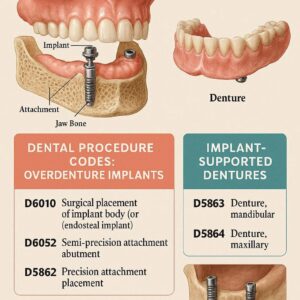
Dental Codes for Overdenture Implants
What is an Overdenture Implant?
Before we dive into the codes, let’s quickly clarify what an overdenture actually is. An overdenture is a removable dental prosthesis (a set of teeth) that covers and rests on one or more dental implants.
Think of it as a hybrid. Unlike a traditional denture that sits directly on your gums, an overdenture snaps onto implants that are surgically placed into your jawbone. This offers superior stability, comfort, and chewing power compared to standard dentures.
There are two main types:
-
Implant-Supported Overdenture: Usually uses two to four implants in the lower jaw (or four to six in the upper jaw) to secure a full arch of teeth.
-
Implant-Retained Overdenture: Similar to the above, but often uses a bar or locator attachments to snap the denture into place.
Because this treatment involves surgery, abutments (connectors), and the prosthetic teeth themselves, multiple dental codes are required to complete the process.
Why Dental Codes Matter for Your Wallet
Dental insurance is notoriously different from medical insurance. Most plans have an annual maximum (usually between $1,000 and $2,000), and they categorize treatments into classes.
Understanding the specific dental code for overdenture implant procedures is crucial because:
-
Coverage Varies: Some codes are considered “major” services (covered at 50%), while others might be “basic” (covered at 80%).
-
Frequency Limitations: Some codes have frequency limits (e.g., once every 5, 7, or 10 years).
-
Bundling Issues: Some insurance companies try to “bundle” the cost of the abutment with the implant, meaning you need to know the correct codes to appeal for proper payment.
The Key Dental Codes for Overdenture Implants
No single code covers the entire overdenture process. Instead, your treatment plan will consist of a series of codes that represent the different phases of treatment. Here are the primary codes you will encounter.
Surgical Phase: Placing the Implants
These codes cover the surgical insertion of the implant fixture (the screw that goes into the bone).
-
D6010 – Surgical placement of implant body (endosteal implant)
This is the most common code for placing a single implant. If you are getting a full overdenture on the lower jaw supported by two implants, you will see two units of D6010 on your treatment plan. This code represents the surgical placement of the titanium post into the jawbone. -
D6013 – Surgical placement of mini implant
Occasionally, mini-implants are used for overdentures, especially in cases where there is insufficient bone for standard implants. If your dentist uses these smaller-diameter implants, they will use this code instead of D6010. -
D6190 – Implant supported prosthesis, surgical stent
Sometimes, a surgical guide (a 3D-printed template) is used to ensure precise implant placement. This code covers the fabrication of that guide.
Abutment Phase: Connecting the Implant to the Tooth
After the implants have healed (osseointegrated), a connector called an abutment is placed on top of the implant. For overdentures, these are often specialized.
-
D6056 – Prefabricated abutment
This is a common code for the abutment that screws into the implant. For overdentures, this might be a “locator abutment” that allows the denture to snap on securely. -
D6057 – Custom fabricated abutment
If the implant is placed at an angle or if a specific aesthetic requirement is needed, the dentist may use a custom abutment. This code covers a more complex abutment that is made in a dental lab specifically for your case. -
D6059 – Abutment supported retainer for implant supported prosthesis (ceramic/porcelain)
In some overdenture cases, especially those with a bar attachment, this code might be used to describe the structure that holds the bar onto the implants.
The Overdenture Prosthesis: The Teeth
This is the part you see and remove for cleaning. The code for the overdenture itself varies based on whether you are replacing a full arch or just a partial.
-
D6110 – Implant supported overdenture (mandibular)
This is the code for a lower (mandibular) full-arch overdenture. If you are replacing all of your bottom teeth with an implant-supported denture, this is the code your dentist will use for the prosthesis. -
D6111 – Implant supported overdenture (maxillary)
This is the same as above, but for the upper (maxillary) arch. Upper overdentures are less common than lower ones due to anatomy, but they are an excellent solution when they are appropriate. -
D6112 – Implant supported overdenture (mandibular) with bar attachment
If your lower overdenture is secured using a metal bar that connects the implants, this code is used. The bar provides rigid support and distributes the force evenly. -
D6113 – Implant supported overdenture (maxillary) with bar attachment
The same bar-supported concept, but for the upper jaw. -
D6114 – Implant supported overdenture (mandibular) with precision attachment
This code is often used for overdentures that use individual locator attachments (like snaps) rather than a full bar. -
D6115 – Implant supported overdenture (maxillary) with precision attachment
The upper arch version of the precision attachment system. -
D6116 – Replacement of implant supported overdenture
If your overdenture breaks or wears out after several years and needs to be replaced, this code is used rather than the initial placement codes. -
D6117 – Replacement of implant supported overdenture (bar or precision attachment)
Similar to D6116, but specifically for replacing the prosthesis when a bar or precision attachment system is involved.
A Typical Overdenture Treatment Plan: Putting the Codes Together
To help visualize how these codes work together, let’s look at a common scenario: a patient receiving a lower overdenture supported by two implants with locator attachments.
| Phase | Procedure | Dental Code | Quantity | Notes |
|---|---|---|---|---|
| Surgery | Implant Placement | D6010 | 2 | Placement of two implant posts. |
| Abutment | Locator Abutment | D6056 | 2 | The “snap” part placed on top of the implants. |
| Prosthesis | Overdenture (Precision) | D6114 | 1 | The removable denture that snaps onto the locators. |
| Optional | Surgical Guide | D6190 | 1 | Used for precise placement if necessary. |
Important Note: In many cases, the fee for the overdenture prosthesis (D6110-D6115) includes the labor and materials for the attachments (like the nylon inserts in locators). However, the abutments (D6056) are almost always separate charges.
Navigating Insurance for Overdenture Implants
Insurance coverage for overdentures can be a maze. Here are a few critical points to remember.
The “Missing Tooth Clause”
Many traditional dental insurance plans have a “missing tooth clause.” This means that if the tooth was missing before the policy started, the plan will not cover the implant or denture to replace it. If you are switching jobs or plans, it is vital to ask your HR department or insurance provider if your plan has this clause.
Implants vs. Dentures
Historically, many insurance plans considered dentures “major” services, but implants were sometimes categorized differently (or not covered at all). In recent years, more plans are covering implants, but often at a lower percentage (e.g., 50% for the implant, 80% for the overdenture). Always check your “Schedule of Benefits.”
The “Alternative Benefit” Rule
Sometimes, an insurance company will apply an “alternative benefit.” This means that if your plan covers traditional dentures but not implants, they may pay the dentures’ allowance toward your overdenture. For example, if a traditional denture costs $1,500 and your plan covers 50%, they might pay $750 toward your implant-supported overdenture, leaving you responsible for the rest.
Coordination of Benefits
If you have two dental plans (e.g., through your employer and your spouse’s employer), the codes help determine which plan pays first. This is called coordination of benefits.
Comparative Table: Overdenture vs. Traditional Denture Coding
It helps to understand how the coding for an implant overdenture differs from a traditional denture. Here is a quick comparison.
| Feature | Traditional Denture | Implant Overdenture |
|---|---|---|
| Surgical Code | None (unless for extractions) | D6010, D6013, etc. (Implant placement) |
| Abutment Code | None | D6056 or D6057 (Connectors) |
| Prosthesis Code | D5110 (Full upper) or D5120 (Full lower) | D6110, D6111, D6114, D6115 (Overdenture specific) |
| Reline Code | D5710 or D5711 (Reline for denture) | D5750 or D5751 (Reline for overdenture) |
| Typical Insurance Class | Major | Major (but often with lower implant allowance) |
Common Questions About Dental Codes for Overdentures
Can one code cover the entire overdenture?
No. The American Dental Association (ADA) Current Dental Terminology (CDT) code set is designed to be specific. An overdenture requires multiple phases of treatment, hence multiple codes. A legitimate treatment plan will always show separate codes for surgery, abutments, and the prosthesis.
Why did I get charged for D6010 and D6056 separately?
This is a common point of confusion. The D6010 is for the implant fixture—the screw in the bone. The D6056 is for the abutment—the piece that connects the fixture to the denture. These are two distinct physical components requiring different lab fees, materials, and clinical time. They are almost always billed separately.
My insurance denied D6114. What do I do?
If your insurance denied the overdenture code, first look at the explanation of benefits (EOB). Check to see if they applied an “alternative benefit” (paying the traditional denture allowance) or if they denied it due to a missing tooth clause. If you believe it was coded incorrectly, ask your dentist’s billing coordinator to review the claim. Sometimes, a simple appeal or a narrative (a written explanation of why an overdenture is medically necessary) can overturn a denial.
Is the “surgical guide” (D6190) always necessary?
Not always. For simple cases with ample bone, a dentist may place implants freehand without a guide. However, for complex cases or when using a “flapless” surgical technique, a surgical guide is highly beneficial. It is a legitimate charge that improves accuracy and safety.
Tips for Reviewing Your Treatment Plan
When you receive your treatment plan for an overdenture, treat it like a contract. Here are a few things to look for:
-
Look for the CDT Codes: Ensure the codes listed are the ones we’ve discussed (D6010, D6056, D6114, etc.).
-
Check Quantities: If you are getting two implants, the plan should list D6010 with a quantity of “2” (or two separate line items).
-
Ask About the Warranty: Some dentists offer a warranty on the implant fixture itself, separate from the overdenture. Ask what happens if an implant fails (a “failure” is usually coded under D6100 – implant removal).
-
Clarify the “Soft Tissue Management”: Sometimes, there is a separate code for a “healing abutment” or a “healing cap” placed after surgery. This is usually D6055 or similar.
The Value of a Second Opinion
Because the financial investment for an overdenture is significant, do not hesitate to get a second opinion. A different provider might use slightly different codes (e.g., custom abutments vs. prefabricated) or a different number of implants (two vs. four), which drastically changes the total cost.
A reputable dentist will gladly explain their coding choices and provide you with a detailed written estimate before any work begins.
Conclusion: Empowering Your Dental Journey
Understanding dental codes for overdenture implants transforms a confusing list of numbers into a clear roadmap of your treatment. By recognizing the difference between surgical codes (like D6010), abutment codes (like D6056), and prosthetic codes (like D6114), you gain the confidence to discuss your treatment plan, verify your insurance coverage, and avoid unexpected bills. Remember, a successful implant overdenture is a partnership between you, your dentist, and your insurance—and knowledge is the key to making that partnership work.
Frequently Asked Questions (FAQ)
Q: Does Medicare cover dental codes for overdenture implants?
A: Original Medicare (Parts A and B) does not cover dental implants or overdentures. However, if the implant placement is deemed medically necessary due to an accident or tumor removal, a Medicare Advantage Plan (Part C) may offer some dental benefits. Always verify with your specific plan.
Q: How long does the process take from the first code to the last?
A: The timeline varies, but typically the surgical placement (D6010) requires 3-6 months of healing. After that, the abutment (D6056) is placed, and the overdenture (D6114) is delivered about 2-4 weeks later. The total process usually takes 4 to 8 months.
Q: Can I use my FSA or HSA to pay for these codes?
A: Yes. Flexible Spending Accounts (FSA) and Health Savings Accounts (HSA) can be used to pay for qualified medical and dental expenses, including all the codes associated with implant overdentures. Keep your detailed treatment plan and receipts for your records.
Q: What is the difference between D6110 and D5120?
A: D5120 is a standard complete denture (lower) that sits on the gums. D6110 is an implant-supported overdenture (lower) that attaches to implants. If you see D5120 on a plan but you are getting implants, it may be an alternative benefit being applied by your insurance.