If you have recently been told you need a bone graft, a sinus lift, or a ridge preservation procedure, you have probably heard the term “membrane” mentioned by your dentist or periodontist. When you look at your treatment plan or insurance pre-authorization, you might see a specific code listed that you don’t fully understand.
Understanding what a dental membrane is and how it is billed is crucial for managing your out-of-pocket costs and ensuring your insurance claim is processed correctly. It is not just about a piece of material; it is about the long-term success of your dental implant or periodontal surgery.
In this guide, we will break down exactly what the dental code for membrane is, why it is used, how it differs from grafting codes, and what you can expect to pay. We aim to take the confusion out of the billing process so you can focus on your recovery.
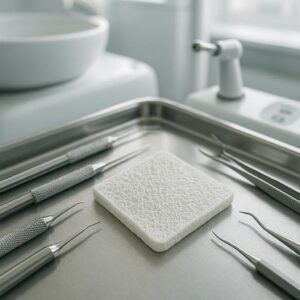
Dental Code for Membrane
What is a Dental Membrane?
Before we dive into the codes, it helps to understand what this material actually does. A dental membrane is a barrier used in guided bone regeneration (GBR) or guided tissue regeneration (GTR). Think of it as a protective blanket.
When a dentist places a bone graft—whether to prepare a site for an implant or to treat periodontal disease—they need to ensure that the bone cells grow back faster than the soft tissue cells. Soft tissue (gums) grows much faster than bone. If the gum tissue invades the space where the bone is supposed to grow, the graft will fail.
The membrane acts as a physical barrier. It covers the graft material, preventing the gum tissue from collapsing into the area. This creates a protected space where your own bone cells can migrate and grow, ensuring a strong foundation for a future implant or tooth stability.
There are generally two types of membranes:
-
Resorbable Membranes: These are usually made from collagen or other natural materials. They break down naturally in the body over time. The benefit is that you do not need a second surgery to remove them. They are the most common type used today.
-
Non-Resorbable Membranes: These are typically made of materials like PTFE (polytetrafluoroethylene). They do not break down, so they require a second, minor surgical procedure to be removed after the healing period. They are often used in larger, more complex bone grafting cases.
The Main Dental Code for Membrane
In the dental world, we rely on the Current Dental Terminology (CDT) code set, published by the American Dental Association (ADA). The specific code used for placing a membrane is separate from the code used for the bone graft itself.
The primary dental code for membrane placement is D4266.
Let’s look at the official description for these codes to understand exactly what they cover.
| Code | Official Description | Typical Use Case |
|---|---|---|
| D4266 | Guided tissue regeneration – resorbable barrier, per site | Placement of a membrane that dissolves naturally over time (collagen). |
| D4267 | Guided tissue regeneration – non-resorbable barrier, per site (includes membrane removal) | Placement of a membrane that requires a second procedure to remove. |
It is vital to understand that these codes are generally billed per site. If you are having a membrane placed in the upper left area where a tooth is missing, that is one site. However, if you are having a procedure involving multiple teeth—for example, a bone graft around three adjacent teeth—the dentist may bill for one site or multiple sites depending on the complexity and surgical access.
D4266 vs. D4267: Which One Will You Get?
Most dentists and periodontists today prefer D4266 (resorbable) for several reasons. It eliminates the need for a second surgery, which reduces patient anxiety and recovery time. Collagen membranes are also biocompatible, meaning they integrate well with the body’s tissues.
D4267 (non-resorbable) is typically reserved for cases where the dentist needs a more rigid barrier that stays in place for a very specific, longer duration. For instance, in large vertical bone augmentations or significant sinus lifts, a non-resorbable membrane might be used to maintain space for a longer period.
Important Note for Readers: If you have a treatment plan that lists D4267, ask your dentist if the removal of the membrane is included in the fee. According to the CDT definition, the removal is included. You should not see a separate charge for taking the membrane out later.
How Membranes Relate to Bone Graft Codes
One of the biggest sources of confusion for patients is seeing a bone graft code and a membrane code on the same treatment plan. These are separate procedures because they involve different materials and surgical steps.
The membrane is an adjunct to the bone graft. You cannot have guided tissue regeneration without a barrier, but you can have a bone graft without a membrane in some very specific, low-risk scenarios.
Here are the common bone graft codes you will see paired with D4266 or D4267:
-
D4263: Bone replacement graft – retained natural tooth – first site in quadrant.
-
D4264: Bone replacement graft – retained natural tooth – each additional site in quadrant.
-
D4265: Biologic materials to aid in soft and osseous tissue regeneration (this is often a separate code for “bone morphogenetic protein” or other growth factors, not the membrane itself).
-
D6010: Surgical placement of implant body (the implant post).
-
D6104: Bone graft at time of implant placement.
-
D7950: Osseous osteoperiosteal pedicle flap (less common, but used for grafting).
-
D7951: Sinus augmentation via lateral window approach.
-
D7953: Sinus augmentation via vertical approach (osteotome technique).
The “Bundle” Myth
A common insurance denial occurs when the carrier says the membrane is “bundled” or “inclusive” to the bone graft. While some insurance plans do consider the membrane a component of the graft, many major PPO plans recognize D4266 and D4267 as distinct, payable procedures when documentation supports the need.
If your dentist uses a membrane, it should be billed separately. If the insurance company denies it, the dental office can appeal with notes, radiographs, and sometimes photographs to prove the membrane was medically necessary for the success of the graft.
Navigating Insurance Coverage
Insurance coverage for membranes varies wildly. Because guided tissue regeneration is considered a “major” surgical service, it often falls under a separate category of coverage with a different deductible or percentage.
Most dental insurance plans work on a “50-50-100” structure:
-
Preventive: Covered at 100% (cleanings, exams).
-
Basic: Covered at 80% (fillings, simple extractions).
-
Major: Covered at 50% (crowns, dentures, implants, bone grafts, membranes).
However, a significant number of plans exclude implant-related services altogether. If the bone graft (and subsequent membrane) is being done to place an implant, and your plan does not cover implants, it may also exclude the grafting and membrane needed to support it.
If the membrane is used for periodontal reasons (to save a natural tooth with bone loss), it is more likely to be covered under the “major” or “periodontal” section of your plan.
Factors That Influence Insurance Approval
-
Medical Necessity: Is the membrane required to treat a disease (periodontitis) or a congenital defect? Or is it purely elective for implant placement? Plans are more likely to pay if it is treating active disease.
-
Missing Tooth Clause: Many plans have a clause stating they do not cover procedures to replace a missing tooth if the tooth was missing before the policy started.
-
Frequency Limitations: Most plans limit bone grafting and membranes to once per site every 36 months or more.
-
Documentation: For a claim to be paid, the dentist must submit X-rays showing the defect size and a narrative explaining why the membrane was necessary.
Cost Analysis: What to Expect
If you do not have insurance, or if your insurance denies the claim, you will be responsible for the full fee. The cost of a dental membrane varies based on your geographic location, the type of specialist performing the surgery (oral surgeon or periodontist), and the type of membrane used.
Estimated Cost Breakdown
| Procedure | Average Cost (Without Insurance) |
|---|---|
| Resorbable Membrane (D4266) | $400 – $1,200 per site |
| Non-Resorbable Membrane (D4267) | $800 – $2,000 per site (includes removal) |
| Bone Graft (D4263/D6104) | $600 – $1,500 per site |
| Combined Bone Graft + Membrane | $1,000 – $2,500 per site |
Note: These are average fees for the surgical component only. This does not include the cost of the implant or crown.
If you are undergoing a sinus lift (D7951), the membrane is almost always used to cover the lateral window opening. In these cases, the membrane cost is often included in the sinus lift fee, though some practices itemize it as D4266 separately.
Common Scenarios and Coding Examples
To help visualize how these codes work in real life, let’s look at a few patient scenarios.
Scenario 1: Immediate Implant with Bone Graft
The Case: A patient fractures a tooth (tooth #19). The tooth cannot be saved and must be extracted. The patient wants an implant. The oral surgeon extracts the tooth and places the implant immediately. However, there is a small gap between the implant and the bone. The surgeon places a bone graft material around the implant and covers it with a resorbable membrane.
The Code Set:
-
D7210: Surgical extraction of tooth (tooth #19).
-
D6010: Surgical placement of implant body.
-
D6104: Bone graft at time of implant placement.
-
D4266: Guided tissue regeneration – resorbable barrier, per site.
Scenario 2: Ridge Preservation
The Case: A patient has tooth #3 extracted. They are not ready for an implant yet, but they want to preserve the bone volume so that in 6 months, they have enough bone to place an implant without needing a large graft. The dentist places a bone graft into the socket and covers it with a resorbable membrane to keep the shape.
The Code Set:
-
D7210: Surgical extraction.
-
D4266: Guided tissue regeneration – resorbable barrier, per site.
-
D4264: Bone replacement graft – each additional site (or D4263 for the first site).
Scenario 3: Sinus Lift
The Case: A patient is missing tooth #14. They want an implant, but the CBCT scan shows there is insufficient bone height due to the sinus cavity being too low. The oral surgeon performs a lateral window sinus lift, places bone graft material into the sinus, and covers the window with a membrane.
The Code Set:
-
D7951: Sinus augmentation via lateral window approach.
-
In many practices, the membrane is considered part of D7951.
-
In some practices, they will bill D4266 in addition to D7951.
-
D6010: Implant placement (usually done 6-9 months later).
Why Proper Coding Matters for Patients
You might wonder, “Why do I care what code they use? I just want to get better.” The reason is simple: accuracy in coding equals accuracy in billing.
If a dentist uses the wrong code, several things can happen:
-
Insurance Denial: The insurance company will reject the claim instantly if the code does not match the procedure performed.
-
Higher Out-of-Pocket Costs: If the code is denied, you are responsible for the full amount. If the appeal fails, you might be stuck with a bill you didn’t anticipate.
-
Delay in Treatment: If you are waiting on insurance pre-authorization, an incorrect code can push your surgery date back by weeks while the office resubmits paperwork.
As a patient, you have the right to ask your dentist to explain the codes on your treatment plan. You can also ask for a pre-determination (pre-authorization) to be sent to your insurance company before the surgery. This is a request for the insurance company to state, in writing, what they will pay. It is the safest way to avoid surprise bills.
The Role of Documentation
For a membrane code to be accepted by insurance, the dental practice must submit detailed documentation. This is a critical part of the process that patients rarely see, but it directly impacts whether the claim is paid.
The documentation typically includes:
-
Radiographs: Clear X-rays showing the bone defect or the extraction site.
-
Periodontal Charting: If the procedure is for a natural tooth, probing depths are required to show deep pockets (usually 5mm or more).
-
Operative Notes: A narrative written by the dentist describing the surgical findings. For a membrane, the notes must state why a barrier was needed. Phrases like “to prevent epithelial migration” or “to maintain space for graft containment” are common.
-
Photographs: Sometimes, intraoral photos are submitted to show the site before and after the membrane placement.
Important Questions to Ask Your Dentist
Before you agree to a treatment plan involving a bone graft and membrane, arm yourself with knowledge. Here are a few questions you can ask your dentist or their billing coordinator.
-
“Which membrane code are we using, D4266 or D4267, and why is that best for my case?”
-
“Is the membrane fee included in the bone graft fee, or is it separate?”
-
“Can you send a pre-authorization to my insurance for the bone graft and membrane to see if they will cover it?”
-
“If the insurance denies the membrane, will I be responsible for the full amount?”
-
“Is there a cheaper alternative? For example, if my insurance doesn’t cover the membrane, can we use a different material or skip it?” (Note: Skipping it may risk graft failure, so ask about the risks).
-
“If I need a non-resorbable membrane (D4267), is the removal fee included in this estimate?”
Common Misconceptions
There are several myths surrounding dental membranes that cause unnecessary anxiety for patients.
Misconception 1: “The membrane is just a way for the dentist to charge more.”
This is false. While membranes do add to the cost, they are scientifically proven to increase the success rate of bone grafts. Without a barrier, the graft can fail, leading to a second, more expensive surgery. It is a standard of care in complex grafting cases.
Misconception 2: “If the membrane dissolves, it means my body rejected it.”
Resorbable membranes are designed to dissolve. They do not “fail” when they dissolve; they have done their job. They act as a temporary scaffold. Over several weeks to months, the membrane breaks down, leaving behind the newly formed bone.
Misconception 3: “My insurance covers everything, so I won’t have to pay for the membrane.”
Even with “good” insurance, you are likely responsible for a portion of the cost. Because membranes fall under major services, you probably have a 50% coinsurance. You will also have to meet your annual deductible before coverage kicks in.
Conclusion
Understanding the dental code for membrane—specifically D4266 for resorbable barriers and D4267 for non-resorbable barriers—is an essential step in navigating complex dental surgeries like bone grafts, ridge preservation, and sinus lifts. These codes represent a critical component of guided bone regeneration, ensuring that your graft has the highest possible chance of success.
While the presence of these codes on a treatment plan can initially seem overwhelming, breaking them down helps demystify the billing process. Remember that these procedures are typically separate from the bone graft itself and are often subject to the “major” category of your dental insurance benefits. The best course of action is always to request a pre-authorization from your insurance provider and to maintain open communication with your dental team about costs and expectations. Being informed not only protects your finances but also contributes to a smoother surgical experience.
Frequently Asked Questions (FAQ)
1. Is the dental membrane code D4266 always covered by insurance?
No, coverage is not guaranteed. It depends on your specific plan. Some plans consider it part of the bone graft (bundled), while others cover it separately, usually at 50% after the deductible. Always get a pre-authorization.
2. Can I have a bone graft without a membrane?
In some cases, yes. If the bone defect is small and surrounded by solid bone walls (like a contained socket), a membrane may not be necessary. However, in most modern surgical protocols, using a membrane significantly improves the predictability of the graft.
3. How long does the membrane stay in place?
For a resorbable membrane (D4266), it begins to break down within a few weeks and is fully absorbed by the body over 3 to 6 months. For a non-resorbable membrane (D4267), it is typically removed in a second procedure 4 to 6 months after the initial surgery.
4. Why does my treatment plan have D4266 and a bone graft code?
These are two distinct steps in the same surgery. The bone graft provides the matrix for new bone to grow, while the membrane protects that area from soft tissue invasion. Both are required for the procedure to be considered “guided bone regeneration.”
5. Does my medical insurance cover dental membranes?
Sometimes. If the procedure is deemed medically necessary due to trauma, pathology (like a tumor removal), or congenital defects, your medical insurance may cover it. However, for routine implant placement, dental insurance is the primary payer.
Additional Resource
For further reading on dental insurance coding and understanding your benefits, the American Dental Association (ADA) offers a resource page on CDT codes. While it is geared toward professionals, it provides the official definitions that insurance companies rely on.
-
Link: ADA.org – CDT Code (Official resource for code definitions)
-
Tip: If you are looking for a third-party advocate to help dispute a denied claim, consider searching for a “dental billing advocate” in your state. These professionals specialize in navigating complex insurance appeals.
Disclaimer: This article is for informational purposes only and does not constitute medical, financial, or legal advice. Dental coding is complex and subject to change. Always consult with your dental insurance provider and your oral surgeon to verify coverage and treatment plans.
Author: Dental Billing Insights Team
Date: March 21, 2026