If the thought of sitting in a dental chair makes your palms sweat, you are not alone. Dental anxiety is one of the most common reasons people avoid the care they need. Fortunately, modern dentistry offers a lifeline: oral sedation.
Often called “sleep dentistry” (even though you remain awake), oral sedation allows patients to relax deeply during procedures. But when you look at your treatment plan or insurance statement, you might see a confusing string of letters and numbers: D9243 or D9248.
What do these codes mean? Are they covered by insurance? Why is there a separate charge for a pill?
I’ve spent years navigating the intricacies of dental billing and patient advocacy. In this guide, I’ll strip away the jargon and give you a clear, honest look at the dental codes used for oral sedation. We’ll cover what they include, how much you can expect to pay, and how to talk to your dentist about making your visit as comfortable as possible.
Let’s get you comfortable with the paperwork so you can focus on getting comfortable in the chair.
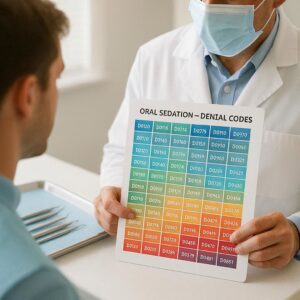
Dental Codes for Oral Sedation
Understanding Dental CDT Codes
Before we dive into the specific codes for sedation, it helps to understand what a CDT code actually is. CDT stands for Current Dental Terminology.
Think of these codes as a universal language. Every time your dentist performs a procedure—whether it’s a routine cleaning or a complex root canal—they assign a specific five-character alphanumeric code. This code is sent to your insurance company to explain what was done and why.
These codes are maintained by the American Dental Association (ADA) and are updated annually. Using the correct code ensures that claims are processed smoothly. When it comes to sedation, using the wrong code can result in a denied claim or a bill you didn’t expect.
The Category: Adjunctive General Services
Oral sedation codes fall under the category of “Adjunctive General Services.” In plain English, this means the sedation is a supporting service. It isn’t the main event (like a filling or extraction), but it is a crucial part of allowing the main event to happen safely and comfortably.
Because sedation is an adjunctive service, it is usually billed separately from the primary procedure. This is why you might see a line item for a crown (D2740) and then a separate line item for the sedation (D9243) on your bill.
What is Oral Sedation?
Before we look at the codes, let’s define the service itself.
Oral sedation involves taking a prescribed medication—usually a pill or liquid—by mouth prior to or at the beginning of your dental appointment. The most common medications used are from the benzodiazepine family (like Triazolam or Diazepam) or other sedatives like Hydroxyzine.
Unlike IV sedation (where a drug is administered directly into the bloodstream), oral sedation does not require a needle stick for the sedation itself.
Levels of Sedation
It is important to understand that oral sedation typically falls into two categories:
-
Minimal Sedation: You are awake but relaxed. You may feel drowsy, but you can respond to commands and breathe on your own.
-
Moderate Sedation: You may drift in and out of consciousness. You are still able to respond to stimulation (like a tap on the shoulder) but may not remember much of the procedure (anterograde amnesia).
Note: Oral sedation generally does not achieve “deep sedation” (where you cannot be easily aroused) or general anesthesia in a typical dental office setting without specific advanced training and equipment.
The Primary Dental Codes for Oral Sedation
Now we get to the heart of the matter. When you receive oral sedation, there are two main codes your dentist will likely use. The distinction usually comes down to the duration of the appointment and the complexity of the patient’s condition.
D9243: Moderate Sedation – First 15 Minutes
Code: D9243
Descriptor: Moderate sedation, first 15 minutes (any route) after achieving moderate sedation.
This code is used when the dentist administers sedation (usually orally) and the patient reaches a state of moderate sedation. It is often used for longer, more invasive procedures like wisdom tooth extractions, multiple implants, or complex root canals where the patient needs to be deeper in the sedative state.
What it covers:
-
The initial 15-minute increment of moderate sedation time.
-
Monitoring of vital signs (blood pressure, heart rate, oxygen levels).
-
The expertise required to maintain the airway and consciousness at a safe level.
-
It is often used in conjunction with code D9244 (each additional 15 minutes) for extended appointments.
D9248: Enteral Sedation – First 30 Minutes
Code: D9248
Descriptor: Enteral sedation, first 30 minutes.
This is the most common code for patients taking a pill to manage anxiety. “Enteral” simply means the medication is administered via the digestive tract (swallowing a pill).
What it covers:
-
The initial 30 minutes of service, which includes pre-operative evaluation, administration of the oral medication, and monitoring as the patient relaxes.
-
This code is typically used for minimal sedation.
-
It is ideal for patients with moderate anxiety undergoing routine procedures like fillings, crowns, or simple extractions.
D9244: The Companion Code (Time Extensions)
While not exclusively an oral sedation code (it covers all moderate sedation routes), it’s crucial to know:
Code: D9244
Descriptor: Moderate sedation, each additional 15 minutes.
If your dentist uses D9243 for the first 15 minutes of moderate sedation, and your procedure lasts another hour, they will bill D9243 once and D9244 three times.
Comparison: D9243 vs. D9248
To help you visualize the difference, here is a simple breakdown of how these two primary oral sedation codes compare.
| Feature | D9243 (Moderate Sedation) | D9248 (Enteral Sedation) |
|---|---|---|
| Sedation Level | Moderate (conscious sedation) | Minimal (anxiolysis) |
| Unit of Time | First 15 minutes | First 30 minutes |
| Typical Patient | High anxiety, complex procedures | Mild to moderate anxiety |
| Monitoring | Continuous vital sign monitoring | Periodic monitoring |
| Common Use | Wisdom teeth, implants, surgical extractions | Fillings, crowns, root canals, cleanings |
| Cost Range | Higher due to intensive monitoring | More affordable |
Important Note: Some dentists may use D9248 for minimal sedation and D9243 for moderate sedation. It depends entirely on the patient’s response to the medication and the complexity of the procedure. Always ask your dentist which code they anticipate using and why.
What Do These Codes Actually Pay For?
When you see these codes on your bill, it is easy to think, “I’m paying $300 for a pill?” But you are paying for far more than the medication.
The dental code covers a bundle of services that ensure your safety. Here is what is included:
-
Pre-Operative Evaluation: The dentist reviews your medical history, current medications, and overall health to ensure the sedative is safe for you. Certain conditions like sleep apnea, obesity, or liver issues can affect how you metabolize sedation.
-
The Medication: The cost of the prescribed pill itself. This is usually a controlled substance, which carries its own regulatory costs for the dental practice.
-
Monitoring Equipment: The pulse oximeter on your finger, the blood pressure cuff, and the supplemental oxygen (if used) are all part of the service.
-
Staff Training: Dental assistants and hygienists undergo specific training in Basic Life Support (BLS) and often Advanced Cardiac Life Support (ACLS) to monitor sedated patients. You are paying for the extra pair of trained eyes in the room.
-
Recovery Time: The dentist and staff monitor you after the procedure to ensure you are stable enough to go home with a responsible adult.
Insurance Coverage for Oral Sedation
This is where things get tricky. Insurance coverage for oral sedation codes is notoriously inconsistent.
When Insurance Pays
Many dental insurance plans will cover sedation (specifically D9248 or D9243) if the patient meets specific medical necessity criteria.
Medical Necessity usually includes:
-
Complexity of Procedure: Surgical extractions of impacted wisdom teeth, placement of multiple implants, or significant bone grafting.
-
Developmental Disabilities: Patients with autism, Down syndrome, or severe cognitive impairments who cannot tolerate traditional dental care.
-
Severe Gag Reflex: A physical gag reflex so severe it prevents basic radiographs (x-rays) or treatment.
-
Medical Conditions: Uncontrollable movements (like Parkinson’s) or conditions that make it unsafe to perform treatment without sedation.
When Insurance Denies
If you are seeking sedation purely for comfort (dental phobia without a secondary physical or developmental condition), most standard PPO plans will classify the sedation as “not medically necessary.”
In these cases, the insurance company will either:
-
Deny the claim entirely. You are responsible for the full fee.
-
Apply the code to the patient’s deductible. You pay the full contracted rate until your deductible is met.
-
Provide a flat allowance. Some plans offer a small benefit (e.g., $50–$100) toward sedation, regardless of the actual cost.
A Note on Medical Insurance
Sometimes, if the reason for sedation is linked to a medical condition (like a heart condition or a severe physical disability), you can ask the dental office to submit the claim to your medical insurance rather than your dental insurance. This is called “cross-coding,” but it is complex and not all offices offer this service.
Cost Expectations Without Insurance
If you are paying out-of-pocket (cash), the cost of sedation codes can vary significantly based on geography and the dental practice’s overhead.
-
D9248 (Enteral Sedation – First 30 min): Typically ranges from $200 to $400.
-
D9243 (Moderate Sedation – First 15 min): Typically ranges from $300 to $600.
-
D9244 (Additional 15 min increments): Typically ranges from $100 to $200 per increment.
Note: These are average fees for the sedation service alone. They do not include the cost of the actual dental procedure (filling, crown, extraction) that is being performed.
How to Talk to Your Dentist About Sedation
Navigating this doesn’t have to be awkward. As a patient, you have the right to understand your financial responsibility before a needle or a drill comes near your mouth. Here is a script you can use during your consultation.
“I’m interested in oral sedation for my upcoming procedure. Can you explain which code you will be using—D9248 or D9243—and what the out-of-pocket cost will be? Also, could you verify if my insurance covers this code under my plan?”
A good dental office will be happy to run a “predetermination” of benefits. This is a request sent to the insurance company before the work is done. It tells you, in writing, exactly what the insurance will pay and what you will owe.
Risks and Safety Considerations
While oral sedation is generally very safe, it is not risk-free. Because these codes involve pharmacological management, there are strict protocols dentists must follow.
Pre-requisites
-
Escort: You must have a responsible adult drive you to and from the appointment. You cannot drive, operate machinery, or sign legal documents for 24 hours after sedation.
-
Fasting: Depending on the level of sedation (D9243 specifically), you may be required to fast (no food or liquids) for 6–8 hours prior.
-
Medication Interactions: You must disclose all medications you take, including herbal supplements. Combining sedatives with opioids or alcohol can cause respiratory depression.
Dentist Qualifications
Not every dentist can offer moderate sedation (D9243). Dentists must obtain a permit from their state’s dental board to offer these services. This requires:
-
Advanced training (often a minimum of 60 hours of coursework)
-
Certification in ACLS (Advanced Cardiac Life Support)
-
Regular facility inspections
When you see D9243 on your treatment plan, you can rest assured that the dentist has undergone rigorous training to keep you safe.
The Patient Experience: What to Expect
If you have never undergone oral sedation before, the process usually follows a specific flow.
Step 1: The Consultation
You meet with the dentist. They review your medical history. If you are a candidate, they prescribe a sedative pill.
Step 2: The Night Before
Usually, you take the first dose at home the night before (for moderate sedation) or a specific time prior to the appointment.
Step 3: Arrival
You arrive with your escort. You take the final dose (if prescribed) in the office. You wait in a comfortable chair for 30 to 60 minutes as the medication takes effect.
Step 4: The Procedure
You feel deeply relaxed. You may fall asleep. The dentist performs the work. You might be aware of sounds and pressure but generally feel no fear or pain.
Step 5: Recovery
You wake up groggy. The staff monitors you for a short time. Your escort drives you home. You will likely have “amnesia” for the procedure, meaning you won’t remember the details—which is the goal for anxious patients.
Common Misconceptions
Let’s clear up a few myths that often cause confusion regarding dental codes and sedation.
Myth 1: “The code is just for the pill.”
Reality: As we covered, the code covers the medical management, monitoring, and expertise—not just the pharmacy cost.
Myth 2: “If I have good dental insurance, sedation is free.”
Reality: Even the best PPO plans often cap sedation benefits at a specific dollar amount or deny them for routine care. Always verify.
Myth 3: “D9243 is just a more expensive version of D9248.”
Reality: They represent different levels of sedation. D9243 requires a higher standard of monitoring and permits. It isn’t a “price gouge”; it’s a different clinical service.
Navigating Denied Claims
If your insurance denies your sedation claim, don’t panic. You have options.
-
Ask for the Clinical Notes: Request that your dentist send the insurance company the clinical notes (charting) that explain why sedation was necessary. If the notes show a severe gag reflex or an inability to numb the patient, the insurance may reverse the denial.
-
Appeal: You have the right to appeal a denial. Sometimes, the insurance adjuster simply misread the code.
-
Payment Plans: If the denial stands and you owe the full fee, ask the office if they offer a payment plan (like CareCredit or in-house financing) to spread the cost out over a few months.
Additional Resources
For those looking to dive deeper into dental coding or to verify the latest updates, the most reliable resource is the American Dental Association. They publish the Current Dental Terminology (CDT) book annually. You can also ask your dentist’s billing coordinator for a copy of their “financial policy” regarding sedation—reputable offices will provide this in writing to avoid surprises.
Conclusion
Navigating dental codes doesn’t have to be a source of anxiety on top of your dental fears. By understanding the difference between D9248 (enteral sedation for minimal anxiety) and D9243 (moderate sedation for complex procedures), you empower yourself to ask the right questions and budget accordingly.
Remember, these codes represent a commitment to your safety and comfort. While insurance coverage can be unpredictable, knowing the terminology allows you to verify costs upfront and focus on what matters most: getting the dental care you need in a way that respects your comfort and peace of mind.
Frequently Asked Questions (FAQ)
Q: Is oral sedation covered by Medicare or Medicaid?
A: Generally, standard dental sedation is not covered by Medicare (Part A or B) unless it is performed in a hospital setting for a medically necessary procedure. Medicaid coverage varies wildly by state. Some state Medicaid programs will cover D9248 for patients under 21 or for adults with developmental disabilities, but it is not universal.
Q: Can I use my HSA or FSA to pay for dental sedation codes?
A: Yes. Dental sedation is considered a qualified medical expense by the IRS. You can use your Health Savings Account (HSA) or Flexible Spending Account (FSA) card to pay for the portion of the bill related to the D9243 or D9248 codes, provided the underlying dental treatment is also qualified.
Q: Why does my dentist charge a different fee than my insurance company’s “allowed amount”?
A: If your dentist is “in-network” with your insurance, they are contractually obligated to accept the insurance company’s pre-negotiated fee. If they are “out-of-network,” they can charge their usual fee, and the insurance will pay a percentage based on their own fee schedule, leaving you responsible for the difference (balance billing).
Q: What if I need a higher level of sedation, like IV or general anesthesia?
A: That would involve different codes. Common codes for IV sedation include D9242 (first 15 minutes) and for general anesthesia, D9222 (first 15 minutes) and D9223 (each additional 15 minutes). These are typically used for complex oral surgery cases.
Q: How do I know if I am a candidate for D9243 vs. D9248?
A: The dentist will determine this based on your medical history, the length of the procedure, and the complexity of the surgery. If you have conditions like severe sleep apnea or high blood pressure, the dentist may opt for a lower level of sedation (D9248) to ensure your safety.
Disclaimer: This article is for informational purposes only and does not constitute medical, dental, or legal advice. Dental coding standards (CDT codes) are updated by the American Dental Association (ADA). Patients should always confirm coverage and costs with their specific dental provider and insurance carrier prior to treatment.
Author: Dental Industry Insights Team
Date: March 24, 2026