If you have ever sat in a dental chair and heard the gentle tapping of a probe while a hygienist called out numbers—”three, four, two, three”—you have witnessed perio charting in action. It is the backbone of periodontal health assessment. But for dental professionals, administrators, and billing specialists, the question often goes beyond clinical technique. It lands squarely on one essential topic: the dental code for perio charting.
Navigating the world of CDT (Current Dental Terminology) codes can feel overwhelming. You have a patient in the chair, you have just completed a thorough periodontal evaluation, and now you need to translate that clinical work into a billable service. Which code do you use? Is it always the same? What if the patient is new? What if they are a child?
This guide is designed to answer all those questions. We will break down the specific codes associated with periodontal charting, explain when to use them, and highlight the common pitfalls that lead to claim denials. By the end, you will have a clear, realistic roadmap for coding perio charting correctly and confidently.
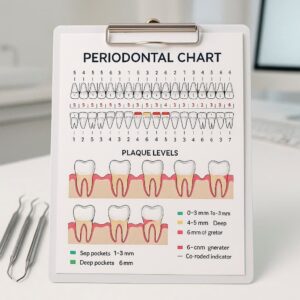
Dental Code for Perio Charting
Understanding the “Dental Code for Perio Charting”
Before we dive into specific codes, it is important to understand what perio charting actually involves from a procedural standpoint. Perio charting is not simply calling out numbers. It is a comprehensive evaluation of the supporting structures of the teeth. This includes measuring pocket depths, assessing bleeding points, noting recession, furcation involvement, and mobility.
From a coding perspective, this clinical work falls under two main categories: comprehensive evaluations and periodontal evaluations. The dental code for perio charting is rarely a standalone item called “perio charting.” Instead, it is part of a broader evaluation service.
The most common confusion arises when teams try to decide between an initial comprehensive exam and a periodic exam, or when they try to add a specific “periodic evaluation” code for a patient with existing periodontal disease.
Let’s look at the primary codes that involve perio charting.
D0180: Comprehensive Periodontal Evaluation
If there is a code that most closely matches the concept of a dedicated perio charting visit, it is D0180. This code represents a comprehensive periodontal evaluation. It is used when a patient presents with signs or history of periodontal disease, or when a detailed assessment of the periodontium is required.
This is not a code you use for every patient. D0180 is specifically for patients who need a detailed assessment of their periodontal health, often as a follow-up to a comprehensive exam or for patients undergoing active periodontal therapy. The documentation for D0180 requires a full-mouth periodontal charting, including probing depths, bleeding on probing, recession, mobility, and furcation assessments.
D0150: Comprehensive Oral Evaluation
For new patients, the code D0150 (Comprehensive Oral Evaluation) is the entry point. This is a comprehensive exam that includes a full evaluation of the hard and soft tissues, a caries assessment, and yes, typically a baseline perio charting.
When a new patient walks into your office, you are establishing a baseline for their oral health. That baseline includes periodontal charting. Therefore, for a new patient, the dental code for perio charting is usually bundled into D0150. You do not bill D0180 in addition to D0150 for the same patient on the same day. The D0150 covers the initial comprehensive assessment.
D0120: Periodic Oral Evaluation
For established patients of record, the code D0120 is used for routine recall visits. This exam is focused on changes since the last visit. It often includes a limited perio charting, or what some practices call a “spot-check” of probing depths, especially if the patient is a periodontal maintenance patient.
However, there is a significant nuance here. If you are seeing an established patient who has a history of periodontal disease, and you are performing a full-mouth, six-point perio charting with detailed documentation, you might need to consider whether D0120 is adequate. Many payers expect that a full-mouth perio charting triggers the use of D0180 instead, provided it is not done on the same day as another comprehensive service.
The Critical Distinction: D4355 vs. Perio Charting Codes
One of the most common points of confusion in dental coding is the difference between perio charting and D4355: Full Mouth Debridement to Enable Comprehensive Evaluation.
Let’s be very clear: D4355 is not a perio charting code. It is a procedure. It involves the removal of gross plaque and calculus that is so heavy it prevents a proper examination. You perform D4355 to allow you to do perio charting.
Imagine a patient comes in who has not seen a dentist in ten years. Their teeth are covered in heavy calculus. You cannot get your probe to the bottom of the pocket because the calculus is in the way. In this scenario, you might perform D4355 first. Once the debris is removed, you then schedule the patient for a comprehensive exam (D0150) or a comprehensive periodontal evaluation (D0180), during which you perform the actual perio charting.
You cannot bill D4355 and D0150 on the same day, nor can you bill D4355 as a substitute for a perio charting code. It is a separate service with a specific purpose.
A Comparative Table: Perio Charting Codes at a Glance
To help you visualize the differences, here is a comparison table of the most relevant codes involving perio charting.
| CDT Code | Procedure Name | When to Use It | Perio Charting Requirement |
|---|---|---|---|
| D0150 | Comprehensive Oral Evaluation | New patient or patient not seen in over 3 years. Establishes a baseline. | Full-mouth perio charting is a standard component of this exam. |
| D0180 | Comprehensive Periodontal Evaluation | Patient with signs of periodontal disease or history of periodontitis. Detailed assessment. | Full-mouth, six-point perio charting with detailed documentation of pockets, bleeding, recession, mobility, and furcations. |
| D0120 | Periodic Oral Evaluation | Established patient at a recall visit. | Usually limited to “spot probing” or focused charting. Full-mouth charting is typically not expected. |
| D4355 | Full Mouth Debridement | To remove gross plaque/calculus that prevents a comprehensive evaluation. | Not applicable. This is a procedure before a perio charting can occur. |
Proper Documentation: The Key to Successful Claims
Knowing the correct dental code for perio charting is only half the battle. The other half is documentation. Insurance companies do not just take your word for it. They require proof that the service was medically necessary and performed correctly.
When you submit a claim for D0180 or D0150, your periodontal charting must be detailed and clear. Vague notes like “perio charting done” are a recipe for a denial.
What Should Your Documentation Include?
Your perio charting documentation should be thorough. Here are the essential elements:
-
Probing Depths: Recorded in millimeters for six sites per tooth (mesiobuccal, buccal, distobuccal, distolingual, lingual, mesiolingual).
-
Bleeding on Probing (BOP): Indicate which sites bled. This is a key indicator of active inflammation.
-
Recession: Measure the distance from the cementoenamel junction (CEJ) to the gingival margin.
-
Furcation Involvement: Note the degree of furcation exposure on multi-rooted teeth.
-
Mobility: Document the grade of tooth mobility.
-
Clinical Attachment Level (CAL): This is calculated by adding probing depth and recession. It provides a more accurate picture of true tissue loss.
Important Note for Readers: Many practices use digital perio charting software that automatically generates a visual chart. While this is excellent, ensure your narrative notes also summarize the findings. For example: “Full-mouth six-point perio charting completed today. Generalized probing depths of 4-6mm with bleeding on probing noted in all quadrants. Localized 7mm pocket on tooth #3 with furcation involvement grade II.”
When to Use D0180 vs. D0150
This is the most common question among dental billers. The choice between D0150 and D0180 for a new patient can be tricky.
-
Use D0150 when the patient is new to the practice and you are establishing a comprehensive baseline for their overall oral health, which includes periodontal health.
-
Use D0180 when the patient is new to the practice but is being referred specifically for a periodontal evaluation. For instance, if a general dentist sends a patient to a periodontist for an assessment of their gum disease, the periodontist would use D0180.
You should not use D0180 for a new patient in a general practice if you are also doing a full oral cancer screening, caries assessment, and overall oral evaluation. That falls under D0150. D0180 is reserved for cases where the primary focus of the visit is the detailed assessment of the periodontium, often in a patient with known or suspected periodontal disease.
Perio Charting for Pediatric Patients
A special consideration arises for younger patients. For children and adolescents, perio charting is not always a routine part of every visit. However, there are situations where it is clinically indicated.
For pediatric patients, the dental code for perio charting is typically included in the appropriate evaluation code. There is no separate pediatric perio charting code.
-
D0145: Oral Evaluation for a Patient Under Three Years – This is a limited exam for very young children. Perio charting is rarely performed at this age.
-
D0150: Comprehensive Oral Evaluation – For an older child or adolescent who is a new patient, this code includes a baseline perio charting if indicated.
-
D0120: Periodic Oral Evaluation – For recall visits, perio charting is typically limited to areas of concern.
It is crucial to document the reason for perio charting in a pediatric patient. For example, if a teenager presents with signs of localized juvenile periodontitis, a full-mouth perio charting is medically necessary. Your notes should state the clinical findings that justify the time and detail of the procedure.
Common Billing Mistakes and How to Avoid Them
Even experienced offices make mistakes when coding for perio charting. These errors lead to claim rejections, delays in payment, and sometimes even audits. Let’s look at the most common pitfalls.
Mistake #1: Bundling D0180 with D0150
This is a major red flag for payers. You cannot bill D0150 (Comprehensive Oral Evaluation) and D0180 (Comprehensive Periodontal Evaluation) for the same patient on the same date of service. The services overlap significantly. Choose the one that best describes the primary purpose of the visit. If it is a new patient exam with a full periodontal assessment, D0150 is the correct choice.
Mistake #2: Using D0120 When a Full-Mouth Charting Was Performed
If you perform a full-mouth, six-point perio charting on an established patient, D0120 (Periodic Oral Evaluation) is often not the appropriate code. Many insurance carriers expect the more comprehensive D0180 code in this scenario, especially if the patient has a history of periodontitis. Using D0120 for a service that mirrors the complexity of D0180 can be seen as undercoding, which may trigger an audit or result in denied claims if the payer deems the service not routine.
Mistake #3: Insufficient Documentation
As mentioned earlier, lack of documentation is a surefire way to lose a claim. If you bill D0180, your chart must contain a complete periodontal chart. If the chart is missing, the claim will likely be denied upon review. Ensure your team is diligent about recording all probing depths, bleeding points, and other relevant findings.
Mistake #4: Confusing D4355 with Perio Charting
Some offices mistakenly bill D4355 (Full Mouth Debridement) as a way to get paid for a “heavy” prophy or for the time spent doing perio charting on a patient with buildup. This is incorrect. D4355 is a separate procedure with strict criteria. It is only used when the buildup prevents a proper exam. If you perform D4355, you are essentially stating that you cannot do a comprehensive perio charting yet. You must schedule a separate visit to complete the evaluation.
Best Practices for Perio Charting in Your Practice
To ensure your coding is always accurate and your claims are paid, consider adopting these best practices.
-
Establish Clear Office Protocols: Decide as a team when you will use D0150, D0180, and D0120. Create a checklist for each code so that clinical documentation aligns with billing expectations.
-
Invest in Perio Charting Software: Digital perio charting tools not only save time but also produce clear, professional records that are easy to submit with claims if required.
-
Train Your Hygiene Team: Your hygienists are the ones performing the perio charting. Ensure they understand the importance of complete and accurate documentation. They should know that a “full-mouth series” of probing depths means exactly that—every tooth, every site.
-
Verify Payer Policies: While the CDT codes are universal, individual insurance companies have their own policies on how often they will cover D0180. Some limit it to once every three years, while others allow it more frequently for active perio patients. Know the rules for the major payers in your area.
-
Use Narrative Descriptions: When submitting claims for D0180, do not just rely on the code. A brief narrative in the claim—such as “full-mouth perio charting completed with 6-point probing; patient with chronic periodontitis”—can help clarify the medical necessity.
The Future of Perio Charting Codes
The world of dental coding is not static. The CDT codes are updated annually by the American Dental Association (ADA). While the core codes for evaluations have remained relatively stable, there is always the possibility of future refinements.
There has been ongoing discussion within the coding community about the need for greater specificity in periodontal evaluation codes. Some experts advocate for codes that distinguish between a patient with a history of periodontitis who is stable and one who is undergoing active disease. However, as of now, D0180 remains the primary dental code for perio charting for patients with periodontal concerns.
Staying informed about annual CDT updates is essential for any practice. Make it a habit to review the changes each year and adjust your protocols accordingly.
A Helpful Checklist: Is Your Perio Charting Claim-Ready?
Before you submit a claim for D0150 or D0180, run through this quick checklist.
-
Is the patient a new patient (D0150) or an existing patient with a history of periodontitis (D0180)?
-
Does the clinical note clearly state that a full-mouth, six-point perio charting was performed?
-
Are the probing depths recorded in the patient’s chart?
-
Are bleeding points, recession, mobility, and furcations noted if present?
-
Is there a diagnosis of periodontal disease (e.g., chronic periodontitis, aggressive periodontitis) if D0180 was billed?
-
Is the date of service accurate?
-
Are you billing only one evaluation code for this date of service?
If you answered “yes” to all these questions, your claim has a strong chance of being processed without issue.
Quotations from Coding Experts
To reinforce the importance of proper coding, here are some insights from dental coding professionals.
“The most frequent error I see is the misuse of D0120 for what is clearly a comprehensive periodontal evaluation. If you are performing full-mouth, six-point probing, you owe it to your practice to bill the service that accurately reflects that work. Undercoding is just as problematic as overcoding.” — Sarah L., Dental Billing Consultant
“Documentation is your shield. In an audit, your perio chart is the first thing a reviewer will look at. If it’s incomplete, it doesn’t matter what code you used—the claim will be denied. Every pocket depth, every bleeding site, every furcation needs to be recorded.” — Michael R., Dental Practice Management Advisor
Conclusion
In summary, the dental code for perio charting is not a single, one-size-fits-all code. It is a decision based on the patient’s status, the reason for the visit, and the extent of the examination performed. For a new patient, the perio charting is part of D0150. For a patient with periodontal disease requiring a detailed assessment, the correct code is D0180. For a routine recall patient, it is D0120. Understanding these distinctions, documenting thoroughly, and avoiding common billing errors will ensure your practice is both clinically excellent and financially healthy.
Frequently Asked Questions (FAQ)
1. What is the exact dental code for perio charting?
There is no single code named “perio charting.” The service is included in evaluation codes. For a comprehensive periodontal evaluation that includes full-mouth charting, the code is D0180. For a new patient comprehensive exam that includes charting, it is D0150.
2. Can I bill D0180 and D0120 together?
No, you should not bill two evaluation codes for the same patient on the same day. D0180 is a comprehensive service that supersedes a periodic exam (D0120).
3. Does insurance always cover perio charting (D0180)?
Coverage varies by plan. Many dental insurance plans cover D0180 once every three years for patients with a history of periodontal disease. Some plans require a referral or pre-authorization. Always verify with the specific payer.
4. Is perio charting required for a child?
Perio charting is not routine for all children. However, it is medically necessary for children and adolescents who show signs of periodontal disease, such as localized juvenile periodontitis. In those cases, it would be included in the evaluation code used (D0150 or D0180).
5. What is the difference between D4355 and perio charting?
D4355 is a full-mouth debridement procedure used to remove heavy plaque and calculus so that a proper evaluation (including perio charting) can be performed. It is not a perio charting code. You perform D4355 before you can do the perio charting.
6. How often can I bill D0180?
Most insurance plans allow D0180 once every three to five years for a patient with a history of periodontitis. However, some plans may allow it more frequently if the patient is undergoing active periodontal therapy. Check the patient’s benefit summary for details.
7. What happens if I don’t document the perio charting for D0180?
If you are audited, the claim will likely be denied. The insurance company requires proof that the service was performed. Without the charting, you cannot prove medical necessity.
Additional Resources
For further reading and to stay updated on the latest CDT codes and coding guidelines, we recommend the following trusted resource:
-
American Dental Association (ADA) – CDT Codebook: The official source for Current Dental Terminology codes, including detailed descriptions and guidelines for proper usage.
-
Link: https://www.ada.org/en/publications/cdt (Note: This is the official ADA resource for coding information).
-