If you have ever sat in a dentist’s chair and had that small, plastic sensor placed inside your mouth—the one that makes you wince just a little as it presses against your gums—you have experienced a periapical X-ray. It is one of the most common, yet most crucial, diagnostic tools in dentistry.
But when you receive your dental insurance statement or a bill from the front desk, you might see a confusing string of letters and numbers. You might ask yourself, what exactly is the dental code for periapical x ray?
Understanding this code is not just about satisfying curiosity. It is about being an empowered patient. When you know the language of dental billing, you can review your insurance claims with confidence, avoid unexpected out-of-pocket costs, and understand exactly what your dentist is looking for.
In this guide, we will strip away the jargon. We will explore the two primary codes used for periapical radiographs, why they are different, how they affect your bill, and why these tiny images are so powerful in preserving your smile. Whether you are a patient trying to decipher a bill or a new dental professional looking to solidify your coding knowledge, this is your comprehensive resource.
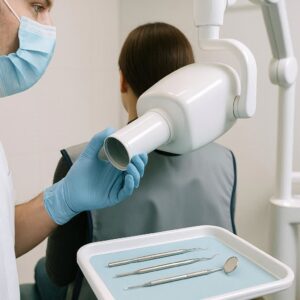
Dental Code for Periapical X Ray
What Exactly Is a Periapical X-Ray?
Before we dive into the numbers, let’s talk about the image itself. The word “periapical” breaks down into two parts: peri (meaning around) and apical (meaning the tip or apex of the root).
Unlike a bitewing X-ray, which focuses primarily on the crowns of your teeth (the part you see above the gum line) to check for cavities between teeth, a periapical X-ray captures the entire tooth—from the crown all the way down to the root tip and the surrounding bone.
Why Is This View So Important?
The periapical view is the detective of the dental world. It allows a dentist to see things that are invisible to the naked eye and even undetectable by other types of X-rays. Here is what a periapical X-ray reveals:
-
Root Health: It shows the shape, number, and length of the tooth roots.
-
Bone Support: It reveals the health of the bone holding the tooth in place. This is critical for diagnosing periodontal (gum) disease.
-
Abscesses and Cysts: If you have an infection at the tip of a root (an abscess), the periapical X-ray will show a dark, shadowy spot where the bone has been destroyed.
-
Impacted Teeth: It helps locate teeth that are stuck in the jawbone, such as wisdom teeth.
-
Trauma: If you have a cracked root or a tooth that has suffered trauma, this X-ray shows the extent of the damage.
In short, if a dentist needs to see the whole story of a specific tooth—from chewing surface to root tip—they will order a periapical X-ray.
The Official Dental Code for Periapical X Ray
In the United States, dental procedures are standardized using the Current Dental Terminology (CDT) codes. These codes are published by the American Dental Association (ADA) and are updated annually. They ensure that whether you are in a small private practice in Maine or a large clinic in California, the same procedure is billed under the same code.
When it comes to periapical X-rays, there are two specific codes. It is crucial to understand the difference between them because they carry different price points and insurance coverage rules.
Code D0220: Intraoral – Periapical – First Film
This is the code used for the first periapical X-ray taken during a specific series or visit.
Think of D0220 as the “setup” code. If a patient walks in with pain localized to a specific tooth, and the dentist takes a single X-ray of that tooth to diagnose the problem, they will bill D0220.
-
What it covers: The technical component, the interpretation, and the first film in a series.
-
When it is used: For a single, isolated periapical image.
-
Patient context: “My tooth hurts on the bottom left. Can you check it?”
Code D0230: Intraoral – Periapical – Each Additional Film
This code is always used in conjunction with D0220. If the dentist takes more than one periapical X-ray during the same visit, the first is billed under D0220, and every subsequent periapical film is billed under D0230.
-
What it covers: Each additional image taken beyond the first.
-
When it is used: When a dentist is taking a series of periapicals, such as a full-mouth series (FMX) or when checking multiple teeth in different quadrants.
-
Patient context: “I need to check the upper right and lower left molars.”
A Quick Comparison
To make the distinction crystal clear, here is a simple breakdown:
| Feature | D0220 | D0230 |
|---|---|---|
| Code Title | Intraoral – Periapical – First Film | Intraoral – Periapical – Each Additional Film |
| Quantity | The 1st film in a series | The 2nd, 3rd, 4th, etc. films |
| Typical Use | Single tooth evaluation | Full Mouth Series (FMX) or multiple area assessment |
| Cost | Generally higher (covers setup) | Generally lower per film |
| Insurance | Often covered at 80-100% depending on plan | Often covered at the same rate as D0220 |
Important Note for Readers: You should never see a dental claim with a D0230 code without a D0220 code on the same date of service (unless it is a correction or reversal of a previous claim). The “additional” code only exists because of the “first” code.
Full Mouth Series (FMX) vs. Single Periapicals
One of the biggest sources of confusion for patients is understanding why they sometimes see a code for a “Full Mouth Series” and sometimes see a combination of D0220 and D0230.
The Full Mouth Series (FMX)
A Full Mouth Series is a comprehensive set of X-rays that typically includes between 14 and 20 images. This series usually combines periapical views (for the roots) and bitewing views (for the crowns and cavities).
When billing for an FMX, dentists have two options depending on how they take the images:
-
Code D0210: This is the comprehensive code for an “Intraoral – Complete Series of Radiographic Images.” If a dentist takes a full set (e.g., 18 images) and uses this single code, it bundles all the work into one fee. You will not see D0220 or D0230 listed separately.
-
Code D0220/D0230 combination: Some offices, depending on their software or the specific insurance plan, will bill the FMX as “D0220 + D0230 (x17).” This means the first film is billed as D0220, and the remaining 17 are billed as D0230.
Which is correct? Both can be correct. The ADA allows for either method. However, insurance plans may prefer one method over the other. If you see a long list of codes on your Explanation of Benefits (EOB) with multiple lines of D0230, do not be alarmed. This is simply the office billing the X-rays individually rather than using the bundled code D0210.
When Single Periapicals Make Sense
A dentist will likely use D0220 and D0230 (as single or limited images) in the following scenarios:
-
Emergency Visits: You call because you have a toothache. The dentist takes one or two periapical X-rays to diagnose the specific problem.
-
Endodontic Treatment: Before a root canal, the dentist needs a precise image of the root tip. They may take one periapical to confirm the diagnosis.
-
Surgical Planning: If you are having a tooth extracted, the surgeon may take a periapical to visualize the root shape and surrounding bone.
-
Recall Patients: If a patient has recent X-rays on file but needs a check on a specific area, the dentist will take a limited number of periapicals rather than a full series.
The Insurance Perspective: Coverage and Limitations
Insurance billing for X-rays is often the area where patients get the most frustrated. Understanding how insurance companies view these codes can help you avoid a surprise bill.
Frequency Limitations
Most dental insurance plans operate on a “frequency” schedule. This means they will only pay for certain X-rays once within a specific time frame.
-
Full Mouth Series (D0210): Typically covered once every 3 to 5 years.
-
Bitewings (D0270-D0274): Typically covered once every 6 to 12 months.
-
Periapicals (D0220/D0230): This is where it gets tricky. Most plans do not have a specific frequency limitation for “single periapicals” because they are considered diagnostic necessities. However, if an insurance company sees a dentist billing 10 periapicals (D0220/D0230) every 6 months, they will likely deny them, arguing that a full mouth series (D0210) or a recall set of bitewings should have been used instead.
The “Same Day” Rule
Insurance companies often bundle procedures in their processing systems. If a patient has a comprehensive oral exam (D0150) and a dentist bills a full mouth series (D0210) on the same day, insurance usually pays for both without issue.
However, if a patient has a periodic oral exam (D0120) and the dentist bills D0220 and D0230 for a series of periapicals that look suspiciously like a full mouth series, the insurance company may downgrade the payment or deny the X-rays entirely, stating that the X-rays are not a covered benefit with that type of exam.
Decoding Your Dental Bill
Let’s look at a practical example of how this might appear on a bill or an Explanation of Benefits (EOB).
Scenario: You visit the dentist for a sharp pain in your upper right molar. The dentist takes two X-rays: one of the upper right molar and one of the upper left molar (for comparison).
| Code | Description | Fee | Insurance Coverage | Patient Responsibility |
|---|---|---|---|---|
| D0220 | Intraoral – Periapical – First Film | $50.00 | $40.00 (80%) | $10.00 |
| D0230 | Intraoral – Periapical – Each Additional | $35.00 | $28.00 (80%) | $7.00 |
| Total | $85.00 | $68.00 | $17.00 |
In this scenario, you pay your deductible or co-pay, and the insurance covers the rest based on your plan’s coverage percentage (often 80% for diagnostics).
The Cost of Periapical X-Rays Without Insurance
One of the most common questions patients have is, “How much is this going to cost me?” If you do not have dental insurance, or if you have a plan that has not yet met its deductible, you will be responsible for the full fee.
The cost of dental X-rays varies widely based on geographic location, the type of practice (private practice vs. corporate chain), and the complexity of the visit.
-
D0220 (First Film): Typically ranges from $25 to $75.
-
D0230 (Each Additional): Typically ranges from $10 to $40 per film.
If you are getting a Full Mouth Series (FMX) using periapical and bitewing X-rays, the total cost usually falls between $100 and $250.
Why Is There a Difference in Cost?
You might wonder why the first film (D0220) costs more than the additional films (D0230). This is standard practice in medical and dental billing. The first code often includes:
-
The cost of the equipment setup.
-
The chair time required to position the sensor.
-
The time for the dentist to interpret and diagnose the single image.
The additional films simply require the staff to reposition the sensor and press a button, requiring less incremental time and resources.
X-Ray Safety and Frequency: A Reassurance
A common concern we hear from patients is about radiation exposure. It is healthy to be cautious, and a good dentist will always weigh the diagnostic benefit against the risk. However, it is important to put the numbers into perspective.
Modern digital X-rays are incredibly safe. The radiation exposure from a digital periapical X-ray is minuscule. To give you an idea:
-
One Periapical X-ray: Approximately 0.005 mSv (millisieverts) of radiation.
-
One Bitewing X-ray: Approximately 0.005 mSv.
-
Full Mouth Series (FMX): Approximately 0.015 mSv.
For comparison:
-
Natural Background Radiation: You are exposed to about 0.01 mSv per day just from living on Earth (from the sun, soil, etc.).
-
Cross-Country Flight: A 5-hour flight exposes you to about 0.025 mSv.
In essence, a Full Mouth Series of X-rays exposes you to less radiation than a short airplane ride. Dentists adhere to the ALARA principle (As Low As Reasonably Achievable). They use lead aprons and thyroid collars to protect your body, and they only take X-rays when there is a clinical need.
Reader Note: If you are pregnant, always inform your dentist. While dental X-rays are considered safe during pregnancy with proper shielding, most dentists will postpone non-emergency X-rays until after the delivery to provide absolute peace of mind.
Technology and the Future: Beyond Traditional Codes
While D0220 and D0230 are the standard today, the world of dental imaging is evolving rapidly. New technologies are changing how images are captured, though the codes remain the same for now.
3D Imaging (CBCT)
Cone Beam Computed Tomography (CBCT) is a three-dimensional imaging technology. It provides a 3D model of your teeth, jaw, nerves, and sinuses. While a periapical X-ray shows a flat (2D) image of a tooth, a CBCT scan shows it in slices.
If your dentist uses a CBCT to diagnose a complex root canal or to plan an implant, they will not use D0220 or D0230. Instead, they use a different set of codes:
-
D0364: Cone beam CT capture and interpretation with limited field of view (less than one full jaw).
-
D0365: Cone beam CT capture and interpretation with a field of view of one full jaw.
These codes are significantly more expensive because they provide exponentially more data.
Artificial Intelligence (AI) in Imaging
A growing trend in dentistry is the integration of AI software that scans X-rays (including periapicals) to assist the dentist in diagnosis. The software can highlight areas of concern—such as tiny cavities, bone loss, or periapical radiolucencies (abscesses)—that the human eye might miss.
Currently, the use of AI does not change the dental code. The dentist still bills D0220 or D0230 for the image. However, in the future, we may see “adjunctive diagnostic” codes emerge to cover the cost of AI analysis.
Common Billing Errors and How to Spot Them
Even the best front offices can make mistakes. As a patient, you are your own best advocate. Here are a few common errors related to periapical X-ray codes.
1. Billing D0230 Without D0220
If you see an insurance claim that has D0230 listed but no D0220 on the same day, this is typically a clerical error. The system may have missed the first code. When this happens, insurance will often deny D0230 because, technically, there is no “first” film to attach it to.
What to do: Call the dental office and ask them to resubmit the claim with the D0220 code added.
2. Overbilling for a Full Mouth Series
If a dentist takes 18 X-rays and bills them as 18 separate “first films” (18 units of D0220), this is incorrect and would be considered insurance fraud. Always ensure that if you have a large set of X-rays, they are billed either as D0210 or as the correct combination of one D0220 and the rest as D0230.
3. Duplicate Billing
Sometimes, if a dentist has to retake an X-ray because the patient gagged or the image was distorted, they might try to bill for both the failed image and the successful image. Insurance generally expects the dentist to eat the cost of retakes. You should only be billed for the images that were successfully captured and used for diagnosis.
A Step-by-Step Guide to Your Periapical X-Ray Appointment
To help you feel more at ease, let’s walk through what happens during a typical periapical X-ray appointment, so you understand exactly what is being coded and why.
-
The Exam: The dentist or hygienist will first talk to you about your symptoms. If you have pain, they will ask you to point to the area.
-
The Prescription: The dentist “prescribes” the X-ray. They decide if a single periapical (D0220) is needed or if multiple areas (D0220 + D0230) require imaging.
-
Placement: The dental assistant will place a small, rigid sensor (or film) in your mouth. For a periapical, they will ask you to bite down gently to hold it in place. The sensor is positioned so it captures the entire tooth from crown to root tip.
-
The Capture: The assistant steps behind a barrier or leaves the room and presses a button. You may hear a quiet beep or hum. The entire exposure takes less than a second.
-
Review: The images appear on a computer screen almost instantly. The dentist will review them, often enlarging them and adjusting the contrast to look for specific details like dark spots (infection) or the shape of the root.
-
Diagnosis and Coding: Based on the findings, the dentist discusses the treatment plan. The front office then codes the X-rays taken (e.g., one D0220 and two D0230) and submits them to your insurance.
Frequently Asked Questions (FAQ)
Here are some of the most common questions we hear from readers about the dental code for periapical X-rays.
Q1: What is the difference between D0220 and D0230?
A: D0220 is used for the first periapical X-ray taken during a visit. D0230 is used for each additional periapical X-ray taken during the same visit. The first film costs more because it covers the setup and interpretation.
Q2: Is a periapical X-ray the same as a bitewing?
A: No. A bitewing (codes D0270-D0274) focuses on the crowns of the upper and lower teeth to detect cavities. A periapical (D0220/D0230) shows the entire tooth, including the root and surrounding bone. They serve different diagnostic purposes.
Q3: Will my insurance always cover D0220 and D0230?
A: Most dental insurance plans cover diagnostic X-rays at a high percentage (often 80-100%) after your deductible. However, if the X-rays are taken more frequently than the plan’s allowed limit, or if they are deemed not “medically necessary” based on the exam code, the claim may be denied.
Q4: Why did my dentist take a periapical X-ray when I just had X-rays last year?
A: Your dentist is likely looking for a specific issue, such as a suspected abscess, a cracked root, or to monitor bone levels around a specific tooth. These are “limited” diagnostic images, which are different from the routine “full series” or “bitewing” X-rays you had last year.
Q5: I see “D0230” multiple times on my bill. Is that a mistake?
A: Not necessarily. If your dentist took, for example, 4 periapical X-rays, your bill should show one D0220 and three units of D0230. If it shows four units of D0230, that is likely a mistake because there is no “first film” code.
Q6: Can a dental hygienist take a periapical X-ray?
A: Yes. Under the supervision of a licensed dentist, a registered dental hygienist is qualified to take periapical X-rays. The dentist is still responsible for interpreting the image and making the diagnosis.
Q7: What if I gag during the X-ray?
A: This is very common. If you have a strong gag reflex, let your dental team know. They have techniques to help, such as using a smaller sensor, applying a topical anesthetic to the palate, or having you lean forward slightly. If they have to retake the X-ray, you generally should not be billed for the retake.
Conclusion: Three Key Takeaways
Understanding the dental code for periapical X-rays empowers you to navigate your dental care with confidence.
-
There are two main codes: D0220 for the first film and D0230 for each additional film. Recognizing this distinction helps you verify your insurance claims and understand why the first X-ray often costs more than the subsequent ones.
-
These codes serve a vital purpose: Periapical X-rays are the only non-invasive way for a dentist to see the root tips and surrounding bone, making them essential for diagnosing abscesses, root fractures, and severe gum disease.
-
Knowledge is your best defense: By understanding when these codes should be used and how insurance typically handles them, you can ask informed questions, spot billing errors, and focus on what truly matters—your oral health.
Additional Resources
For those looking to dive deeper into dental codes, insurance navigation, or oral health education, we recommend visiting the American Dental Association’s (ADA) official website. The ADA publishes the annual CDT code manual, which is the definitive source for all dental procedure codes.
-
Resource Link: https://www.ada.org/en/publications/cdt
You can also check with your state’s dental board for patient rights and resources regarding dental billing transparency.
Disclaimer: This article is for informational and educational purposes only. It is not a substitute for professional dental advice, diagnosis, or treatment. Dental codes and insurance policies are subject to change. Always consult with your dental provider or insurance carrier regarding specific billing and coverage questions.