If you are considering Invisalign, you have probably asked yourself one of the most frustrating questions in modern dentistry: How much is this actually going to cost me?
You have heard the term “dental codes” thrown around. Maybe your dentist’s front office mentioned a “D-code” when talking about your insurance. But what exactly is the dental code for Invisalign insurance, and why does it matter so much?
The truth is, there isn’t just one magic number. Invisalign is a brand name—a specific method of orthodontic treatment. In the world of dental billing, insurance companies don’t typically see the word “Invisalign.” Instead, they see a set of standardized codes that describe what the dentist is doing, not necessarily how they are doing it.
Understanding this distinction is the key to unlocking your insurance benefits. This guide is designed to walk you through everything you need to know. We will break down the complex world of ADA dental codes, explain how to talk to your insurance company, and give you the tools to read your treatment plan like a pro.
Let’s pull back the curtain on dental billing so you can walk into your next appointment feeling confident, not confused.
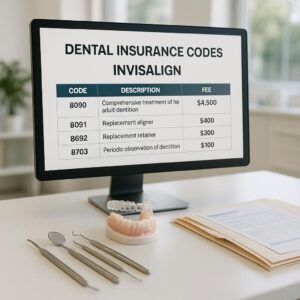
Dental Code for Invisalign Insurance
Understanding the Basics: What Are Dental Codes?
Before we dive into the specifics of Invisalign, it helps to understand the system behind the numbers.
Dental procedures are standardized using a set of codes maintained by the American Dental Association (ADA). These are called Current Dental Terminology (CDT) codes. Every time a dentist performs a procedure—whether it’s a simple cleaning, a filling, or a full set of braces—they submit a claim to your insurance company using these specific codes.
Think of it like a universal language. If your dentist sends the code “D0120,” every insurance company in the country knows that means a periodic oral evaluation (a routine check-up).
Because Invisalign is a type of orthodontic treatment, it falls under a specific category of these codes: the Orthodontic Codes (D8000 – D8999) .
Why the Brand Name Doesn’t Appear on Your Claim
This is the most important thing to understand. When your dentist submits a claim for Invisalign to your insurance company, they are not submitting a code that says “Invisalign.” They are submitting a code that says “comprehensive orthodontic treatment.”
To the insurance adjuster looking at the claim, there is no functional difference between traditional metal braces, ceramic braces, or clear aligners like Invisalign. They are all considered orthodontia.
This is actually good news for you. Because if your insurance plan covers orthodontics, it typically covers the treatment, not the hardware. As long as your dentist uses the correct orthodontic code, you can usually apply your benefits toward Invisalign.
The Exact Dental Codes for Invisalign Insurance
Now, let’s get to the heart of the matter. There isn’t a single “Invisalign code.” Instead, there are several codes depending on the complexity of your case and whether you are starting a new case or continuing treatment.
Here are the primary ADA CDT codes used for Invisalign billing.
D8010 – D8090: The Limited vs. Comprehensive Debate
These codes represent the scope of the treatment. Invisalign can be used for minor corrections or major, full-mouth realignments.
-
D8010: Limited orthodontic treatment of the primary dentition (baby teeth).
-
D8020: Limited orthodontic treatment of the transitional dentition (mix of baby and permanent teeth).
-
D8030: Limited orthodontic treatment of the adolescent dentition (permanent teeth, but patient is under a certain age).
-
D8040: Limited orthodontic treatment of the adult dentition.
-
D8050: Interceptive orthodontic treatment (usually for children to guide growth).
-
D8060: Interceptive orthodontic treatment (comprehensive in nature).
-
D8070: Comprehensive orthodontic treatment of the transitional dentition.
-
D8080: Comprehensive orthodontic treatment of the adolescent dentition.
-
D8090: Comprehensive orthodontic treatment of the adult dentition.
The Key Takeaway:
Most adults getting full Invisalign treatment will see D8090 on their insurance claim. This is the “comprehensive orthodontic treatment” code for adults. It signals to the insurance company that the patient requires a full course of treatment, typically lasting 12 to 24 months.
If you are only doing a short-term correction (like Invisalign Express or Lite) to fix a few front teeth that have shifted, your dentist might use a limited code (like D8040) instead. This is crucial because insurance benefits for “limited” treatment are often capped at a lower amount than “comprehensive” treatment.
D8670: The Monthly Visit Code
Orthodontic treatment isn’t a one-and-done procedure. It requires ongoing maintenance. After the initial placement of your aligners, you will visit your dentist every 6 to 10 weeks to check progress and pick up new trays.
Your insurance company pays for this ongoing care through a code called D8670 – Periodic orthodontic treatment visit.
Typically, the initial fee for your Invisalign treatment (the D8090 or D8040) covers the cost of all these visits. However, on the insurance side, the office often “bundles” the fee. When you see an explanation of benefits (EOB), you might see this code listed multiple times. It represents the active phase of your treatment where adjustments and monitoring are happening.
D8680: What Happens When Treatment Ends
Once your teeth are straight and you have finished your active trays, you will need retainers to ensure your teeth don’t shift back.
The code used for this is D8680 – Orthodontic retention (removal of appliances, construction and placement of retainer(s)) .
This is a vital code to watch. Some dental insurance plans cover the cost of retainers under the orthodontic benefit. Others consider this a separate procedure that may not be covered if you have exhausted your lifetime orthodontic maximum. If your Invisalign treatment included retainers in the total fee, your dentist’s office will often allocate a portion of the fee to this code for insurance purposes.
D8999: The Unspecified Code
Sometimes, a situation is unique. If your treatment involves a combination of approaches or if a specific code doesn’t fit the scenario perfectly, you might see D8999 – Unspecified orthodontic procedure.
This is a “catch-all” code. While it is used legitimately for complex cases, it is also a code that insurance companies scrutinize heavily. If you see this on your claim, it is worth asking your dental office for a detailed explanation, as some insurers may deny it or pay less than they would for a standard D8090.
How Insurance Applies to Invisalign
Understanding the code is one thing. Understanding how insurance pays for that code is another. Medical and dental insurance operate very differently.
The Orthodontic Lifetime Maximum
Unlike a dental cleaning, which renews every year, orthodontic benefits usually have a lifetime maximum.
This is a hard cap on the amount of money the insurance company will pay toward orthodontic treatment for a single person. Common lifetime maximums range from $1,000 to $3,500, though some premium plans may go higher.
Once that maximum is reached, the insurance company will not pay another penny toward orthodontics for that patient. Ever. Even if you switch jobs or plans.
This is critical because orthodontic treatment is expensive. If your Invisalign costs $6,000 and your insurance has a $1,500 lifetime orthodontic maximum, you will be responsible for the remaining $4,500.
Age Limitations
Many dental insurance plans have strict age limitations for orthodontic coverage.
-
Child/Adolescent Coverage: Most plans cover orthodontics for dependents up to age 18 or 19.
-
Adult Coverage: Not all plans cover adult orthodontics. Some plans exclude it entirely. Others may cover it but with a lower lifetime maximum or a longer waiting period.
If you are an adult seeking Invisalign, you must verify that your plan includes “Adult Orthodontics.” If it doesn’t, the insurance will deny the claim, even if the dental code is correct.
Deductibles and Coinsurance
Like medical insurance, dental plans have deductibles (an amount you pay before the insurance kicks in) and coinsurance (the percentage the insurance pays after the deductible).
For orthodontics, coinsurance is often structured as “50/50” or “50% coverage.” This means the insurance pays 50% of the allowed amount until you hit your lifetime maximum.
However, unlike a filling or crown which is paid in a lump sum, orthodontic benefits are usually paid in installments. The insurance company pays a percentage each month or quarter over the life of the treatment. This is why you might see a small payment from the insurance on your EOB every month rather than one large check.
Decoding Your Treatment Plan: What to Look For
When you receive a treatment plan from your dentist for Invisalign, it is a legal and financial document. It should list the specific codes your dentist plans to use. Here is how to read it like a detective.
Line Item Details
A standard treatment plan will look something like this:
| Code | Description | Fee | Insurance Est. | Patient Est. |
|---|---|---|---|---|
| D8090 | Comprehensive Ortho (Adult) | $5,800.00 | $1,500.00 | $4,300.00 |
| D8680 | Retainer Placement | $0.00 | $0.00 | $0.00 |
Note: Often, the retainer fee is included within the D8090 fee, so it shows as a $0.00 line item to avoid double charging.
The “UCR” Trap
You might hear the term “Usual, Customary, and Reasonable” (UCR). This is the amount the insurance company thinks the procedure should cost in your geographic area.
Sometimes, a dentist charges $6,000 (their fee), but the insurance company says the UCR for D8090 is $5,000. They will only pay a percentage of the $5,000. This is called a “write-off” if the dentist is in-network, or a balance bill if they are out-of-network.
Always ask: Are you in-network with my insurance? If yes, the fee schedule is pre-negotiated, and you won’t face surprise UCR discrepancies.
The Verification Process: Steps to Take Before Starting
Before you sign on the dotted line and agree to a payment plan, you need to do your homework. Relying on the dentist’s office to handle everything is common, but verifying yourself can prevent financial headaches later.
Step 1: Get the Codes
Ask your dentist’s treatment coordinator for the specific CDT codes they will be billing. Specifically, ask:
-
“What is the primary orthodontic code you will use? (D8090, D8040, etc.)”
-
“Will you be billing a separate code for retainers (D8680)?”
-
“Are there any other codes like D8670 for monthly visits that will show up on my EOB?”
Step 2: Call Your Insurance Company
Once you have the codes, call the customer service number on the back of your dental insurance card. Have the codes ready.
Do not ask, “Do you cover Invisalign?” because the representative may not know what that is. Instead, say:
“I am looking at having orthodontic treatment. I have the ADA codes. Can you tell me if my plan covers code D8090 for adult comprehensive orthodontics? If so, what is my lifetime orthodontic maximum, and is there an age limitation for adults?”
Step 3: Ask About the “Missing Tooth Clause”
This is a hidden gem of insurance knowledge. Some plans have a “missing tooth clause.” If you are missing a permanent tooth (usually a molar), some insurance companies will deny orthodontic coverage for that arch, arguing that you cannot “straighten” a space where a tooth is missing.
If you have missing teeth, ask your insurance representative specifically: Does my plan have a missing tooth clause that would affect orthodontic coverage?
Step 4: Confirm the Payment Schedule
Ask how the insurance pays for orthodontics. Do they pay the benefit in a lump sum, or do they pay monthly over the course of treatment? If they pay monthly, you need to ensure your dentist’s office is comfortable with that schedule so they don’t demand the full patient portion upfront if the insurance is dragging their feet.
In-Network vs. Out-of-Network: A Critical Choice
One of the biggest factors affecting your final cost is whether your orthodontist is “in-network” with your insurance plan.
In-Network Providers
If your dentist is in-network, they have a contract with your insurance company. This contract dictates:
-
Contracted Rates: The dentist cannot charge you more than a pre-agreed fee for the D8090 code.
-
No Balance Billing: If the insurance pays $1,500, and the contracted fee is $5,000, you owe $3,500. You cannot be billed extra.
-
Assignment of Benefits: The dentist usually handles the insurance claims directly.
Pros: Lower costs, predictable pricing, less paperwork for you.
Cons: You are limited to providers within the network.
Out-of-Network Providers
If your dentist is not in your insurance network, they are considered out-of-network. This changes the financial dynamics significantly.
-
No Contracted Rate: The dentist charges their full fee.
-
UCR Limits: The insurance will pay a percentage of their UCR, not the dentist’s fee.
-
Balance Billing: You are responsible for the difference between what the insurance pays and what the dentist charges.
Example:
-
Dentist Fee: $6,500
-
Insurance UCR (D8090): $5,000
-
Insurance pays 50% of UCR: $2,500
-
You owe: $6,500 – $2,500 = $4,000
Whereas, if that dentist were in-network with a contracted fee of $5,500, and insurance paid 50% ($2,750), you would owe $2,750.
Common Scenarios and Why Claims Get Denied
Even with the correct codes, insurance companies sometimes deny claims. Understanding why can help you fight back.
Scenario 1: The “Medical Necessity” Denial
Sometimes, an insurance company will deny orthodontic coverage, stating it is “cosmetic.”
-
The Code: D8090
-
The Problem: The plan might have a clause stating orthodontics is only covered for “medically necessary” conditions (like severe overbites causing trauma or chewing issues).
-
The Fix: Your dentist may need to submit a “narrative” with the claim, including photos, X-rays, and a letter explaining the functional (not just cosmetic) necessity of the treatment. This is common with medical insurance overlays, though rare with standard dental PPOs.
Scenario 2: The “Alternative Benefit” Denial
If you have a missing tooth, the insurance might downgrade the code.
-
The Code: D8090 (Comprehensive)
-
The Problem: Insurance says because a tooth is missing, comprehensive treatment isn’t necessary, and they will only pay for a “limited” code (D8040) which has a lower benefit.
-
The Fix: Ask your dentist to appeal. If the comprehensive treatment is necessary to create space for an implant or bridge later, the appeal often works.
Scenario 3: Timely Filing
Every insurance policy has a “timely filing limit,” usually 6 to 12 months from the date of service.
-
The Code: D8670 (Periodic Visit)
-
The Problem: The dental office fails to submit the claim on time.
-
The Fix: This is the office’s responsibility. Ensure your provider has a robust billing department. If they miss the deadline, they may have to write off the fee, or they may try to bill you. A good office will eat this cost.
How to Maximize Your Invisalign Insurance Benefits
Getting the most out of your insurance requires strategy. It’s not just about having the insurance; it’s about using it wisely.
1. Use a Flexible Spending Account (FSA) or Health Savings Account (HSA)
Even with insurance, you will have out-of-pocket costs. Orthodontic treatment is a qualified medical expense. If your employer offers an FSA or HSA, you can contribute pre-tax dollars to pay for your portion of the treatment. This can save you 20% to 40% on your out-of-pocket costs depending on your tax bracket.
2. Double Coverage (Spousal Coordination of Benefits)
If you are married and both you and your spouse have dental insurance that covers orthodontics, you may be able to double dip—legally.
This is called Coordination of Benefits (COB) . Typically, the primary insurance pays its lifetime maximum. Then, the secondary insurance may pay a portion of the remaining balance, up to their lifetime maximum.
Important: You cannot profit from insurance. The total paid by both insurances cannot exceed the total cost of the treatment. However, if you have two plans with $1,500 lifetime maximums each, you could potentially cover $3,000 of your treatment cost.
3. Timing Your Start Date
Orthodontic benefits are paid out over time. If you start treatment in November, and your insurance pays a monthly portion, you might only use a small amount of your lifetime maximum before the plan year resets. However, lifetime maximums don’t reset annually—they are lifetime caps.
The timing that matters is plan eligibility. If you are leaving a job soon, you need to ensure you start treatment before your insurance terminates, or you will lose the benefit.
4. Negotiate with Your Dentist
If your insurance only covers a small portion, don’t be afraid to negotiate. Dental offices want the case. If you have a high out-of-pocket cost, ask for:
-
A “pay-in-full” discount (often 3-5%).
-
An interest-free payment plan for the remaining balance.
-
A courtesy write-off if you are close to the network fee schedule.
The Difference Between Dental and Medical Insurance for Invisalign
While Invisalign is usually billed under dental insurance, there is a growing trend of using medical insurance for orthodontics, particularly in cases involving:
-
Sleep Apnea: If Invisalign is being used to advance the mandible to treat obstructive sleep apnea, it might be billable under medical insurance (though usually with different codes like D9945 for sleep apnea appliances).
-
Cleft Palate or Craniofacial Anomalies: If orthodontics is part of reconstructive surgery, medical insurance may cover it.
-
Trauma: If teeth were knocked out or misaligned due to an accident, medical insurance (auto insurance or health insurance) might be the primary payer.
However, for standard Invisalign cases, dental insurance is the primary route.
A Closer Look at Invisalign-Specific Tiers and Their Codes
Invisalign itself offers different product tiers. While the ADA codes remain the same, the tier you choose can affect the total fee and how the dentist allocates the insurance benefit.
| Invisalign Tier | Typical ADA Code | Description | Insurance Impact |
|---|---|---|---|
| Invisalign Comprehensive | D8090 | Full treatment, unlimited trays, up to 5 years of coverage. | Ideal for insurance; matches the “comprehensive” code expected by insurers. |
| Invisalign Lite | D8040 | Up to 14 trays (or 20 with refinements). Minor corrections. | May be billed as limited treatment. Insurance benefits may be lower if the plan caps limited treatment. |
| Invisalign Express | D8040 | Up to 10 trays. Very minor movement. | Often not covered well, as many insurers require a comprehensive plan for benefits. |
| Invisalign Go / Go Plus | D8040 or D8090 | Designed for general dentists for mild to moderate cases. | Varies. If the case is complex enough, dentists may use D8090. |
Important Note: Just because you are getting “Lite” or “Express” does not mean your insurance will pay less if the dentist uses a comprehensive code. However, if the dentist uses a limited code (D8040) to match the treatment scope, your insurance might only apply a limited orthodontic benefit, which is often significantly lower than the comprehensive benefit.
Navigating Insurance When Switching Dentists
Sometimes, life gets in the way. You move, or you decide you don’t like your current orthodontist. What happens to your insurance if you transfer your Invisalign case?
When you transfer orthodontic treatment, the billing gets complicated. The initial dentist has already billed the insurance for the start of treatment. The new dentist will need to take over.
The transfer is usually handled with code D8999 (unspecified) or by the new dentist starting a new “course” of treatment. However, if the lifetime maximum has already been partially paid to the first dentist, the second dentist will only be able to collect the remaining balance from the insurance.
Crucial Advice: Before transferring, get a written release from the first office detailing how much of the lifetime maximum was used and how much of the total fee was allocated to treatment already rendered. This prevents double-billing and ensures the new office knows exactly what is left in your insurance benefit.
The Role of Pre-Authorization (Predetermination)
Before starting Invisalign, a smart dental office will send a pre-authorization (or predetermination) to your insurance company.
This is not a guarantee of payment, but it is a very strong estimate. The insurance company reviews the codes (usually D8090, D8670, D8680), the X-rays, and the charting, and sends back a document stating:
-
“We have reviewed this case. Based on the plan, we will pay up to $1,500 lifetime maximum for code D8090.”
If your dentist does not offer to do this, ask for it. A pre-authorization is your best tool to avoid surprises. It confirms:
-
The codes are correct.
-
The patient is eligible.
-
The estimated insurance portion.
Keep in mind, pre-authorizations usually expire after 6 to 12 months, so don’t wait too long to start treatment.
Hidden Costs: What Insurance Usually Doesn’t Cover
Even with great insurance and the correct codes, there are almost always out-of-pocket expenses. Insurance is designed to cover a portion, not all. Here are typical costs that insurance usually does not cover:
-
Replacement Trays: If you lose your aligners or your dog chews them up, insurance rarely covers the cost of reprints. This is usually an out-of-pocket expense.
-
Refinements (Beyond Policy): While most comprehensive Invisalign cases include refinements, if your insurance has a time limit (e.g., coverage ends after 24 months), any treatment beyond that is on you.
-
Whitening: Many patients whiten their teeth after Invisalign. This is cosmetic and never covered by dental insurance.
-
Lost Retainers: After treatment, if you lose your Vivera or Hawley retainers a year later, insurance will not cover replacements unless you have a specific rider.
Frequently Asked Questions (FAQ)
Here are some of the most common questions people ask when trying to decipher their Invisalign insurance benefits.
Is Invisalign covered by dental insurance?
Yes, if your dental insurance plan includes orthodontic benefits, Invisalign is typically covered. Because it is classified under the same ADA codes as braces (D8090, etc.), insurance treats it as orthodontic treatment, not as a separate, excluded procedure.
What is the specific dental code for Invisalign?
There is no single code for the “Invisalign” brand. The most common code used for adult Invisalign is D8090 (Comprehensive Orthodontic Treatment of the Adult Dentition). For minor cases, it may be D8040 (Limited Orthodontic Treatment of the Adult Dentition).
Does insurance cover Invisalign for adults?
It depends on the plan. You must check if your specific plan includes “Adult Orthodontics.” Many plans only cover orthodontics for dependents under 19. If your plan includes adult coverage, Invisalign will likely be covered under the same orthodontic benefit as braces.
How do I find out if my insurance covers Invisalign?
First, get the CDT codes from your dentist (likely D8090 or D8040). Then, call your insurance company and ask specifically about coverage for those codes, your lifetime orthodontic maximum, and any age limitations. Do not simply ask if they cover “Invisalign.”
What is the lifetime maximum for orthodontic insurance?
A lifetime maximum is the total amount an insurance plan will pay for orthodontic treatment over the entire time you are covered by that plan. This amount varies widely by plan, typically ranging from $1,000 to $3,500. Once used, it does not renew annually.
Can I use my HSA or FSA for Invisalign?
Absolutely. Invisalign treatment is considered a qualified medical expense by the IRS. You can use funds from a Health Savings Account (HSA) or Flexible Spending Account (FSA) to pay for your out-of-pocket costs, including deductibles and coinsurance.
Why did my insurance deny my Invisalign claim?
Common reasons for denial include:
-
The plan excludes adult orthodontics.
-
The patient has reached their lifetime maximum.
-
The dentist used a code (like D8090) but the insurance requires a different code for that specific plan.
-
Missing tooth clause.
-
The treatment was deemed cosmetic rather than medically necessary.
If I have two dental insurances, can I use both for Invisalign?
Yes, through Coordination of Benefits (COB). The primary insurance pays its benefit first. The secondary insurance may then pay a portion of the remaining balance up to its own lifetime maximum. You cannot receive more than the total cost of treatment, but you can significantly reduce your out-of-pocket costs.
What is the difference between D8090 and D8040 for Invisalign?
D8090 is Comprehensive Orthodontic Treatment for adults. It is used for full-mouth corrections, usually involving all teeth, with a treatment plan lasting 12-24 months. D8040 is Limited Orthodontic Treatment, used for minor corrections (like fixing a few rotated front teeth) with a shorter treatment duration. Insurance benefits are often higher for D8090 than for D8040.
Does insurance cover retainers after Invisalign (D8680)?
Often, yes, but it depends on how the benefit is structured. If the retainer placement (D8680) is included in the total comprehensive fee, the insurance benefit is applied to the overall case. If the retainers are billed separately after the orthodontic case is closed, you may need to check if you have remaining orthodontic benefits or if they fall under general dental coverage.
Additional Resources
For further reading and to verify your specific plan details, the following resources are invaluable.
-
American Dental Association (ADA) – CDT Code Search: The official source for understanding current dental terminology.
-
National Association of Dental Plans (NADP): A resource for understanding the different types of dental plans (PPO, HMO, Indemnity) and how they work.
-
Link: https://www.nadp.org
-
Conclusion
Navigating the intersection of dental codes and insurance coverage for Invisalign doesn’t have to feel like decoding a secret language.
The key takeaway is that the process revolves around standardized ADA codes—primarily D8090 for comprehensive adult treatment. By shifting your focus from the brand name “Invisalign” to the functional code representing orthodontic care, you empower yourself to have informed conversations with both your dentist and your insurance provider.
Remember to always verify your benefits before treatment, ask for a pre-authorization, and understand the difference between in-network and out-of-network billing. Armed with the right questions and a clear understanding of these codes, you can confidently move forward with your treatment plan, minimizing financial surprises and maximizing the value of your insurance.