If you or someone you care about is facing a liver biopsy, you’ve likely found yourself navigating a maze of medical terminology. Among the most confusing aspects can be the billing and coding side of things. You might be staring at a form or an estimate, wondering what all those numbers and abbreviations actually mean. One of the most common questions we hear is, “What is the correct CPT code for a liver biopsy when it’s guided by ultrasound?”
You’re not alone in this. The world of medical codes can feel like a foreign language. But understanding it is a powerful tool. It helps you communicate with your healthcare provider, anticipate costs, and ensure your medical records are accurate.
In this guide, we will break down everything you need to know about the CPT code for an ultrasound-guided liver biopsy. We’ll go beyond just the number to explore what it includes, why there might be multiple codes on a bill, and how the process works from a coding perspective. Our goal is to turn a complex topic into something clear, simple, and useful for you.
We’ll cover the primary codes involved, the role of the radiologist versus the surgeon, what “guidance” actually means in a coding context, and even touch on what happens if the biopsy is done differently. Let’s get started.
CPT Code for Liver Biopsy Ultrasound Guided
Table of Contents
ToggleUnderstanding the Basics: What is a Liver Biopsy?
Before we dive into the codes, it’s helpful to understand the procedure itself. A liver biopsy is a medical procedure where a small sample of liver tissue is removed so it can be examined under a microscope. Doctors use this to diagnose a variety of liver conditions, such as hepatitis, fatty liver disease, cirrhosis, or to check for tumors.
In the past, these were often done “blind,” meaning the doctor would use anatomical landmarks to guess where the liver was and then insert a needle. Today, that’s rarely the case.
The Role of Ultrasound Guidance
Modern medicine relies heavily on imaging to make procedures safer and more accurate. Ultrasound guidance means the doctor uses real-time, moving images from an ultrasound machine to see exactly where the needle is going. They can watch the needle’s tip enter the liver, avoiding major blood vessels, the gallbladder, or other critical structures.
This approach is now the gold standard. It significantly reduces the risk of complications and increases the chances of getting a high-quality tissue sample on the first try. Because it adds a layer of complexity—requiring specialized equipment and a skilled operator—it’s also handled differently in the world of medical coding.
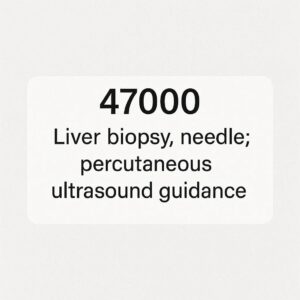
The Primary CPT Code: 47000
When we talk about the core procedure of taking a tissue sample from the liver, the main CPT code you’ll encounter is 47000.
This code is officially defined as: Biopsy of liver, needle; percutaneous.
Let’s break that down:
-
Biopsy of liver: This tells us the body part and the action.
-
Needle: This specifies the method used to obtain the sample.
-
Percutaneous: This is a key term. It means “through the skin.” The doctor makes a small nick in the skin and inserts a needle directly through it to reach the liver.
So, code 47000 describes the act of inserting a needle through the skin to take a piece of liver tissue. It is the foundational code for the procedure.
However, here’s where it gets a bit more detailed. Code 47000 describes the biopsy itself. But what about the ultrasound that guides the needle? Is that included? In most cases, for a percutaneous liver biopsy, the guidance is not included in the 47000 code. It is considered a separate, billable service.
The Guidance Code: 76942
This is where the second crucial code comes in. For the ultrasound guidance that makes the procedure so safe and precise, the appropriate CPT code is 76942.
This code is defined as: Ultrasonic guidance for needle placement (e.g., biopsy, aspiration, injection, localization device), imaging supervision and interpretation.
This code covers the work of the radiologist or the physician who is using the ultrasound. It includes:
-
Setting up the ultrasound machine.
-
Scanning the area to find the best path to the liver.
-
Using a sterile probe cover.
-
Actively watching the needle on the screen as it moves toward the liver.
-
Documenting the images and providing a report of the guidance.
Think of it this way: 47000 is the action of taking the tissue. 76942 is the “map” that ensures the action is done safely.
Why Two Codes?
It’s common for patients to see both 47000 and 76942 on a single bill or explanation of benefits (EOB). This is not an error or double-billing. It reflects that two distinct services were provided, often by different physicians or different parts of the same practice.
-
One physician (often a gastroenterologist, hepatologist, or surgeon) performs the biopsy itself.
-
Another physician (often a radiologist) provides and interprets the ultrasound guidance.
Both services were medically necessary and are billed separately according to standard coding guidelines.
The Professional and Technical Components
To truly understand how these codes work, you need to know about a concept called “modifiers.” In medical coding, a modifier is a two-digit code added to a CPT code to provide more information about the service performed.
For imaging codes like 76942, the service is often split into two components:
-
The Technical Component (TC): This covers the use of the equipment, the ultrasound machine, the room, the supplies (like the sterile probe cover and gel), and the work of the sonographer or technician. It’s the “hardware” part of the service.
-
The Professional Component (26): This covers the physician’s work. It includes reviewing the images, interpreting what they show, providing real-time guidance during the procedure, and writing a formal report. It’s the “expertise” part of the service.
When a hospital or facility performs the ultrasound, they will bill the TC component. When the interpreting physician performs their part, they will bill the professional component using modifier -26.
The Modifier -26 in Action
For our ultrasound-guided liver biopsy, you will almost always see 76942-26 on the radiologist’s bill. This tells the insurance company that the radiologist is only charging for their professional interpretation and guidance, not for the use of the machine (which is typically covered by a facility fee from the hospital or outpatient center).
Sometimes, if a single physician group owns the equipment and provides the entire service (for example, in a private clinic), you might see 76942 without a modifier, or with the modifier -TC for the technical side if it’s billed separately.
Important Note: Code 47000 for the biopsy itself also has professional and technical components. The physician performing the biopsy will bill the professional component (using modifier -26 if they don’t own the facility), and the facility will bill the technical component for the use of the procedure room, nursing staff, and supplies.
A Comparative Look at the Codes
To make this clearer, let’s put the key codes side-by-side in a table. This visual will help you understand the distinct roles each code plays in the billing process.
| CPT Code | Description | Key Component | Who Typically Bills This? |
|---|---|---|---|
| 47000 | Biopsy of liver, needle; percutaneous | The core procedure of obtaining the tissue sample. | The performing physician (e.g., gastroenterologist, hepatologist, surgeon). |
| 47000-26 | Biopsy of liver (professional component) | The physician’s skill in performing the biopsy. | The performing physician (if they don’t own the facility). |
| 47000-TC | Biopsy of liver (technical component) | Use of the procedure room, nursing staff, and supplies. | The hospital, ambulatory surgery center, or clinic facility. |
| 76942 | Ultrasonic guidance for needle placement | The use of ultrasound to guide the biopsy needle. | The interpreting physician (usually a radiologist). |
| 76942-26 | Ultrasound guidance (professional component) | The radiologist’s expertise in performing and interpreting the guidance. | The interpreting radiologist. |
| 76942-TC | Ultrasound guidance (technical component) | The use of the ultrasound machine, equipment, and sonographer’s time. | The hospital or facility where the ultrasound is performed. |
As you can see, a single outpatient procedure can generate multiple bills from different providers, each using a different combination of codes and modifiers. This is standard practice and ensures each provider is correctly reimbursed for their distinct role.
When Other Codes Might Be Used
While 47000 and 76942 are the standard codes for a percutaneous ultrasound-guided liver biopsy, there are other scenarios. It’s good to be aware of them because they might apply to your situation.
Alternative Biopsy Codes
-
47100: This code is for Biopsy of liver, wedge. A wedge biopsy is not done with a needle. It involves making an incision and surgically removing a small, wedge-shaped piece of the liver. This is typically done during an open surgery or laparoscopically. It’s a more invasive procedure and has its own set of coding rules.
-
+47101: This is an add-on code for Biopsy of liver, wedge, when done for transplantation. It’s used in specific surgical scenarios.
If your biopsy is done as part of a larger surgery, a different code might be used, or the biopsy might be considered part of the main surgical package and not billed separately.
Alternative Guidance Codes
While ultrasound is the most common method, some biopsies use other imaging technologies. The coding principle is similar, but the guidance code changes.
-
CT Guidance (77012): Computed tomography guidance for needle placement. If a CT scanner is used to guide the biopsy instead of ultrasound, this code would replace 76942. CT is often used when the liver lesion is difficult to see on ultrasound or when the patient’s body habitus makes ultrasound less effective.
-
MRI Guidance (77021): Magnetic resonance imaging guidance for needle placement. This is less common and used in very specific situations where the target is best seen on MRI.
The key takeaway is that the guidance is always a separate service from the biopsy itself, and the specific guidance code will match the imaging modality used.
The Role of the Radiologist: A Collaborative Effort
One of the most important aspects of understanding the CPT code for an ultrasound-guided liver biopsy is understanding the collaborative nature of the procedure. It’s rarely a one-person job.
In many hospitals, the procedure is performed by a team. You might have your gastroenterologist in the room, but it’s often an interventional radiologist who actually places the needle using ultrasound. The radiologist is the expert in using imaging to guide instruments through the body.
In this common scenario:
-
The interventional radiologist will bill for both the biopsy (47000) and the guidance (76942-26), as they performed both the tissue acquisition and the imaging interpretation.
-
If the patient is in a hospital, the facility will bill the technical components for the use of the room, the ultrasound machine, and support staff.
If a non-radiologist (like a hepatologist) performs the biopsy, they might still work with a radiologist. In that case:
-
The hepatologist bills for the biopsy (47000).
-
The radiologist bills separately for the ultrasound guidance (76942-26).
This is why you might receive a bill from a doctor you never even met. The radiologist might have been working behind the scenes, viewing the ultrasound screen and providing guidance to the performing doctor.
What Influences the Final Cost?
The CPT codes are the starting point for billing, but they are not the final word on what you will pay. Several factors influence the final cost of the procedure.
-
Insurance Coverage: Your health insurance plan has a fee schedule for each CPT code. It will determine how much it will reimburse the provider and what your portion (co-pay, deductible, coinsurance) will be.
-
Place of Service: The cost can vary dramatically depending on where the procedure is done.
-
Hospital Outpatient Department (HOPD): Typically the most expensive due to higher facility fees.
-
Ambulatory Surgery Center (ASC): A freestanding facility for outpatient procedures. Usually less expensive than a hospital.
-
Physician’s Office: If the procedure is performed in a private clinic that is equipped to do it, this is often the most cost-effective setting.
-
-
Geographic Location: Medical costs vary by region. The same procedure in New York City will likely cost more than in a rural area.
-
Multiple Providers: As discussed, you may receive separate bills from the facility, the surgeon, the radiologist, and even the anesthesiologist if sedation was used. Each bill will have its own set of codes.
Understanding the codes gives you a clear way to ask your provider’s billing office for a detailed cost estimate. You can say, “I’m having procedure with CPT codes 47000 and 76942. Can you provide an estimate of my out-of-pocket costs for these services, including both the professional and technical components?”
Navigating Your Medical Bill
Receiving a bill with these codes can be confusing. Here are some practical steps to help you navigate it with confidence.
-
Check for Accuracy: Make sure the CPT codes on your bill match the procedure you had. If you had a percutaneous needle biopsy with ultrasound, 47000 and 76942 (or 76942-26) are the codes you should see.
-
Look for Modifiers: See if the codes have modifiers like -26 or -TC attached. This helps you understand if you’re being billed for the professional service, the equipment, or both.
-
Understand Your EOB: Your Explanation of Benefits from your insurance company is not a bill. It shows what the provider charged, what the insurance allowed, what they paid, and what you may owe. Compare your EOB to the final bill to ensure they match.
-
Don’t Hesitate to Ask: If you don’t understand a charge, call the billing department. You can say something like, “I see a charge for CPT 76942. Can you explain what that service was and who provided it?” Billing staff are used to these questions.
A Note from Our Experts: “One of the most common points of confusion for patients is seeing a charge for a radiologist they never met. It’s important to remember that in modern image-guided procedures, the radiologist is a crucial member of the team, even if they are not in the same room. Their interpretation and guidance are integral to the safety and success of the biopsy. The separate charge reflects their specialized skill and responsibility.”
How to Prepare for the Billing Process
Knowledge is your best tool when it comes to medical billing. Being proactive can save you from surprises.
-
Ask Before the Procedure: When scheduling your biopsy, ask for the CPT codes. A good scheduler will tell you, “You will have a percutaneous liver biopsy with ultrasound guidance. The codes for this are 47000 and 76942.” Write them down.
-
Confirm In-Network Status: Call your insurance company with the CPT codes and the names of the providers (the facility, the performing doctor, and the radiologist) to confirm they are all in-network. This is a critical step. You might be surprised to learn that a radiologist working at an in-network hospital is not in your insurance network.
-
Ask About Cost: Inquire if the facility has a cash-pay discount or a financial assistance program. If you have a high-deductible plan, ask for an upfront estimate so you can budget.
Common Questions Patients Ask
Let’s address some of the most frequent questions people have about the coding and billing for this procedure.
Is the ultrasound guidance always billed separately?
Yes, in almost all cases of a percutaneous needle liver biopsy, the ultrasound guidance is a separate and distinct service from the biopsy itself. Coding guidelines consider the guidance a separate procedure because it requires additional skill, equipment, and interpretation. It is rarely considered “bundled” into the biopsy code.
What if the biopsy is done using CT guidance?
If the biopsy is performed using CT guidance, the core biopsy code remains the same: 47000. However, the guidance code will change from 76942 (ultrasound) to 77012 (CT guidance). The same principles of professional and technical components apply to 77012.
Why did I get a bill from a hospital and a separate bill from a doctor?
This is due to the technical and professional components we discussed. The hospital bill (or facility fee) covers the technical components—the room, the staff, the equipment. The doctor’s bill covers the professional components—their expertise, skill, and interpretation. This is a standard billing practice in the United States healthcare system.
What does the -26 modifier mean on my bill?
The -26 modifier stands for the “professional component.” When you see it attached to a code like 76942-26, it means you are being billed only for the physician’s interpretation and work, not for the equipment. This is most commonly seen on bills from radiologists.
Can I request an itemized bill to understand these codes better?
Absolutely. You have the right to request an itemized bill from any healthcare provider. An itemized bill will list each charge with its corresponding CPT code, description, and date of service. This is an excellent tool for verifying the services you received and understanding exactly what you are being charged for.
A Step-by-Step Guide to the Billing Workflow
To help you visualize the entire process, here’s a simplified step-by-step look at how the coding and billing workflow typically unfolds.
-
Procedure is Scheduled: The scheduler provides the patient with the CPT codes (47000 and 76942) and a cost estimate.
-
Insurance Verification: The provider’s billing office verifies the patient’s insurance coverage and benefits for the specific CPT codes.
-
Procedure Performed: The interventional radiologist performs the ultrasound-guided liver biopsy.
-
Documentation: The radiologist documents the procedure, noting the use of ultrasound guidance and the biopsy itself. The facility documents the use of the room and supplies.
-
Coding: A certified medical coder reviews the documentation. They assign CPT code 47000 for the biopsy and 76942 for the ultrasound guidance. They add the -26 modifier to the radiologist’s charge for the professional component of the guidance.
-
Claim Submission: The facility submits a claim with the technical components (47000-TC and 76942-TC). The radiologist submits a separate claim with the professional components (47000-26 and 76942-26).
-
Insurance Adjudication: The insurance company processes the claims based on their fee schedule, applying the patient’s deductible, co-pay, and coinsurance.
-
Explanation of Benefits (EOB): The insurance company sends an EOB to the patient, explaining how the claim was processed and what the patient may owe.
-
Patient Billing: The facility and the radiologist send bills to the patient for the remaining balance as indicated on the EOB.
Additional Resources for Understanding Medical Codes
Navigating medical coding can feel overwhelming, but you don’t have to do it alone. Here are some reliable resources you can turn to.
-
Your Insurance Company’s Member Services: The phone number on the back of your insurance card is one of your best resources. Representatives can explain your benefits, verify if a provider is in-network, and help you understand your EOB.
-
The Provider’s Billing Office: These teams are experts in coding and billing for their specific practice. They can explain the charges, set up payment plans, and help resolve billing discrepancies.
-
American Medical Association (AMA): The AMA is the organization that owns and maintains CPT codes. Their website offers general information about what CPT codes are and how they are used.
-
Medicare.gov: For those with Medicare, the official Medicare website provides detailed information about coverage and payment for specific procedures. You can look up national coverage determinations for liver biopsies.
The Importance of Accurate Coding
Accurate coding is not just about billing. It’s about patient safety and quality of care.
-
Medical Records: CPT codes become part of your permanent medical record. They document exactly what procedure you had, on what date, and by whom. Accurate coding ensures your medical history is precise.
-
Research and Public Health: Aggregated coding data is used for medical research, tracking disease patterns, and public health reporting. Accurate codes help paint a true picture of healthcare trends.
-
Insurance Coverage: Correct codes ensure that your insurance claim is processed correctly the first time. Incorrect coding can lead to denials, delays, and unnecessary stress.
When you understand the codes, you become an active participant in ensuring your own medical record is accurate.
Future Trends in Image-Guided Biopsy Coding
The world of medical coding is constantly evolving to keep up with technology. While the current codes for ultrasound-guided liver biopsy are well-established, there are trends to be aware of.
-
Fusion Imaging: Some centers now use “fusion” technology, where ultrasound is overlaid with CT or MRI images to provide even more precise targeting. Coding for these advanced techniques is still evolving, and it may involve multiple guidance codes or new, more specific codes in the future.
-
Artificial Intelligence (AI): AI is beginning to play a role in image analysis. As AI becomes integrated into ultrasound guidance, it may lead to new coding considerations.
-
Value-Based Care: There is a growing shift toward value-based care models. In these models, providers are reimbursed based on patient outcomes rather than individual services. This could eventually change how procedures like image-guided biopsies are coded and reimbursed.
For now, 47000 and 76942 remain the standard, but it’s always good to be aware that the landscape can change.
Conclusion
Understanding the CPT code for an ultrasound-guided liver biopsy is about more than just a number. It’s about empowering yourself with knowledge. We’ve explored that the core procedure is captured by code 47000, while the critical ultrasound guidance is captured by code 76942. These two codes work together to describe a safe, modern, and effective procedure, and their use of modifiers like -26 helps differentiate the professional expertise from the technical equipment costs.
Armed with this information, you can confidently discuss your procedure with your healthcare team, ask informed questions about billing, and navigate your medical bills with less stress. Your role as an informed patient is invaluable. By understanding the language of medical codes, you take an active part in your own healthcare journey.
Frequently Asked Questions (FAQ)
Q1: Is CPT code 47000 always used for a liver biopsy?
A: Code 47000 is used specifically for a percutaneous needle biopsy of the liver. If the biopsy is done as a surgical wedge biopsy (open or laparoscopic), a different code, such as 47100, would be used.
Q2: What is the difference between 47000 and 76942?
A: 47000 describes the act of the biopsy itself—the needle insertion and tissue collection. 76942 describes the ultrasound guidance used to guide the needle. They are two separate but related services.
Q3: Why did I receive a bill from a radiologist if my gastroenterologist did the biopsy?
A: The radiologist likely provided the ultrasound guidance. Even if you didn’t meet them, they were involved in the procedure by using the ultrasound to guide the needle, and their service is billed separately.
Q4: What does the -26 modifier mean on my bill?
A: The -26 modifier indicates the “professional component” of a service. It means you are being charged for the physician’s expertise and interpretation, not for the equipment or facility use.
Q5: Will my insurance cover both 47000 and 76942?
A: Coverage depends on your specific insurance plan. In most cases, both codes are covered when deemed medically necessary. It is always best to verify coverage with your insurance company before the procedure.
Q6: Can I negotiate the cost of these codes?
A: Yes, you can often negotiate with the provider’s billing office, especially if you are paying out-of-pocket or have a high-deductible plan. Asking for an upfront discount or setting up a payment plan are common approaches.
Q7: What if my biopsy was done with CT instead of ultrasound?
A: If CT guidance was used, the guidance CPT code would be 77012 instead of 76942. The biopsy code remains 47000.
Additional Resource
For more detailed information on liver biopsies and what to expect before, during, and after the procedure, the American College of Radiology (ACR) offers patient-friendly resources on image-guided procedures. You can visit their website and search for “Image-Guided Liver Biopsy” to find patient brochures and safety information.
Link: https://www.acr.org/ (Search for “liver biopsy patient information”)