If you or a loved one is scheduled for surgery to relieve pressure on the ulnar nerve, you have likely stumbled upon a world of medical jargon, insurance forms, and confusing numbers. At the heart of this administrative puzzle is a specific code: the CPT code for left ulnar nerve decompression.
Understanding this code isn’t just about satisfying curiosity. It is about ensuring your medical records are accurate, your insurance claim processes smoothly, and you understand exactly what procedure your surgeon is planning to perform.
In this guide, we are going to strip away the complexity. We will look at what ulnar nerve decompression actually is, why the “left” side matters in coding, the specific codes used by surgeons and hospitals, and how to navigate the financial side of this common orthopedic and hand surgery procedure.
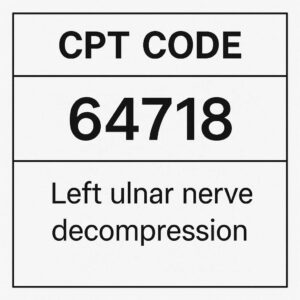
CPT Code for Left Ulnar Nerve Decompression
Table of Contents
ToggleWhat is Ulnar Nerve Decompression?
Before we dive into the numbers, it helps to understand the “what” and the “why.” The ulnar nerve is one of the three main nerves in your arm. It runs from your neck, down your arm, and passes through a narrow tunnel at the inside of your elbow called the cubital tunnel. You know it as the “funny bone.”
When this nerve becomes compressed or irritated at the elbow, it leads to a condition called cubital tunnel syndrome. Symptoms can range from annoying to debilitating. You might feel tingling in your ring and little fingers, a sensation that your hand is “falling asleep,” weakness in grip, or even muscle wasting in severe cases.
When conservative treatments—like bracing, physical therapy, or activity modification—fail to provide relief, surgery becomes the next logical step.
The Goal of the Procedure
Ulnar nerve decompression aims to relieve that pressure. The surgeon essentially creates more space for the nerve to move freely. There are a few ways to do this, and interestingly, the way the surgeon performs the operation dictates which CPT code gets used.
The main techniques include:
-
In-situ decompression (simple decompression): The surgeon releases the tissue that is compressing the nerve without moving the nerve from its original location.
-
Subcutaneous transposition: The nerve is moved from its groove behind the elbow to a new position under the skin, in front of the elbow.
-
Submuscular transposition: The nerve is moved and placed under a layer of muscle for protection.
-
Medial epicondylectomy: A small portion of the bone (the bump on the inside of the elbow) is removed to stop it from rubbing against the nerve.
Why Coding Matters: Left vs. Right
You might be wondering why the keyword emphasizes “left.” In the world of medical coding, laterality—or which side of the body is operated on—is critical.
In the past, coders would simply report a code for “ulnar nerve decompression.” Today, modern coding systems require specificity. If the surgery is performed on the left arm, the code must reflect that. If it is the right arm, the code reflects that. If it is bilateral (both arms), there are specific modifiers or codes for that as well.
This specificity ensures that insurance companies understand exactly what was done. If you submit a claim for a left ulnar nerve decompression but the operative report says “right,” the claim will be denied. It is a simple detail with massive financial consequences.
The Primary CPT Codes for Ulnar Nerve Decompression
Let’s get to the heart of the matter. When a surgeon performs a decompression of the ulnar nerve at the elbow, they will typically use codes from the 647 series in the Current Procedural Terminology (CPT) manual. These codes cover “Neuroplasty” and nerve decompression procedures.
Here are the most common codes you will encounter for this procedure on the left arm.
CPT 64718: The Standard Decompression
64718 – Neuroplasty and/or transposition; ulnar nerve at elbow.
This is the primary code used for ulnar nerve surgery at the elbow. However, it is a bit of a “catch-all” code. It includes decompression, but it also includes transposition.
If your surgeon performs a simple decompression (in-situ) , they may still report 64718. If they perform a transposition (moving the nerve), they also report 64718. The code covers the work of freeing the nerve and, if necessary, moving it to a new location.
How it applies to the left side: Since CPT codes are numeric and do not specify laterality in the code description itself, the surgeon’s office appends a modifier to indicate the left side.
-
Modifier -LT: This modifier is appended to 64718 to indicate the procedure was performed on the Left side.
-
Modifier -RT: This would be used for the right side.
So, if you look at your insurance claim, you will likely see: 64718 – LT.
What About the Endoscopic Approach?
In recent years, some surgeons have adopted endoscopic techniques for ulnar nerve decompression. This involves smaller incisions and the use of a camera.
Currently, there is no specific CPT code that exclusively describes “endoscopic ulnar nerve decompression at the elbow.” As such, surgeons typically still use 64718 for this approach. They may add a modifier -22 (Increased Procedural Services) to indicate the added complexity and technology involved, though this is subject to payer approval.
Hospital vs. Surgeon Fees: The Global Period
When you undergo surgery, you receive two separate bills: one from the surgeon (professional fee) and one from the facility (hospital or surgery center fee).
The CPT code 64718 is used by the surgeon to bill for their work. However, the hospital uses a different coding system called ICD-10-PCS (for inpatient) or HCPCS Level II / APC codes (for outpatient) to bill for the use of the operating room, staff, and supplies.
The Global Surgical Package
Understanding the “global period” helps you understand what is included in the CPT code. When a surgeon bills 64718, it typically covers:
-
The pre-operative visit (if performed within a specific timeframe before surgery).
-
The surgery itself.
-
Standard, uncomplicated post-operative care for the 90 days following the surgery (this is a 90-day global period).
If you have to go back to the surgeon for follow-up visits to check the incision or monitor nerve recovery within those 90 days, those visits are usually covered under the original surgery fee. You should not receive a separate bill for those routine checks.
A Deeper Look at Modifiers
To ensure accurate reimbursement and to prove medical necessity, coders often use modifiers. We touched on -LT for the left side, but here are a few others you might see alongside the ulnar nerve decompression CPT code.
| Modifier | Name | Application for Left Ulnar Nerve Decompression |
|---|---|---|
| -LT | Left Side | Used to specify the procedure was on the left arm. Essential for billing. |
| -RT | Right Side | Used if the procedure was on the right arm. |
| -50 | Bilateral Procedure | Used if the surgeon performs decompression on both the left and right arms during the same surgical session. |
| -22 | Increased Procedural Services | Used if the procedure was significantly more complex than usual (e.g., severe scarring, revision surgery, endoscopic approach). Requires documentation. |
| -59 | Distinct Procedural Service | Used if another procedure is performed in a different anatomical location during the same session. |
Associated Procedures and Their Codes
Sometimes, ulnar nerve decompression is not the only procedure performed. If a patient has carpal tunnel syndrome in the same hand and cubital tunnel syndrome, the surgeon might fix both at once.
If a surgeon performs a left ulnar nerve decompression (64718-LT) and a left carpal tunnel release (64721-LT) , both codes are typically reported. However, payers often apply a “Multiple Procedure Reduction.” This means the primary procedure is paid at 100%, but the secondary procedure is paid at a reduced rate (usually 50% of the allowable amount).
Common Bundling Scenarios
It is also important to know what cannot be billed separately. For example, if the surgeon performs an incision and drainage of a hematoma during the surgery, that is considered part of the main procedure. Similarly, routine wound closure (suturing) is included in 64718. You cannot bill a separate “suture” code.
Realistic Costs and Insurance Navigation
While the CPT code standardizes the description of the procedure, it does not standardize the price. The cost of a left ulnar nerve decompression varies wildly based on:
-
Geographic location: Surgery in Manhattan costs more than surgery in rural Montana.
-
Facility type: A hospital outpatient department charges more than an ambulatory surgery center (ASC).
-
Insurance contracts: The negotiated rate between your insurance and the provider.
Average Cost Estimates
If you are paying out-of-pocket or looking at your Explanation of Benefits (EOB), here is a realistic breakdown of what the charges might look like.
| Service Component | Estimated Total Cost (Before Insurance) | Notes |
|---|---|---|
| Surgeon Fee | $800 – $2,500 | This is the professional fee for performing 64718. |
| Anesthesia Fee | $400 – $1,200 | Anesthesia is billed separately. The time units matter. |
| Facility Fee | $3,000 – $8,000+ | This is the cost of the operating room. ASCs are typically cheaper than hospitals. |
| Total Estimate | $4,200 – $11,700+ | Your out-of-pocket maximum and deductible determine what you pay. |
Important Note: If you have insurance, your out-of-pocket cost is governed by your plan’s deductible, coinsurance, and out-of-pocket maximum. Always ask for a “pre-authorization” and a “cost estimate” before scheduling.
What Patients Should Ask Before Surgery
Navigating the CPT code system is largely the job of the billing department, but as a patient, asking the right questions can prevent financial surprises.
1. “Is this an in-network facility and surgeon?”
Even if your surgeon is in-network, the anesthesiologist or the facility might not be. Confirm that everyone involved in your left ulnar nerve decompression is covered under your plan’s network.
2. “What is the specific CPT code you will be billing?”
By asking for 64718 upfront, you can call your insurance company to verify coverage. You can ask: “Is code 64718 considered medically necessary for cubital tunnel syndrome?” and “Is there a prior authorization requirement?”
3. “Is this a simple decompression or a transposition?”
While the CPT code may be the same, the recovery time can differ. A simple decompression often allows for a quicker return to work than a submuscular transposition. Understanding the surgical technique helps you set realistic recovery expectations.
Recovery and the Coding Connection
You might be wondering why recovery is mentioned in an article about CPT codes. It matters because of the 90-day global period.
If you have complications during recovery—such as a wound infection, a hematoma, or persistent symptoms requiring a second look—how that is coded changes.
-
Return to the OR within 90 days: If you require a return to the operating room for a related issue, the surgeon usually cannot bill a new CPT code. It is often considered part of the original global package.
-
Unrelated issues: If you fall three weeks after surgery and break your wrist, that is a separate issue and will be billed with new codes.
The ICD-10 Connection: Medical Necessity
A CPT code without a diagnosis code is like a car without an engine. It doesn’t go anywhere. For 64718 to be paid by insurance, it must be linked to a valid diagnosis code (ICD-10-CM) that proves medical necessity.
Common diagnosis codes for left ulnar nerve decompression include:
-
G56.20: Lesion of ulnar nerve, unspecified upper limb (often used initially).
-
G56.21: Lesion of ulnar nerve, right upper limb.
-
G56.22: Lesion of ulnar nerve, left upper limb.
-
M79.641: Pain in left hand (non-specific, but sometimes used with supporting documentation).
The most accurate code for a left-sided cubital tunnel syndrome is G56.22. This tells the insurance company exactly why the surgeon performed 64718-LT.
Avoiding Common Billing Errors
Mistakes happen. Here are the most common errors that cause denials for ulnar nerve decompression claims, which might lead to you receiving a surprise bill.
-
Laterality Mismatch: The operative report says “left,” but the claim was submitted with no modifier or with “-RT.” Denied.
-
Missing Modifier -LT: Without the -LT modifier, the insurance company doesn’t know which arm was operated on. Some payers automatically deny if laterality is missing.
-
Unbundling: The billing office tries to bill for “exploration of nerve” (64704) and “decompression” (64718) together. The decompression code typically includes the exploration.
-
Lack of Prior Authorization: Many insurance plans require pre-approval for elective surgery. If the surgeon’s office fails to obtain this, the claim may be denied, leaving you responsible for the full cost.
A Note on Workers’ Compensation
If your ulnar nerve compression is due to a repetitive motion injury at work (commonly seen in assembly line workers, carpenters, or office workers), the coding process falls under Workers’ Compensation.
In these cases, the CPT code 64718 remains the same, but the billing process is different. The payer is the employer’s insurance carrier. These claims often undergo stricter scrutiny to ensure the condition is truly work-related. Documentation must clearly link the left ulnar nerve condition to the patient’s specific job duties.
Future Trends in Ulnar Nerve Coding
As of April 2026, the coding landscape remains stable for peripheral nerve surgery. However, there is ongoing discussion in the medical community about creating a distinct code for endoscopic nerve decompression.
Currently, because 64718 covers open, endoscopic, and transposition techniques, it can be difficult to track which surgical method yields the best outcomes based on claims data. If the American Medical Association (AMA) introduces a new code in the coming years, it will likely further distinguish between simple decompression and complex transposition.
For patients, this means staying informed. If you are scheduled for a left ulnar nerve decompression in the near future, the codes discussed here are the ones you will likely encounter.
Conclusion
Understanding the CPT code for left ulnar nerve decompression—specifically 64718 with the -LT modifier—empowers you to take control of your healthcare journey. It transforms a confusing medical bill into a document you can actually read and verify. It allows you to confirm that your insurance has approved the correct procedure and helps you anticipate the costs involved.
While your primary focus should always be on healing and trusting your surgical team, taking a few moments to understand the administrative side of things ensures that your financial health recovers just as smoothly as your physical health. Remember to ask questions, verify laterality, and confirm prior authorizations before the day of surgery.
Frequently Asked Questions (FAQ)
Q1: Is the CPT code the same for left and right ulnar nerve decompression?
Yes, the base CPT code (64718) is the same. However, the billing differs by using modifiers. -LT is added for the left side, and -RT is added for the right side. If both sides are done in one surgery, -50 (bilateral) is typically used.
Q2: What is the difference between CPT 64718 and CPT 64719?
64718 is used for ulnar nerve decompression at the elbow. 64719 is used for decompression of the ulnar nerve at the wrist (Guyon’s canal). If you have “ulnar tunnel syndrome” in the wrist, the code differs from cubital tunnel syndrome at the elbow.
Q3: Will I need to pay for follow-up visits after surgery?
Generally, no. The surgical fee for 64718 includes a 90-day global period. This means routine post-operative visits (wound checks, suture removal, follow-up exams) are included in the original surgery price and should not result in separate bills.
Q4: What happens if the surgeon changes the procedure during surgery?
If the surgeon goes in for a simple decompression but finds the nerve is severely compressed and requires a transposition, they will still bill 64718 because that code covers both scenarios. The documentation in the operative report will justify the complexity.
Q5: How do I verify if my insurance covers this procedure?
You can call the customer service number on the back of your insurance card. Provide them with the CPT code (64718), the modifier (-LT if left), and the diagnosis code (G56.22 for left cubital tunnel syndrome). Ask if it is a covered benefit and if prior authorization is required.
Additional Resource
For the most up-to-date information on coding guidelines and to verify the official CPT descriptors, we recommend consulting the American Medical Association (AMA) website.
-
Link: AMA CPT Code Lookup and Resources (Note: This link directs to the official source for CPT information. Always consult the official CPT manual for definitive coding guidance.)