If you have ever dealt with a small, fluid-filled bump on your wrist or finger, you know how annoying a ganglion cyst can be. They are not usually dangerous, but they can cause pain, weakness, and a visible lump that nobody wants.
When a doctor decides to remove one, the billing process gets very specific. You might think a cyst is just a cyst. But in the world of medical coding, the exact location and method matter a lot.
This guide will walk you through the correct cpt code for ganglion cyst removal in plain English. We will look at the differences between codes, what the documentation must show, and how to avoid common mistakes that lead to denied claims.
Whether you are a medical coder, a biller, or a patient trying to understand an estimate, you are in the right place.
CPT Code for Ganglion Cyst Removal
Understanding the Basics of Ganglion Cyst Excision
Before we jump into numbers, let’s talk about what a ganglion cyst actually is. Unlike a sebaceous cyst (which comes from a hair follicle) or a synovial cyst (which is different in structure), a ganglion cyst forms near a joint or tendon sheath. It is filled with a thick, sticky fluid similar to joint fluid.
Doctors often call it a “Bible bump” because in the past, people would hit it with a heavy book to make it burst. We do not recommend that today.
Why Surgery Happens
Most ganglion cysts do not need surgery. Doctors usually start with observation, splinting, or aspiration (draining the fluid with a needle). However, surgery becomes necessary when:
-
The cyst causes persistent pain.
-
It interferes with daily activities like typing or gripping.
-
It causes nerve compression, leading to tingling or numbness.
-
It keeps coming back after aspiration.
When the scalpel comes out, the coder must decide which code fits best.
The Main CPT Codes for Ganglion Cyst Removal
There is no single code for every ganglion cyst removal. Instead, the CPT manual gives us three main options. The choice depends entirely on where the cyst is located and how complex the surgery is.
Here are the three codes you need to know:
-
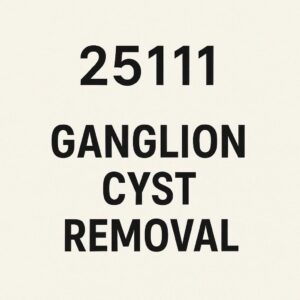
25111 – Excision of ganglion, wrist (dorsal or volar); primary
-
25112 – Excision of ganglion, wrist; recurrent
-
25116 – Excision of ganglion, finger or hand (including the dorsum of the hand)
Let’s break each one down.
CPT 25111: The Primary Wrist Code
This is the most common code you will use. 25111 covers the removal of a ganglion cyst on the wrist for the very first time. It does not matter if the cyst is on the top of the wrist (dorsal) or the palm side (volar). This code works for both.
What the procedure looks like:
The surgeon makes a small incision directly over the cyst. They carefully dissect down to the cyst wall, remove the entire sac, and often trace it back to the joint capsule where it originates. The surgeon then repairs the joint capsule to try to prevent recurrence.
Key documentation requirements:
-
The operative note must clearly state “wrist.”
-
It must be the first surgical removal for this specific cyst.
-
The surgeon should describe the size and attachment.
Important Note: If the surgeon only drains the cyst (aspiration) without removing the sac, you cannot use 25111. Aspiration is not excision. For aspiration, you would use an office visit code or a minor procedure code like 20612 if it is ultrasound-guided.
CPT 25112: When the Cyst Comes Back
Recurrence is a real problem with ganglion cysts. Even with perfect surgery, about 5% to 15% come back. When a patient returns for a second surgery on the same wrist, you use 25112.
This code is specifically for recurrent ganglion cysts of the wrist. It is almost always higher in relative value units (RVUs) because the surgery is harder. Scar tissue from the first operation makes the anatomy difficult to identify. Nerves and tendons may be stuck down, increasing the risk of injury.
When to use 25112:
-
The patient had a prior excision of the same wrist ganglion.
-
The current operative note mentions “recurrent” or “repeat excision.”
-
The surgeon describes significant scar tissue or altered anatomy.
When not to use it:
-
A new cyst on the same wrist but in a completely different location. (Some coders argue this is still recurrent, but many payers want 25111 if the site is truly separate. Check your payer guidelines.)
CPT 25116: Ganglion Cyst on the Finger or Hand
Not all ganglion cysts live on the wrist. They frequently appear on the fingers, especially near the end joint (mucous cysts) or on the back of the hand. For these locations, you use 25116.
This code covers the excision of a ganglion cyst on the finger or hand. Notice that the code descriptor explicitly includes “dorsum of the hand.” That means a cyst on the top of the hand between the knuckles falls under 25116, not the wrist codes.
What makes this code different:
Finger ganglia are often smaller but more delicate. They can be attached to the flexor tendon sheath or the joint capsule of the finger. The surgeon must be very careful to avoid damaging the digital nerves.
Common scenarios:
-
A mucous cyst at the DIP joint (the joint closest to the fingernail).
-
A flexor tendon sheath ganglion on the palm side of the finger.
-
A cyst on the back of the hand near the metacarpophalangeal joints.
Comparative Table: Wrist vs. Hand vs. Recurrent
To make this clearer, here is a simple comparison.
| CPT Code | Location | Status | Typical Reimbursement Level |
|---|---|---|---|
| 25111 | Wrist (dorsal or volar) | Primary (first time) | Moderate |
| 25112 | Wrist (dorsal or volar) | Recurrent (second surgery) | Higher (due to complexity) |
| 25116 | Finger or hand (including dorsum) | Primary or recurrent | Lower to Moderate |
Notice that 25116 does not have a separate recurrent code. If a ganglion on a finger comes back, you would generally use 25116 again. Some coders add modifier 22 (increased procedural services) if the recurrence involves significant scar tissue. However, you must have strong documentation to support modifier 22.
What About Ganglion Cysts on the Foot or Ankle?
This is a very common question. The codes above (25111, 25112, 25116) are strictly for the upper extremity. They belong to the “Hand and Wrist” section of the CPT manual.
If a patient has a ganglion cyst on the foot or ankle, you cannot use these codes. Instead, you look to the lower extremity codes.
The correct codes for foot or ankle ganglion cysts are:
-
28090 – Excision of lesion, foot or toe, deep
-
28092 – Excision of lesion, foot or toe, superficial
However, many payers expect a more specific code for ganglion cysts of the foot. You might also consider 27632 (excision of lesion, deep, ankle or tarsus). The best practice is to check with your specific payer or use an unlisted code if no specific code fits.
Important: Always double-check the anatomical location. Do not automatically use wrist codes for an ankle cyst. That is a quick way to get a denial.
Modifiers That Affect Your Claim
Modifiers are two-digit codes that tell the payer something special happened. For ganglion cyst removal, a few modifiers come up often.
Modifier 50 – Bilateral Procedure
Can a patient have a ganglion cyst on both wrists? Yes. If the surgeon removes them during the same operative session, you can bill for both sides. However, you do not just bill 25111 twice.
You have two options:
-
Bill 25111 with modifier 50 on one line (for the bilateral procedure).
-
Bill 25111 with modifier LT (left) on one line and modifier RT (right) on the second line.
Payer preference varies. Medicare generally prefers modifier 50. Many commercial payers prefer the LT/RT method. Check your contract.
Modifier 58 – Staged or Related Procedure
Sometimes, a patient has a ganglion cyst removal, and then within the global period (usually 90 days), they need a second related surgery. For example, the first surgery was a simple excision, but the patient develops a tendon problem that requires a separate procedure.
If the second procedure is planned at the time of the first (or is clearly related), you can use modifier 58. This tells the payer to pay for the second surgery even though the patient is still in the global period of the first.
Modifier 78 – Unplanned Return to the OR
This is different. If the patient goes back to the operating room for a complication (like a hematoma or infection) within the global period, you use modifier 78. The reimbursement is lower because the payer assumes the complication was part of the original surgery.
Modifier 79 – Unrelated Procedure
If a patient has a ganglion cyst removed and three weeks later falls and breaks their wrist, requiring a fracture repair, that is unrelated. You would use modifier 79 on the fracture code. The ganglion cyst code would not need a modifier because it is already outside its global period or because the fracture is clearly separate.
Bundling Issues: What Not to Bill Separately
This is where many coders lose money or cause denials. Some services are considered part of the ganglion cyst excision. You cannot bill them separately unless the documentation clearly shows they were distinct and separate.
Do not bill separately for:
-
Incision and drainage: Opening the skin is part of the excision.
-
Simple exploration of the joint: Looking around is included.
-
Closure of the joint capsule: That is an integral part of the code.
-
Standard wound closure (sutures): This is always included.
When you might bill separately (with documentation):
-
Tenosynovectomy: If the surgeon performs a significant removal of the tendon sheath (not just the cyst), you might add 26145 (tenosynovectomy, hand or finger). This requires a separate operative note description.
-
Nerve decompression: If the ganglion is compressing a nerve and the surgeon performs a formal nerve release (like carpal tunnel release), you can bill 64721 (neuroplasty, median nerve) with modifier 59 (distinct procedural service). The documentation must prove the nerve work was not just incidental to the cyst removal.
-
Ultrasound guidance: If the surgeon uses ultrasound to locate a deep or occult ganglion before making the incision, you might bill 76942 (ultrasonic guidance for needle placement). However, if the cyst is visible and palpable, ultrasound is usually not separately billable.
Documentation Checklist for Clean Claims
Payers deny claims for lack of documentation more often than for medical necessity. Protect your revenue by ensuring every operative note includes these six items.
-
Exact location: “Left wrist, volar aspect, over the scaphotrapezial joint” is much better than “left wrist.”
-
Size and description: “1.5 cm x 1 cm cystic mass, mucinous contents.”
-
Prior surgery history: For 25112, explicitly state “recurrent” and note the date of the prior surgery.
-
Attachment point: “Stalk traced to the radiocarpal joint capsule.”
-
Complete excision statement: “The cyst wall was removed in its entirety.”
-
No separate billing for standard steps: Do not list “skin incision” or “suture removal” as separate charges.
What Patients Need to Know About Costs
If you are a patient reading this, you might not care about the CPT code itself. You care about what you will pay.
The CPT code tells your insurance company what procedure you had. Your insurance company then looks at your plan. Do you have a deductible? Coinsurance? Copay?
Here is a realistic look at costs without insurance (cash pay prices):
-
CPT 25111: Average surgeon fee $1,200 to $2,500 (plus facility and anesthesia fees).
-
CPT 25112: Average $1,800 to $3,500 due to higher complexity.
-
CPT 25116: Average $900 to $1,800.
With insurance, you will likely pay your deductible first. After that, you may pay 10% to 30% coinsurance. Always ask for a “good faith estimate” before surgery if you are uninsured or underinsured.
Patient Tip: If you see “CPT 25111” on your bill, check that the surgery was on your wrist. If it was on your finger, ask the billing office why they did not use 25116. The finger code is often less expensive.
Common Billing Errors and How to Avoid Them
Even experienced coders make mistakes. Here are the top five errors we see with ganglion cyst removal claims.
Error 1: Using 25111 for an Aspiration
A surgeon drains a cyst with a needle in the office. No incision. No removal of the sac. Someone bills 25111. This is incorrect. Aspiration is not excision. Use an evaluation and management code (99212-99214) plus 20612 if ultrasound is used.
Error 2: Using 25116 for a Volar Wrist Cyst
The palm side of the wrist is still the wrist. Some coders see “volar” and think it is part of the hand. It is not. The wrist codes (25111, 25112) cover both dorsal and volar wrist.
Error 3: Forgetting the Global Period
All three of these codes have a 90-day global period. That means any related office visits for 90 days after surgery are included in the payment. Do not bill separate office visit codes for suture removal or routine post-op checks unless there is a truly separate problem.
Error 4: Billing for Tendon Repair That Did Not Happen
Sometimes the operative note says, “The cyst was adherent to the tendon sheath.” That does not mean you can bill for tendon repair (26350 or similar). Adhesion is not a repair. Only bill tendon repair if the surgeon explicitly states the tendon was cut and reattached or reconstructed.
Error 5: Misusing Modifier 22 for “Hard Surgery”
Surgeons often feel a case was more difficult than usual. They ask you to add modifier 22 (increased procedural services). However, modifier 22 requires extensive documentation. You need to describe:
-
Why the case was harder (large size, scarring, obesity, unusual anatomy).
-
How much extra time it took (e.g., “45 minutes longer than usual”).
-
What additional work was done.
Without this, modifier 22 will be denied. Most payers deny modifier 22 on ganglion codes anyway because the base work already accounts for some variation.
Payer-Specific Guidelines to Watch For
Not all insurance companies follow the same rules. Here are a few differences to keep on your radar.
Medicare: Generally follows CPT guidelines closely. They require a clear diagnosis of ganglion cyst (M67.40 for unspecified site, M67.41 for wrist, M67.42 for hand, etc.). Medicare also expects you to use the LT/RT modifiers rather than modifier 50 for bilateral wrist procedures.
UnitedHealthcare: Has a policy that considers ganglion cyst excision cosmetic in some cases. If the cyst is asymptomatic and the patient only wants it removed for appearance, UnitedHealthcare may deny coverage. Medical necessity must be proven with pain, limitation of motion, or nerve compression.
Blue Cross Blue Shield (varies by state): Some BCBS plans require prior authorization for 25112 (recurrent) but not for 25111. Check your local BCBS medical policy.
Workers’ Compensation: Ganglion cysts related to repetitive motion at work may be covered. However, you often need a specific ICD-10 code linking the cyst to the occupation. The carrier may require a causation letter from the surgeon.
How to Handle Denials
Even with perfect coding, denials happen. Here is a three-step plan to fight back.
Step 1: Read the denial reason carefully.
Do not guess. Look for phrases like “non-covered service,” “missing modifier,” or “bundling issue.” The EOB (Explanation of Benefits) will give you a code like CO-50 (non-covered) or CO-97 (bundled).
Step 2: Compare the denial to the operative note.
If the denial says “incorrect code for location,” but the note clearly says “wrist,” you have an easy appeal. Submit the operative note with a highlighting of the location.
Step 3: Write a concise appeal letter.
Do not write a novel. State the patient name, date of service, and CPT code used. Explain why the code is correct. Attach the relevant portion of the operative note. Send it to the address on the EOB within the appeal deadline (often 180 days).
Real-Life Scenarios and Coding Solutions
Let’s walk through three patient stories. These examples show how the same diagnosis leads to different codes.
Scenario 1: The First-Time Wrist Cyst
Patient: Maria, 34-year-old office worker.
History: Noticed a lump on the top of her right wrist. It aches when she types. She has never had surgery on this wrist before.
Procedure: The surgeon makes a 2 cm incision over the dorsal wrist. He finds a 2 cm ganglion cyst arising from the scapholunate ligament. He excises the entire cyst and repairs the ligament.
Correct CPT Code: 25111 (primary, wrist).
Why not 25116? Because it is on the wrist, not the hand or finger.
Why not 25112? Because it is the first surgery.
Scenario 2: The Recurrent Wrist Nightmare
Patient: James, 52-year-old construction worker.
History: Had a ganglion cyst removed from his left wrist 14 months ago. It came back 6 months later. Now it is painful again.
Procedure: The surgeon notes “extensive scar tissue from prior excision.” He carefully dissects free the recurrent cyst, which is embedded in scar. He removes it and closes.
Correct CPT Code: 25112 (recurrent, wrist).
Why not 25111? The operative note says “recurrent.” The patient had prior surgery.
Modifier? None needed unless the work was truly extraordinary (then consider modifier 22 with strong documentation).
Scenario 3: The Finger Cyst
Patient: Linda, 67-year-old retired teacher.
History: A small, painful bump on the end joint of her right ring finger. It makes it hard to wear gloves.
Procedure: The surgeon excises a 5 mm mucous cyst from the DIP joint of the right ring finger. He removes the cyst and trims an osteophyte (bone spur) from the joint.
Correct CPT Code: 25116 (finger).
Why not 25111? Because the finger is not the wrist. The code specifically says “finger or hand.”
Can you bill separately for the bone spur? No, unless the surgeon performed a separate, distinct procedure like a formal osteophyte excision (which is rare). Usually, trimming a small spur is part of the cyst excision.
The Relationship Between ICD-10 and CPT Codes
Your CPT code tells the payer what you did. Your ICD-10 code tells them why you did it. For ganglion cyst removal, you need a specific diagnosis code that matches the location.
Here are the most common ICD-10 codes for ganglion cysts:
-
M67.40: Ganglion, unspecified site (use only if location is truly unknown)
-
M67.41: Ganglion, right wrist
-
M67.42: Ganglion, left wrist
-
M67.43: Ganglion, right hand
-
M67.44: Ganglion, left hand
-
M67.45: Ganglion, right finger
-
M67.46: Ganglion, left finger
Notice the laterality. You must specify right vs. left. If you bill CPT 25111 for a left wrist cyst, but your ICD-10 code says M67.41 (right wrist), the claim will deny or be delayed.
Medical necessity tip: Add a secondary code for pain (G89.29, other chronic pain) or limited motion (M25.741-M25.742 for wrist stiffness) to justify surgery. Some payers deny asymptomatic ganglion removal as cosmetic.
Anesthesia Coding for Ganglion Cyst Removal
This article focuses on the surgical CPT codes, but anesthesia matters too. The anesthesia code depends on the location and complexity.
-
Wrist ganglion (25111, 25112): Anesthesia code 01810 (brachial plexus block or general for wrist surgery).
-
Finger or hand ganglion (25116): Anesthesia code 01810 (same as wrist) or 01830 (digital block) depending on the extent.
If the surgeon performs a local anesthetic only (without an anesthesiologist), you do not bill a separate anesthesia code. The local anesthesia is included in the surgical code.
Future Trends in Ganglion Cyst Coding
Coding changes slowly, but there are trends to watch.
Telemedicine for post-op checks: Some payers now allow virtual visits for routine post-operative checks. If a patient is healing well and has no complications, a video visit might replace an in-person visit. However, the global period still applies. You cannot bill a separate telemedicine code for a visit that is included in the global period.
More scrutiny on modifier 22: Payers are tightening rules around “increased complexity.” Do not expect to get paid extra just because the cyst was large. The base code already includes a range of sizes. You need extraordinary circumstances.
Possible bundling of hand and wrist codes: The AMA (American Medical Association) periodically reviews CPT codes for consolidation. Do not be surprised if, in a future edition, 25111 and 25116 merge into a single “excision of ganglion, upper extremity” code. But for now, use the current codes.
Frequently Asked Questions (FAQ)
1. Can I bill 25111 and 25116 on the same day for the same patient?
Yes, if the patient has a ganglion cyst on the wrist AND a separate ganglion cyst on the finger of the same arm. You would bill 25111 for the wrist and 25116 for the finger. Use modifier 59 (distinct procedural service) on the second code to show they are separate locations.
2. What CPT code is used for arthroscopic ganglion cyst removal?
There is no specific arthroscopic code for ganglion excision. Some surgeons remove wrist ganglia arthroscopically. In that case, you use the unlisted code 29999 (unlisted procedure, arthroscopy). You must submit the operative note with a comparison to the open code (25111) to request payment.
3. Does Medicare cover ganglion cyst removal?
Yes, Medicare covers medically necessary excision of ganglion cysts. The cyst must cause pain, limit motion, or compress a nerve. Medicare does not cover cosmetic removal of asymptomatic cysts.
4. What is the global period for 25111, 25112, and 25116?
All three codes have a 90-day global period. That means routine post-operative care for 90 days is included in the payment. Only bill separate evaluation and management visits if a distinct, unrelated problem occurs.
5. How do I bill for a ganglion cyst excision that turns into a more complex procedure?
If the surgeon starts a simple excision (25111) but finds extensive adhesions requiring tenosynovectomy (26145), you can bill both codes. Append modifier 59 to the tenosynovectomy. The documentation must clearly show the tenosynovectomy was separate and necessary beyond the cyst excision.
6. Is there a different code for a pediatric ganglion cyst?
No. CPT codes are the same for adults and children. However, some payers have different medical necessity criteria for pediatric patients. Always check your specific payer policy.
7. What happens if I accidentally use 25111 for a finger cyst?
The claim will likely deny for incorrect coding. You will need to resubmit with the correct code (25116). If the claim already paid incorrectly, the payer may take the money back during an audit. Always double-check your location documentation.
Additional Resources
For further reading and official guidance, bookmark these trusted sources.
-
American Academy of Orthopaedic Surgeons (AAOS): Offers coding clinics and webinars on hand and wrist procedures. Their “Coding for Hand and Upper Extremity” guide is excellent.
-
American Medical Association (AMA) CPT Network: The official source for CPT code changes and guidelines. You can purchase the full CPT manual here.
-
Centers for Medicare & Medicaid Services (CMS): Search for Local Coverage Determinations (LCDs) for your state. LCDs tell you exactly what Medicare covers for ganglion cyst excision in your region.
[Link to CMS Fee Schedule Lookup Tool]
Use this tool to see the exact allowed amount for 25111, 25112, and 25116 in your zip code.
Final Thoughts and Conclusion
Choosing the right cpt code for ganglion cyst removal does not have to be a headache. The decision comes down to three simple questions: Is it the wrist or the hand/finger? Is it the first surgery or a recurrence? Is the documentation clear?
To summarize this guide in three lines:
Use 25111 for a first-time ganglion on the wrist. Use 25112 for a recurrent cyst on the same wrist. Use 25116 for ganglia on the fingers or the back of the hand, and never use wrist codes for the foot or ankle.
Keep your operative notes detailed, double-check your modifiers, and always link the correct ICD-10 code for the specific location and side. When you do that, your claims will be clean, your payments will be faster, and your patients will understand their bills better.
Thank you for reading. Code wisely.
Disclaimer: This article is for educational purposes only and does not constitute legal or medical advice. CPT codes, payer policies, and reimbursement rates change frequently. Always verify current codes and guidelines with the AMA and your specific payer contracts.