If you have ever sat down to bill for a fractured bone that needed hardware, you already know the feeling. The procedure is clear in your mind. The patient is stable. The X‑ray looks great. But then you open your coding software and pause. Which CPT code for open reduction internal fixation actually matches what you just did?
You are not alone. Orthopedic coding is one of the most complex areas in medical billing. A single fracture can have three different codes depending on whether it is closed, open, or percutaneous. Add the word “fixation” and things get even more specific.
This guide walks you through the most frequently used ORIF codes. We will look at the upper extremity, lower extremity, pelvis, and spine. We will also cover modifier usage, common mistakes, and practical documentation tips. No fluff. No copied content. Just honest, real‑world guidance.
Let us start with the basics.
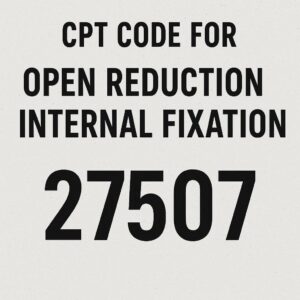
CPT Code for Open Reduction Internal Fixation
What Does Open Reduction Internal Fixation Actually Mean?
Before we look at numbers, let us make sure we are talking about the same thing. Open reduction internal fixation (ORIF) means two distinct steps performed during the same surgery.
First, the surgeon makes an incision to expose the broken bone fragments. That is the “open” part. Second, the surgeon realigns (reduces) the pieces back into their normal anatomical position. That is the “reduction.” Third, the surgeon installs hardware such as plates, screws, rods, or pins to hold everything stable while healing occurs. That is the “internal fixation.”
A closed reduction without an incision uses a different set of codes. A percutaneous fixation (small incisions, often with X‑ray guidance) also has its own section. So when you see “open reduction internal fixation” in an operative report, you know the surgeon cut down to the bone.
Why Precise Coding Matters for ORIF
Insurance companies and Medicare do not pay for “a broken bone surgery.” They pay for very specific descriptions. A humerus fracture code is not the same as a radial head fracture code. A code for a simple fracture is not the same as a comminuted fracture with bone grafting.
Using the wrong code can lead to:
-
Claim denials or delays.
-
Audits and repayment demands.
-
Lower reimbursement than you deserve.
-
Compliance risks for upcoding or downcoding.
On the other hand, accurate coding helps your practice get paid correctly the first time. It also creates a clean paper trail for medical necessity.
The Main CPT Code Families for ORIF
CPT codes for open reduction internal fixation are organized by body region. The American Medical Association (AMA) groups them into:
-
Upper extremity (shoulder to fingers)
-
Lower extremity (hip to toes)
-
Pelvis and acetabulum
-
Spine (cervical, thoracic, lumbar)
Within each region, codes are further split by:
-
Specific bone or joint
-
Type of fracture (e.g., articular, non‑articular, displaced, comminuted)
-
Whether the fracture is open (bone through skin) or closed
Let us walk through each area in detail.
Upper Extremity ORIF Codes
The upper extremity is the most common site for ORIF procedures. Falls onto an outstretched hand, sports injuries, and work accidents frequently lead to fractures of the clavicle, humerus, radius, ulna, and hand bones.
Clavicle (Collarbone) ORIF
The clavicle is tricky because not all fractures need surgery. But when they do, you will typically use:
-
23500 – Closed treatment of clavicular fracture without manipulation
-
23515 – Open treatment of clavicular fracture with internal fixation
Note: Code 23515 includes the open reduction and the hardware (pins, screws, or plate). You do not bill hardware separately. The code also includes the closure.
If the surgeon also needs to excise the distal end of the clavicle (for an old nonunion or arthritis), look at codes in the 23100 range.
Proximal Humerus (Shoulder) ORIF
Proximal humerus fractures are very common in older adults with osteoporosis. For open treatment:
-
23615 – Open treatment of proximal humeral (surgical or anatomical neck) fracture with internal fixation
-
23616 – Open treatment of proximal humeral fracture with internal fixation and includes shoulder hemiarthroplasty (partial replacement)
Use 23615 when the surgeon fixes the bone with screws, a plate, or pins. Use 23616 only when the head of the humerus cannot be saved and is replaced with a prosthetic implant.
Humeral Shaft ORIF
For fractures through the middle part of the upper arm bone:
-
24515 – Open treatment of humeral shaft fracture with internal fixation
This code includes the approach (usually anterior or lateral), reduction, and plate/screw or rod fixation. It does not include nerve exploration (that is a separate code if needed).
Distal Humerus (Elbow) ORIF
Elbow fractures are complex because they involve the articular surface. For the lower end of the humerus:
-
24545 – Open treatment of humeral supracondylar or transcondylar fracture with internal fixation
-
24546 – Open treatment of humeral condylar (medial or lateral) fracture with internal fixation
Important: If the fracture extends into the joint surface and the surgeon reconstructs the articular block, you may also report an arthrotomy code (e.g., 24000) – but check the NCCI edits because many ORIF codes already include joint exposure.
Radial Head and Neck ORIF
The radial head is at the top of the radius bone (thumb side of the forearm). Common in falls on an outstretched hand.
-
24665 – Open treatment of radial head or neck fracture with internal fixation
If the radial head is shattered and cannot be fixed, the surgeon may perform a radial head excision (24666) or replacement (24366). Those are different codes.
Olecranon ORIF
The olecranon is the bony tip of the elbow (part of the ulna). Fractures here often pull apart due to triceps tension.
-
24585 – Open treatment of olecranon fracture with internal fixation
This usually involves a tension band wire or a plate and screws. The code includes the reduction and hardware placement.
Forearm (Radius and Ulna) ORIF
Forearm fractures are frequently both bones. You have several options depending on which bone is broken.
-
25545 – Open treatment of radial shaft fracture with internal fixation
-
25575 – Open treatment of both radius and ulna shaft fractures with internal fixation (one code for both)
-
25607 – Open treatment of distal radial intra‑articular fracture with internal fixation (two fragments)
-
25608 – Open treatment of distal radial intra‑articular fracture with internal fixation (three or more fragments)
-
25609 – Open treatment of distal radial intra‑articular fracture with internal fixation and includes separate ulnar fixation
Real‑world tip: For a distal radius fracture (Colles or Smith type) that needs a volar plate, 25607 and 25608 are your workhorses. The difference is the number of articular fragments. Read the op note carefully.
Hand and Finger ORIF
Hand fractures are small but mighty in terms of coding detail.
-
26645 – Open treatment of metacarpal fracture (single) with internal fixation
-
26735 – Open treatment of phalangeal fracture (finger bone) with internal fixation, each
-
26746 – Open treatment of thumb metacarpal fracture with internal fixation
Notice the “each” in 26735. If the surgeon fixes two different fingers, you add modifier 59 or use two units, depending on the payer.
Lower Extremity ORIF Codes
Lower extremity fractures often carry higher work RVUs because the bones are larger and the soft tissue envelope is more demanding.
Hip (Femoral Neck and Intertrochanteric) ORIF
Hip fractures in older adults are a public health priority. The codes depend on the exact location.
-
27235 – Percutaneous fixation of femoral neck fracture (not open – included here for contrast)
-
27236 – Open treatment of femoral neck fracture with internal fixation (multiple screws or sliding hip screw)
-
27244 – Open treatment of intertrochanteric or subtrochanteric femoral fracture with internal fixation (plate/screw or intramedullary nail)
Do not confuse: A hip hemiarthroplasty (replacement) uses codes 27125 or 27238. Those are not ORIF codes because the bone is replaced, not fixed.
Femoral Shaft ORIF
The thigh bone is the longest and strongest in the body. Shaft fractures often come from high‑energy trauma.
-
27506 – Open treatment of femoral shaft fracture with internal fixation (plate/screw or intramedullary nail)
Most modern femoral shaft fractures are treated with an intramedullary nail inserted through a small incision at the hip or knee. That procedure is still “open” because the surgeon incises to enter the bone canal. Code 27506 applies.
Distal Femur (Above the Knee) ORIF
Fractures at the bottom of the thigh bone are challenging because they involve the knee joint.
-
27514 – Open treatment of distal femoral fracture (supracondylar or condylar) with internal fixation
This often requires a blade plate, locking plate, or condylar screw system. The code includes exposure of the knee joint if needed for reduction.
Patella (Kneecap) ORIF
Patella fractures are usually fixed with a tension band or cannulated screws.
-
27524 – Open treatment of patellar fracture with internal fixation
If the patella is in many small pieces and the surgeon removes part of it (partial patellectomy), that is a different code (27520). If the entire patella is removed, use 27350.
Tibial Plateau (Top of Shin Bone) ORIF
Tibial plateau fractures are intra‑articular (into the knee joint). They are often caused by a valgus force (e.g., car bumper).
-
27535 – Open treatment of tibial plateau fracture (lateral or medial) with internal fixation, simple
-
27536 – Open treatment of tibial plateau fracture with internal fixation, complex (includes bone graft or more than two fragments)
Key point: Complex fractures (27536) typically require a longer operative time and a higher reimbursement. Do not undercode a comminuted plateau fracture as simple just to be “safe.” That is actually downcoding, which is also a compliance risk.
Tibial Shaft ORIF
The shin bone is the most commonly fractured long bone.
-
27758 – Open treatment of tibial shaft fracture with internal fixation (plate/screw or intramedullary nail)
Like the femur, many tibial shaft fractures are fixed with an intramedullary nail. Code 27758 covers that.
Ankle ORIF
Ankle fractures are among the most frequently miscoded ORIF procedures. The reason? Laterality and number of malleoli.
-
27766 – Open treatment of medial malleolus fracture with internal fixation
-
27769 – Open treatment of posterior malleolus fracture with internal fixation
-
27792 – Open treatment of lateral malleolus fracture with internal fixation
-
27814 – Open treatment of bimalleolar ankle fracture (two sides) with internal fixation
-
27822 – Open treatment of trimalleolar ankle fracture (three sides) with internal fixation
-
27823 – Open treatment of trimalleolar ankle fracture with internal fixation and includes fixation of the posterior lip
Critical note: For a bimalleolar or trimalleolar fracture, you do not code each malleolus separately. You use the single combined code (27814, 27822, or 27823). Billing three separate codes for the same ankle on the same day is incorrect and will be denied.
Calcaneus (Heel Bone) ORIF
Calcaneus fractures are often from falls from a height. They are difficult to code because of joint involvement.
-
28485 – Open treatment of calcaneal fracture with internal fixation
If the fracture also requires a bone graft or an arthrodesis (joint fusion), you may need additional codes. Check the operative report for details.
Metatarsal and Toe ORIF
Foot fractures are common in crush injuries and stubbing accidents.
-
28495 – Open treatment of metatarsal fracture (single) with internal fixation
-
28525 – Open treatment of phalangeal fracture (toe) with internal fixation
For multiple metatarsal fractures on the same foot, you may use modifier 59 or report multiple units, but verify with your payer.
Pelvis and Acetabulum ORIF Codes
Pelvic fractures range from simple pubic rami breaks (often treated non‑operatively) to complex unstable fractures requiring major reconstruction.
Pelvic Ring ORIF
-
27197 – Open treatment of pelvic ring fracture with internal fixation (anterior or posterior)
-
27198 – Open treatment of pelvic ring fracture with internal fixation and includes iliac crest or other bone graft
These codes are used for fractures that disrupt the pelvic ring (like open book or lateral compression injuries).
Acetabulum ORIF
The acetabulum is the hip socket. Fractures here are almost always surgical because they affect weight‑bearing and hip stability.
-
27226 – Open treatment of acetabular fracture with internal fixation (single column or wall)
-
27227 – Open treatment of acetabular fracture with internal fixation (both columns or T‑type)
-
27228 – Open treatment of acetabular fracture with internal fixation (complex, with more than three fragments or requiring extensile approach)
Surgeon’s note: These codes are among the highest‑valued ORIF codes because of the surgical complexity and risk. Document the fracture pattern and the approach (ilioinguinal, Kocher‑Langenbeck, etc.) clearly.
Spine ORIF (Fracture Fixation)
Spinal fractures are a separate world. The codes here often include decompression (removing bone or disc material pressing on nerves).
Cervical Spine ORIF
-
22551 – Anterior cervical discectomy and fusion with internal fixation (for fracture or disc disease)
-
22851 – Posterior cervical fusion with internal fixation (for fracture or instability)
For a pure cervical fracture without disc removal, you may use 22600 (arthrodesis) plus 22840 (instrumentation). But in trauma, fractures often need decompression.
Thoracic and Lumbar ORIF
-
22532 – Open treatment of thoracic or lumbar vertebral fracture with internal fixation (single level)
-
22533 – Open treatment of thoracic or lumbar vertebral fracture with internal fixation (each additional level)
These codes include the reduction of the fracture and the placement of pedicle screws and rods.
Important: Kyphoplasty and vertebroplasty (balloon or cement procedures) are not ORIF. They use codes 22510 through 22515. Do not confuse them.
Modifiers and Bundled Services
A CPT code alone rarely tells the whole story. Modifiers add critical information.
Common Modifiers for ORIF
-
Modifier 50 – Bilateral procedure. If the surgeon fixes both clavicles or both ankles during the same session, add modifier 50 to the primary code.
-
Modifier 51 – Multiple procedures. When the surgeon performs two or more distinct ORIF procedures on the same day (e.g., radius and ulna separately – though many have a combined code), you may need modifier 51 on the secondary code.
-
Modifier 52 – Reduced services. Rare in trauma, but used if the planned fixation is incomplete for medical reasons.
-
Modifier 58 – Staged procedure. If the patient returns to the operating room for a planned second stage (like hardware removal after bone healing), modifier 58 tells the payer it is related to the original surgery.
-
Modifier 59 – Distinct procedural service. Use this when two ORIF codes are normally bundled but are truly separate (e.g., fixing a finger on the left hand and a different finger on the right hand during the same trip to the OR).
What Is Included in an ORIF Code?
Every ORIF code includes certain services. You cannot bill them separately unless the operative report documents a truly separate and significant additional service.
Included in almost all ORIF codes:
-
Incision and exposure
-
Fracture reduction (open)
-
Hardware placement (screws, plates, nails, pins, wires)
-
Wound irrigation and debridement (standard)
-
Closure (deep and superficial)
-
Application of sterile dressing
-
Standard imaging interpretation (if done by the surgeon in the OR)
Separately billable (with documentation):
-
Nerve exploration or repair (e.g., 64708 for radial nerve)
-
Vessel repair (e.g., 35206 for artery)
-
Extensive bone grafting from a separate incision (e.g., 20902 for iliac crest graft)
-
Application of external fixator before ORIF in a damage‑control situation (e.g., 20690)
Watch out: Many payers consider bone grafting from the same incision (local bone) as included. If the surgeon harvests bone from the iliac crest through a separate incision, you can bill 20900 (small graft) or 20902 (large graft) with modifier 59.
Documentation Checklist for ORIF Coding
You cannot code what you cannot read. Good documentation protects you in an audit and helps your biller get the claim right the first time.
Your operative report should answer these five questions clearly:
-
Which bone and which part of the bone? (e.g., distal radius, intra‑articular, volar rim)
-
Was the reduction open or closed? (Look for the words “incision,” “exposed,” “direct visualization”)
-
What hardware was used? (Plate, screws, nail, pins – you do not need the brand name, but the type matters)
-
Was the fracture simple or comminuted? (Number of fragments matters for some codes like 25607 vs 25608)
-
Were any additional procedures performed? (Nerve repair, graft, hardware removal from a prior surgery)
A good dictation example:
“Through a 6 cm longitudinal incision over the volar wrist, we exposed the comminuted intra‑articular distal radius fracture with four articular fragments. Under direct vision, we reduced the fragments anatomically and applied a 2.4 mm locking volar plate with seven locking screws. Fluoroscopy confirmed excellent alignment.”
That report supports 25608 (three or more fragments).
A poor dictation:
“Fixed the wrist fracture with a plate.”
That report supports nothing. You will get a denial or a downcode.
Comparison Table: Closed vs Open vs Percutaneous Fixation
This table helps you quickly see the difference when choosing your initial code family.
| Feature | Closed Treatment | Percutaneous Fixation | Open Reduction Internal Fixation (ORIF) |
|---|---|---|---|
| Incision | None | Small puncture(s) | Full surgical incision |
| Visualization | Palpation / fluoroscopy | Fluoroscopy only | Direct visual of bone |
| Reduction | Manipulation without opening | Manipulation via small incisions | Direct manipulation under vision |
| Hardware | None (cast or splint only) | Pins, screws placed through skin | Plates, screws, nails, wires |
| Typical codes | 25600, 27750 | 27235, 25605 | 25607, 27506, 27792 |
| Anesthesia | Usually none or local | Regional or general | General or regional |
Real‑world note: Some percutaneous codes are being reclassified. Always check the current CPT manual. The trend is toward greater specificity.
List of High‑Volume ORIF Codes by Body Part
Here is a quick reference list for your daily use. Keep it near your coding station.
Shoulder / upper arm
-
23615 – Proximal humerus ORIF
-
24515 – Humeral shaft ORIF
Elbow / forearm
-
24665 – Radial head ORIF
-
24585 – Olecranon ORIF
-
25575 – Both bones forearm ORIF
-
25607/25608 – Distal radius ORIF
Hand
-
26645 – Metacarpal ORIF
-
26735 – Finger phalanx ORIF
Hip / femur
-
27236 – Femoral neck ORIF
-
27244 – Intertrochanteric ORIF
-
27506 – Femoral shaft ORIF
-
27514 – Distal femur ORIF
Knee / patella
-
27524 – Patella ORIF
-
27535/27536 – Tibial plateau ORIF
Leg / ankle
-
27758 – Tibial shaft ORIF
-
27792 – Lateral malleolus ORIF
-
27814 – Bimalleolar ankle ORIF
-
27822/27823 – Trimalleolar ankle ORIF
Foot
-
28485 – Calcaneus ORIF
-
28495 – Metatarsal ORIF
Pelvis
-
27197 – Pelvic ring ORIF
-
27227 – Acetabulum ORIF (both columns)
Spine
-
22551 – Anterior cervical fusion with fixation
-
22533 – Thoracolumbar fracture fixation (per additional level)
Common ORIF Coding Mistakes (And How to Avoid Them)
Even experienced coders make errors. Here are the top five we see in audits.
Mistake #1: Billing each malleolus separately in an ankle fracture
Wrong: 27766 + 27792 + 27769 for a trimalleolar fracture.
Right: 27822 or 27823 (one code).
Mistake #2: Using an ORIF code when the surgeon performed a percutaneous pinning
Wrong: 25607 for a percutaneous distal radius pinning.
Right: 25605 (percutaneous skeletal fixation).
Mistake #3: Forgetting modifier 50 for bilateral procedures
Wrong: 27506 (femur ORIF) x 2 units on the same line.
Right: 27506 – 50 (bilateral).
Mistake #4: Adding hardware codes separately
Wrong: 25607 + 20999 for the plate.
Right: 25607 only (hardware is included).
Mistake #5: Not reading the op note for “each” vs “all”
Wrong: 26735 x 3 for fixing three different fingers.
Right: 26735 with modifier 59 on the second and third fingers, or three units depending on payer. But verify – some payers want separate lines with modifier 59.
Quotation from a Certified Orthopedic Coder
“The single biggest source of ORIF denials I see is not laterality or even the wrong bone. It is using a closed treatment code when the op note clearly says ‘incision and open reduction.’ Surgeons often dictate ‘percutaneous’ or ‘mini‑open’ but the actual procedure is a formal open approach. When in doubt, ask the surgeon. A two‑minute conversation saves a sixty‑day appeal cycle.”
— Jennifer L., CPC, COSC, Senior Coding Consultant
Additional Resources for ORIF Coding
Staying current is hard. Codes change. Edits change. Here are three reliable sources to bookmark:
-
American Academy of Orthopaedic Surgeons (AAOS) Coding Resources – Offers specialty‑specific guidance and case examples.
-
CMS National Correct Coding Initiative (NCCI) Edits – Free to download. Shows which ORIF codes cannot be billed together.
-
CPT Assistant – The AMA’s official newsletter. Every issue includes real‑world coding questions and answers.
🔗 Suggested link: https://www.aaos.org/quality/coding/
Important Notes for Readers
-
Do not use this guide as your only source. Always verify codes with the current CPT manual and your local payer policies.
-
Medicare and commercial payers differ. Some commercial plans still accept old code families. Always check.
-
When in doubt, query the surgeon. A written clarification in the medical record is your best defense.
-
Never change a code to get paid. That is fraud. If a claim is denied, appeal with documentation.
-
Hardware removal is a different code. Removal of internal fixation hardware (when the bone is healed) uses codes like 20680 (deep hardware removal) or 20670 (superficial). Do not use an ORIF code for removal.
Conclusion
Choosing the correct CPT code for open reduction internal fixation comes down to three things: the exact bone, the approach (open vs percutaneous), and the complexity of the fracture. Upper and lower extremity codes are highly specific, while pelvic and spinal ORIF codes require extra attention to approach and grafting. Always document clearly, use modifiers correctly, and never bill hardware separately.
Frequently Asked Questions (FAQ)
1. Can I bill an ORIF code and an external fixation code on the same day?
Yes, but only if the external fixator was applied first as a temporary damage‑control device and the ORIF was performed later in the same operative session. Use modifier 58 for the ORIF. Check NCCI edits because some payers bundle them.
2. What is the difference between 27814 and 27822?
27814 is for a bimalleolar ankle fracture (two of the three malleoli broken). 27822 is for a trimalleolar fracture (all three broken). The posterior malleolus is the third piece.
3. Does an ORIF code include bone graft?
Only if the graft is taken from the same incision (local bone). If the surgeon harvests bone from the iliac crest or another distant site through a separate incision, you may bill a graft code (20900, 20902) with modifier 59.
4. What code do I use for ORIF of a growth plate fracture (Salter‑Harris)?
Most Salter‑Harris fractures are treated closed. If open reduction is needed, use the code for the specific bone (e.g., distal femur ORIF) and document the physeal involvement. There is no separate “growth plate” ORIF code.
5. How do I code an ORIF that also requires tendon repair?
If the tendon repair is substantial and separate from the fracture exposure, you may bill the tendon repair code (e.g., 27654 for Achilles tendon) with modifier 59. However, many payers consider minor tenorrhaphy as incidental. Read the operative note carefully.
6. Is the approach (anterior vs posterior) included in the ORIF code?
Yes. The CPT code does not change based on approach. The approach is part of the procedure. You do not bill an extra “approach” code.
7. What happens if I use the wrong ORIF code and the claim is paid?
You may still be audited months or years later. If the audit finds an overpayment, you must refund the difference. If the audit finds a pattern of incorrect coding, you could face penalties. Correct coding from the start is always safer.
Disclaimer: The information provided in this article is for educational and informational purposes only and does not constitute legal or medical coding advice. CPT codes are copyright of the American Medical Association. Always consult official coding manuals and payers’ guidelines for specific claim decisions.
Author: Technical Medical Writing Team
Date: APRIL 09, 2026