If you have ever stared at a charge sheet after a TEE procedure and felt unsure which code truly fits, you are not alone. Transesophageal echocardiography is an invaluable tool for seeing the heart from the inside, but its coding can feel surprisingly complex.
The good news is that once you understand the logical structure behind the codes, choosing the right one becomes far simpler.
This guide walks you through every relevant CPT code for transesophageal echocardiography. We will cover the difference between imaging only, with Doppler, and with color flow. We will also look at what happens before the probe goes in, what happens during the procedure, and how to bill for the physician’s interpretation separately from the technical component.
Let us clear up the confusion together.
CPT Code for Transesophageal Echocardiography
Table of Contents
ToggleWhat Exactly Is Transesophageal Echocardiography (TEE)?
Before we talk numbers, let us make sure we are on the same page about the procedure itself.
A standard echocardiogram looks at the heart through the chest wall. That is called a transthoracic echocardiogram (TTE). It works well for many patients, but sometimes the images are not clear enough. Factors like lung disease, obesity, or chest wall deformities can get in the way.
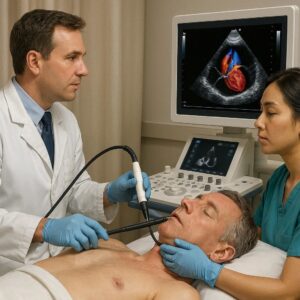
A transesophageal echocardiogram takes a different route. The doctor passes a small, flexible tube with an ultrasound probe at its tip down the patient’s throat into the esophagus. Because the esophagus sits directly behind the heart, the probe gets extremely clear, high-resolution images without interference from the ribs or lungs.
This makes TEE invaluable for:
-
Detecting blood clots in the heart before cardioversion
-
Evaluating heart valve infections (endocarditis)
-
Looking for aortic dissection
-
Guiding certain cardiac surgeries or catheter-based procedures
-
Assessing prosthetic heart valve function
Most TEE procedures take between 30 and 60 minutes. The patient receives sedation to stay comfortable. A nurse or anesthesiologist monitors vital signs throughout.
Now, let us get to the codes you came here for.
The Main CPT Codes for Transesophageal Echocardiography
The American Medical Association (AMA) created a dedicated set of CPT codes specifically for TEE. These codes live in the range 93312–93318. They cover everything from placing the probe to generating the final report.
Here is the complete list at a glance.
Complete TEE Code Set (93312–93318)
| CPT Code | Short Descriptor | Typical Use |
|---|---|---|
| 93312 | TEE probe placement, image acquisition, and interpretation and report (complete study) | Full diagnostic TEE (physician component) |
| 93313 | TEE probe placement and image acquisition only (technical component) | Hospital or lab performing the imaging |
| 93314 | TEE interpretation and report only (professional component) | Physician reading a study performed by someone else |
| 93315 | TEE for congenital cardiac anomalies (complete study) | Complex congenital heart disease evaluation |
| 93316 | TEE for congenital anomalies (technical component only) | Image acquisition for congenital study |
| 93317 | TEE for congenital anomalies (professional component only) | Interpretation of congenital TEE |
Important note: Codes 93315, 93316, and 93317 are not add-ons. They are complete, separate codes for congenital TEE studies. Do not use them together with 93312–93314.
Breaking Down Code 93312 – The Complete TEE
Let us start with the code you will use most often for a standard diagnostic TEE in an adult.
CPT 93312 covers the entire service:
-
Placement of the probe
-
Acquisition of images (including 2D, M-mode, and spectral Doppler when performed)
-
Real-time interpretation during the procedure
-
Written final report
When a cardiologist or anesthesiologist performs the entire TEE themselves—from inserting the probe to writing the report—this is your code.
When to Use 93312
-
Routine outpatient TEE for suspected endocarditis
-
Pre-cardioversion TEE to rule out left atrial thrombus
-
Evaluation of prosthetic valve dysfunction
-
Assessment of aortic dissection
What 93312 Does Not Include
-
Moderate sedation (separate codes, discussed later)
-
Injection of contrast agent (93319, if applicable)
-
Intraoperative monitoring (different codes, such as 93318)
💡 Pro tip: Code 93312 includes the probe placement, imaging, interpretation, and report. You cannot bill separately for image acquisition and interpretation under the same physician.
When to Separate the Components: 93313 and 93314
Not every TEE is performed by the same person who interprets it. In many hospitals, a sonographer or a fellow may acquire the images, and then an attending cardiologist interprets them later. Sometimes a physician places the probe, but a different physician reads the study.
That is why CPT created separate component codes.
Code 93313 – Technical Component (Image Acquisition Only)
Use 93313 when you are billing only for the work of placing the probe and capturing the images. This does not include interpretation or a final report.
Who typically bills 93313?
-
Hospital outpatient departments
-
Imaging centers
-
Sonographers or technicians (through their employer)
Code 93314 – Professional Component (Interpretation Only)
Use 93314 when you are billing only for the physician’s work of reviewing the images, interpreting the findings, and producing a signed report. You do not perform the probe placement or image acquisition.
Who typically bills 93314?
-
A cardiologist who reads a TEE performed by a sonographer
-
A remote reading physician
-
A consulting physician reviewing images from another facility
Example Scenario
A hospital sonographer performs the TEE probe placement and image acquisition (93313). Later that day, a cardiologist reviews the stored images, writes an interpretation, and sends a report to the referring doctor (93314). The total payment equals roughly what 93312 would have paid if the same person had done everything.
Billing note: Some payers require a modifier (often -26 for professional component or -TC for technical component) depending on their policies. Always check your local MAC or commercial payer guidelines.
TEE for Congenital Cardiac Anomalies (93315–93317)
Congenital heart disease presents unique challenges. The anatomy is often unusual. The imaging planes may need to be adjusted significantly. The AMA recognized this added complexity by creating separate codes.
Code 93315 – Complete Congenital TEE
This code covers the entire congenital TEE study: probe placement, image acquisition, interpretation, and report. Use it when the patient has a known or suspected congenital heart defect and the study focuses specifically on that condition.
Examples:
-
Atrial septal defect (ASD) evaluation
-
Ventricular septal defect (VSD) assessment
-
Complex single ventricle anatomy
-
Evaluation after congenital heart surgery
Code 93316 – Congenital TEE Technical Component
Same as 93313, but for congenital studies. Use for image acquisition only.
Code 93317 – Congenital TEE Professional Component
Same as 93314, but for congenital studies. Use for interpretation only.
Important: Do not use 93315–93317 together with 93312–93314 on the same patient on the same date of service. They are mutually exclusive categories. Choose the appropriate set based on whether the study is for congenital or non-congenital indications.
Comparison Table: Non-Congenital vs. Congenital TEE Codes
| Service Type | Complete Study | Technical Only | Professional Only |
|---|---|---|---|
| Standard TEE | 93312 | 93313 | 93314 |
| Congenital TEE | 93315 | 93316 | 93317 |
This table makes it easy to see the parallel structure. Remember the rule: congenital codes are not add-ons. They replace the standard codes entirely.
Add-On Codes and Related Services
Sometimes a TEE is not just a TEE. You may need to report additional services performed during the same session.
Contrast Injection (93319)
If the physician injects an ultrasound contrast agent during the TEE (for example, to better visualize a mass or thrombus), you can report 93319 as an add-on code. This code is used with 93312 or 93315.
Moderate Sedation
Many TEE procedures require moderate sedation (sometimes called conscious sedation). This is typically provided by the same physician performing the TEE or by a separate provider.
If the TEE physician administers the sedation, you may report:
-
99152 – Moderate sedation by the same provider performing the procedure (first 30 minutes)
-
99153 – Each additional 15 minutes beyond the first 30
If a different provider (such as an anesthesiologist or nurse anesthetist) gives the sedation, use the appropriate anesthesia codes (00100–01999) or moderate sedation codes depending on the provider type and payer rules.
Caution: Some payers, including Medicare, consider moderate sedation included in 93312 for facility-based services. Check your specific payer policies before billing separate sedation codes.
Intraoperative TEE (93318)
There is a completely different code for TEE performed during cardiac surgery. CPT 93318 covers TEE for monitoring and guiding surgical procedures like valve repairs, aneurysm repairs, or congenital defect corrections. Do not confuse 93318 with 93312. They are for different clinical scenarios.
Common Billing Mistakes and How to Avoid Them
Even experienced coders slip up sometimes. Here are the most frequent errors we see with TEE coding.
Mistake #1 – Billing 93312 and 93313 Together
You cannot bill the complete code and the technical component code for the same study. If one physician does everything, use 93312. If the technical and professional components are split, use 93313 + 93314. Never use 93312 + 93313.
Mistake #2 – Forgetting the Sedation Documentation
Moderate sedation codes require specific documentation. You must note:
-
The patient’s baseline level of consciousness
-
The drugs used (name, dose, route)
-
Time of administration
-
Monitoring of vital signs (at least every five minutes)
-
The patient’s response and level of sedation during the procedure
-
Recovery time and criteria for discharge
Without this documentation, payers will deny the sedation codes.
Mistake #3 – Using Congenital Codes Incorrectly
A routine TEE on an adult with a small, unrepaired PFO that is not the focus of the study does not justify 93315. Use 93312 instead. The congenital codes are for significant, complex anomalies where the exam requires substantially more work.
Mistake #4 – Missing the Written Report Requirement
CPT 93312 and 93314 both require a written, signed, and dated report. The report must describe:
-
Indication for the study
-
Quality of images
-
Relevant findings (positive and negative)
-
Limitations
-
Clinical impression
No report? No bill.
Real-World Billing Scenarios
Let us walk through some common situations you may encounter in practice.
Scenario 1 – Outpatient TEE at a Hospital (Complete Study)
A cardiologist performs a TEE in the hospital’s echo lab to evaluate a patient with suspected endocarditis. The cardiologist places the probe, acquires the images, interprets them in real time, and writes the report. A nurse monitors the patient.
Billing:
-
93312 (complete TEE)
-
Moderate sedation is likely included in facility payment (check payer policy)
Scenario 2 – TEE Performed by Sonographer, Read by Remote Cardiologist
A sonographer places the probe and acquires images at a small rural hospital. The images are sent electronically to a cardiologist at a larger center. The cardiologist reviews the images, writes the interpretation, and sends the report.
Billing:
-
Hospital: 93313 (technical component)
-
Cardiologist: 93314 (professional component)
Scenario 3 – Congenital TEE for Teenager with ASD
A 16-year-old with a known atrial septal defect undergoes a TEE to assess defect size and timing for closure. The pediatric cardiologist performs the entire study.
Billing:
-
93315 (complete congenital TEE)
Scenario 4 – TEE with Contrast
Same as scenario 1, but the cardiologist injects an ultrasound contrast agent to better visualize a possible thrombus.
Billing:
-
93312
-
93319 (add-on for contrast)
Frequently Asked Questions (FAQ)
1. Is there a separate CPT code for TEE probe insertion alone?
No. Probe insertion is included in 93312, 93313, 93315, and 93316. You cannot bill it separately.
2. Can I bill 93312 and 93314 for the same physician?
No. That would be double-billing for the interpretation component.
3. What is the difference between 93312 and 93318?
93312 is for diagnostic TEE (performed to answer a clinical question). 93318 is for intraoperative monitoring during cardiac surgery. They have different relative value units (RVUs) and different clinical indications.
4. Does Medicare cover TEE?
Yes, for medically necessary indications. Coverage policies vary by local MAC, but common covered indications include evaluation of infective endocarditis, prosthetic valve dysfunction, aortic dissection, and cardiac source of embolism.
5. What diagnosis codes work with TEE?
Common ICD-10 codes include:
-
I33.0 – Acute and subacute infective endocarditis
-
I34.11 – Nonrheumatic mitral valve insufficiency
-
I71.00 – Dissection of aorta, unspecified site
-
I48.91 – Unspecified atrial fibrillation (for pre-cardioversion TEE)
Always code to the highest specificity based on documentation.
6. Do I need a modifier with 93313 or 93314?
Many payers require modifier -TC for 93313 and modifier -26 for 93314. However, some accept these codes without modifiers. Check your specific payer manual.
7. What if the TEE is aborted?
If the procedure cannot be completed (for example, the patient cannot tolerate the probe), you may report the appropriate evaluation and management (E/M) code (e.g., 99205 or 99215) with modifier -53 (discontinued procedure). Do not report a TEE code if no images were acquired.
8. Can a nurse bill for TEE?
No. Only physicians (MD, DO) and certain qualified non-physician practitioners (such as a certified registered nurse anesthetist under specific circumstances) may bill TEE professional services. Technical component billing may be done by the facility.
Additional Resources
For the most current information on TEE coding, always refer to official sources:
-
American Society of Echocardiography (ASE) – Offers coding guidance and webinars
https://www.asecho.org -
CMS Physician Fee Schedule Look-Up Tool – Check RVUs and payment rates for your zip code
https://www.cms.gov/medicare/physician-fee-schedule/search
A Quick Word on Compliance
Medical coding is not a set-it-and-forget-it task. CPT codes change. Payer policies change. The codes in this article reflect current CPT guidelines as of the publication date. However, you must verify all codes, modifiers, and coverage policies with your specific payers and your local Medicare Administrative Contractor (MAC).
If you are ever uncertain, document your decision-making process. Keep a copy of the payer policy or coding guideline you followed. This protects you in the event of an audit.
Conclusion
We have covered the complete CPT code set for transesophageal echocardiography: 93312 for complete studies, 93313 and 93314 for split technical and professional components, and 93315–93317 for congenital anomalies. We also discussed moderate sedation, contrast add-ons, common mistakes, and real-world billing scenarios. Always document thoroughly and verify payer policies before submitting claims.
Disclaimer
This article is for educational purposes only and does not constitute legal, financial, or medical advice. Coding and billing rules vary by payer, region, and individual patient circumstances. Always consult current CPT manuals, payer policies, and qualified coding professionals before submitting any claim. The author and publisher disclaim any liability for any adverse outcomes resulting from the use or misuse of this information.
Author: R. Sterling, CPC, Technical Medical Writer
Date: APRIL 10, 2026