Vital pulp therapy sounds complex. But it is a common procedure that helps save a tooth’s natural inner tissue. You might know it as a pulpotomy or a pulpectomy on a healthy, vital tooth.
If you work in a dental office, you need the right code. The wrong code can mean denied claims or lost revenue. The right code ensures you get paid for the work you actually performed.
So what is the correct ADA code for vital pulp therapy?
The short answer is: It depends on the specific type of therapy. There is not one single code. Instead, you have two primary codes: D3110 and D3120. A third code, D3220, is often confused with vital pulp therapy.
Let’s break this down in a way that makes sense for your daily practice.
What Is Vital Pulp Therapy? A Quick Refresher
Before we talk codes, let us quickly define the procedure. Vital pulp therapy treats a tooth where the pulp (the nerve and blood vessels inside) is inflamed or injured but still alive. We call this “vital.”
The goal is simple. Remove the damaged part of the pulp. Keep the healthy part alive. This helps the tooth continue to develop and function normally.
You typically perform this on children with baby teeth or young adults with immature permanent teeth.
There are two main types:
- Direct pulp cap (DPC): A small exposure of the pulp is covered with a medicament.
- Indirect pulp cap (IPC): Deep decay is removed, but a thin layer remains over the pulp to avoid exposure.
Many people confuse these with a pulpotomy (partial removal of the pulp in the crown). We will clarify that later.
The Main ADA Codes for Vital Pulp Therapy
The American Dental Association (ADA) publishes the Current Dental Terminology (CDT) code set. For vital pulp therapy, you will use two specific codes.
Here is the simple breakdown.
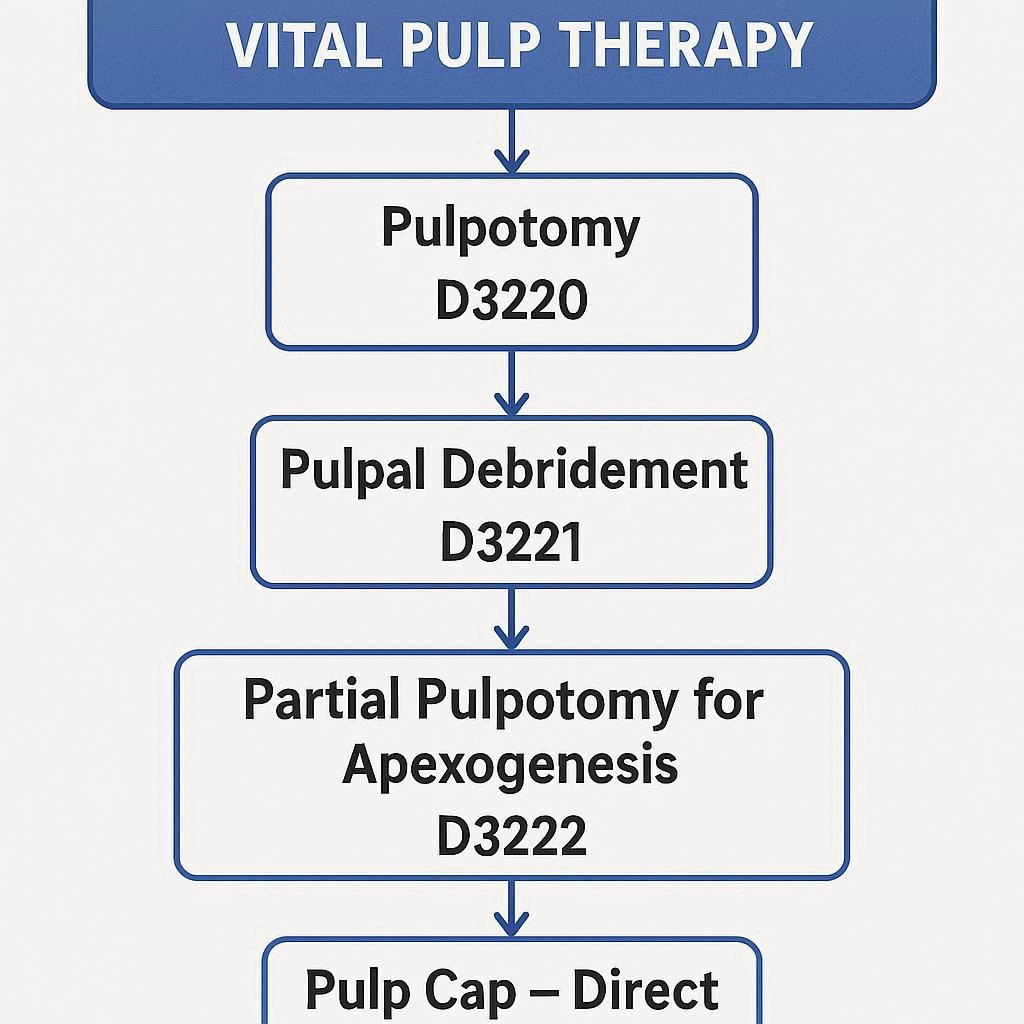
| ADA Code | Procedure Name | What It Actually Means |
|---|---|---|
| D3110 | Pulp cap – direct (excluding final restoration) | A direct cap over an exposed vital pulp. |
| D3120 | Pulp cap – indirect (excluding final restoration) | A cap over nearly exposed pulp, leaving a thin layer of dentin. |
| D3220 | Pulpotomy (excluding final restoration) | Removal of pulp from the coronal (top) portion only. |
Important note: D3220 is not technically vital pulp therapy. It is a related but distinct procedure. However, many offices mistakenly use D3220 for vital pulp therapy. We will explain why this is a problem.
ADA Code D3110 – Direct Pulp Cap
You use D3110 when you accidentally or intentionally expose the pulp. The exposure is small. The pulp is still healthy and bleeding normally.
Example: A patient has a deep cavity. While removing decay, you make a tiny pinhole exposure. You place a biocompatible material like calcium hydroxide or MTA (mineral trioxide aggregate) directly over the exposure. You then place a permanent restoration later.
Key points:
- The pulp is exposed.
- The pulp is vital (alive and healthy).
- You place a medicament directly onto the pulp tissue.
- The final filling (crown or composite) is billed separately.
ADA Code D3120 – Indirect Pulp Cap
You use D3120 when decay is very deep but has not yet reached the pulp. You leave a thin layer of affected dentin over the pulp to avoid direct exposure. Then you place a medicament over that dentin.
Example: A child has a large cavity. Removing all decay would expose the pulp. So you leave a thin, firm layer of dentin. You place a liner or medicament over that dentin. Then you restore the tooth.
Key points:
- The pulp is NOT exposed.
- You leave a protective layer of dentin.
- The goal is to avoid pulp exposure and allow healing.
- The final restoration is billed separately.
Direct vs. Indirect Pulp Cap: A Simple Comparison
This is where many coding errors happen. Let us put these two codes side by side.
| Feature | D3110 (Direct) | D3120 (Indirect) |
|---|---|---|
| Pulp exposure? | Yes – visible exposure | No – dentin only |
| Bleeding at site? | Yes, usually minor | No |
| Material placed on | Pulp tissue | Remaining dentin |
| Typical setting | After trauma or deep decay | Deep decay near pulp |
| Common patient age | Any | Children or young adults |
Quote from a dental coding expert: “The simplest way to remember the difference is this: direct means you see the pulp. Indirect means you only see dentin. Never guess. Always document what you see.”
When NOT to Use D3110 or D3120
Not every deep filling is a pulp cap. You should not use these codes for routine liners or bases under a standard filling.
For example, you place a glass ionomer liner in a shallow cavity. That is not a pulp cap. That is just a liner. You include that in the restoration code.
You also should not use D3110 or D3120 if the pulp is necrotic (dead). Vital pulp therapy requires a vital tooth. If the tooth is non-vital, you need root canal therapy codes (D3310 for anterior, D3320 for bicuspid, D3330 for molar).
The D3220 Confusion: Pulpotomy vs. Vital Pulp Therapy
Many dental billers ask: “Can I use D3220 for vital pulp therapy?”
The short answer is no. But let us explain why.
D3220 is a pulpotomy. That means you remove the entire pulp from the crown of the tooth (the coronal pulp). You leave the pulp in the roots (the radicular pulp) intact.
Vital pulp therapy (D3110 or D3120) does NOT remove any pulp tissue. You only place a medicament over the pulp or over dentin.
Here is a simple way to visualize it:
- Indirect pulp cap (D3120): Remove decay → leave dentin → place medicament → restore. No pulp removed.
- Direct pulp cap (D3110): Remove decay → see pulp → place medicament directly → restore. No pulp removed.
- Pulpotomy (D3220): Remove decay → open pulp chamber → remove coronal pulp tissue → place medicament → restore. Pulp tissue IS removed.
Why does this matter? Because payers look for consistency. If you document vital pulp therapy but bill a pulpotomy, your claim may be denied or audited.
Step-by-Step Documentation for D3110 and D3120
Good documentation saves you from headaches. Payers want to see proof that you performed the procedure you billed. Here is what you need in your clinical notes for each code.
Documentation for D3110 (Direct Pulp Cap)
Your note should include:
- Tooth number.
- Reason for procedure (e.g., “carious exposure during caries removal”).
- Condition of pulp (e.g., “pulp exposed, bleeding present, bleeding controlled easily”).
- Hemostatic agent used (if any).
- Pulp capping material (e.g., “Biodentine placed directly over exposure”).
- Temporary or permanent restoration placed (note: final restoration is billed separately).
- Follow-up plan.
Example note:
“Tooth #19. Deep mesial caries. During excavation, a 1mm pinpoint pulp exposure occurred. Bleeding was controlled with a cotton pellet moistened with saline. MTA (ProRoot MTA) was placed directly over the exposure. The tooth was restored with a temporary IRM. Patient to return for permanent composite restoration in 6 weeks.”
Documentation for D3120 (Indirect Pulp Cap)
Your note should include:
- Tooth number.
- Depth of caries (e.g., “caries within 0.5mm of pulp radiographically”).
- Decision to leave dentin (e.g., “removed soft caries, left firm affected dentin to avoid exposure”).
- Medicament used (e.g., “TheraCal LC placed over remaining dentin”).
- Restoration placed (again, final restoration is separate).
Example note:
“Tooth #A (primary molar). Large occlusal caries extending near pulp on radiograph. Caries excavation stopped when firm, leathery dentin remained. No pulp exposure. TheraCal LC placed as indirect pulp cap. Tooth restored with stainless steel crown.”
Billing and Reimbursement Tips for Vital Pulp Therapy Codes
Getting paid for D3110 and D3120 can be tricky. Some payers do not reimburse these codes well. Others bundle them into the restoration. Here are five practical tips.
1. Always Bill the Final Restoration Separately
Both D3110 and D3120 say “excluding final restoration.” That means you can bill the filling or crown on the same day. Use a modifier if required by the payer (check your local rules).
Example: D3110 (direct pulp cap) + D2391 (composite resin, one surface, posterior) on the same tooth.
2. Check Medical Insurance for Trauma Cases
If a patient falls and chips a tooth, causing a pulp exposure, you might bill medical insurance. Some medical plans cover D3110 for traumatic injuries. You will need a primary dental code and a medical cross-code. Always verify first.
3. Know Your Payer’s Frequency Rules
Some Medicaid plans limit pulp caps to once per tooth per lifetime. Others allow them only on primary teeth. Read your provider manual.
4. Do Not Bill D3110 or D3120 with a Pulpotomy
You cannot perform a direct pulp cap AND a pulpotomy on the same tooth on the same day. That does not make clinical sense. If you do a pulpotomy, use D3220.
5. Appeal Denials with Your Documentation
If a payer denies D3110, send them your clinical note. Highlight the exposed pulp and bleeding. If they deny D3120, highlight the “no exposure” and the dentin left in place. A short appeal letter often works.
Common Coding Mistakes and How to Avoid Them
Let us look at real-world errors. You might recognize some of these.
Mistake #1: Using D3120 when you exposed the pulp.
- Why it is wrong: D3120 requires no exposure. If you see pulp, you need D3110.
- Fix: Look at your photo or note. If you see red (pulp), use D3110.
Mistake #2: Using D3110 for a pulpotomy.
- Why it is wrong: D3110 does not remove pulp tissue. A pulpotomy removes coronal pulp.
- Fix: Use D3220 for pulpotomy.
Mistake #3: Billing D3110 or D3120 as standalone codes without a restoration.
- Why it is wrong: These codes explicitly exclude the final restoration. You need a separate restoration code.
- Fix: Add a filling or crown code on the same claim.
Mistake #4: Using D3110 on a non-vital tooth.
- Why it is wrong: Vital pulp therapy requires vital pulp. A non-vital tooth needs root canal therapy.
- Fix: Use D3310, D3320, or D3330.
ADA Code for Vital Pulp Therapy on Primary vs. Permanent Teeth
Good news: The codes are the same. D3110 and D3120 work for both primary (baby) teeth and permanent teeth. The ADA does not have separate codes for primary teeth for these procedures.
However, your clinical approach might differ. On primary teeth, you often use a pulpotomy (D3220) instead of a direct pulp cap. That is a separate discussion.
Quick reference:
| Tooth Type | Direct Pulp Cap Code | Indirect Pulp Cap Code |
|---|---|---|
| Primary (baby) | D3110 | D3120 |
| Permanent | D3110 | D3120 |
A Complete Coding Workflow for Vital Pulp Therapy
Here is a step-by-step workflow you can use in your practice tomorrow.
Step 1: Diagnose
- Is the pulp vital? (Cold test, electric pulp test, or visual inspection.)
- Is the pulp exposed or not exposed?
- Is the tooth restorable?
Step 2: Choose the correct code
- Exposed vital pulp → D3110
- Deep caries, no exposure, leaving dentin → D3120
Step 3: Perform the procedure and document
- Write a detailed note (see examples above).
- Take a photo if possible (great for appeals).
Step 4: Place a restoration
- Temporary or permanent.
- Bill the restoration code separately (e.g., D2391, D2940, D2910).
Step 5: Submit the claim
- List D3110 or D3120.
- List the restoration code.
- Attach your narrative if required.
Step 6: Follow up
- Recall patient to check vitality.
- If symptoms develop, consider pulpotomy or root canal.
Frequently Asked Questions (FAQ)
Q1: Can I bill D3110 and D3120 on the same tooth on the same day?
No. A tooth cannot have both a direct and indirect pulp cap. Choose the one that matches what you did.
Q2: Does medical insurance cover vital pulp therapy codes?
Sometimes. For traumatic injuries (e.g., a fall causing pulp exposure), medical may cover D3110. You will need a cross-code and pre-authorization.
Q3: What is the difference between D3110 and D2940?
D2940 is a protective restoration (sedative filling). It is not a pulp cap. D2940 is used for temporary relief of symptoms without any pulp medicament placed directly over the pulp or dentin.
Q4: Can I use D3110 on a tooth that needs a crown?
Yes. You can place a direct pulp cap and then later place a crown. Bill D3110 at the time of the pulp cap. Bill the crown code (D2740 or D2750) separately, often on a different date.
Q5: How much do payers reimburse for D3110 and D3120?
Reimbursement varies widely. In 2025-2026, typical fees range from $50 to $150 per code, depending on your region and contract. Some Medicaid plans pay as little as $20. Check your fee schedule.
Q6: What material should I document for D3110?
Common accepted materials include MTA, Biodentine, calcium hydroxide (Dycal), and TheraCal LC. Avoid documenting only a liner like glass ionomer for a direct pulp cap.
Additional Resource
For the most current CDT codes and official ADA guidelines, always refer to the ADA’s official website:
🔗 Official ADA CDT Code Resource
https://www.ada.org/en/publications/cdt
(Open this link to purchase the latest CDT manual or access coding news.)
Important Notes for Readers
- Codes change. The information above is accurate as of April 2026. Always verify with the current CDT manual.
- Payers have different rules. What works for Delta Dental may not work for Cigna or a local Medicaid plan.
- Documentation is your best defense. A two-line note will not protect you in an audit. Write detailed notes.
- Do not upcode or downcode. Bill what you actually performed. Never change a code to get a higher reimbursement.
- When in doubt, ask. Contact your payer’s provider line. Or consult a certified dental coder.
Conclusion
The correct ADA code for vital pulp therapy depends on whether you directly exposed the pulp or left a dentin barrier. Use D3110 for direct pulp caps on exposed vital pulps. Use D3120 for indirect pulp caps where no exposure occurs. Never confuse these with a pulpotomy (D3220). Document every step, bill the restoration separately, and always follow your payer’s specific rules.
Author: Dental Coding Team
Date: APRIL 15, 2026
Disclaimer: This information is provided for educational purposes. It does not constitute legal or medical advice. Always refer to the most current ADA CDT manual and verify coverage with individual payers before submitting claims.