Walking out of the oral surgeon’s office with a treatment plan in your hands can feel like reading a secret medical document. You see a list of numbers like D7210 or D7240, and next to them, numbers that make your wallet ache. You are not alone if you have asked yourself, “What is the exact dental code for wisdom tooth extraction?”
The short answer is that there is not just one single code. In fact, dental professionals use a family of five main codes. These codes depend entirely on how difficult your specific wisdom tooth is to remove.
In this guide, we will break down every single code. We will explain what each number means for your mouth, your pain level, and your final bill. By the end, you will be able to look at any dental estimate and know exactly what the dentist plans to do.
Understanding the CDT Code System
Before we talk about specific numbers, you need to understand where these codes come from. Dentists in the United States use a set of codes called the Current Dental Terminology (CDT) . The American Dental Association (ADA) updates these codes every year.
Think of these codes as a universal language. Whether you live in New York, Texas, or California, code D7210 means the same thing. This consistency helps your insurance company understand exactly what service you received.
Wisdom tooth codes fall under the “Oral and Maxillofacial Surgery” section of the CDT manual. They specifically describe the removal of a third molar—which is the clinical name for a wisdom tooth.
Important Note: Codes change slightly every year. Always check with your dentist’s office to confirm they are using the most current CDT codes for your procedure.
Why the Simple “Extraction” Code Does Not Fit Wisdom Teeth
You might wonder why dentists do not just use a simple extraction code. After all, pulling a tooth seems straightforward. However, a standard extraction code (like D7140) is only for teeth that are fully visible above the gum line and easy to remove with simple forceps.
Wisdom teeth are rarely that simple.
Most wisdom teeth cause problems because they are:
- Impacted (stuck under the gum or against another tooth)
- Partially erupted (only part of the tooth shows)
- Angled strangely (tipped sideways or even backwards)
Because of these complications, the dental code for wisdom tooth extraction changes based on the position of the tooth and how much bone or gum tissue the surgeon must cut.
The Five Main Dental Codes for Wisdom Tooth Extraction
Let us look at each code individually. I will explain what the code means, what procedure the dentist performs, and when your dentist would choose that specific code.
| CDT Code | Description | Typical Use Case |
|---|---|---|
| D7210 | Surgical extraction of erupted tooth | Tooth is fully visible but requires cutting gum or bone |
| D7220 | Removal of impacted soft tissue | Tooth is covered only by gum (no bone) |
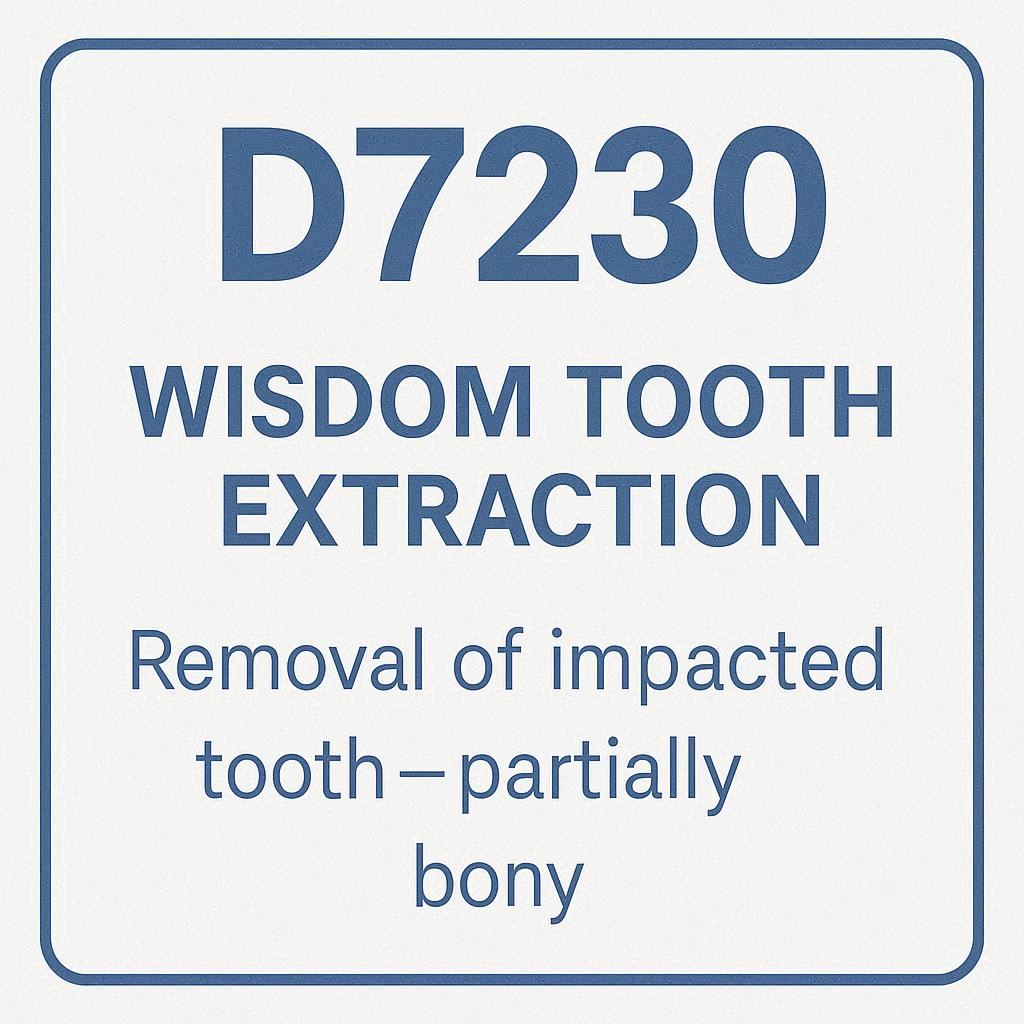
| D7230 | Removal of impacted partially bony | Tooth is partly covered by bone |
| D7240 | Removal of impacted completely bony | Tooth is fully covered by bone |
| D7241 | Removal of impacted completely bony with unusual complications | Extreme case: tooth near nerve or sinus |
Now, let us explore each code in detail.
D7210: Surgical Extraction of an Erupted Tooth
This code often confuses patients. The word “erupted” means the tooth has broken through the gum. You can see it. So why does it need a surgical code?
The answer is simple: even if the tooth is visible, the dentist may need to cut the gum or remove some bone to get a good grip on it.
What Happens During a D7210 Procedure?
Your dentist will:
- Numb the area with local anesthetic.
- Make a small incision in the gum around the tooth.
- Remove a tiny amount of bone if the tooth is stuck.
- Section (cut) the tooth into smaller pieces.
- Remove each piece separately.
- Clean the socket and place stitches if needed.
When Do Dentists Use D7210?
Dentists use this code for wisdom teeth that are:
- Fully visible in the mouth
- Too broken down (decayed) to grab with regular forceps
- Fused to the bone (ankylosed)
- Curved roots that will not come out in one piece
Realistic cost range: $250 to $450 per tooth
D7220: Removal of Impacted Soft Tissue
This is the first of the true “impaction” codes. A soft tissue impaction means your wisdom tooth has not fully come through the gum. However, the tooth is not covered by bone. Only a flap of gum tissue sits on top of it.
What Happens During a D7220 Procedure?
The dentist will:
- Make a small cut in the gum flap covering the tooth.
- Push the gum aside to expose the tooth.
- Remove the tooth, often in one or two pieces.
- Clean the area and suture the gum back together.
Signs You Might Need a D7220
You might see a small bump of gum where the tooth should be. Sometimes, food gets trapped under the gum flap, causing pain and bad breath. This is a classic sign of a soft tissue impaction.
Realistic cost range: $300 to $500 per tooth
D7230: Removal of Impacted Partially Bony
Now we move into more complex territory. A partially bony impaction means part of the wisdom tooth is covered by bone. The rest may be visible or covered by gum tissue. This is one of the most common types of wisdom tooth impactions.
Why Partially Bony Impactions Are Tricky
The bone covering part of the tooth makes removal harder. The dentist cannot simply pull the tooth out because the bone acts like a wall blocking the tooth’s path.
The D7230 Procedure Step by Step
- The dentist makes an incision in the gum.
- They use a surgical handpiece (a special drill) to remove the bone covering the tooth.
- Once the tooth is fully exposed, they may cut it into sections.
- Each section is removed carefully.
- The dentist smooths the remaining bone edges.
- The gum is stitched closed.
Realistic cost range: $350 to $600 per tooth
D7240: Removal of Impacted Completely Bony
This code describes a wisdom tooth that is entirely hidden under bone. You cannot see any part of the tooth in your mouth. Often, dentists discover these teeth on routine X-rays.
What Makes a Completely Bony Impaction Different?
Because the tooth sits inside the jawbone, the dentist must remove a window of bone just to reach it. This requires more time, more skill, and often a stronger anesthetic.
The D7240 Procedure
This is a more invasive surgery. The dentist will:
- Numb the area and possibly use sedation.
- Cut and lift back the gum tissue.
- Use a drill to remove bone over the entire tooth.
- Cut the tooth into several small pieces.
- Remove each piece through the opening.
- Clean the deep socket thoroughly.
- Place sutures to close the gum.
Recovery Note: You can expect more swelling and discomfort after a D7240 compared to the previous codes. This is normal because the bone itself was disturbed.
Realistic cost range: $450 to $750 per tooth
D7241: Removal of Impacted Completely Bony with Unusual Complications
This is the most complex code in the wisdom tooth family. Dentists reserve this code for cases where the tooth is not just fully covered by bone but also presents additional serious risks.
What Counts as “Unusual Complications”?
According to the CDT manual, complications include:
- The tooth’s roots are wrapped around or pressing on the inferior alveolar nerve (the nerve that gives feeling to your lower lip and chin)
- The tooth is displaced into the sinus cavity
- The tooth is fused to the bone (severe ankylosis)
- The tooth is in an abnormal position, such as upside down or sideways against another molar
Why This Code Matters for Your Safety
When a dentist uses D7241, they are telling your insurance company: “This case required extraordinary skill and time because of serious anatomical risks.” The dentist may need to use a microscope, take a 3D CT scan (CBCT), or refer you to a specialist oral surgeon.
Realistic cost range: $600 to $1,200+ per tooth
A Note on the “Coronectomy” Code (D7251)
You might hear about a procedure called a coronectomy. This is not a full extraction. Instead, the dentist cuts off the crown (top) of the wisdom tooth and leaves the roots in place. Dentists use this technique when the roots are dangerously close to the nerve. Removing the whole tooth could cause permanent lip numbness.
The code for a coronectomy is D7251. It is a valid alternative to D7240 or D7241 in high-risk cases.
Soft Tissue Impaction vs. Bony Impaction: A Visual Comparison
| Feature | Soft Tissue (D7220) | Partial Bony (D7230) | Complete Bony (D7240) |
|---|---|---|---|
| Tooth visible? | No, but a bump exists | Partially visible | Not visible at all |
| Bone covering? | None | Part of the tooth | Entire tooth |
| Typical surgery time | 15-20 minutes | 25-35 minutes | 40-60 minutes |
| Stitches needed | Usually | Yes | Yes |
| Recovery difficulty | Mild | Moderate | Moderate to severe |
How Dentists Decide Which Code to Use
You might wonder how your dentist chooses the right code before they even start the surgery. The answer lies in two things: clinical exam and X-rays.
The Role of X-rays
A panoramic X-ray (the machine that rotates around your head) gives the dentist a clear view of:
- How many wisdom teeth you have
- Their angle (straight, tilted, or horizontal)
- How deep they sit in the bone
- How close the roots are to the nerve canal
Some dentists also use a CBCT scan (3D X-ray) for complicated cases. This scan helps them plan the surgery down to the millimeter.
The Exam
The dentist will also look inside your mouth. They will check:
- If any wisdom teeth have broken through the gum
- If there is gum tissue covering any teeth
- Signs of infection or decay
Based on this information, the dentist assigns a code to each tooth. Yes, each tooth gets its own code. You could have four different codes on the same treatment plan if each wisdom tooth is in a different position.
A Realistic Example Treatment Plan
Let us look at a typical patient, Sarah, who is 24 years old. Her panoramic X-ray shows:
- Upper right wisdom tooth: Fully erupted and straight → Code D7210
- Upper left wisdom tooth: Fully erupted but decayed → Code D7210
- Lower right wisdom tooth: Partially covered by bone → Code D7230
- Lower left wisdom tooth: Fully covered by bone, roots near nerve → Code D7241
Sarah’s treatment plan will list all four codes separately. Her total surgical fee will be the sum of each code.
Important: Always ask your dentist for a written treatment plan with the specific CDT codes before you schedule surgery. This document is your right as a patient.
Insurance Coverage for Each Wisdom Tooth Code
Insurance companies treat these codes very differently. Here is a general guide, but remember: every plan is unique.
What Insurance Typically Pays
| Code | Insurance Attitude | Typical Coverage |
|---|---|---|
| D7210 | Often covered like a standard extraction | 50-80% after deductible |
| D7220 | Covered as medically necessary | 50-80% after deductible |
| D7230 | Well-covered | 50-80% after deductible |
| D7240 | Well-covered | 50-80% after deductible |
| D7241 | Fully covered (medically complex) | 80-100% in many plans |
The “Missing Tooth” Clause
Be careful: some insurance plans only cover wisdom tooth removal if the tooth is impacted (codes D7220 through D7241). They may deny coverage for D7210 (surgical extraction of an erupted tooth) because they consider it a routine extraction, which your plan might not cover for wisdom teeth.
Always call your insurance company before surgery. Ask them specifically: “Does my plan cover code D7210 for wisdom teeth? What about D7220?”
Why You Should Never Let a Dentist “Guess” the Code
A good dentist will never guess. They will take an X-ray and examine you first. If a dentist offers to remove your wisdom teeth without an X-ray, walk away. That is not standard of care.
The wrong code can cause two problems:
- Insurance denial: If the dentist uses a code that does not match the actual procedure, your claim will be rejected.
- Inadequate anesthesia: A simple code might not reflect how complex the surgery actually is. You could end up in pain during the procedure.
What the Codes Do NOT Include
These dental codes cover the surgeon’s work. However, they do not include several other important services. You will likely see additional charges for:
- Initial exam and X-rays (codes D0210, D0270, D0272, or D0330 for CBCT)
- Sedation or anesthesia (codes D9222, D9223, or D9248)
- Antibiotics or pain medication prescriptions
- Follow-up visits for complications
Always ask for a complete breakdown. A quote that only shows the extraction codes is incomplete.
Sedation Codes Often Paired with Wisdom Tooth Extractions
Most people do not want to be awake while a surgeon drills into their jawbone. That is why sedation is common. Here are the codes you might see alongside your extraction codes:
| Sedation Code | Description |
|---|---|
| D9222 | Deep sedation/general anesthesia – first 15 minutes |
| D9223 | Deep sedation/general anesthesia – each additional 15 minutes |
| D9248 | Non-intravenous conscious sedation (oral medication like Valium) |
These codes are billed in addition to your extraction codes. They are separate line items on your bill.
Regional Differences in Code Pricing
The same dental code for wisdom tooth extraction can cost very different amounts depending on where you live. A D7240 in rural Mississippi might cost $400. The exact same code in Manhattan, New York could cost $900.
Why? The cost of rent, staff salaries, and medical supplies varies dramatically by region. Dental schools and community health centers often offer lower fees. Private oral surgery offices charge more but may offer more comfort and shorter wait times.
What to Do If You See an Unfamiliar Code
Sometimes, patients see codes on their bill that they did not discuss before surgery. Do not panic. Here is what to do:
- Ask for an explanation. Call the billing office and ask: “What does code XXXX mean? I do not see it on my treatment plan.”
- Request a coding review. A certified dental coder can verify if the code was appropriate.
- Ask about a courtesy adjustment. If the code was added without your consent, you may negotiate.
Mistakes happen. Billing staff are human. Most offices will correct honest errors if you ask politely but firmly.
How to Prepare for Your Consultation
When you go to your wisdom tooth consultation, bring these three things:
- Your insurance card (front and back)
- A list of all medications you take, including vitamins and herbs
- A notebook and pen to write down the codes they mention
Then ask these five questions:
- “Which CDT codes will you use for each of my wisdom teeth?”
- “Could any of these codes change during the surgery?”
- “What is the total fee per code, not including sedation?”
- “Do I need a CBCT scan for the lower teeth near the nerve?”
- “Can you give me a predetermination of benefits to send to my insurance?”
A predetermination is a request you send to your insurance company before surgery. They will send back a letter explaining exactly what they will pay. This document protects you from surprise bills.
Common Mistakes Patients Make with Dental Codes
I have seen thousands of dental bills over my career. Here are the most common mistakes patients make:
Mistake #1: Assuming One Price Covers All Four Teeth
Many patients hear a total price like $1,800 and assume that is the cost. Then they see a bill for $1,800 per tooth. Always confirm: “Is that price per tooth or for all teeth?”
Mistake #2: Not Getting Codes in Writing
A verbal estimate is worth nothing. Get the codes and fees printed on office letterhead before you pay a deposit.
Mistake #3: Ignoring the Difference Between “In-Network” and “Out-of-Network”
Your dentist might be in-network for a cleaning but out-of-network for oral surgery. Check your insurance portal or call to verify.
The Future of Wisdom Tooth Codes
The CDT codes change every year, but the basic structure for wisdom teeth has been stable for over a decade. However, there is growing discussion about creating separate codes for upper versus lower wisdom teeth. Upper wisdom teeth are usually easier to remove than lower ones. Some experts argue that the current codes do not fairly reflect this difference.
For now, the codes we covered today (D7210, D7220, D7230, D7240, D7241) remain the standard. I will update this article if the ADA announces major changes.
Frequently Asked Questions (FAQ)
Q1: What is the most common dental code for wisdom tooth extraction?
The most common code depends on your age. For patients under 25, D7230 (partial bony impaction) is very common. For patients over 30, D7240 (complete bony impaction) becomes more common because the roots have had more time to fully form and curve.
Q2: Can a dentist use the same code for all four wisdom teeth?
Yes, if all four teeth are in the same condition. However, most people have different levels of impaction on each side of their mouth. It is common to see a mix of codes on one treatment plan.
Q3: Does insurance cover all these codes the same way?
No. Many plans cover impacted codes (D7220-D7241) better than D7210. Always check your specific plan.
Q4: What happens if the dentist uses a different code than what was on my treatment plan?
If the surgery was more complex than expected (for example, a soft tissue impaction turned out to be a bony impaction), the dentist can change the code. However, they must document why. If they change it to a more expensive code without a valid reason, you can dispute the bill.
Q5: Is coronectomy (D7251) a good alternative to full extraction?
For patients with high nerve risk, yes. A coronectomy removes the crown but leaves the roots. The success rate is high, but the tooth roots may cause problems years later. Discuss this option with your oral surgeon.
Q6: Do pediatric dentists use these same codes for children’s molars?
No. These codes are specifically for third molars (wisdom teeth). First and second molars use different extraction codes.
Q7: How do I find a dentist who uses correct coding?
Look for an office with a certified dental coder on staff. You can also check reviews that mention “transparent billing” or “clear treatment plans.” Oral surgeons typically code more accurately for wisdom teeth than general dentists because they do these procedures daily.
Additional Resources
For the most up-to-date information on dental codes and to verify any code changes, visit the American Dental Association’s official CDT coding page:
👉 ADA CDT Code Resource Center (External Link)
Note: Always verify any code with your dental provider, as codes are updated annually in January.
Final Summary (Conclusion)
Wisdom tooth extraction uses five main dental codes: D7210, D7220, D7230, D7240, and D7241. Each code reflects a different level of surgical difficulty based on how deeply the tooth is impacted. Understanding these codes helps you verify your treatment plan, communicate with your insurance company, and avoid unexpected bills. Always request a written estimate with specific CDT codes before scheduling your surgery.
Disclaimer: This article is for educational purposes only. It does not constitute medical advice or a guarantee of insurance coverage. Dental codes, fees, and insurance policies vary by provider and region. Always consult with your licensed dentist or oral surgeon for a personal diagnosis and treatment plan.