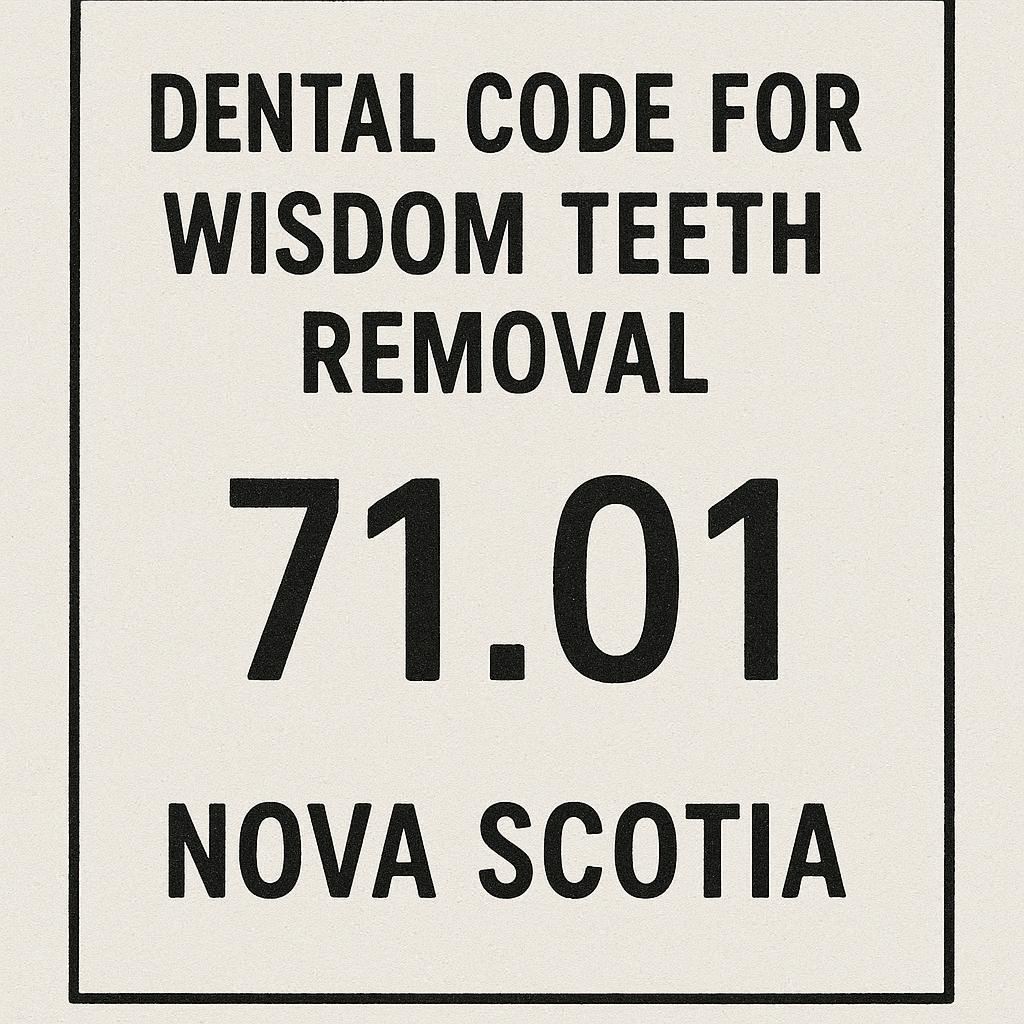
If you have been told by your dentist that it is time to remove your wisdom teeth, you likely have a lot of questions. Will it hurt? How long is recovery? But for many adults in Halifax, Dartmouth, Bedford, or anywhere else across the province, the very first question is often about money and insurance. Specifically, what is the dental code for wisdom teeth removal in Nova Scotia, and how much will your plan actually cover?
You are not alone. Dental billing codes can feel like a secret language. They look like a random mix of letters and numbers. But understanding these codes is the key to unlocking your insurance benefits. It helps you avoid surprise bills and plan your budget.
In this guide, we will break down everything you need to know. We will look at the specific Canadian Dental Association (CDA) codes used in Nova Scotia. We will explain the difference between a simple extraction and a surgical one. We will also talk about what MSI (Medical Services Insurance) does and does not cover, and how to read your insurance explanation of benefits like a pro.
Let us make this confusing topic simple, clear, and friendly.
Why Knowing the Correct Dental Code Matters
Before we list the actual numbers, let us talk about why you should care about a billing code in the first place.
Dental insurance is not like medical insurance. Every single procedure a dentist performs has a specific code. When your dentist sends a claim to your insurance company, they do not write “pull a tooth.” They send a four or five-digit code.
If your dentist uses the wrong code, even by accident, your claim can be denied. For example, a simple extraction (tooth is already visible) costs less than a surgical extraction (tooth is impacted under the gum). If your dentist uses the simple code when it should be surgical, you could end up paying the difference.
Important Note for Nova Scotia Patients: Always ask your dentist’s front desk team for the exact codes before your procedure. You can call your insurance company with those codes to get a pre-determination of benefits. This tells you exactly what they will pay.
The Difference Between Simple and Surgical Codes
This is the most important distinction you will make.
- Simple extraction (often code 71101): The tooth is fully erupted (visible) in the mouth. The dentist uses an elevator and forceps. No cutting of gum tissue or bone is required.
- Surgical extraction (codes 72111, 72121, 72131, 72141): The tooth is partially or fully impacted (stuck under the gum). The dentist must make an incision in the gum, sometimes remove bone, and possibly section the tooth into pieces.
Most wisdom teeth removals fall under surgical codes. Lower wisdom teeth are often more complicated because the roots can be close to the inferior alveolar nerve.
The Official Dental Codes for Wisdom Teeth Removal (Nova Scotia)
Nova Scotia dentists follow the Canadian Dental Association (CDA) coding system. The codes below are the standard ones you will see on your treatment plan and insurance claim.
Simple Erupted Wisdom Tooth Removal
| Code | Description | When it applies |
|---|---|---|
| 71101 | Extraction, erupted tooth | The wisdom tooth is fully visible and accessible. No surgery involved. |
This code is rarely used for wisdom teeth in adults over 20 because most wisdom teeth have some level of impaction. However, if your wisdom tooth came in straight and is fully erupted, this is the code.
Surgical Removal of Wisdom Teeth (Impacted or Soft Tissue)
When the tooth has not broken through the gum properly, you move into surgical codes.
| Code | Description | What the dentist does |
|---|---|---|
| 72111 | Surgical removal of an erupted tooth or root removal | This is the simplest surgical code. The tooth is visible, but it is broken or requires surgical flaps to remove. |
| 72121 | Surgical removal of an unerupted tooth (soft tissue impaction) | The tooth is covered by gum tissue. The dentist cuts the gum to expose the tooth. No bone is removed. |
| 72131 | Surgical removal of a partially bony impacted tooth | The tooth is partially covered by gum and partially by bone. The dentist removes a small amount of bone to extract the tooth. |
| 72141 | Surgical removal of a completely bony impacted tooth | The tooth is fully encased in bone. This is the most complex extraction. Requires bone removal and often sectioning of the tooth. |
Additional Codes You Might See
Sometimes, the extraction is just one part of the bill. You may see these additional codes on your estimate:
- 91111 – Intravenous (IV) sedation (per 15 minutes or per appointment). Many Nova Scotia oral surgeons use this for wisdom teeth.
- 92111 – Inhalation sedation (laughing gas).
- 92221 – Deep sedation or general anesthesia in a hospital setting.
- 02311 – Radiograph (X-ray) – panoramic (full mouth). This is required before any surgical extraction to see the position of the roots.
- 00111 – Complete oral examination (new patient or recall exam).
Quotation from a Halifax dental billing coordinator:
“The most common mistake patients make is assuming one code covers all four wisdom teeth. Your dentist will bill each tooth individually. If you have four impacted teeth, you will see four line items, each with the 72131 or 72141 code.”
How Much Does Wisdom Teeth Removal Cost in Nova Scotia? (2026 Estimates)
Insurance codes are useless without understanding real dollar amounts. Prices in Nova Scotia vary depending on where you live (Halifax vs. Cape Breton) and who performs the procedure (general dentist vs. oral surgeon).
The Nova Scotia Dental Association publishes a suggested fee guide. Most dentists follow this guide closely, but some may charge slightly more or less.
Here is a realistic breakdown of the dentist’s fee (not including anesthesia or X-rays).
| Procedure | Code | Average Cost (per tooth) |
|---|---|---|
| Simple erupted extraction | 71101 | $150 – $250 |
| Surgical – soft tissue impaction | 72121 | $250 – $400 |
| Surgical – partial bony impaction | 72131 | $350 – $550 |
| Surgical – full bony impaction | 72141 | $450 – $700 |
Total Estimated Cost for All Four Wisdom Teeth
Let us say you are 22 years old and need all four wisdom teeth removed. Two are partially bony (upper) and two are fully bony (lower).
- Two 72131 codes: 2 x $450 = $900
- Two 72141 codes: 2 x $600 = $1,200
- Panoramic X-ray (02311): $150
- Oral exam (00111): $100
- IV sedation (91111): $400 – $600
Estimated total without insurance: $2,750 – $3,150
If you choose local anesthesia only (freezing), you will save the sedation cost. But most patients prefer sedation for comfort.
MSI Coverage for Wisdom Teeth Removal in Nova Scotia
This is a very common source of confusion. Let us clear it up right now.
Does MSI (Nova Scotia Health) cover wisdom teeth removal?
In almost all cases, no. MSI does not cover routine dental care, including wisdom teeth extractions. Dentistry is considered a private service in Canada, not a medically insured service under the Canada Health Act.
The Only Exceptions (Very Rare)
MSI will only pay for wisdom teeth removal if the procedure is done in a hospital operating room and if the patient has a specific medical condition that requires hospital admission. Examples include:
- Patients with bleeding disorders (hemophilia).
- Patients with significant heart conditions requiring cardiac monitoring.
- Patients with severe developmental disabilities who cannot safely be treated in a clinic.
- Extreme cases of infection spreading to the deep neck space (Ludwig’s angina).
Even then, MSI covers the hospital stay and anesthesia, but not the dentist’s or oral surgeon’s professional fee. You still pay for the extraction itself.
Important Note: Do not assume you can go to a hospital ER to have wisdom teeth removed. Emergency rooms do not perform elective extractions. They will treat infections and pain but send you to a dentist for the removal.
The Nova Scotia Senior’s Dental Program
If you are a Nova Scotia resident aged 65 or older with an income below a certain threshold, you may qualify for the Seniors’ Dental Program. This program covers some basic extractions, but it is limited. It may not cover surgical impactions (72141). You must apply through the Department of Health and Wellness.
Private Insurance: What Your Plan Likely Covers
Most Nova Scotians with dental insurance get it through work (Blue Cross, Manulife, Sun Life, Canada Life, or Greenshield). Here is how these plans typically handle the codes we listed.
Typical Coverage Structure (80/50 Rule)
Most plans use a two-tier system:
- Basic services (70% – 90% coverage): Code 71101 (simple extractions). Also covers X-rays and exams.
- Major services (50% – 80% coverage): Codes 72121, 72131, 72141 (surgical extractions). Also covers crowns, bridges, and dentures.
Example: Your plan says it covers “Major Restorative at 50%.” You need a 72141 (full bony impaction) costing $600. Your insurance will pay $300. You pay $300.
Annual Maximums
Every plan has a cap on how much it will pay per calendar year. Common annual maximums are $1,000, $1,500, or $2,000. If your wisdom teeth removal costs $3,000 and your max is $1,500, you will pay the other $1,500 out of pocket.
Pre-determination of Benefits
This is your best friend. Ask your dentist to send a pre-determination (also called a pre-authorization) to your insurance. They will send the exact codes (72131, etc.) and get a written estimate of what is covered. This is not a guarantee, but it is very accurate.
How to request it: “Hi, I have insurance with Sun Life. Could you please submit a pre-determination for codes 72131 and 72141 before I schedule the surgery?”
How to Read Your Dental Insurance Explanation of Benefits (EOB)
After your procedure, you will get a document called an EOB. It looks confusing, but here is what to look for.
| Term on EOB | What it means |
|---|---|
| Submitted fee | What your dentist charged. |
| U&C fee (Usual & Customary) | The maximum your insurance thinks is reasonable for that code in Nova Scotia. |
| Co-insurance | The percentage you pay (e.g., 50% for surgical codes). |
| Deductible applied | A fixed amount you pay first (e.g., $50 per person per year) before insurance starts. |
| Non-covered charge | The insurance denied this code. This happens if your plan excludes surgical impactions. |
| Patient responsibility | What you owe. This is (Submitted fee – Insurance payment). |
Example EOB line:
*72141 – Submitted: $600 – U&C: $550 – Plan pays 50%: $275 – Patient pays: $325*
In this case, the insurance only recognizes $550 as reasonable, even though your dentist charged $600. You pay the difference ($50) plus your 50% co-insurance on the $550.
Direct Billing in Nova Scotia: What You Need to Know
Most dental clinics in Halifax, Dartmouth, Truro, Sydney, and Yarmouth offer direct billing. This means the clinic sends the claim electronically, and the insurance pays their portion directly to the dentist. You only pay your portion.
Clinics That Offer Direct Billing
Almost all do. But confirm before your appointment. Ask: “Do you direct bill to [your insurance company name]?”
Important: Even with direct billing, you are ultimately responsible for the full bill. If your insurance denies the claim later, the clinic will send you the bill.
Do all clinics use the same codes?
Yes. The CDA codes are national. Whether you are in Halifax or Yellowknife, a surgical impaction is always 72141. However, the fee associated with that code varies by region. Nova Scotia’s fees are generally lower than Ontario or Alberta but higher than New Brunswick or PEI.
Wisdom Teeth Removal Under 18 (Child Benefits)
If your teenager needs wisdom teeth removed, the rules are slightly different.
- Healthy Smiles Program: Nova Scotia’s children’s dental program covers children aged 3 to 17 from families with low to moderate income. It covers simple extractions (71101) and some surgical extractions if medically necessary. You must apply through the Department of Health.
- Private family plans: Most employer plans cover dependent children until age 21 or 25 (if a full-time student).
Code note for teens: Wisdom teeth in 16-18 year olds are often less developed. The roots may not be fully formed. This can make the extraction easier and may fall under 72121 (soft tissue) instead of 72131. That means lower cost for you.
A Complete Checklist Before Your Wisdom Teeth Appointment
Use this list to avoid billing surprises.
- Get a written treatment plan. It must list every dental code (e.g., 72131, 72141, 91111).
- Call your insurance. Read the codes to the agent. Ask: “Is this covered under my plan? At what percentage? Is there a waiting period?”
- Ask about the annual maximum. If you already had a crown or root canal this year, you may have less money left for wisdom teeth.
- Ask about the “missing tooth clause.” Some plans will not pay to extract a wisdom tooth if a previous molar was already missing. Check your policy.
- Confirm sedation coverage. Many plans cap sedation at $250 or require a separate deductible.
- Ask about payment plans. If your out-of-pocket cost is high, many Nova Scotia clinics offer in-house financing or payment plans through companies like PayBright.
Frequently Asked Questions (FAQ)
1. What is the exact dental code for impacted wisdom teeth in Nova Scotia?
The exact codes are 72131 (partially bony impacted) and 72141 (completely bony impacted). Your dentist will choose one based on your X-ray.
2. Does MSI cover any part of wisdom teeth removal?
Almost never. MSI only covers the hospital portion if you have a qualifying medical condition that requires hospital admission. It does not cover the extraction itself.
3. Can I use my parent’s insurance for wisdom teeth removal if I am over 18?
Yes, if you are a full-time student (usually under 25) or if your parent’s specific plan covers dependents of any age. You must check the policy definition of “dependent child.”
4. Why did my insurance deny code 72141?
Common reasons: your plan excludes surgical impactions, you have a “missing tooth clause,” you have reached your annual maximum, or the procedure is considered “not medically necessary” by the insurer.
5. How do I appeal a denied claim?
Ask your dentist to write a narrative letter explaining why the surgical code was necessary. Include your X-ray. Send this with a formal appeal letter to your insurance company’s appeals department.
6. What is the difference between 72121 and 72131?
72121 means the tooth is covered only by gum (soft tissue). 72131 means the tooth is partially covered by bone. 72131 is more complex and expensive.
7. Are panoramic X-rays (02311) always required?
Yes, for surgical extractions. A dentist cannot safely remove an impacted wisdom tooth without a panoramic X-ray to see the root position and nerve location. Insurance almost always covers this code at 100% for diagnostic purposes.
8. Can a general dentist use these codes, or only an oral surgeon?
Both can. General dentists in Nova Scotia perform many wisdom teeth extractions. They use the same codes. However, for complex full bony impactions (72141) close to the nerve, they may refer you to an oral surgeon. The code remains the same.
Additional Resource
For the official Nova Scotia Dental Association fee guide and to find a registered dentist near you, visit:
➡️ nsdentalboard.ca (Nova Scotia Dental Board)
This resource allows you to verify a dentist’s license, see if any complaints have been filed, and understand the provincial standards of care.
Conclusion
Understanding the right dental codes for wisdom teeth removal in Nova Scotia—especially the difference between simple (71101) and surgical (72131 or 72141)—saves you money and prevents insurance denials. MSI does not cover routine extractions, but most private plans cover 50-80% of surgical codes after deductibles. Always get a pre-determination with the exact codes before your procedure to know your real out-of-pocket cost.