If you have just been told you need a crown, your mind is probably racing with a few big questions. How much will it hurt? How long will it take? And, of course, how much will it cost?
But there is another question that often gets overlooked until you are staring at a confusing bill from your insurance company: What is the dental code for a crown?
You are not alone if that question makes you feel a little lost. Dental codes look like a secret language. They are a mix of letters and numbers that seem to have no logical meaning.
The good news? Understanding the code for a dental crown is actually quite simple once you break it down. And knowing this little piece of information can save you a lot of money, confusion, and time on the phone with your insurance provider.
In this guide, we are going to walk through everything you need to know about the dental code for a crown. No complicated jargon. No medical school required. Just honest, clear, and helpful information that puts you back in control of your dental health decisions.
What Exactly is a Dental Crown?
Before we talk about codes and billing, let us make sure we are on the same page about what a crown actually is.
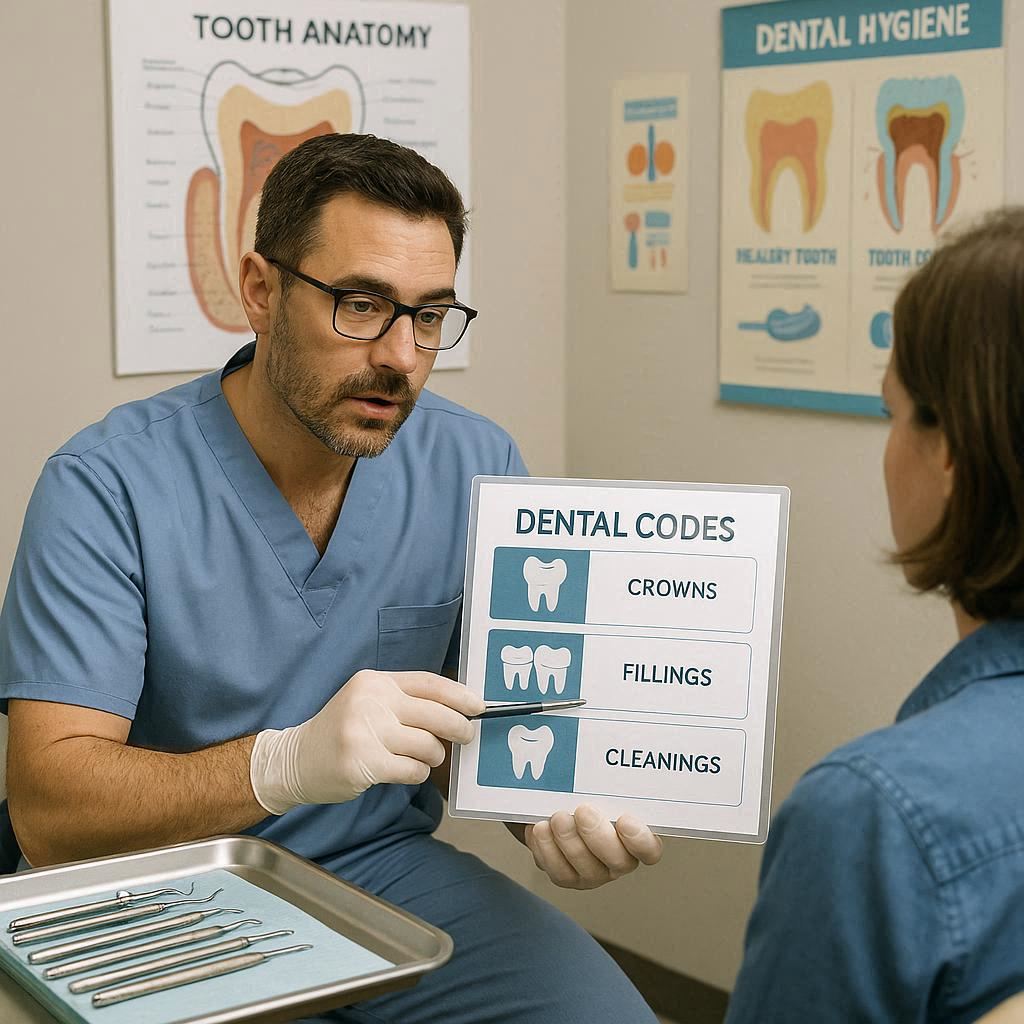
Think of a crown like a small helmet for your tooth. When a tooth is too damaged, too weak, or too ugly to fix with a simple filling, a dentist will shape the tooth down and cover it completely with a crown. This “cap” restores the tooth’s shape, size, strength, and appearance.
You might need a crown for several common reasons:
- After a root canal: The tooth becomes brittle and needs protection.
- Large cavities: When a filling would be bigger than the healthy tooth left.
- Cracked tooth syndrome: To hold the tooth together and stop pain when chewing.
- Cosmetic reasons: To cover a tooth that is badly stained or misshapen.
- Dental implant: To serve as the visible “tooth” on top of an implant post.
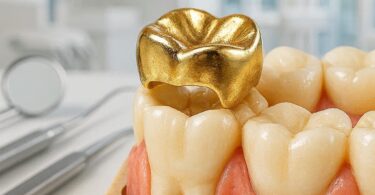
Crowns can be made from different materials. The most common ones are porcelain (looks natural), ceramic, metal (gold or silver), or a mix of porcelain fused to metal.
Now, here is the important part. From an insurance and billing perspective, not all crowns are treated the same. And that is where the dental codes come into play.
The Short Answer: The Main Dental Code for Crown
Let us answer your main question directly.
The primary dental code for a crown is D2740.
This code stands for “Crown – Porcelain/Ceramic Substrate.” In plain English, this means a crown that is made entirely of porcelain or ceramic with no metal inside.
If your dentist recommends a crown that looks completely natural and metal-free, they will almost certainly bill this code.
However, and this is a big “however,” D2740 is not the only crown code. Depending on the material your dentist uses and the specific tooth being treated, the code might change.
Think of D2740 as the “standard” answer. But like ordering coffee, sometimes you want a different version. You would not use the same code for a gold crown as you would for a white porcelain crown. Insurance companies are very picky about this.
The Complete List of Dental Crown Codes (D27xx Series)
The American Dental Association (ADA) created a standardized coding system called CDT (Current Dental Terminology). All crown codes fall under the D27xx series.
Here is a simple, honest breakdown of every crown code you might see on a bill.
| Code | Official Description | What It Means For You |
|---|---|---|
| D2710 | Crown – Resin (Composite) | A crown made of tooth-colored plastic/resin. Usually a temporary or lower-cost option. Not as strong as porcelain. |
| D2712 | Crown – Resin with High Viscosity | A thicker, stronger resin crown. More durable than D2710 but still not as long-lasting as ceramic. |
| D2720 | Crown – Resin with Metal | A plastic crown that has a metal inside layer. Strong, but not beautiful. Rarely used today. |
| D2721 | Crown – Resin with Metal – High Viscosity | Same as above but with a stronger resin outer layer. |
| D2740 | Crown – Porcelain/Ceramic Substrate | The most common code. All-ceramic, metal-free crown. Best for natural look. Great for front teeth. |
| D2750 | Crown – Porcelain Fused to High Noble Metal | Porcelain on the outside, high noble metal (gold, platinum, palladium) inside. Very strong and durable. |
| D2751 | Crown – Porcelain Fused to Predominantly Base Metal | Porcelain on the outside, cheaper metal (nickel, chromium) inside. Strong but some people have metal allergies. |
| D2752 | Crown – Porcelain Fused to Noble Metal | Porcelain on the outside, noble metal (not as valuable as high noble, but better than base). A middle option. |
| D2780 | Crown – 3/4 Cast High Noble Metal | A partial crown (covers only 3/4 of the tooth) made of high noble metal. Preserves more natural tooth. |
| D2781 | Crown – 3/4 Cast Predominantly Base Metal | Same partial coverage but with base metal. |
| D2782 | Crown – 3/4 Cast Noble Metal | Same partial coverage with noble metal. |
| D2783 | Crown – 3/4 Porcelain/Ceramic | A partial crown made of porcelain. Less common today due to better bonding techniques. |
| D2790 | Crown – Full Cast High Noble Metal | A full gold or high noble metal crown. Very durable. Best for back molars that take heavy chewing force. |
| D2791 | Crown – Full Cast Predominantly Base Metal | Full metal crown made of cheaper base metals. |
| D2792 | Crown – Full Cast Noble Metal | Full metal crown made of noble metal (like silver). |
| D2794 | Crown – Titanium | A full crown made of titanium. Often used for patients with severe metal allergies. |
Important Note for Readers: Do not panic if you see a code on your bill that is not D2740. Your dentist did not make a mistake. They chose the material that is best for your specific tooth, your bite, and your budget. A gold crown (D2790) on a back molar is often a smarter choice than a porcelain crown (D2740) because it lasts longer.
Why Does the Exact Code Matter So Much?
You might be thinking, “A crown is a crown. Why does the insurance company care about the exact material?”
The honest answer is money.
Insurance companies have a “preferred” code for each situation. And they will pay less, or sometimes nothing at all, if your dentist uses a different code.
Here is a real-world example.
Let us say you need a crown on a back molar. Your dentist recommends a full gold crown (D2790) because gold is soft, seals well, and lasts for decades. But your insurance company’s policy says they only cover “porcelain fused to metal” (D2750) for back teeth.
The result? You might get a check from insurance for $500. But the gold crown costs $1,200. You pay $700 out of pocket.
If your dentist had used the D2750 code, the insurance might have paid $800, leaving you with only $400 to pay.
That is why knowing your codes matters. It helps you have an honest conversation with your dentist about what your insurance will actually pay for.
Temporary Crowns Have Their Own Code
There is one more code you will almost certainly see on your treatment plan.
Before you get your permanent crown, your dentist will place a temporary crown. This is a plastic or resin cap that protects your tooth for the two or three weeks while the lab makes your real crown.
The code for a temporary crown is D2930.
This code stands for “Prefabricated Crown – Resin.”
Here is an important financial truth. Many patients assume the temporary crown is included in the price of the permanent crown. It is not always.
Some dentists include the temporary crown in their global fee. Others bill it separately. You should always ask: “Is code D2930 included in my crown price, or will I see a separate charge?”
A separate temporary crown fee is usually small, between $50 and $150. But it is better to know upfront than to be surprised on your bill.
What About Crown Repairs and Recementing?
Crowns are tough, but they are not invincible. Over time, a crown can chip, crack, or simply fall off.
When this happens, your dentist does not bill the original crown code again. They use different codes for repairs.
| Code | Description | Typical Cost (Without Insurance) |
|---|---|---|
| D2920 | Recement Crown | The crown is still in good shape, but it fell off. The dentist cleans it and glues it back on. |
| D2980 | Repair Crown (Chairside) | A small chip or crack. The dentist fixes it in the office without removing the crown. |
| D2990 | Repair Crown (Lab) | The crown has significant damage. The dentist removes it, sends it to a lab for repair, then re-cements it. |
A quick tip: If your crown falls off, do not throw it away. Put it in a safe place and call your dentist. As long as the crown is intact, code D2920 (recement) is much cheaper than making a whole new crown.
How Insurance Uses Crown Codes Against You (And What to Do)
Let us be honest for a moment. Dental insurance is not really insurance like medical insurance. It is more like a coupon book with annual limits.
Insurance companies use crown codes to manage their costs. They have a few common “tricks” you should know about.
The “Downcoding” Trick
Sometimes, your dentist submits a claim for a porcelain crown (D2740) because that is what you need. The insurance company looks at the claim and changes the code to a cheaper one, like resin (D2710), and pays based on that cheaper code.
This is called downcoding. It is legal, but it is frustrating.
What can you do? Ask your dentist’s office to appeal the decision. If your dentist can prove that a porcelain crown is medically necessary (for example, because of a metal allergy), the insurance company might reverse the decision.
The “Frequency Limitation” Rule
Most insurance plans will only pay for a crown on the same tooth once every five, seven, or even ten years.
If your crown breaks after three years, insurance will likely deny the claim. They will say, “Too soon. Not covered.”
In this case, your only options are to pay out of pocket or ask your dentist if a repair (D2980) is possible instead of a full replacement.
The “Missing Tooth” Clause
Here is a weird one. Some insurance plans will not pay for a crown on a tooth if the tooth next to it is missing. Their logic? If the tooth has no neighbor, it is not “functional.”
Always read your policy’s fine print about “abutment teeth” and “functioning dentition.”
A Complete Walkthrough: From Diagnosis to Billing
To make all of this feel more real, let us walk through a typical patient story.
Meet Sarah. Sarah is 45 years old. Her back molar has a large, old silver filling that is starting to crack the tooth.
Step 1: Diagnosis
The dentist takes an x-ray and sees the crack. The dentist says, “Sarah, you need a crown to hold this tooth together.”
Step 2: Treatment Plan
The dentist’s office gives Sarah a printed treatment plan. On that plan, they write:
- D2740 (Porcelain crown) – Recommended for natural look.
- D2930 (Temporary crown) – While the lab makes the permanent one.
Step 3: Insurance Pre-determination
The dentist sends these codes to Sarah’s insurance company. The insurance replies: “We will pay 50% of D2740 after Sarah meets her $50 deductible. We do not pay for D2930.”
Step 4: Sarah’s Decision
Sarah now knows:
- The crown costs $1,400.
- Insurance will pay $700.
- Sarah owes $700 for the crown + $100 for the temporary crown = $800 total.
Step 5: The Procedure
The dentist prepares the tooth, takes impressions, places the temporary crown (D2930).
Step 6: Two Weeks Later
Sarah returns. The dentist removes the temporary crown and cements the permanent porcelain crown (D2740).
Step 7: The Bill
Sarah receives an explanation of benefits (EOB) that shows:
- D2740 – Billed $1,400 – Insurance paid $700 – Sarah owes $700.
- D2930 – Billed $100 – Insurance paid $0 – Sarah owes $100.
Because Sarah understood the codes from the beginning, there were no surprises. She knew exactly what to expect.
The Most Common Questions Patients Ask About Crown Codes
Let us answer the real questions people ask in dental offices every single day.
“Can my dentist use a different code to help my insurance pay more?”
This is a very common question, and the answer is delicate.
Technically, it is insurance fraud for a dentist to bill a code that does not match the procedure they performed. For example, billing a gold crown (D2790) when they placed a porcelain crown (D2740) is illegal.
However, a dentist can choose a different material that still fits your clinical needs and is covered better by your insurance. This is called “treatment planning within your benefits.” It is completely legal and ethical.
Always have an honest conversation: “Doc, my insurance does not cover D2740 well. Is there another crown code they do cover that would work for my tooth?”
“What is the code for a crown on a dental implant?”
This is an excellent question because it confuses many patients.
A crown that goes on a natural tooth uses the D27xx codes we listed above.
A crown that goes on a dental implant uses completely different codes. They are in the D60xx series.
| Code | Description |
|---|---|
| D6058 | Abutment Supported Porcelain/Ceramic Crown |
| D6059 | Abutment Supported Porcelain Fused to Metal Crown |
| D6060 | Abutment Supported Cast Metal Crown |
| D6061 | Abutment Supported Resin Crown |
Why the different codes? Because attaching a crown to an implant is clinically different from attaching it to a natural tooth. The insurance companies want to track these procedures separately.
“Why did I get two crown codes on the same tooth?”
Sometimes a bill will show two crown codes for the same tooth on the same day. This is usually a mistake, but not always.
One rare but legitimate reason is a “crown buildup” (D2950). This is not a crown. It is a filling that rebuilds the core of the tooth so the crown has something to hold onto. You will see both D2950 and your crown code on the same bill.
If you see two crown codes (like D2740 and D2790), call your dentist. Someone probably made a data entry error.
How Much Do Crowns Actually Cost by Code?
Let us talk about real money. These are average fees in the United States without insurance. Your location and your dentist’s experience will change these numbers.
| Code | Material | Average Cost (No Insurance) | Insurance typically pays |
|---|---|---|---|
| D2710 | Resin (Composite) | $600 – $900 | 50-80% |
| D2740 | Porcelain/Ceramic | $1,000 – $1,800 | 50-80% |
| D2750 | Porcelain Fused to High Noble Metal | $900 – $1,500 | 50-80% |
| D2751 | Porcelain Fused to Base Metal | $800 – $1,300 | 50-80% |
| D2790 | Full Cast High Noble Metal (Gold) | $1,000 – $2,000 | 50-80% (often less for gold) |
| D2791 | Full Cast Base Metal | $700 – $1,200 | 50-80% |
| D2930 | Temporary Crown | $50 – $150 | Usually $0 (not covered) |
A crucial note: Dental discount plans work differently. They have set fees for each code. A porcelain crown (D2740) might cost a flat $750 on a discount plan, regardless of what the dentist normally charges. Always ask for the “code-specific fee” before joining a discount plan.
The Difference Between “Core Buildup” and Crown Codes
One of the biggest sources of billing confusion is the “core buildup” code, D2950.
Here is the honest truth. A crown does not just snap onto a tooth like a Lego. If your tooth is badly broken down, there is nothing for the crown to hold onto. The dentist must first build up the tooth’s core using filling material.
- D2950 = Core buildup (a special filling under the crown).
- D27xx = The crown itself.
You should expect to see both codes on your treatment plan if your tooth has a large cavity or is cracked. The core buildup is not a scam. It is a necessary step.
However, some insurance companies consider D2950 to be “part of the crown” and will not pay for it separately. Others will pay for it only if the tooth has less than 50% of its original structure left.
Always ask your dentist: “Do I really need D2950, or can the crown be made without it?”
Geographic Variations: Do Crown Codes Change by State or Country?
The ADA’s CDT codes are standardized across the United States. D2740 means the same thing in New York, Texas, and California.
However, the price attached to that code changes dramatically based on where you live.
- Rural area: D2740 might cost $900.
- Suburb: D2740 might cost $1,300.
- Major city (NYC, LA, Chicago): D2740 might cost $2,000 or more.
If you travel to another country for dental work (dental tourism), they may not use ADA codes at all. They might use FDI (World Dental Federation) codes or no codes at all. Be very careful. Your insurance will almost never pay for a crown done outside the United States.
How to Read Your Explanation of Benefits (EOB)
Your EOB is not a bill. It is an explanation from your insurance company. But it can be scary to read. Let us decode a real example.
Example EOB:
| Procedure Code | Billed Amount | Allowed Amount | Insurance Paid | Patient Responsibility |
|---|---|---|---|---|
| D2740 | $1,500 | $1,000 | $500 | $500 |
| D2930 | $100 | $0 | $0 | $100 |
- Billed Amount: What the dentist charged.
- Allowed Amount: What your insurance contract says the procedure is worth. The dentist must write off the $500 difference ($1,500 – $1,000 = $500). You never pay the difference between billed and allowed.
- Insurance Paid: Usually 50% of the allowed amount for crowns.
- Patient Responsibility: Your portion (the other 50% of allowed amount + any non-covered codes).
If the “Allowed Amount” column is missing or says $0, your insurance denied the claim. You need to call them.
Five Tips to Avoid Surprise Crown Bills
Let us end this section with practical advice you can use tomorrow.
- Ask for the codes before treatment. Say, “Please write down the D codes for my crown, the temporary, and the core buildup.”
- Call your insurance yourself. Do not assume the dentist’s office did it right. Read the codes to the insurance representative and ask, “What is my patient responsibility for each code?”
- Ask about the “upgrade” fee. Some dentists accept insurance for a base metal crown (D2751) but offer porcelain (D2740) as an “upgrade” with an extra fee. Get this in writing.
- Check for bundling. Some insurance companies will say, “We only pay for D2930 (temporary) if it is billed on a separate date of service.” This is silly but true. Ask your dentist to bill on different days.
- Do not be afraid to appeal. If insurance downcodes or denies your claim, write a short appeal letter. Include a note from your dentist. Patients win appeals more often than you think.
Conclusion
Let us summarize this entire guide into three simple lines.
The main dental code for a crown is D2740 for porcelain/ceramic, but the exact code changes based on the material (gold, metal, resin) and the tooth’s location. Understanding these codes helps you avoid billing surprises, ask smarter questions, and potentially save hundreds of dollars on your dental care. Always request the specific codes before treatment and verify coverage with your insurance company directly.
Frequently Asked Questions (FAQ)
Q1: What is the difference between D2740 and D2750?
A: D2740 is a crown made entirely of porcelain or ceramic with no metal. D2750 is porcelain fused to a high noble metal (like gold) inside. D2740 looks more natural. D2750 is slightly stronger for back teeth.
Q2: Will my insurance cover D2740?
A: Most PPO plans cover D2740 at 50% of their allowed amount. However, some older plans only cover metal or porcelain-fused-to-metal crowns for back teeth. Always check your specific policy.
Q3: Can I ask my dentist to use a different code to get better insurance payment?
A: No, that would be insurance fraud. But you can ask your dentist if a different material (with a different code) would still work well for your tooth and be covered better by your plan.
Q4: What code is used for a same-day crown (CEREC)?
A: The same crown codes apply (D2740, D2750, etc.). The difference is in the technique, not the code. Same-day crowns are not billed with a special code. They simply use the standard crown code for the material used.
Q5: Why was I charged D2930 (temporary crown) separately?
A: Many insurance plans do not cover temporary crowns. The dentist still has to make one to protect your tooth. This fee is usually small ($50-$150) and is separate from the permanent crown.
Q6: How often can I bill insurance for a crown on the same tooth?
A: Most plans have a frequency limitation of 5, 7, or 10 years per tooth. Check your policy’s “crown replacement frequency” clause.
Q7: What is the code for a crown repair?
A: D2980 for a repair done in the dentist’s office. D2920 for recementing a crown that fell off.
Q8: My crown code on my bill is D2999. What does that mean?
A: D2999 is a “miscellaneous” code. It means your dentist performed a crown procedure that does not fit any standard code. You should ask for a written explanation of exactly what was done. Insurance often denies D2999 because it is not a standard code.
Additional Resource
For the most up-to-date official dental codes directly from the American Dental Association, visit the CDT Code Search Tool on the ADA’s official website. You can also find patient-friendly guides to understanding dental benefits at the National Association of Dental Plans (NADP) website.
Link placeholder: www.ada.org/en/publications/cdt/coverage-for-dental-codes
Disclaimer: This article is for informational purposes only and does not constitute medical, billing, or legal advice. Dental codes vary by region and insurance provider. Always consult your dentist and insurance carrier for precise information.
Author: Digital Health Desk
Date: APRIL 18, 2026