You are not alone if your heart races the moment you smell a dental office.
Millions of people around the world avoid the dentist because of fear. Some even lose sleep before a routine cleaning. The good news is that modern medicine recognizes this fear as a real condition.
And yes, there is a specific diagnosis code for dental anxiety.
This guide walks you through everything you need to know about that code. We will explore why it matters, how it affects your treatment options, and what it means for insurance coverage. No complex medical jargon. Just clear, honest answers.
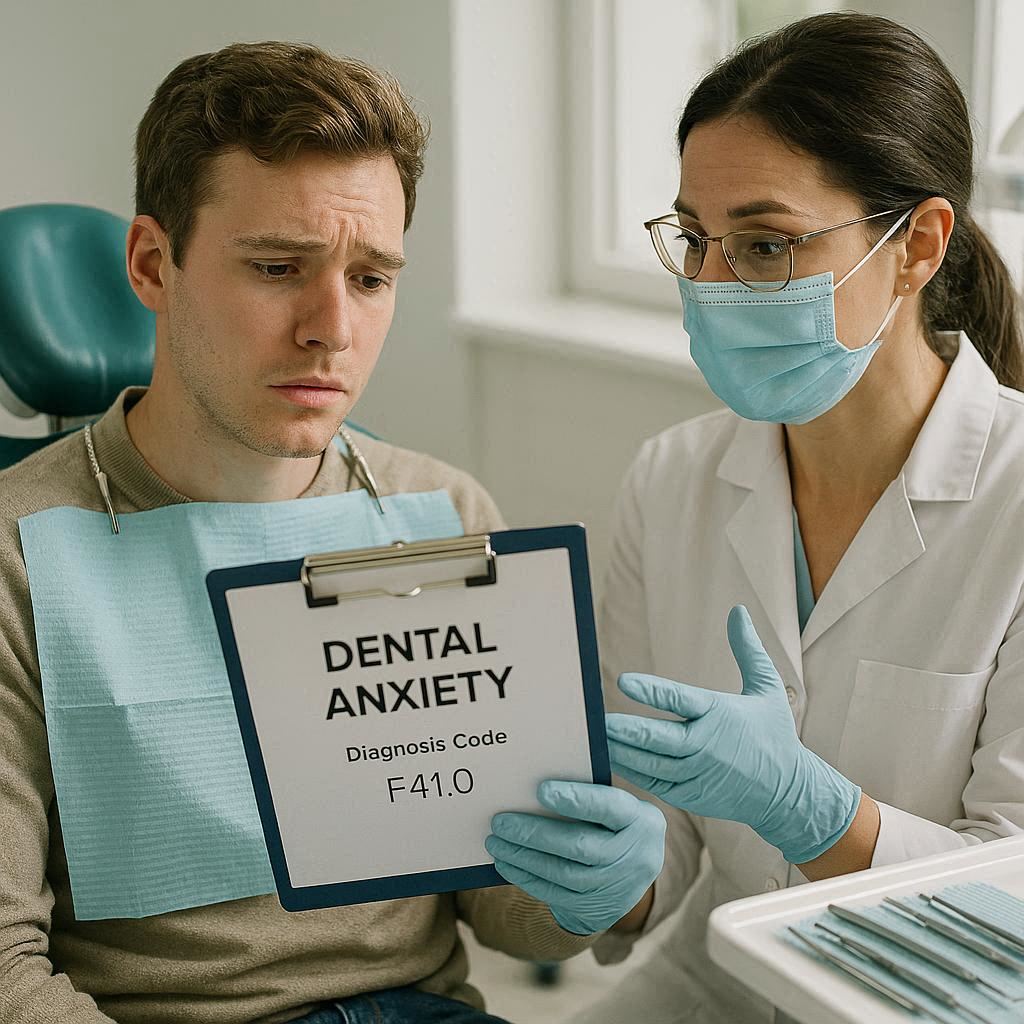
What Exactly Is Dental Anxiety?
Dental anxiety is more than just feeling nervous before an appointment. It is a persistent fear of dental procedures that can stop you from getting necessary care.
Some people feel a mild flutter in their stomach. Others experience full-blown panic attacks in the waiting room.
Common signs of dental anxiety
- Trouble sleeping the night before a dental visit
- Feeling physically ill or crying at the thought of a dentist
- Increased heart rate or sweating in the dental chair
- Needing to stop a procedure multiple times
- Avoiding the dentist for years, even with tooth pain
This condition is very common. Studies suggest that nearly one in three adults experiences some level of dental anxiety. For about one in ten, the fear is severe enough to cause complete avoidance.
The important thing to remember is that dental anxiety is not a personal weakness. It is a recognized medical condition. And because it is recognized, it has its own diagnostic code.
The Official Diagnosis Code for Dental Anxiety
Let us get straight to the answer you came for.
The official diagnosis code for dental anxiety is F40.2.
This code belongs to a larger family of codes used by doctors, dentists, and insurance companies. The full name is “F40.2 – Other specified phobias.” Under this umbrella, dental anxiety is classified as a specific phobia.
Breaking down the code
| Code Component | Meaning |
|---|---|
| F | Mental and behavioral disorders |
| 40 | Phobic anxiety disorders |
| .2 | Other specified phobias (including dental fear) |
This code comes from the ICD-10 system. ICD stands for International Classification of Diseases. It is the global standard for tracking health conditions.
Version 10 is currently used in most countries, including the United States. The system allows healthcare providers to document exactly what is affecting a patient.
What F40.2 includes
The F40.2 code covers several specific phobias, such as:
- Animal phobias (fear of spiders, dogs, or snakes)
- Natural environment phobias (fear of heights, storms, or water)
- Blood-injection-injury phobias
- Situational phobias (flying, enclosed spaces, elevators)
- Dental phobia (fear of dental examinations or procedures)
So when your dentist or doctor assigns F40.2, they are officially documenting that your fear of dental care is a genuine health concern.
Why This Code Matters to You
You might wonder why a code matters at all. After all, you just want to get through your appointment without panicking.
But this small combination of letters and numbers can make a big difference in your care.
Insurance recognition
Insurance companies rely on diagnostic codes to approve treatments. Without a proper code, they may refuse to pay for certain services.
For example, many dental insurance plans do not cover sedation or anxiety management. But when your provider uses the F40.2 code, it signals that sedation is not a luxury. It is a medical necessity for you to receive care.
Medical record accuracy
Your health records tell a story. If you have dental anxiety, that information should be clearly documented. The F40.2 code ensures that any future provider knows about your fear before you even sit in the chair.
This saves you from having to explain your anxiety repeatedly. It also helps new dentists prepare a calm, patient-centered approach from the first visit.
Access to specialized care
Some dental practices specialize in treating anxious patients. They may require documentation of your condition before offering certain services like oral sedation or general anesthesia.
The F40.2 code serves as that official documentation. It opens doors to specialized clinics that might otherwise turn you away.
How Dental Anxiety Is Diagnosed
Getting a diagnosis code is not automatic. A qualified professional must first determine that your fear meets specific criteria.
This process is straightforward and respectful. No one will force you into a chair or trick you into a procedure.
The diagnostic process
A dentist or mental health professional will typically:
- Ask about your dental history – When did the fear start? What triggers it?
- Assess your avoidance behavior – How long have you avoided the dentist?
- Rate your anxiety level – Using validated scales like the Modified Dental Anxiety Scale (MDAS)
- Rule out other conditions – Ensuring your symptoms are not caused by something else
The professional will listen without judgment. They understand that dental anxiety has many causes, including past trauma, fear of pain, or even stories you heard as a child.
Who can assign the F40.2 code?
Several healthcare providers can diagnose dental anxiety:
- General dentists with training in anxiety management
- Oral surgeons
- Psychiatrists and psychologists
- Licensed clinical social workers
- Some primary care physicians
Not every dentist will assign this code during a routine exam. You may need to ask for a formal anxiety assessment. Do not hesitate to bring up your fears. Dentists hear about dental anxiety every single day.
Treatment Options Covered by This Diagnosis
Once you have the F40.2 code on your record, you gain access to several treatment pathways. These options range from simple behavioral techniques to medical interventions.
Behavioral approaches
Cognitive behavioral therapy (CBT) is highly effective for dental anxiety. A therapist helps you identify negative thought patterns and replace them with realistic ones. Over several sessions, your fear response gradually decreases.
Exposure therapy involves gradual, controlled contact with dental stimuli. You might start by just looking at pictures of a dental office. Later, you sit in the waiting room. Eventually, you sit in the chair without any treatment.
Relaxation techniques include deep breathing, guided imagery, and progressive muscle relaxation. You can learn these in a few minutes and use them during actual appointments.
Pharmacological options
Oral sedation involves taking a pill about an hour before your appointment. Common medications include diazepam (Valium) or triazolam (Halcion). You remain awake but deeply relaxed. Many patients remember little of the procedure afterward.
Nitrous oxide – also known as laughing gas – is inhaled through a small mask. The effect wears off within minutes after the mask is removed. You can drive yourself home afterward.
IV sedation delivers medication directly into your bloodstream. This produces a deeper level of relaxation. Most patients have no memory of the procedure. You will need someone to drive you home.
General anesthesia puts you completely to sleep. This is usually reserved for complex procedures or for patients with extreme phobias. It is often performed in a hospital or surgical center.
Which option is right for you?
| Anxiety Level | Recommended Approach |
|---|---|
| Mild (nervous but can cope) | Relaxation techniques + supportive dentist |
| Moderate (significant distress, some avoidance) | Nitrous oxide or oral sedation + CBT |
| Severe (panic attacks, years of avoidance) | IV sedation or general anesthesia + therapy |
Your dentist will work with you to find the safest and most effective option. The F40.2 code makes it easier to justify these interventions to insurance companies.
Does Insurance Cover Treatment for Dental Anxiety?
This is where honest expectations matter. Insurance coverage for dental anxiety treatment varies widely.
Dental insurance
Most standard dental insurance plans do not cover sedation or anxiety management for routine procedures like fillings or cleanings. However, there are important exceptions.
Some plans cover sedation if:
- The F40.2 code is clearly documented
- The procedure is complex (wisdom teeth removal, implants)
- The patient has a documented medical condition that requires sedation
- The plan includes a “conscious sedation” rider
Always call your insurance provider before scheduling sedation. Ask specifically about coverage for “diagnosed dental phobia (F40.2).” Get the answer in writing if possible.
Medical insurance
Here is a strategy many patients overlook. Medical insurance sometimes covers dental anxiety treatment when it is framed as a mental health condition.
Because F40.2 is a mental health diagnosis, you may be able to access:
- Therapy sessions with a psychologist (CBT for phobias)
- Psychiatric consultations for anti-anxiety medication
- In rare cases, sedation administered by a medical anesthesiologist
The catch is that the treatment must be billed through your medical insurance, not your dental insurance. You may need a referral from your primary care physician.
Out-of-pocket costs
Realistically, many patients pay for dental sedation themselves. Costs vary by region and provider:
- Oral sedation: $100 – $300 per appointment
- Nitrous oxide: $50 – $150 per appointment
- IV sedation: $300 – $800 per hour
- General anesthesia: $500 – $2,000 per session
Do not let these numbers scare you. Many dental offices offer payment plans. Some even provide discounts for patients who pay in cash. Talk openly with your dentist about financial concerns.
Important Note for Readers
Do not self-diagnose. Only a qualified healthcare professional can assign the F40.2 code to your record. Self-tagging your condition may lead to incorrect treatment or insurance problems. Always seek a formal evaluation if you believe you have dental anxiety.
How to Talk to Your Dentist About Anxiety
Bringing up your fear can feel embarrassing. But remember: dental professionals deal with anxious patients every single day. They have seen it all.
Use this simple script to start the conversation:
“I have a lot of anxiety about dental work. In fact, I have avoided coming for [X years]. I think I might have a phobia. Can we talk about ways to make this easier for me?”
Questions to ask your dentist
- Have you treated patients with dental anxiety before?
- Do you use the F40.2 diagnosis code for anxious patients?
- What sedation options do you offer?
- Can I schedule a “meet and greet” appointment with no treatment?
- Do you have a signal I can use to stop the procedure?
A good dentist will welcome these questions. A great dentist will thank you for being honest.
The Difference Between Dental Anxiety and Dental Phobia
You will see two terms used in articles like this one: dental anxiety and dental phobia. They are related but not identical.
| Feature | Dental Anxiety | Dental Phobia (F40.2) |
|---|---|---|
| Intensity | Mild to moderate | Severe |
| Avoidance | May delay appointments | Avoids at all costs |
| Physical symptoms | Some sweating, increased heart rate | Panic attacks, nausea, crying |
| Daily impact | Minor | Significant |
| Diagnosis code | May not require a code | F40.2 assigned |
Most people with dental phobia meet the criteria for F40.2. People with milder anxiety may not need a formal code unless their symptoms interfere with necessary care.
Creating Your Personal Anxiety Management Plan
A diagnosis code is just the first step. The real work happens when you build a strategy that works for you.
Step 1: Find the right provider
Look for dentists who advertise “sedation dentistry,” “anxiety-free dentistry,” or “special needs dentistry.” Read online reviews from other anxious patients. Call the office and ask how they handle fearful patients.
Step 2: Schedule a consultation
Do not book a procedure on your first visit. Instead, schedule a 15-minute consultation. Sit in the chair fully clothed. Let the dentist look in your mouth without doing any work. This builds trust gradually.
Step 3: Establish clear signals
Agree on a stop signal before any procedure begins. A simple hand raise works well. When you give the signal, the dentist stops immediately. This gives you a sense of control.
Step 4: Start small
Your first appointment might involve nothing more than a conversation. The second might be a single x-ray. The third could be a cleaning. Move at your own pace. There is no finish line.
Step 5: Use your support system
Bring a trusted friend or family member to appointments. Their presence can lower your anxiety significantly. Some dentists even allow support persons to stay in the room during treatment.
What If You Cannot Afford Treatment?
Financial barriers are real. Do not let cost stop you from seeking help. Several low-cost options exist.
Community health centers
Federally qualified health centers offer dental care on a sliding fee scale. Some employ dentists trained in anxiety management. Call your local center and ask about sedation options.
Dental schools
Teaching clinics provide low-cost care supervised by experienced faculty. Many dental schools have special clinics for anxious patients. The appointments take longer, but the savings are substantial.
Nonprofit organizations
Groups like the Dental Lifeline Network connect volunteer dentists with patients who have special needs. This includes people with severe dental phobia. There may be a waiting list, so apply early.
Payment plans
Many private dental offices offer in-house financing. You might pay 50% upfront and the rest over six months. Always ask about payment plans before assuming you cannot afford care.
Frequently Asked Questions (FAQ)
Q: Can I get the F40.2 code from my regular doctor?
A: Yes. Your primary care physician can diagnose dental anxiety and assign the code. They may refer you to a dentist for actual treatment.
Q: Will having F40.2 on my record affect my health insurance premiums?
A: Generally, no. Mental health diagnoses like specific phobias do not typically raise premiums for standard health insurance plans.
Q: Can children receive the F40.2 diagnosis?
A: Yes. Pediatric dentists often diagnose dental anxiety in children. The same code applies regardless of age.
Q: How long does the F40.2 code stay on my record?
A: It remains until a provider determines your condition has resolved. Many adults carry the diagnosis for years, which is perfectly normal.
Q: Does F40.2 cover fear of needles used in dentistry?
A: Yes. Needle phobia related to dental injections falls under this code as long as the fear is specific to dental procedures.
Q: Can I request the F40.2 code if my dentist refuses?
A: You can ask for a second opinion. If your dentist disagrees with the diagnosis, you may need an evaluation from a mental health professional.
Q: Will my employer see this diagnosis?
A: No. Medical privacy laws protect your specific diagnoses. Employers only see anonymized billing data, not detailed codes.
Additional Resources
For more information on dental anxiety and finding a compassionate dentist, visit the ADAA (Anxiety & Depression Association of America) dental anxiety resource page. They offer directories of mental health professionals who specialize in phobia treatment.
Link: adaa.org/find-help-for-dental-anxiety
Common Myths About Dental Anxiety Codes
Let us clear up a few misunderstandings.
Myth: The F40.2 code means you are crazy.
Truth: Specific phobias are among the most common mental health conditions. Millions of successful, healthy people have this code on their records.
Myth: Dentists will use the code to charge you more.
Truth: Diagnostic codes exist for documentation, not pricing. Your treatment fees are based on procedures performed, not the diagnosis code.
Myth: Once you have the code, you must use sedation forever.
Truth: Many patients eventually overcome their anxiety and no longer need sedation. The code simply stays in your history.
Myth: Insurance always covers sedation with this code.
Truth: As discussed earlier, coverage varies. The code helps your case but does not guarantee payment.
A Note on Realistic Expectations
This article does not promise miracles. No diagnosis code will magically erase your fear. Sedation is not right for everyone. Some people try therapy for months and still feel anxious.
That is okay.
Progress looks different for everyone. For some, progress means getting a full filling without shaking. For others, progress means simply walking into the dental office and sitting in the waiting room for two minutes.
Celebrate small victories. Be patient with yourself. And remember that avoiding the dentist entirely is far more dangerous than facing your fear with proper support.
Putting It All Together
You now have the complete picture of the diagnosis code for dental anxiety.
- The official code is F40.2 (Other specified phobias).
- This code recognizes your fear as a legitimate medical condition.
- It helps with insurance approval for sedation and therapy.
- It opens access to specialized anxiety management treatments.
- You need a formal diagnosis from a healthcare provider to use it.
Do not let fear control your dental health any longer. Talk to a dentist today about your anxiety. Ask about the F40.2 code. Build a treatment plan that works for you.
Your smile is worth it.
Conclusion
The diagnosis code for dental anxiety is F40.2, a recognized medical code that validates your fear as a real health condition. This code helps secure insurance coverage for sedation and therapy while ensuring accurate medical records. Most importantly, it opens the door to compassionate, effective dental care without shame or judgment.
Disclaimer: This article is for informational and educational purposes only. It does not constitute medical advice, diagnosis, or professional coding recommendations. Always consult with a licensed dentist, physician, or certified medical coder for accurate diagnosis and billing.
Author: Technical Health Writer
Date: APRIL 21, 2026