If you are researching Invisalign, you have probably heard a lot about clear aligners, treatment time, and cost. But there is one question that often confuses patients and even some front-desk staff: what dental code is used for Invisalign?
The short answer is that there is no single code labeled “Invisalign” in the dental world. Instead, dental professionals use a specific set of ADA (American Dental Association) CDT codes. These codes describe the type of orthodontic treatment you receive.
Understanding this code is important. It helps you verify your insurance benefits. It also explains why your treatment might cost a certain amount.
In this guide, we will break down everything you need to know about Invisalign dental codes. You will learn which codes apply to you, how insurance reads them, and what to expect on your bill.
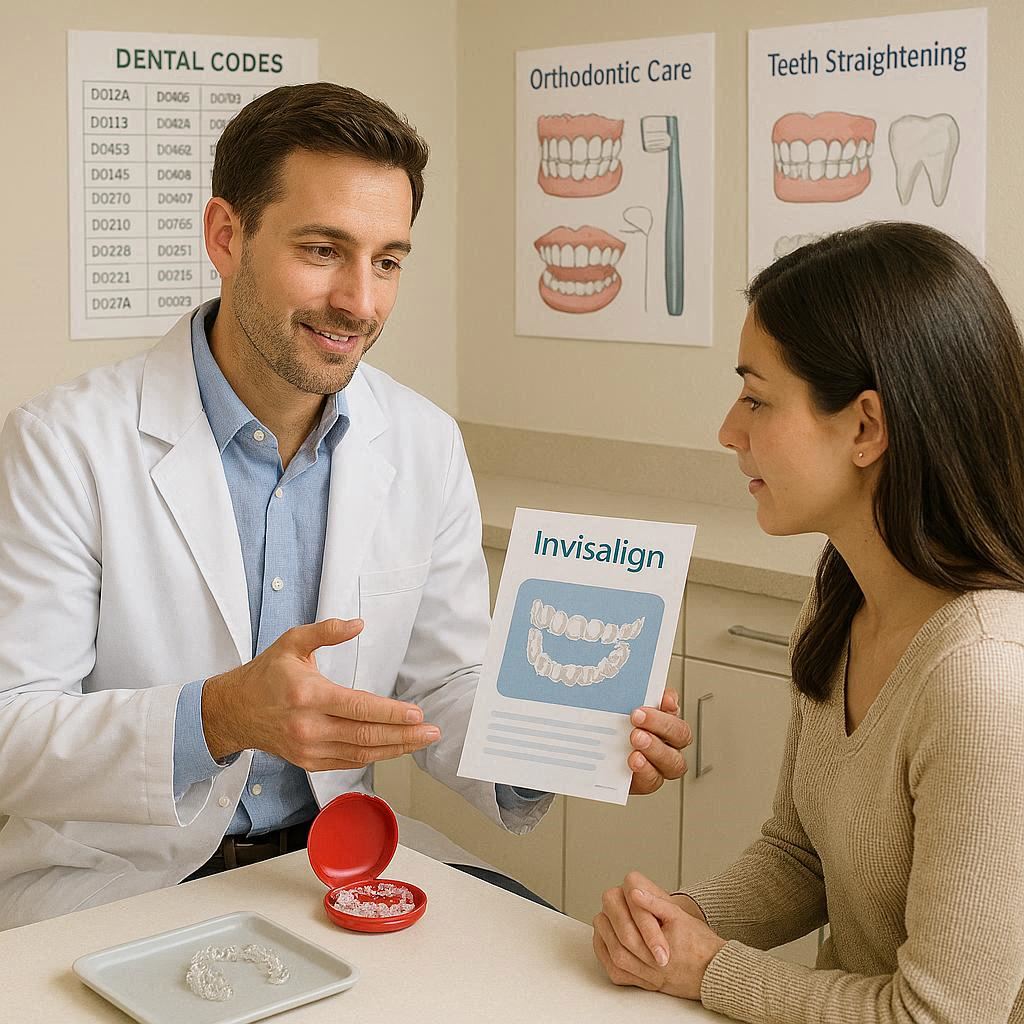
Why Dental Codes Matter for Your Invisalign Treatment
Before we list the codes, let us talk about why these numbers matter to you as a patient.
Dental offices use CDT (Current Dental Terminology) codes to communicate with insurance companies. When your orthodontist submits a claim, they must pick the correct code. That code tells your insurer exactly what service you received.
If the wrong code is used, your claim may be denied. Or you might pay more than you expected.
For Invisalign, the codes are not unique to the brand “Invisalign.” Instead, they describe the type of malocclusion (bite problem) being treated and whether the treatment is comprehensive or limited.
This means that traditional metal braces and Invisalign often share the same code categories. The difference is in the appliance used, but the billing code reflects the service, not the brand name.
Important Note: Always ask your dental office to verify your benefits using the correct code before starting treatment. A verbal estimate is not enough.
The Main Dental Codes for Invisalign (Comprehensive List)
The American Dental Association (ADA) publishes the CDT code set. For orthodontic treatment, the codes fall under the D8000 series. Here are the specific codes your dentist might use for Invisalign.
Comprehensive Orthodontic Treatment Codes
These codes are used for full treatment that corrects the entire bite. Most Invisalign cases fall into this category.
| CDT Code | Description | When Used for Invisalign |
|---|---|---|
| D8080 | Comprehensive orthodontic treatment of the adolescent dentition (early teens) | Most common code for teens with full Invisalign treatment. |
| D8090 | Comprehensive orthodontic treatment of the adult dentition | Most common code for adults over 18 receiving full Invisalign. |
| D8070 | Comprehensive orthodontic treatment of the transitional dentition (mixed baby and permanent teeth) | Used for younger patients with a mix of baby and adult teeth. |
Limited Orthodontic Treatment Codes
These codes are for shorter, less complex cases. For example, treating only the front teeth (social six) or a minor relapse.
| CDT Code | Description | When Used for Invisalign |
|---|---|---|
| D8010 | Limited orthodontic treatment of the primary dentition (baby teeth) | Rare for Invisalign, but possible for very young children. |
| D8020 | Limited orthodontic treatment of the transitional dentition | Minor corrections before all permanent teeth erupt. |
| D8030 | Limited orthodontic treatment of the adolescent dentition | Short-term Invisalign treatment for teens (e.g., minor crowding). |
| D8040 | Limited orthodontic treatment of the adult dentition | Short-term or “touch-up” Invisalign for adults (often 10-20 aligners). |
Other Related Codes You Might See
Sometimes your Invisalign treatment involves more than just aligners. Here are other codes that may appear on your bill.
| CDT Code | Description |
|---|---|
| D8660 | Pre-orthodontic treatment examination (records visit) |
| D8670 | Periodic orthodontic treatment visit (adjustments or check-ins) |
| D8680 | Orthodontic retention (removal of appliances, retainers after Invisalign) |
| D8690 | Orthodontic treatment (emergency visit) |
| D8999 | Unspecified orthodontic procedure (rarely used, but sometimes for unique cases) |
The Most Common Code: D8080 vs. D8090
When people ask “what dental code is used for Invisalign,” the real answer is usually D8090 for adults and D8080 for adolescents.
Let us look at these two codes side by side.
| Feature | D8080 | D8090 |
|---|---|---|
| Patient age | Typically 13-19 years | 19 years and older |
| Treatment length | 12-24 months | 12-24 months |
| Typical Invisalign plan | Invisalign Teen | Invisalign Full (or Comprehensive) |
| Insurance coverage | Often covered up to $1,500-$3,000 | Often similar coverage, but some plans have lower lifetime max for adults |
| Average out-of-pocket after insurance | $2,000 – $4,000 | $3,000 – $6,000 |
Why does the adult code sometimes cost more?
Adult cases often involve more complex movement. Also, many dental insurance plans have lower lifetime orthodontic maximums for adults. Some plans do not cover adult orthodontics at all.
Real-life example: Sarah, age 32, received a treatment plan using code D8090. Her insurance covered 50% up to a $1,500 lifetime max. She paid $4,500 out of pocket. Her son, age 14, used code D8080 with the same insurance. His plan covered 80% up to $2,000. He paid $1,800.
Invisalign Express vs. Comprehensive: Which Code Is Used?
Invisalign offers different treatment packages. The package your dentist recommends directly affects which dental code they will bill.
Invisalign Lite or Express (Limited Treatment)
- Number of aligners: Up to 14 (Lite) or up to 10 (Express)
- Treatment duration: 3-6 months
- Common code: D8040 (limited adult orthodontic treatment)
- Best for: Minor crowding, small gaps, or relapse after previous braces
Invisalign Comprehensive (Full Treatment)
- Number of aligners: Unlimited refinements
- Treatment duration: 12-24 months
- Common code: D8090 (adults) or D8080 (teens)
- Best for: Moderate to severe crowding, bite issues (overbite, underbite, crossbite)
Invisalign Teen
- Number of aligners: Unlimited with compliance indicators
- Treatment duration: 12-24 months
- Common code: D8080
- Best for: Teens with erupting molars and compliance concerns
Here is a simple comparison.
| Invisalign Package | Typical ADA Code | Insurance Recognition |
|---|---|---|
| Invisalign Express | D8040 | Some plans cover, but often as “limited” benefit |
| Invisalign Lite | D8040 | Same as above |
| Invisalign Comprehensive | D8090 or D8080 | Full orthodontic benefit applies |
| Invisalign Teen | D8080 | Full orthodontic benefit applies |
How Insurance Companies Read These Codes
Insurance companies do not care about the name “Invisalign.” They care about the code. When your dentist submits a claim with D8090, the insurer checks your plan documents for coverage of “comprehensive adult orthodontics.”
Here is what happens behind the scenes.
- Code submission: Your dental office sends the claim with D8090 (or D8080).
- Insurance review: The insurer checks if orthodontics is a covered benefit.
- Age verification: Some plans only cover D8080 (adolescent) and deny D8090.
- Lifetime maximum applied: Most orthodontic benefits have a lifetime maximum (e.g., $1,500). This is separate from your regular dental maximum.
- Deductible applied: Some plans require a separate orthodontic deductible.
- Payment structure: Many plans pay orthodontic benefits in monthly installments over the treatment period, not as a lump sum.
Common Insurance Terms for Invisalign Codes
- Lifetime orthodontic maximum: The total amount your plan will pay for orthodontics in your entire life. Often $1,000 to $3,000.
- Waiting period: Some plans require you to be enrolled for 12-24 months before orthodontic benefits start.
- Age limit: Many plans stop covering orthodontics after age 19 or 21.
- Frequency limitation: Most plans cover comprehensive orthodontics once per lifetime.
Warning: Never assume Invisalign is covered just because braces are covered. Many plans cover the code regardless of appliance type. But some plans explicitly exclude “invisible aligners.” Always ask your insurer: “Do you cover code D8090 when the treatment uses clear aligners?”
What If Your Dentist Uses a Different Code?
Sometimes a dental office might use a less common code. This can happen for several reasons.
Code D8999 (Unspecified Orthodontic Procedure)
This is a catch-all code. Dentists use it when no other code fits perfectly. For example, a very short Invisalign case with only 5 aligners might not fit D8040 cleanly.
Is D8999 a problem?
It can be. Many insurance companies automatically deny unspecified codes. They want a specific description of the service. If you see D8999 on your treatment plan, ask your dentist to change it to a standard code like D8040 or D8090.
Code D8070 (Transitional Dentition)
This code is sometimes used for pre-teens (ages 9-12) who have a mix of baby and permanent teeth. Invisalign is not common at this stage, but some orthodontists use Invisalign First for younger patients. In that case, D8070 is appropriate.
A Realistic Look at Invisalign Costs by Code
Let us break down what you might actually pay based on the code used. These are average US prices as of 2026. Your costs will vary by location and provider.
| Code | Treatment Type | Average Total Fee | Insurance Typical Coverage | Estimated Patient Payment |
|---|---|---|---|---|
| D8090 | Adult comprehensive | $5,000 – $7,500 | $1,500 – $2,500 | $3,500 – $5,500 |
| D8080 | Teen comprehensive | $4,500 – $6,500 | $1,500 – $3,000 | $2,500 – $4,000 |
| D8040 | Adult limited (Express/Lite) | $2,500 – $4,000 | $500 – $1,500 | $1,500 – $3,000 |
| D8030 | Teen limited | $2,000 – $3,500 | $500 – $1,500 | $1,200 – $2,500 |
These fees usually include:
- Initial records (x-rays, scans, photos)
- All aligners
- All refinement aligners (for comprehensive plans)
- Retainers after treatment
- All periodic visits (code D8670)
They usually do not include:
- Extractions (if needed before Invisalign)
- Restorative work (fillings, crowns)
- Teeth whitening after treatment
How to Verify Your Invisalign Coverage Before Starting
You have the power to check your benefits before you sign any contract. Follow these steps.
Step 1: Get the exact code from your dentist
Ask your orthodontist: “Which specific ADA code will you bill for my Invisalign treatment?” Write it down. Most likely it will be D8090 or D8080.
Step 2: Call your insurance company
Do not rely on what the front desk tells you. Call the number on the back of your dental card. Ask these exact questions:
- “Does my plan cover orthodontic code D8090 for adult clear aligner treatment?”
- “What is my lifetime orthodontic maximum benefit?”
- “Is there a waiting period for orthodontics?”
- “Is there an age limit for orthodontic coverage?”
- “Do I need a separate orthodontic deductible?”
Step 3: Get it in writing
Ask the insurance representative to send you a confirmation email or letter. Verbal promises are not enough.
Step 4: Ask your dentist for a pre-determination
A pre-determination (sometimes called a pre-authorization) is not a guarantee of payment, but it is a strong indication. Your dentist submits the treatment plan and codes to your insurance. The insurer responds with what they would likely pay. This process takes 2-4 weeks.
Pro tip: Even with a pre-determination, insurance companies can deny claims after treatment starts. Always read your policy’s exclusions carefully.
Common Billing Mistakes to Avoid
Patients and dental offices sometimes make errors with Invisalign codes. Here are the most frequent problems.
Mistake 1: Using the wrong age code
A 22-year-old patient should not be billed under D8080 (adolescent). That code is for patients under 19. If an office uses D8080 for an adult, the insurance will likely deny the claim.
Mistake 2: Billing comprehensive when treatment is limited
If you only need to fix two slightly crooked front teeth, your treatment is limited. The office should use D8040. If they use D8090, you might be overcharged. Worse, your insurance might deny it because the treatment does not match the code’s description.
Mistake 3: Not separating records and treatment
Some offices bundle the initial exam and records (x-rays, scans) into the total Invisalign fee. Others bill separately using code D8660. If your insurance covers diagnostic records but not orthodontics, you want D8660 billed separately.
Mistake 4: Assuming all Invisalign is “comprehensive”
Invisalign offers different packages. Your dentist might recommend Invisalign Lite (limited) to save you money. But if they use the comprehensive code D8090 for a Lite case, they are billing incorrectly. This could be considered insurance fraud.
What About Retainers After Invisalign?
After your Invisalign treatment ends, you will need retainers. Retainers are not included in the orthodontic codes above. They use their own codes.
| Code | Description | Typical Cost |
|---|---|---|
| D8680 | Orthodontic retention (removal of appliances, delivery of retainers) | $300 – $600 (per arch or total) |
| D8695 | Replacement of retainer (if lost or broken) | $200 – $400 per retainer |
Most comprehensive Invisalign packages include one set of retainers (usually Vivera retainers) in the total fee. The code D8680 is used to bill for the delivery of those retainers. If your insurance covers orthodontics, they often cover D8680 as part of the treatment.
FAQ: Your Questions About Invisalign Dental Codes Answered
Q1: Is there a specific code just for Invisalign?
No. There is no CDT code that says “Invisalign.” The codes describe the type of orthodontic treatment, not the brand of aligners. Your dentist uses the same codes for metal braces, ceramic braces, and clear aligners.
Q2: Will my insurance cover Invisalign if they cover braces?
Usually yes, but not always. Most insurance plans cover the service (code D8090 or D8080) regardless of the appliance. However, some plans have a specific exclusion for “invisible aligners” or “esthetic orthodontics.” You must check your policy documents.
Q3: Can my dentist use a different code to get my insurance to pay more?
No. That is insurance fraud. A dentist cannot change a code to match what your insurance covers. They must use the code that accurately describes your treatment. If they use a different code, the claim is false.
Q4: What code is used for Invisalign for underbite?
The same codes apply. Underbite, overbite, crossbite, and open bite are all types of malocclusion. The dentist will use D8080 (teen) or D8090 (adult) for comprehensive treatment. The specific bite problem does not change the code.
Q5: How do I know if my Invisalign is comprehensive or limited?
Ask your dentist. Comprehensive treatment means your entire bite is being corrected. Limited treatment means only certain teeth (usually the front six) are being moved. Limited cases are shorter (3-6 months) and cost less.
Q6: Does Medicare cover Invisalign using these codes?
Generally, no. Original Medicare (Part A and B) does not cover dental or orthodontic care. Some Medicare Advantage plans (Part C) offer dental benefits, but orthodontic coverage is rare for adults. Medically necessary orthodontics for jaw surgery might be an exception, but it is difficult to get approved.
Q7: What code is used for Invisalign after braces relapse?
If you previously had braces and now have minor relapse, your dentist will likely use D8040 (limited adult orthodontic treatment). This is a shorter, less expensive treatment. Some offices call this “touch-up” or “retreatment.”
Q8: Can I use my FSA or HSA for Invisalign codes?
Yes. Flexible Spending Accounts (FSA) and Health Savings Accounts (HSA) cover orthodontic treatment. The specific code does not matter. As long as the service is for treating a dental condition (like malocclusion), it is eligible. Keep your itemized bill showing the ADA code.
Additional Resources
For more reliable information about dental codes and orthodontic billing, visit the American Dental Association (ADA) CDT Code webpage.
🔗 Resource link: https://www.ada.org/en/publications/cdt (Official source for Current Dental Terminology codes)
You can also check your specific insurance policy’s Summary of Benefits. Look for the section on “Orthodontic Services.” It will list covered codes.
Final Summary (Conclusion)
Invisalign does not have its own unique dental code. Instead, dentists use standard ADA codes like D8090 for adult comprehensive treatment and D8080 for adolescents. Your insurance coverage depends entirely on these codes, not the Invisalign brand name. Always verify your benefits with the exact code before starting treatment.
Disclaimer: This article is for informational purposes only. It does not constitute medical, dental, or legal advice. Dental codes and insurance policies change frequently. Always consult with your dental provider and insurance company directly for your specific situation. The author and publisher are not responsible for any claims denied or costs incurred based on this information.