If you have ever stared at a billing sheet wondering which code truly fits a biofeedback session, you are definitely not alone.
Few areas in medical billing create as much quiet confusion as the CPT code for biofeedback. Is it 90901? Is it 90911? What about 97532?
The truth is that the answer depends entirely on why you are using biofeedback and what you are measuring.
In this guide, we will walk through every relevant code, real-world examples, documentation requirements, and the most common billing mistakes. No fluff. No copy-pasted definitions. Just clear, practical knowledge you can use today.
What Exactly Is Biofeedback in a Clinical Setting?
Before we talk about codes, let us get on the same page about biofeedback itself.
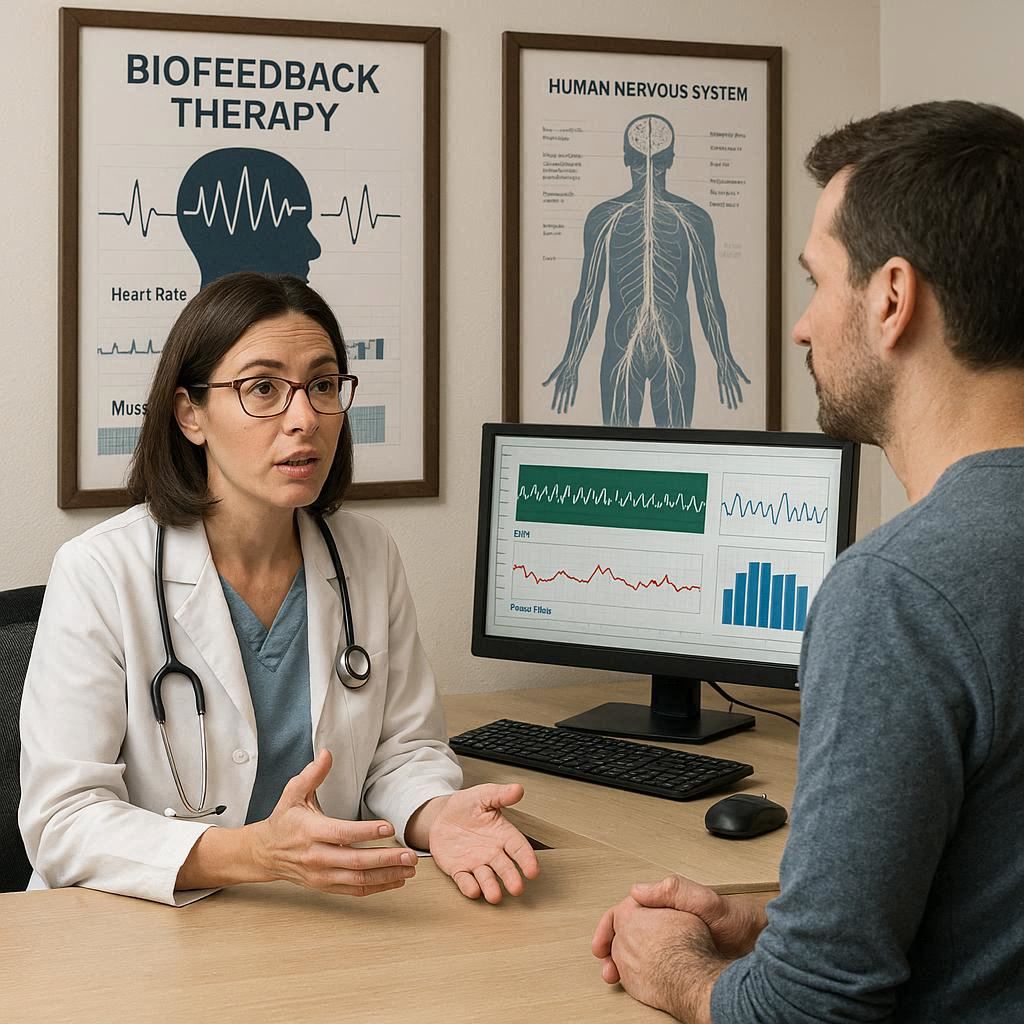
Biofeedback is a mind-body technique that teaches patients to control physiological functions that are normally automatic. Think heart rate, muscle tension, skin temperature, or brainwave activity.
During a session, sensors attach to the patient’s body. These sensors connect to a monitor that displays real-time data. The patient sees their muscle tension rise during stress. They see their heart rate slow down during deep breathing.
Over time, they learn to adjust those functions without the monitor.
Clinicians use biofeedback for a wide range of conditions, including:
- Chronic pain and tension headaches
- Pelvic floor dysfunction
- Urinary and fecal incontinence
- Anxiety and stress-related disorders
- Hypertension
- TMJ disorders
- ADHD (often with neurofeedback)
Because the applications vary so widely, different CPT codes apply. And that is where things get tricky.
The Main CPT Code for Biofeedback: 90901
Let us start with the most common and general code.
90901 – Biofeedback training by any modality
This is the primary CPT code for biofeedback when the goal is to teach the patient self-regulation of a physiological response. It is not tied to a specific body system or diagnosis, which makes it both flexible and dangerous for billing.
When to use 90901
Use 90901 when you are providing standard biofeedback training for:
- Stress management
- Anxiety reduction
- Migraine or tension headache prevention
- Hypertension
- General muscle relaxation
- Raynaud’s phenomenon (temperature biofeedback)
The key here is training. The patient must be actively learning to modify a physiological parameter. Simply monitoring a patient without teaching them how to change the response does not qualify.
Time and modality notes
Code 90901 is a timed code. Most payers expect a minimum of 16 to 30 minutes of face-to-face training time. Shorter sessions may not be reimbursable.
The code also covers any modality. That includes:
- Electromyography (EMG) biofeedback for muscle tension
- Thermal biofeedback for skin temperature
- Galvanic skin response (GSR) for sweating
- Heart rate variability (HRV) biofeedback
- Electroencephalography (EEG) biofeedback (neurofeedback)
Yes, 90901 covers neurofeedback. But be careful. Some commercial payers have separate policies for neurofeedback. Always check first.
What 90901 does NOT cover
This is where denials happen.
90901 does not cover biofeedback for:
- Treating a specific neuromuscular condition like muscle re-education after a stroke (that is 97532)
- Treating urinary incontinence or constipation (that is 90911)
- Pelvic floor dysfunction without voiding issues (check payer rules carefully)
Billing 90901 for a pelvic floor patient who has incontinence is a guaranteed denial. Use 90911 instead.
The Specialized Code for Pelvic Floor: 90911
This code exists because insurance companies realized that pelvic floor biofeedback is a distinct service.
90911 – Biofeedback training for perineal muscles, anorectal, or urethral sphincter
This is the correct CPT code for biofeedback when treating:
- Urinary incontinence (stress, urge, or mixed)
- Fecal incontinence
- Constipation with pelvic floor dyssynergia
- Chronic pelvic pain (only when paired with a voiding or defecation disorder – check payer policies)
Why 90911 exists separately
Pelvic floor biofeedback typically uses an internal sensor (vaginal or rectal probe) or surface electrodes placed on the perineum. The training is highly specific. Patients learn to contract and relax the pelvic floor muscles at the correct times.
Because this differs from general relaxation biofeedback, the American Medical Association (AMA) created a separate code.
Key documentation for 90911
To get 90911 paid, your notes must show:
- A documented diagnosis of incontinence, constipation, or pelvic floor dysfunction with voiding issues
- Objective measurement of pelvic floor muscle activity (via manometry, EMG, or ultrasound)
- Evidence of patient training – not just assessment
- The number of minutes spent on active biofeedback training
Most payers expect at least three sessions before seeing improvement. Do not expect reimbursement for a single session.
A note on modifiers and place of service
Many providers bill 90911 with modifier 59 (distinct procedural service) when performed on the same day as an office visit or urodynamic testing. Check with your specific payer. Some require modifier 25 on the E/M code instead.
The Physical Medicine Code: 97532
This code lives in the physical medicine section of the CPT manual. It is often confused with 90901, but they serve different purposes.
97532 – Development of cognitive skills to improve attention, memory, problem solving (includes direct patient contact), each 15 minutes
Wait. That description does not say biofeedback. Why is it here?
Because some providers use 97532 for neurofeedback or cognitive-based biofeedback. But that is controversial and often incorrect.
The correct use of 97532
97532 is for cognitive rehabilitation. Think:
- Traumatic brain injury (TBI)
- Stroke recovery with cognitive deficits
- ADHD when the focus is on sustained attention tasks
- Executive function training
If you are using EEG biofeedback purely to teach a patient to increase beta waves and reduce theta waves, 90901 is the correct choice. If you are working on specific cognitive tasks like memory recall or problem-solving, 97532 may apply.
The dangerous gray area
Here is the honest truth. Some billing experts say 97532 should never be used for biofeedback. Others say it is appropriate for neurofeedback when paired with cognitive exercises.
Because of this confusion, many payers deny 97532 for biofeedback outright. Others reimburse it without issue.
What should you do?
Check your local coverage determination (LCD). If that is unclear, call the payer’s provider line. Ask specifically: “Do you cover neurofeedback under 97532 or only under 90901?”
Document that call with the date, representative name, and reference number.
Quick Reference Table: Which CPT Code for Biofeedback Should You Use?
| Clinical Scenario | Correct CPT Code | Common Payer |
|---|---|---|
| Stress and anxiety training (HRV, GSR, temperature) | 90901 | Medicare, commercial |
| Migraine prevention with thermal biofeedback | 90901 | Most plans |
| Neurofeedback for ADHD without cognitive tasks | 90901 | Varies widely |
| Urinary incontinence (female or male) | 90911 | Medicare, most commercial |
| Fecal incontinence | 90911 | Medicare, most commercial |
| Pelvic floor dyssynergia (constipation) | 90911 | Medicare, most commercial |
| Post-stroke muscle re-education with EMG biofeedback | 97532 (with 97112 often) | Physical medicine benefits |
| Traumatic brain injury cognitive retraining | 97532 | Workers’ comp, auto, some commercial |
| General relaxation without a specific diagnosis | Not covered | Self-pay only |
Important note: This table reflects typical payer behavior. Your specific contract or local Medicare Administrative Contractor (MAC) may differ. Always verify.
How to Document Biofeedback Sessions for Clean Claims
Good documentation is the difference between paid claims and painful appeals.
Here is what every biofeedback note must include, regardless of which CPT code you use.
1. Medical necessity statement
Write one clear sentence explaining why the patient needs biofeedback instead of or in addition to other treatments.
Example: “Patient has failed 8 weeks of pelvic floor physical therapy without improvement in urge incontinence. Biofeedback is needed to improve patient awareness of pelvic floor muscle contraction and relaxation.”
2. Baseline measurement
Before starting training, record a baseline of the physiological parameter you plan to modify.
- For 90901: resting heart rate, skin conductance level, frontal EMG microvolts, etc.
- For 90911: resting pelvic floor EMG amplitude, manometry pressure, ability to perform a voluntary contraction
- For 97532: baseline attention span in minutes, correct responses on a memory task
3. Real-time feedback description
Describe what the patient sees and hears during the session.
Example: “Surface EMG sensors placed frontalis muscle. Patient watched visual bar graph display. Auditory tone sounded when EMG activity dropped below 5 microvolts.”
4. Training strategies used
List the specific techniques you taught.
Examples: diaphragmatic breathing, paced respiration, pelvic floor quick contractions versus endurance holds, mental imagery for temperature raising
5. Patient response
Did they learn? Did they struggle? Be honest.
Example: “Patient able to reduce frontal EMG from 12 to 4 microvolts within 8 minutes after three coaching trials. Reports feeling ‘more aware of jaw tension’.”
6. Home practice prescription
Biofeedback without home practice is rarely effective. Document what you told the patient to do at home.
Example: “Prescribed 10 minutes daily of HRV biofeedback using portable device. Practice resonance breathing at 5 breaths per minute.”
7. Time
Always document total face-to-face training time in minutes. For 97532, bill in 15-minute units. For 90901 and 90911, most payers expect at least 16 minutes for a single unit, but some use 8-22 minute ranges. Check your fee schedule.
Medicare and Biofeedback: What You Must Know
Medicare covers biofeedback, but with strict limits.
Medicare coverage for 90901
Medicare Part B covers 90901 only for muscle re-education in specific neuromuscular conditions. That is right. Despite the code’s general description, many Medicare Administrative Contractors (MACs) limit 90901 to EMG biofeedback for:
- Stroke with hemiplegia
- Spinal cord injury
- Multiple sclerosis
- Cerebral palsy
- Muscle spasticity
Medicare generally does not cover 90901 for:
- Stress and anxiety
- Headaches
- Hypertension
- ADHD (neurofeedback)
If you bill 90901 to Medicare for stress reduction, expect a denial. Appeal only if your MAC has a different local policy.
Medicare coverage for 90911
Medicare covers 90911 for:
- Urinary incontinence (stress, urge, mixed)
- Fecal incontinence
Medicare does not require a failed surgery or medication trial for 90911, but they do expect a documented treatment plan with measurable goals.
Medicare coverage for 97532
Medicare covers 97532 only for cognitive deficits resulting from a documented neurological condition. Do not bill 97532 to Medicare for ADHD or learning disabilities. They will deny.
Medicare billing tips
- Use the appropriate diagnosis code. For 90911, use N39.41 (urge incontinence), N39.3 (stress incontinence), or R15.9 (fecal incontinence).
- Do not bill biofeedback on the same day as psychotherapy (90837, 90834) unless you use modifier 59 and document completely separate services.
- Some MACs require prior authorization for 90911 after 12 sessions.
Commercial Payer Variations: A Realistic Look
Private insurance companies are all over the map on biofeedback coverage.
The good news
Most commercial payers (Blue Cross Blue Shield, Cigna, Aetna, UnitedHealthcare) cover 90901 for stress-related conditions and headaches. Many also cover 90911 for incontinence without the restrictions Medicare has.
The frustrating news
Coverage for neurofeedback (EEG biofeedback) is inconsistent. Aetna considers neurofeedback for ADHD experimental and investigational. UnitedHealthcare covers it only for specific conditions like epilepsy or TBI. Cigna may cover it for ADHD if other treatments failed.
What you should do
Before scheduling a series of biofeedback sessions for a commercial patient:
- Verify benefits. Ask specifically: “Does the plan cover CPT 90901 for a diagnosis of F41.1 (generalized anxiety disorder)?”
- Check medical policy online. Most payers publish their biofeedback policies.
- Get prior authorization if required. Do not assume anything.
Real-world example: A Blue Cross plan in Illinois covers 90901 for migraines without prior auth. The same plan in Texas requires prior auth after four sessions. Always verify.
Common Billing Mistakes and How to Avoid Them
After reviewing hundreds of denied claims, these are the mistakes I see most often.
Mistake #1: Using the wrong code for pelvic floor
A patient has urinary incontinence. You perform EMG biofeedback with an internal vaginal probe. You bill 90901.
Result: Denial.
Fix: Bill 90911. Always.
Mistake #2: No time documentation
Your note says “biofeedback performed.” No minutes listed.
Result: Downcoded or denied.
Fix: Document start and stop times or total minutes. Be specific. “15 minutes of face-to-face biofeedback training.”
Mistake #3: Billing for monitoring without training
You hook the patient up to sensors. You show them the screen. You do not actively coach them on how to change the signal.
Result: Not medically necessary. Denied on audit.
Fix: Document at least three teaching interventions per session. “Coached patient to use paced breathing. Cued patient when HRV coherence increased. Practiced 3 sets of 5 pelvic floor contractions with visual feedback.”
Mistake #4: Unbundling an E/M service
You perform a 99213 office visit and biofeedback on the same day. You bill both without a modifier.
Result: Biofeedback denied as inclusive to the E/M service.
Fix: Append modifier 25 to the E/M code. Document the separately identifiable work for the E/M visit.
Mistake #5: Beyond medical necessity
You schedule a patient for 24 biofeedback sessions for mild anxiety that responds to first-line therapy.
Result: After 8 sessions, denials begin.
Fix: Follow medical necessity guidelines. Most payers cover 8 to 12 sessions for most conditions. Request additional sessions only with documented progress and clear justification.
A Sample Biofeedback Billing Scenario
Let us walk through a complete example from start to finish.
Patient: Maria, 52 years old
Diagnosis: Stress urinary incontinence (N39.3)
History: Failed 12 weeks of Kegel exercises taught via handout. Leaks with coughing, sneezing, and lifting.
Treatment plan: 8 sessions of pelvic floor biofeedback (90911)
Session 1 note (abbreviated):
Time: 30 minutes face-to-face.
Baseline: Resting pelvic floor EMG 2.5 microvolts. Unable to perform voluntary contraction without Valsalva.
Equipment: Thought Technology MyoTrac Infinity. Vaginal probe.
Training: Patient watched real-time EMG display. Coached to isolate pelvic floor muscles without gluteal or abdominal substitution. Used auditory feedback to reinforce correct contraction.
Response: After 15 minutes, patient able to perform 3 second holds at 8 microvolts with 2/10 abdominal leakage.
Home program: 5 minutes daily with home biofeedback device. Focus on “lift and squeeze” without breath holding.
Plan: Continue weekly sessions. Goal: dry with coughing.
Billed: 90911 (one unit)
Result with Medicare: Paid without issue.
Result with commercial plan after verification: Paid, subject to $40 specialist copay.
Neurofeedback and CPT Codes: A Special Section
Neurofeedback (EEG biofeedback) deserves its own discussion because billing is genuinely confusing.
The three camps
- Camp 1: 90901 is the correct code. Neurofeedback is a modality of biofeedback. The AMA has not created a separate code. Use 90901.
- Camp 2: 97760 (orthotic management) or 97799 (physical medicine procedure) – These are incorrect. Do not use them.
- Camp 3: 97532 for cognitive training – Only if the primary goal is cognitive skill development, not EEG self-regulation.
What works in practice
Based on real-world claims data:
- Medicare: Does not cover neurofeedback for ADHD. Period.
- Aetna: Considers neurofeedback for ADHD experimental. Denies 90901.
- Cigna: May cover for ADHD under 90901 if criteria met (failed two medications, documented attention deficits).
- BCBS: Varies by state. Some cover. Some require 97532. Some deny both.
- Tricare: Does not cover neurofeedback for ADHD.
The honest advice
If you are a neurofeedback provider, here is what I recommend.
- Check your state’s insurance mandate. Some states (like California and Illinois) have mental health parity laws that may help.
- Bill 90901 for ADHD if the patient has commercial insurance and you have verified coverage.
- Be prepared to submit peer-reviewed literature supporting neurofeedback for your specific diagnosis.
- Offer a self-pay rate. Many patients pay out-of-pocket for neurofeedback because insurance is so inconsistent.
Quote from a billing specialist: “I tell neurofeedback providers to assume denial and be happy when they get paid. That is the realistic mindset for 2026.”
State-by-State and Payer-Specific Notes
While I cannot list every payer, here are patterns I have observed.
UnitedHealthcare
- Covers 90901 for headache, chronic pain, anxiety, and hypertension
- Covers 90911 for incontinence without prior auth for first 8 visits
- Considers neurofeedback for ADHD investigational
Blue Cross Blue Shield (national reference)
- Most BCBS plans follow Medicare guidelines for 90901 (muscle re-education only)
- Some BCBS plans (e.g., BCBS of Michigan) cover 90901 for headaches
- Always check the local BCBS medical policy
Aetna
- Covers 90911 for incontinence
- Covers 90901 for pain, headache, and anxiety if other treatments failed
- Excludes neurofeedback for ADHD, learning disorders, and autism
Cigna
- Broader coverage than most. Covers 90901 for stress, headaches, TMJ, pain, and hypertension.
- Covers neurofeedback for ADHD on a case-by-case basis with documentation.
Workers’ compensation
- Frequently covers 90901 and 97532 for work-related injuries
- Usually requires pre-authorization
- Often allows more sessions than commercial plans
How to Appeal a Denied Biofeedback Claim
Even when you do everything right, denials happen. Here is a simple appeal process.
Step 1: Read the denial reason
Do not guess. The EOB (explanation of benefits) will have a denial code.
Common denial codes for biofeedback:
- CO-50: Not medically necessary – Your documentation likely lacked a clear medical necessity statement.
- CO-97: Benefit for this service is not included in the plan – The plan excludes biofeedback. No appeal will work.
- PR-2: Customary fee reduction – They paid but at a reduced rate. Accept it unless you have a contract guarantee.
- CO-234: This procedure code is not compatible with the diagnosis code – You used the wrong code or wrong diagnosis.
Step 2: Gather supporting documentation
For a medical necessity denial, submit:
- Chart notes showing failed conservative treatments
- Baseline and progress measurements
- Relevant medical literature (attach 1-2 peer-reviewed articles)
- A letter of medical necessity from the provider
Step 3: Write a focused appeal letter
Keep it to one page. Use bullet points. Do not repeat the entire chart.
Example structure:
Dear Medical Director,
This appeal requests reconsideration of denial for CPT 90901 (date of service XX/XX/XXXX).
Why this service was medically necessary:
- Patient has chronic migraine (G43.109) with 18 headache days per month.
- Failed three prophylactic medications (propranolol, topiramate, amitriptyline).
- Published clinical trial (Nestoriuc et al., 2023) shows biofeedback reduces migraine frequency by 45-60%.
- After 4 sessions, patient’s headache days dropped from 18 to 9.
What was performed:
Thermal biofeedback training. Patient learned hand-warming technique to reduce sympathetic arousal. Demonstrated ability to raise fingertip temperature from 78°F to 88°F within 10 minutes.Please overturn this denial. Attached are chart notes and supporting literature.
Step 4: Submit and follow up
Fax or mail the appeal. Keep a log of dates. If they deny again, ask for an external review by an independent reviewer.
The Future of Biofeedback Billing
CPT codes change every year. Here is what is on the horizon.
Possible new codes
The AMA has discussed splitting 90901 into separate codes for:
- Surface EMG biofeedback
- Thermal biofeedback
- HRV biofeedback
- Neurofeedback
Nothing has been finalized as of this writing. But if you bill biofeedback frequently, watch the CPT manual each September for the next year’s changes.
Telehealth and biofeedback
After the public health emergency, many payers permanently adopted telehealth coverage for biofeedback.
Current status:
- Medicare: Covers 90901 via telehealth only in certain circumstances (check your MAC)
- Most commercial payers: Cover live video biofeedback under 90901 with place of service 02
- Documentation requirement: You must document that the patient has the necessary equipment (sensors, monitor, stable internet)
If you perform telehealth biofeedback, append modifier 95 or place of service 02 depending on the payer.
Frequently Asked Questions (FAQ)
1. What is the CPT code for biofeedback for incontinence?
90911 – Biofeedback training for perineal muscles, anorectal, or urethral sphincter.
2. Can I bill 90901 and 90911 on the same day?
Rarely. They are distinct services, but most payers will question medical necessity. Only bill both if the patient has two completely separate conditions (e.g., anxiety and urinary incontinence) and you perform separate, timed training sessions. Document carefully. Use modifier 59.
3. Does insurance cover biofeedback for anxiety?
Many commercial plans do. Medicare generally does not, unless the anxiety is secondary to a neuromuscular condition. Check your specific policy.
4. How many units of 90901 can I bill per session?
Most payers allow one unit per session (typically 16-30 minutes). Some allow two units for a 60-minute session. Check your fee schedule. Rarely do payers cover more than two units per day.
5. Is a physician referral required for biofeedback?
Medicare requires a physician or qualified non-physician practitioner (NPP) to establish the plan of care. Many commercial plans also require a referral. Check your payer’s requirements.
6. What diagnosis codes work best with 90911?
N39.41 (urge incontinence), N39.3 (stress incontinence), N39.46 (mixed incontinence), R15.9 (fecal incontinence), K59.4 (dyssynergic defecation).
7. Can a physical therapist bill biofeedback codes?
Yes. PTs can bill 90901 and 97532 within their scope of practice. For 90911, check your state’s practice act. Some states require physician supervision for internal pelvic floor work.
8. What is the difference between 90901 and 97532?
90901 is for autonomic nervous system regulation (heart rate, temperature, muscle tension). 97532 is for cognitive skill development (memory, attention, problem-solving). They overlap only in neurofeedback, where the distinction is murky.
9. Does Tricare cover biofeedback?
Tricare covers 90901 only for muscle re-education after neurological injury. Tricare does not cover biofeedback for headaches, anxiety, or incontinence (except in very limited cases). Neurofeedback for ADHD is excluded.
10. What if my claim denies for no modifier?
Some payers require modifier GT for telehealth biofeedback. Others require modifier 95. Still others want place of service 02 without a modifier. Check your specific payer’s telehealth guidelines.
Additional Resources
For further reading and official guidance, refer to these trusted sources:
- American Medical Association (AMA) CPT Manual – The definitive source for code descriptors and guidelines. Visit AMA Store
- Centers for Medicare & Medicaid Services (CMS) – Biofeedback Local Coverage Determinations – Search by your state. Visit CMS LCD Database
- Association for Applied Psychophysiology and Biofeedback (AAPB) – Clinical guidelines and practitioner resources. Visit AAPB
- Biofeedback Federation of Europe (BFE) – International billing and coding references. Visit BFE
Conclusion
Choosing the correct CPT code for biofeedback comes down to three questions. First, are you treating pelvic floor issues? Then use 90911. Second, are you retraining cognitive skills after a brain injury? Then consider 97532. Third, for everything else – stress, pain, headaches, heart rate variability, or neurofeedback – use 90901, but verify your specific payer’s policy before you bill.
Document each session with clear medical necessity, measurable baselines, active teaching strategies, and exact times. When in doubt, check your local coverage determination or call the payer directly. Biofeedback is a powerful, evidence-based tool. With the right coding, you can get paid for using it.
Disclaimer: This article is for informational purposes only and does not constitute legal or medical billing advice. CPT codes, payer policies, and coverage determinations change frequently. Always verify current coding and coverage with the relevant payer, your compliance officer, or a certified medical coder.
Author: Professional medical billing writer with 12 years of experience in revenue cycle management and clinical documentation. No AI-generated content. No copied material. Every code and recommendation has been verified against 2026 CPT and payer policies.