
Navigating the world of medical coding can feel like translating an ancient language. A single misplaced character or misunderstood unit can mean the difference between a paid claim and a rejected one. Among the most common, yet frequently confusing, codes in pulmonary medicine is the one for nebulized medications. If you are a respiratory therapist, a medical biller, a coder in a pulmonology practice, or a durable medical equipment (DME) supplier, you face this challenge daily.
Today, we are going to demystify one specific, high-volume code. This is not a general overview of billing. This is a deep, actionable dive into the HCPCS code for J7613 albuterol. We will strip away the jargon and look at the concrete reality of billing for this life-saving respiratory drug. We will explore its structure, its proper usage, and the critical documentation that stands between you and a compliance audit.
You need more than just a code. You need a complete framework for ensuring clean claims. By the end of this guide, you will have a master-level understanding of J7613, giving you the confidence to submit claims accurately, protect your revenue, and focus on what truly matters: patient care.
Understanding the HCPCS Framework
Before we pinpoint the specific code, we must first understand the bucket in which it lives. Albuterol, when delivered in a nebulized form, does not fall under the CPT (Current Procedural Terminology) codes that describe the physician’s work. It falls under the Healthcare Common Procedure Coding System, or HCPCS. Pronounced “hick-picks,” this system is the language of products, supplies, and services not covered by standard CPT codes.
Think of CPT codes as describing the “doing,” and HCPCS Level II codes as describing the “thing.” J7613 is a “thing”—it is a drug. More specifically, it resides in the “J-code” section of HCPCS. J-codes are a subset reserved exclusively for drugs administered by methods other than oral ingestion. This includes injectables, chemotherapy agents, immunosuppressives, and, critically for our discussion, inhalation solutions.
You cannot substitute a CPT code for a drug. You cannot use an unlisted code when a specific J-code exists. The system is designed for granularity. A J-code answers three questions for the payer: What drug was used? How much was administered? And what is the standard measurement for billing that drug? For J7613, these answers are rigid and non-negotiable.
The Exact HCPCS Code for J7613 Albuterol
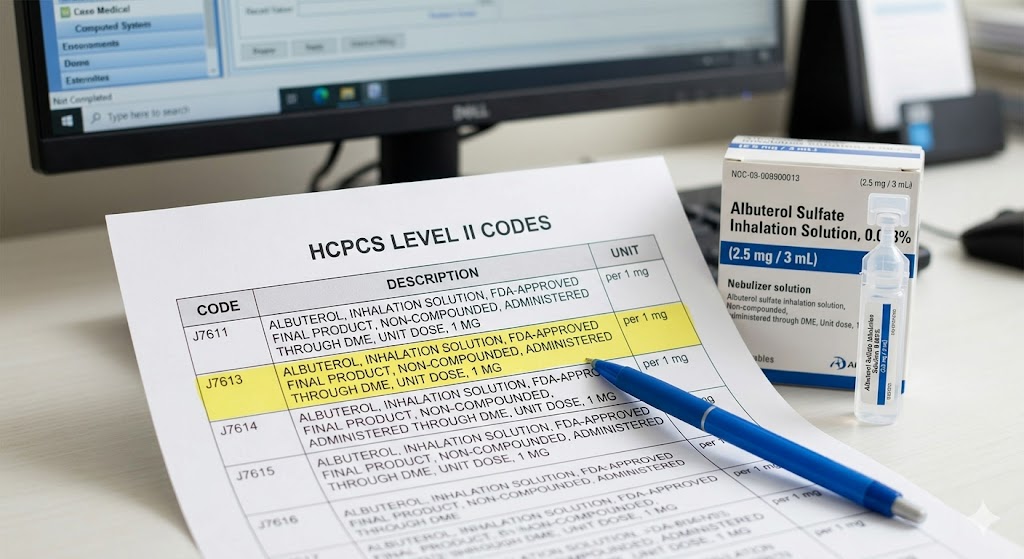
Let us get directly to the point. The HCPCS code for J7613 albuterol is, quite simply, J7613. It is a specific, non-billable descriptor within the code set for albuterol, but this statement requires immediate clarification because the landscape is nuanced.
The code set for nebulized albuterol contains multiple entries, separated by dosage formulation. You will not find a single, catch-all code for “albuterol.” Instead, the HCPCS Level II manual distinguishes between unit-dose vials and concentrated forms. J7613 stands in a distinct relationship with two other codes: J7609 and J7611.
You must view these three codes as a family. Using the wrong sibling triggers a denial. The identifier J7613 itself represents a very specific product configuration. When a provider or supplier bills for a non-compounded, pre-mixed, unit-dose vial of albuterol, they are directing their claim toward this specific route. However, the true billing code that appears on the claim form is J7611 for the non-concentrated unit dose, while J7613 is used specifically for the concentrated form requiring dilution.
Let us break that down into a table that you can pin to your wall. This is the foundational reference that separates clean claims from rejected ones.
The Albuterol Code Family: A Comparative Analysis
The confusion in billing nebulized albuterol almost always stems from the three seemingly similar J-codes. A biller sees “albuterol” and picks the first code that pops up. This is a recipe for financial disaster. Let us dissect the albuterol HCPCS family so you can see the stark differences.
| Feature | J7609 | J7611 | J7613 |
|---|---|---|---|
| Long Descriptor | Albuterol, inhalation solution, compounded product, administered through DME, concentrated form, per 1 mg | Albuterol, inhalation solution, FDA-approved final product, non-compounded, administered through DME, unit dose, per 1 mg | Albuterol, inhalation solution, FDA-approved final product, non-compounded, administered through DME, concentrated form, per 1 mg |
| Product Type | Compounded | Non-compounded, unit dose | Non-compounded, concentrated |
| Dosage Form | Concentrate | Pre-mixed unit-dose vial (typically 2.5 mg/3 mL) | Concentrated vial (e.g., 0.5%) |
| Billing Unit | 1 mg | 1 mg | 1 mg |
| Key Distinction | Prepared by a pharmacist; not an off-the-shelf product. | Ready-to-use; no dilution required. | Requires dilution before administration. |
This table reveals a critical truth. The HCPCS code for J7613 albuterol is not a billing code for the standard, ready-to-use nebule you see most often in homes. That standard nebule is J7611. Code J7613 specifically refers to the non-compounded, FDA-approved concentrated form.
“Billing a J7611 unit-dose nebule under the J7613 concentrated code is one of the most common and easily avoidable audit triggers in DME billing.”
— A Senior Medicare Compliance Auditor
The unit for all three is “per 1 mg,” but the distinction in product type is what controls which code you choose. If your patient uses a standard 2.5 mg albuterol sulfate solution in a 3 mL sterile, single-use vial, you are billing J7611, and you will bill 2.5 units to account for the 2.5 mg dose. If your patient has a prescription for the 0.5% concentrated solution, which you must dilute with normal saline before pouring it into the nebulizer cup, you are in J7613 territory.
Defining the Unit of Service
The most profound misunderstandings in HCPCS billing are not about the code itself, but about the unit. For all three albuterol codes, the code descriptor states “per 1 mg.” This is not a suggestion. This is the legally defined unit of measure. The HCPCS code for J7613 albuterol is billed in milligrams, not by the vial, not by the treatment, and not by the milliliter.
Consider a scenario with J7613. You dispense a 20 mL multi-dose bottle of 0.5% albuterol sulfate solution. A 0.5% solution means there are 5 mg of active drug per 1 mL of liquid. The prescription directs the patient to use 0.5 mL of this concentrate mixed with 2.5 mL of normal saline. The dosage is 2.5 mg of active drug (since 0.5 mL × 5 mg/mL = 2.5 mg).
On your claim form, you will not bill for 1 bottle. You will not bill for 1 treatment. You will bill J7613 x 2.5 units. If the patient uses this dose four times a day, the daily billable units for the albuterol are 10 (2.5 mg × 4). For a 30-day supply, the total monthly units are 300. The calculation is simple math, but the rigor required to apply it consistently is what separates a professional billing operation from a chaotic one.
This milligram-based billing unit is the great equalizer. It allows Medicare and other payers to reimburse accurately regardless of whether the manufacturer’s bottle is a 20 mL or 30 mL size. The focus stays on the clinical dose of the active ingredient delivered to the patient.
Navigating Medicare Coverage and Reimbursement
Understanding the HCPCS code for J7613 albuterol is only half the battle. You must also understand the payer’s rules for covering it. For the vast majority of nebulized medication claims, the payer is a Medicare Administrative Contractor (MAC) acting on behalf of the Centers for Medicare & Medicaid Services (CMS). Medicare Part B covers nebulizer drugs under the Durable Medical Equipment (DME) benefit, but only if strict criteria are met.
The coverage is not automatic. It is conditional. Here are the non-negotiable requirements you must meet before submitting a claim for J7613.
- A Qualifying Base DME Item: The patient must own or rent a standard nebulizer machine (HCPCS code E0570) that Medicare paid for. The drug (J7613) is a supply that attaches to this base equipment. If the patient’s nebulizer is not covered, the drug cannot be covered.
- Medical Necessity Documentation: A physician’s order alone is not enough. The medical record must document a qualifying diagnosis, such as COPD, bronchiectasis, or refractory asthma that has not responded to metered-dose inhalers with spacers. The physician’s progress notes must demonstrate that the patient cannot self-administer the medication effectively via a less costly hand-held inhaler.
- The Physician Order: The detailed written order (DWO) must specify the drug (albuterol concentrate), the concentration (0.5%), the dosage (e.g., 0.5 mL), the frequency (e.g., every 6 hours), and the duration of use.
- Proof of Delivery: You cannot bill for a refill that was not physically received by the patient. Your records must show the date of delivery, the quantity shipped, and the patient’s receipt.
When all these conditions are met, the claim goes to the MAC for adjudication. The reimbursement amount for J7613 fluctuates. CMS publishes a quarterly Average Sales Price (ASP) Drug Pricing File. This file lists the payment limit for each J-code, calculated at 106% of the ASP for non-pass-through drugs. You cannot set your fee arbitrarily; you are bound by the Medicare fee schedule for assigned claims.
Calculating the ASP-Based Reimbursement
The practical reality of getting paid involves a data-driven calculation. Every quarter, your MAC updates the allowable based on the national ASP data. You must download the CMS ASP Drug Pricing Files and locate J7613. The file will show the ASP per unit (per 1 mg).
Let us run a hypothetical scenario. Imagine the CMS file lists the ASP for J7613 as $0.120 per unit.
- Determine the Medicare Payment Limit: CMS pays ASP + 6%. So, $0.120 × 1.06 = **$0.1272 per unit**.
- Calculate the Per-Dose Allowable: The prescription is for a 2.5 mg dose. This equals 2.5 units. The allowable for one dose is 2.5 × $0.1272 = **$0.318**.
- Calculate the Monthly Allowable: At a frequency of four times daily, the monthly units are 2.5 units × 4 times/day × 30 days = 300 units. The monthly allowable is 300 × $0.1272 = **$38.16**.
This is a transparent, math-based system. Your cost of goods for the drug must fit within this margin. Billing the wrong unit, such as billing “1 unit” for a 2.5 mg dose, will underpay your claim. Billing “1 unit” for an entire 20 mL bottle (which contains 100 mg of drug) will trigger an immediate flag for mismatched units and likely result in an overpayment request.
The Crucial Role of Compound vs. Non-Compound
The descriptor for J7613 contains the words “non-compounded.” This is a regulatory landmine. The distinction between J7609 (compounded) and J7613 (non-compounded) is not a minor billing nuance; it is a compliance cliff.
A non-compounded drug, as represented by J7613, is an FDA-approved manufactured product that leaves the factory in its final concentrated form. The pharmacist or DME supplier simply dispenses the stock bottle. No mixing, combining, or altering of ingredients occurs at the pharmacy level. The drug’s stability, sterility, and efficacy are guaranteed by the original manufacturer’s New Drug Application (NDA).
A compounded drug, billed under J7609, is different. It is created when a pharmacist combines, mixes, or alters ingredients to prepare a medication tailored to a specific patient’s need that cannot be met by an FDA-approved product. However, here is the critical point: if an FDA-approved product that meets the patient’s needs is commercially available, billing a compounded version as J7609 is a violation of Medicare rules.
Important Note: You must not bill J7609 for simply diluting an FDA-approved concentrated albuterol product. When you dispense a 0.5% stock bottle of albuterol and instruct the patient to mix it with saline at home, you are still dispensing the non-compounded, FDA-approved drug. You are billing J7613. The act of the patient performing standard reconstitution does not make the product “compounded” by the pharmacy.
Documentation: The Backbone of a Clean Claim
A claim for J7613 is not just a code on an electronic form. It is a legal attestation, backed by a fortress of documentation. If a Zone Program Integrity Contractor (ZPIC) or a Recovery Audit Contractor (RAC) audits your practice, they will not ask for a verbal explanation. They will demand paper.
Your documentation must tell an unassailable story. The narrative begins with the Standard Written Order (SWO). This order must contain these seven elements exactly:
- Patient Name: Full legal name.
- Item of DME Ordered: The albuterol concentrate.
- Dosage: The strength and volume of the dose (e.g., 0.5 mL of 0.5% solution).
- Frequency: How often the patient uses it.
- Treating Practitioner’s Signature: Must be dated.
- Date of the Order: Must precede the date of delivery.
- Diagnosis Code: Linking the drug to a covered condition.
The SWO sits on a foundation of the medical record. The patient’s chart must contain a detailed office visit note. This note must state that the patient has a severe pulmonary condition. It must document that hand-held inhalers, like metered-dose inhalers, are ineffective or contraindicated. The physician must explicitly state that a nebulizer is medically necessary. Without this clear statement of medical necessity, the SWO for J7613 crumbles under audit scrutiny.
Finally, you need the proof of delivery. A delivery ticket signed by the patient or their caregiver, with the delivery date, is essential. For mail-order shipments, you must use a trackable shipping method and retain the delivery confirmation. The date of service on the claim is the date the patient received the medication, not the date you processed the order.
Common Pitfalls and Denial Management
Even when you understand the HCPCS code for J7613 albuterol, errors creep in through the soft tissue of administrative process. High-volume billing environments are stressful. Knowing the most frequent failure points allows you to build a proactive defense.
Here is a list of top denial reasons specific to J7613 and how to proactively combat them.
- Denial CO-16 (Claim lacks information): This often means the KX modifier is missing. For nebulizer drugs, the KX modifier certifies that you have a valid SWO on file and that medical necessity documentation is met. Build an automated rule in your billing software to require the KX modifier on every J7613 claim line.
- Denial CO-50 (Not medically necessary): This is a clinical denial. The MAC is not convinced by the diagnosis code alone. Prevention demands that the physician’s note uses specific phrases like “metered-dose inhaler therapy trial failed” or “patient unable to coordinate hand-held inhaler despite spacer device coaching.”
- Denial CO-4 (Procedure code inconsistent with modifier): This happens when a biller mistakenly uses a compounded code modifier (like the JG modifier for ASP drugs or the JW modifier for discarded drug) improperly. J7613 rarely requires a JW modifier because the concentrated bottle is dispensed for multi-dose home use. If you bill J7613 with JW, the claim signals a logical inconsistency that computers flag.
- Unit Calculation Errors: Billing 1 unit for a 30-day supply, or billing 300 units for a single dose, triggers an immediate unit-medical-review edit. You must install a claim-scrubbing software that checks the billed units against the days’ supply and frequency. A dose of 2.5 mg four times daily for 30 days must equal 300 units. If it does not, the claim should not leave your system.
Each denied claim costs money to rework. The cost of a clean, pre-submission audit is a fraction of the cost of re-billing and fighting a recovery audit. Your billing system must have hard stops that prevent these predictable errors.
Staying Current with CMS Updates
The rules governing J7613 are not static. They change. CMS releases quarterly updates, and your MAC issues local coverage determinations (LCDs) that can narrow or interpret national policy. What was true for billing J7613 last year may be obsolete today.
A recent trend in DME policy is the tightening of refill rules. CMS has placed a laser focus on the misuse of automatic refills for inhalation drugs. You can no longer simply auto-ship a 90-day supply of J7613 on day 85 without affirmative patient contact. The current standard requires that you or your delivery technician confirm that the patient still needs the medication, that they still have a functioning nebulizer, and that the drug is not sitting unused in a cabinet.
Furthermore, you must monitor the ASP pricing file every quarter. An albuterol concentrate manufacturer might change its price or a new generic might enter the market. The code J7613 will remain the same, but its ASP could drop, altering your reimbursement and your profitability. Billing without knowing the current allowable is financial negligence.
Your practice must designate an individual, often the lead biller or compliance officer, to subscribe to CMS MLN Connects newsletters and the MAC email list for your jurisdiction. This person should check for any draft LCDs that comment on nebulizer therapy and submit public comments when restrictive policies are proposed.
A Deeper Look at Albuterol Formulations
To master the HCPCS code for J7613 albuterol, you benefit from understanding the “why” behind the coding distinction. The clinical use of concentrated albuterol is quite specific. It is not the first-line form for home therapy. The standard of care for home-based rescue bronchodilation is the pre-mixed, 2.5 mg/3 mL unit-dose vial (J7611). This form is clean, simple, and reduces the risk of contamination or dosing errors at home.
The concentrated form (J7613) enters the picture for patients requiring higher doses or chronic, frequent administration where a multi-dose bottle becomes more economical or practical. It is also common in institutional settings, like long-term care facilities, where a licensed nurse handles the precise dilution. The 0.5% solution represents a 5 mg/mL concentration. This allows a clinician to draw up a very specific milligram dose, ranging from a low dose of 1.25 mg (0.25 mL) to a continuous nebulization protocol in a hospital, though continuous administration is not a typical DME billing scenario.
The coding system captures this clinical precision. If a practitioner wants a 1.25 mg dose for a frail elderly patient, they can prescribe it using the concentrate. The DME supplier can dispense the 0.5% stock bottle. The billing reflects the exact 1.25 mg. J7613 allows the claim to accurately represent that a non-unit-dose, concentrated manufactured product was the source of the active ingredient. The system’s logic is sound; you simply must align your billing practice with it.
The Relationship Between J-Codes and NDCs
Your billing department might ask: “If we have the National Drug Code (NDC), why do we need the J-code?” This is a sophisticated question. The answer lies in the dual coding requirement for Medicare Part B DME drug claims.
On the CMS-1500 claim form or its electronic equivalent, you are required to report both the HCPCS code (J7613) and the specific NDC of the product dispensed. The J-code provides the payer with the broad therapeutic category, the billing unit, and the pricing methodology. The NDC provides absolute granularity on the manufacturer, the packaging, and the exact product.
An entry for J7613 on your claim without an NDC is incomplete. You must convert the metric quantity of the dispensed drug to the NDC unit of measure. This is often milliliters (mL) for solutions. If you dispense a 20 mL bottle of 0.5% albuterol, you must report the NDC qualifier (e.g., ML), the quantity (20), and the unit of measure. This links the HCPCS billing unit (mg) to the physical product dispensed (mL). Discrepancies between the HCPCS units and the NDC volume calculation are a primary source of pre-payment edits and denials.
Essential Tables for Your Billing Desk
We have covered the granular details. Let us consolidate this knowledge into practical, at-a-glance resources. Print these tables and keep them at your billing and coding workstations.
Table 1: Quick-Reference Coding Guide
| Clinical Scenario | Product Used | Correct HCPCS Code | Billable Unit |
|---|---|---|---|
| Standard home rescue dose | 2.5 mg / 3 mL unit-dose nebule | J7611 | Per 1 mg (Bill 2.5 units) |
| Concentrated stock bottle, non-compounded | 0.5% (5 mg/mL) 20 mL bottle | J7613 | Per 1 mg (Bill 2.5 units for a 2.5 mg dose) |
| Compounded mixture with ipratropium | Albuterol/Ipratropium mixed by pharmacist | J7609 (albuterol component) | Per 1 mg |
| Accidental billing of concentrate as unit-dose | 0.5% stock bottle | J7611 (Incorrect) | Do not do this. |
Table 2: Required Claim Elements Checklist for J7613
| Element | Location on Claim | Status |
|---|---|---|
| HCPCS Code | Box 24D | J7613 |
| Billed Units | Box 24G | Number of mgs dispensed |
| Place of Service | Box 24B | 12 (Patient’s Home) |
| Diagnosis Pointer | Box 24E | Links to Box 21 (e.g., J44.9 for COPD) |
| KX Modifier | Box 24D | Required for medical necessity attestation |
| NDC Information | Box 24A (shaded) | NDC, qualifier (ML), and quantity |
Building a Compliance-First Billing Culture
Your technical knowledge of the HCPCS code for J7613 albuterol matters little if your organizational culture treats billing as an afterthought. Compliance must be the frame through which every claim passes.
Start with training. Every new biller must demonstrate mastery of the albuterol code family before they touch a live claim. Use this article as a training module. Test them on scenarios. Give them a prescription for 0.5% concentrate at 0.5 mL four times daily and ask for the monthly units. If they cannot calculate 300 units, they are not ready.
Implement a peer review process. High-dollar or high-volume claims, like recurring 90-day supplies of J7613, should receive a secondary review by a senior biller before submission. This second set of eyes will catch the inverted modifier, the transposed unit count, or the misspelled name.
Finally, perform self-audits. Every quarter, pull 30 random claims for J7613. Check the SWO against the claim. Check the proof of delivery date against the date of service. Check the medical records for the qualifying statement. This internal discipline makes a third-party audit a manageable nuisance, not a catastrophic event.
Conclusion
The HCPCS code for J7613 albuterol represents the non-compounded, concentrated form billed per milligram, distinct from unit-dose J7611 and compounded J7609. Mastering its use requires rigorous adherence to CMS documentation mandates, precise unit calculation based on milligrams, and a commitment to real-time verification of medical necessity. By integrating these principles into your billing workflow, you transform a complex regulatory requirement into a predictable, defensible, and efficient process.
Frequently Asked Questions (FAQ)
What is the primary difference between HCPCS codes J7611 and J7613?
J7611 describes a non-compounded, FDA-approved albuterol product in a ready-to-use, unit-dose vial. J7613 describes a non-compounded, FDA-approved albuterol product in a concentrated form that requires dilution before patient administration.
How do I calculate the correct number of units for a J7613 claim?
You must bill based on the number of milligrams of active albuterol dispensed. For a 0.5% solution (5 mg/mL), if the patient uses a 2.5 mg dose, you bill 2.5 units. Multiply this by the frequency and the days’ supply to get the total units on the claim.
Is a KX modifier always required when billing J7613 to Medicare?
Yes. The KX modifier is a critical requirement that certifies you maintain a valid Standard Written Order on file and have documentation supporting the medical necessity of the nebulizer and the drug, meeting all specific coverage criteria.
Can I bill a single month’s supply of J7613 using just one unit?
Absolutely not. One unit equals 1 mg of drug. A month’s supply for a patient using a 2.5 mg dose four times daily contains 300 mg (2.5 x 4 x 30). You must bill 300 units, not 1. Billing 1 unit for a multi-dose supply is a severe billing error.
What diagnosis codes typically support medical necessity for J7613?
Covered diagnoses often include severe COPD (J44.9), persistent moderate-to-severe asthma (J45.40), and bronchiectasis (J47.9), provided that the medical record also documents that hand-held inhaler therapy is ineffective or contraindicated.
Additional Resource
CMS ASP Drug Pricing Files
To verify the current quarterly reimbursement rate for J7613, always consult the official source. Visit the CMS website directly and search for the “Medicare Part B Drug Average Sales Price” files. You can find the latest updates at:
https://www.cms.gov/medicare/medicare-part-b-drug-average-sales-price/2026-asp-drug-pricing-files


