Fundus photography stands as one of the most fundamental diagnostic tools in modern eye care. For practitioners navigating the complex landscape of medical billing, few codes generate as much confusion as CPT Code 92250. This code, seemingly straightforward on the surface, carries layers of nuance regarding documentation, medical necessity, and payer-specific policies that can make or break a clean claim.
We wrote this guide to serve as your definitive resource. Whether you are a seasoned ophthalmologist, a diligent optometrist, a certified coder, or an administrator safeguarding the revenue cycle, understanding the intricate dance between clinical indication and coding compliance is paramount. Forget the fragmented, superficial summaries you find on general medical coding forums. We are going deep, covering the granular details of bilateral billing indicators, the separation of technical and professional components, the critical distinction from Optical Coherence Tomography (OCT), and the strategic defense of your claims during an audit.
Let’s pull back the curtain on CPT Code 92250 and anchor your understanding in clinical reality and regulatory precision.
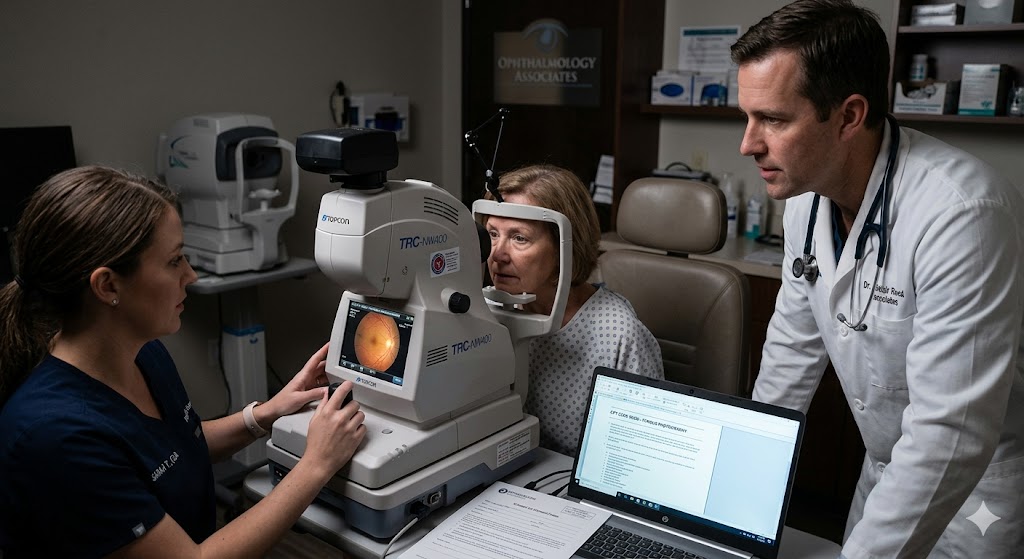
The Foundation: Defining CPT Code 92250
When you submit a claim with CPT Code 92250, you are telling the payer a very specific story. The official descriptor reads: “Fundus photography with interpretation and report.” It sounds simple. However, the simplicity of the language belies the strict clinical context required to justify it.
This code represents a bilateral service. You do not append modifier -50 (Bilateral Procedure) or modifiers -LT/-RT (Left/Right) when billing this service. One unit of 92250 inherently covers the imaging of both eyes unless a specific payer policy explicitly states otherwise for unique circumstances. The test produces a two-dimensional, static, color or red-free photographic image of the retina, optic disc, and macula.
Medicare and most commercial carriers classify this as a “sometimes therapy” code. It carries a “T” status on the Medicare Physician Fee Schedule (MPFS), meaning it comprises both a Technical Component (TC) and a Professional Component (PC). This split design is the source of much billing friction, but it also offers flexibility for practices that lease space, use co-management agreements, or employ technicians.
The Anatomy of the Service: Technical vs. Professional
To master the reimbursement, you must dissect the service into its two core elements. Failing to understand this split leaves money on the table or, worse, invites take-backs during post-payment review.
The Technical Component (TC)
The technical component, designated by modifier -TC, covers the “machine” side of the equation. It includes the cost of the camera, the maintenance, the supplies, the clinical staff who perform the acquisition of the image, and the overhead of the physical space. When a practice owns the equipment and employs the photographer, they bill 92250-TC.
You must not confuse the technician’s act of centering the camera with the physician’s act of reading the image. In a global billing scenario, both happen under one roof and you bill 92250 with no modifier. In a split scenario, an independent diagnostic testing facility (IDTF) or a hospital outpatient department might bill the TC, while the physician bills the PC. The TC is the tangible artifact—the digital or film image itself.
The Professional Component (PC)
The professional component, indicated by modifier -26, represents the cognitive work. This is where the physician’s medical decision-making lives. Billing 92250-26 requires a written interpretation and report, typically a separate paragraph or a distinct section in the electronic health record, that goes beyond a simple notation of “normal” or “see image.”
The physician must describe the optic nerve, the macula, the vasculature, and the periphery. The report must connect the findings to the patient’s presenting complaint or systemic disease. A sticky note on the front of the chart saying “NPDR mild” is not a sufficient report. A stand-alone, dated, signed interpretation is the shield against downcoding or denial.
| Component | Modifier | What it Covers | Who Typically Bills it? | Key Documentation Element |
|---|---|---|---|---|
| Technical Component | -TC | Equipment, supplies, technician time, overhead | Practice owner, Hospital, IDTF | Image acquisition log, quality control records |
| Professional Component | -26 | Physician interpretation, analysis, report writing | The interpreting physician | Signed, dated, stand-alone written report |
| Global Service | None | Both acquisition and interpretation | Physician who owns equipment | Both image log and physician report |
Coverage Determinations: Why Medical Necessity Is Non-Negotiable
A clear, focused photograph is not, by itself, justification for payment. The foundational pillar for reimbursement is medical necessity, and your documentation must make that necessity leap off the page for a claims reviewer. Medicare Administrative Contractors (MACs) publish Local Coverage Determinations (LCDs) that dictate the exact conditions they consider a reasonable and necessary justification for this test.
You cannot simply take fundus photos because it is “standard practice” or because you do it for every comprehensive exam. Payers draw a hard line between screening and diagnostic testing. A screening test performed on an asymptomatic patient with no risk factors is not a covered service and falls under the patient’s financial responsibility, usually necessitating an Advance Beneficiary Notice of Noncoverage (ABN).
Accepted Medical Necessity Rationales
LCDs generally converge on a list of symptoms and diagnoses that support the medical reasonableness of 92250. Before you capture the image, ask yourself: what question am I trying to answer? If you cannot articulate a clear clinical question that the photo will help resolve, you probably should not hit the shutter from a billing perspective.
Commonly Covered Indications Include:
- Sudden, severe, or persistent visual loss or disturbance.
- Suspected or documented diabetic retinopathy, hypertensive retinopathy, or vascular occlusions.
- Glaucoma, especially to document baseline optic disc appearance and nerve fiber layer defects (though OCT is often preferred here, photography maintains specific value).
- Macular degeneration (dry or wet) monitoring.
- Retinal tears, holes, or detachments.
- Unexplained visual field defects.
- Fundus changes associated with systemic diseases like lupus, sarcoidosis, or certain cancers.
- Documentation of optic nerve head edema or atrophy.
- Monitoring for chloroquine/hydroxychloroquine retinopathy (though screening schedules are strict).
The Screening Trap and the ABN
This is the point where many practices stumble. Let’s say a healthy 25-year-old presents for a routine check-up with a prescription of -2.00 D. Taking a fundus photo “for the baseline” is a textbook screening test. Medicare does not pay for screening fundus photography. If you perform it, you must issue a voluntary ABN to the patient, explaining they may be liable for the cost.
Conversely, if that same 25-year-old presents with flashes, floaters, and a temporal shadow, the clinical context shifts entirely. Now you are looking for a tear or a detachment. The presenting complaint drives the diagnostic test. Document the patient’s reported symptoms verbatim. “Patient reports ‘a swarm of gnats’ and ‘lightning bolts’ in the temporal periphery of the right eye for two days.” That statement justifies the test.
Documentation: The Unbreakable Record
If the service is not written down, in the eyes of an auditor, it did not happen. This adage haunts many a physician during a Zone Program Integrity Contractor (ZPIC) audit. Documentation for 92250 is a two-part affair: the order and the interpretation.
The Physician’s Order
For the test to be valid, an ordering physician or qualified non-physician practitioner (NPP) must provide an order. The order must be documented in the medical record prior to the test being performed. A retroactive order scribbled in after the image pops up on the screen does not satisfy intent.
A compliant order includes:
- The specific test ordered (Fundus photography, not just “photos”).
- The clinical indication (the signs, symptoms, or diagnosis prompting the test).
- The signature of the ordering provider.
This order can reside in the office visit note preceding the testing or on a discrete test requisition form. The key is the time stamp. In a busy retina practice, the order often comes from the referring doctor. The performing practice must secure that order before proceeding.
The Interpretation and Report: Crafting a Defensible Narrative
This is your professional worth distilled into text. The report does not need to be a novel, but it needs to be specific. Avoid the common pitfall of using only a boilerplate phrase: “Fundus photos reviewed. No acute findings.” This telegraphs a lack of engagement to an auditor.
A robust report contains four elements:
- The Comparatives: State explicitly whether you are comparing to prior photographs. “Compared to fundus photos taken on 01/15/2025, there is a stable appearance…”
- The Structures: Comment on the disc, macula, vessels, and periphery. “The optic nerve has distinct margins with a cup-to-disc ratio of 0.4. The macula displays a crisp foveal light reflex without edema or drusen. The vessels exhibit mild arteriovenous nicking at the crossing points consistent with chronic hypertension. The periphery is flat and intact for 360 degrees.”
- The Synthesis: Connect the findings to the history. “The mild arteriovenous nicking correlates with the patient’s history of essential hypertension.”
- The Impression: Summarize the findings. “Mild hypertensive retinopathy, stable.”
If you are using an EHR template, actively edit it. Your unique cognitive input must be evident. Sign and date the report immediately. An unsigned report is an unbillable report.
Reimbursement Rates and the Relative Value Unit (RVU) Breakdown
Reimbursement is a dynamic beast, adjusted yearly by the Centers for Medicare & Medicaid Services (CMS) through the Physician Fee Schedule rulemaking process. While the national conversion factor dictates the dollar value, the Relative Value Units (RVUs) reveal the “why” behind the payment. CPT 92250 is assigned a specific weight, broken down into Physician Work (wRVU), Practice Expense (PE RVU), and Malpractice (MP RVU).
The total RVUs for the global service are the sum of these components. When you bill the professional component (-26) or technical component (-TC), you claim only the respective portion of those RVUs. Understanding this helps you negotiate contracts with commercial payers and assess the financial viability of leasing a camera.
Relative Value Unit Allocation (Illustrative National Averages):
| Component | Physician Work (wRVU) | Practice Expense (PE RVU) | Malpractice (MP RVU) | Total RVUs |
|---|---|---|---|---|
| Global (92250) | 0.24 | 0.87 | 0.03 | 1.14 |
| Professional (-26) | 0.24 | 0.15 | 0.01 | 0.40 |
| Technical (-TC) | 0.00 | 0.72 | 0.02 | 0.74 |
Note: These values are approximations for illustrative purposes based on the Medicare Physician Fee Schedule and are subject to geographic adjustment via the Geographic Practice Cost Index (GPCI). Always refer to your local MAC’s fee schedule for exact contracted rates.
The table above highlights a crucial economic reality: the technical component, the hardware and the staff, consumes the majority of the code’s value. This is why independent diagnostic testing facilities (IDTFs) aggressively market retinal screening services. For the physician, the professional component compensation is a cognitive service fee that, while modest per unit, scales with volume and reinforces the medical decision-making in complex cases.
Bilateral Nature and Modifier Pitfalls
CPT 92250 has a bilateral surgery indicator of “2.” This designation on the Medicare Physician Fee Schedule Status Indicator means the standard payment methodology already accounts for the bilateral nature of the procedure. You must not use modifier -50.
Appending modifier -50 to 92250 on a 1500-claim form flags the claim incorrectly. Most payers’ automated systems will reject the line item or, in some cases, halve the fee schedule amount and then multiply by two, resulting in no additional payment but creating a confusing remittance advice that clogs up your billing workflow. Trust the intrinsic design of the code. One unit equals both eyes.
The exception, though rare, comes into play in monocular patients or in cases where you image only one eye for a documented, specific medical reason. In a true, justified unilateral scenario, some payers want the modifier -52 (Reduced Services). However, you will find that billing one unit of 92250 at full fee and documenting that one eye was not imagable due to, say, a dense vitreous hemorrhage, is often the cleaner path, as the setup and interpretation labor remain consistent.
Clinical Scenarios: Applying the Code in Real Life
Let’s move from theory to the exam lane. What does the code look like when it collides with a patient’s chart?
Scenario 1: The Diabetic on an Annual Visit
Sarah, a 62-year-old with Type 2 diabetes for 15 years, comes in for her annual eye exam. Her last HgbA1c was 8.2%. She has no visual complaints. You capture fundus photos that show a few microaneurysms and dot-blot hemorrhages in the posterior pole of both eyes, unchanged from the prior year’s photos.
- Code it: 92250 (Global). You link the diagnosis code E11.329 (Type 2 diabetes mellitus with mild nonproliferative diabetic retinopathy without macular edema). The documentation links the stable hemorrhage to her diabetic history. This is clearly medical necessary diagnostic monitoring, not screening.
Scenario 2: The Flashing Lights Patient
Michael, 58, a high myope, calls at 4:00 PM with new onset of flashes and a sudden shower of floaters in his left eye. You work him in immediately. You capture fundus photos that reveal an operculated retinal tear with a surrounding cuff of subretinal fluid in the superior temporal periphery. You send the photos to the retina specialist on call.
- Code it: 92250-26 if you are interpreting the photos in your office but do not own the camera. If you own the camera, you bill 92250 globally. The diagnosis is H33.311 (Horseshoe tear of retina without detachment, left eye). The flashes and floaters provide the medical necessity hook. The photo captures a critical, acute finding.
Scenario 3: Suspect Optic Nerve in Glaucoma
Robert, 70, has elevated intraocular pressure of 26 mmHg and a suspicious optic nerve appearance. You perform a full glaucoma workup. As part of the structural evaluation, you take stereoscopic optic disc photographs. The photos show a localized inferior notch, absent in your review of old records.
- Code it: 92250. Even though you also performed an OCT (92134), you can bill both on the same day if documentation supports that each test evaluates a distinct anatomical structure and provides non-redundant information. For 92250, the test provides the color, two-dimensional view of the nerve rim notch and the presence of a disc hemorrhage—subtle details OCT might miss. The medical necessity for the photo is the suspicious excavation of the neural rim independent of the RNFL thickness map.
Comparative Analysis: 92250 vs. Other Retinal Imaging Codes
The retina imager’s toolbox has expanded dramatically, which creates coding crossovers that invite payer scrutiny. The most frequent source of confusion is the line between 92250 and OCT (92134) or between 92250 and the more expansive scanning laser codes (92133, 92134). You must pinpoint the clinical question to choose the right code.
92250 vs. 92134 (OCT)
This is the classic duel. Fundus photography is a surface-level, wide-field, color topographic map. OCT is a cross-sectional, subsurface, micron-level structural biopsy. If the question is, “Is there a retinal hole?” you use 92250. If the question is, “Is there cystoid macular edema?” you use 92134.
The macular OCT has largely replaced photos for tracking diabetic macular edema, but wide-field fundus photography remains the standard for grading the peripheral severity of diabetic retinopathy. In a single visit, if you perform ultra-widefield fundus photography to assess the peripheral ischemic index of a diabetic patient and also perform a macular OCT to measure central subfield thickness, you bill both. You append modifier -59 (Distinct Procedural Service) or the newer XU modifier to the OCT to signal the distinct anatomical region or different clinical query. The documentation must clearly bifurcate the reasons for each test.
92250 vs. 92235 (Fluorescein Angiography)
Fundus photography is a static snapshot without injectable dye. 92235 (Fluorescein Angiography) captures dynamic transit of fluorescein dye through the retinal and choroidal vasculature. The complexity, risk, and RVU weight of angiography are significantly higher. You will never use 92235 for a simple baseline photograph. However, the photographic “red-free” imaging and color imaging acquired as part of the angiography suite are not separately billable as 92250. They are bundled into the angiography code.
92250 vs. 92228 (Remote Imaging)
The rise of telemedicine has spurred the use of remote retinal screening, often coded as 92228. This code involves the remote interpretation and report for a screening test where the acquiring technician is in a different location than the supervising physician. For diabetic screening programs in primary care offices, 92228 is the appropriate code, not 92250, which presumes a diagnostic, physician-directed, in-clinic or near-site clinical workflow. The regulatory environment for 92228 is distinct and often targeted toward specific disease prevalence.
Comparative Retinal Imaging Code Chart:
| CPT Code | Descriptor | Typical Clinical Question | Key Distinguishing Feature |
|---|---|---|---|
| 92250 | Fundus photography | “What does the retinal surface and disc look like?” | Color or red-free, two-dimensional, static surface image |
| 92134 | OCT, posterior segment | “Is there intraretinal or subretinal fluid?” | Cross-sectional depth imaging, retinal layer quantification |
| 92235 | Fluorescein angiography | “Is there leakage, blockage, or non-perfusion?” | Dynamic dye transit, shows vasculature integrity and flow |
| 92242 | Indocyanine-green angiography | “Is there choroidal neovascularization?” | Infrared dye penetrates RPE, shows choroidal circulation |
| 92228 | Remote retinal imaging | “Is diabetic retinopathy present in this remote screening?” | Telemedicine context, discrete management/interpretation pathway |
| 92227 | Remote eval of existing images | “Does this externally sourced photo need a formal report?” | Only the professional interpretation, equipment is elsewhere |
The Pediatric and Uveitis Application: Special Considerations
While adult retinal vascular disease dominates the billing landscape, CPT Code 92250 holds a vital place in pediatric ophthalmology and uveitis practices. The clinical context shifts, but the coding principles remain rigid.
Pediatric Fundus Documentation
In children, cooperation is the limiting reagent. A fundus photo often represents a “snapshot” of a moving target. Nonetheless, for conditions like suspected retinoblastoma, Coats’ disease, or retinopathy of prematurity (ROP), a photo provides a medico-legal document of the highest order. For ROP, while wide-field digital imaging with angiography (often mapped to unlisted codes or specific pediatric imaging paths) is the standard, a static photo 92250 might document the posterior pole vessels’ status prior to treatment. When billing for pediatric patients, the documentation must emphasize the necessity. A photo of a stable optic nerve coloboma is a perfect use case; a photo of a happy, healthy pink disc in a child with no risk factors is not.
Uveitis and Sequential Monitoring
Uveitis specialists rely on fundus photography to track the haze and vitritis objectively. A picture genuinely speaks a thousand words when a patient claims they “can’t see well” but the exam is equivocal. Serial photos looking at the clarity of the disc and the presence of snowballs document the inflammatory burden over time. In this context, the report should mention the comparison to prior images explicitly: “Compared to photos from 2024-11-01, vitreous haze over the optic disc shows moderate improvement.”
Modifiers Deep Dive: The Gatekeepers of Payment
We touched on -TC and -26. But the modifier ecosystem for 92250 extends further, and misapplication is a leading cause of denials. You must treat modifiers not as arcane bureaucratic nuisances but as precise signals that unlock the payer’s logic.
Modifier -25 (Significant, Separately Identifiable E/M Service)
This is the heavy lifter in eye care coding. When a patient presents for a check-up and you discover a problem that prompts immediate fundus photography, you bill the Evaluation and Management (E/M) code (e.g., 99214) with a -25 modifier, alongside 92250. The -25 tells the payer, “The cognitive work that went into the decision to order this photo was above and beyond the photo itself.”
The common mistake? Not having a distinct chief complaint or a separate paragraph in the E/M note that documents the medical decision-making that stood alone from the photo interpretation. Your E/M note must be able to be read in isolation, and a peer reviewer should still see a fully fleshed-out level of history, exam, and decision-making.
Modifier -59 (Distinct Procedural Service)
As discussed with OCT, when you perform two procedures that are normally bundled by the National Correct Coding Initiative (NCCI) edits, you must break the edit with a modifier. For 92250 and 92134, the NCCI edit pair exists because CMS considers them part of the same anatomical region family. When you use -59, you certify that these are different sessions, different structures, or totally independent clinical questions.
Your audit shield here is the separate report. Do not write a single integrated paragraph that mixes OCT and photo findings. Write a distinct “Fundus Photography Interpretation” section and a separate “Optical Coherence Tomography Interpretation” section. This physical separation in the chart is your strongest evidence that the services were distinct.
Modifier -52 (Reduced Services)
Use this sparingly. When a patient can only tolerate a photo of the posterior pole of one eye before their back spasm forces them out of the chair, you performed a reduced service. Billing 92250-52 with a clear note about the partial completion signals your honesty to the payer and typically results in a prorated payment.
The Technical Side: Camera Types and Imaging Protocols
The type of camera used does not change the CPT code, but it informs the clinical value. The standard for modern 92250 services has largely shifted to digital imaging, yet the code originated in the film era. Understanding the equipment underscores the value you are billing for.
Standard Fundus Cameras
A standard mydriatic fundus camera captures a 30- to 50-degree field of view. To image the standard seven fields for a diabetic study, the photographer must take multiple stereo pairs, requiring a compliant, well-dilated patient. The images provide high-resolution, stereoscopic detail.
Ultra-Widefield (UWF) Imaging
Optos and similar systems capture a 200-degree field of view in a single capture, often without dilation. The fact that UWF imaging is not a separate CPT code frustrates many practitioners who invested heavily in the technology. From a strict coding perspective, a 200-degree pseudo-color image is still a fundus photograph. You bill 92250. However, the medical necessity for UWF imaging is often easier to define because of the documented higher yield in detecting peripheral pathology in diabetic retinopathy or uveitis. The report should note, “Ultra-widefield fundus imaging demonstrates…”
Regardless of the camera, the protocol for image storage matters. Images must be retrievable in a format that allows for comparison. A legacy JPEG burned onto a DVD in a drawer is a compliance risk. A DICOM-compatible image stored in a PACS archive is the gold standard.
Audit Trails: Surviving the Payer Review
The letter arrives. A contractor requests records for 50 claims of 92250. Panic sets in. This is the moment your meticulous documentation system proves its worth or reveals its cracks. An audit response is a structured, professional legal argument.
What the Auditor Wants:
- The signed order.
- The legible image with patient identifiers and date stamps.
- The signed interpretation and report.
- The E/M documentation that justifies the medical necessity for that date of service.
The “Incident To” Trap:
If a technician performs the photo in a physician’s office, the service is billed under the physician’s NPI as “incident to.” This requires direct supervision, meaning the physician must be physically present in the office suite, immediately available to provide assistance. If the doctor leaves the office while the tech takes photos, those services do not meet the incident-to threshold, regardless of whether the doctor later reads them. The split-second the shutter clicks is the moment the “service” occurs for incident-to purposes.
Common Audit Failures:
- Missing Date Stamps: The image capture date doesn’t match the interpretation date, or the image has no identifying metadata.
- Cloned Notes: The exact same phrase “Disc flat, macula dry, periphery attached” appears for every single patient, including the one with an obvious 4-disc-diameter choroidal melanoma. Cloned notes destroy credibility.
- Lack of Order: The physician’s order is not recorded anywhere except as an inferred check-in procedure.
Documentation Checklist: A Pre-Claim Litmus Test
Before your billing team hits “submit,” use this checklist. This simple, reproducible process slashes denial rates and builds a culture of compliance.
- Medical Necessity Trigger: Is there a recent (<3 months) documented sign, symptom, or diagnosis that drives the need for this specific test? (Yes/No)
- Unique Order: Is there a signed, dated order in the chart for fundus photography on this date of service? (Yes/No)
- Image Identity: Does the digital image contain the patient’s name, date of birth, and date of acquisition burned into the metadata or display? (Yes/No)
- Dual Structure: If billing globally, does the chart separate the technician acquisition logs from the physician’s cognitive report? (Yes/No)
- Report Specificity: Does the physician’s report mention at least three anatomical zones (e.g., disc, macula, vessels) and a comparison to prior, if available? (Yes/No)
- Signature Lock: Is the final interpretation signed, dated, and locked by the interpreting physician? (Yes/No)
- Unilateral Logic: If only one eye was imaged, is the medical reason for the monocular study clearly stated? (Yes/No)
The Interaction with Other Diagnostic Modalities
Eye care does not exist in a silo. The real power of 92250 emerges when it’s integrated with structural OCT and functional testing like visual fields.
Fundus Photo and Visual Fields (92083)
Glaucoma management exemplifies this synergy. A Humphrey Visual Field (HVF) tells you the patient has a superior arcuate defect. The fundus photo confirms the anatomical correlation: a focal notch at the inferior temporal rim. Billing both on the same day is standard care. The medical necessity for the HVF is the functional status; the medical necessity for the photo is the structural documentation. They are two halves of the same story.
Fundus Photo and Anterior Segment Imaging
Don’t forget that 92250 is strictly a posterior segment code. Photography of the external eye, lids, or anterior segment falls under a different code set (e.g., 92285, external ocular photography). If you take a photo of a limbal mass and a fundus photo, you can bill both, but the codes must clearly map to the respective anatomical sites.
Commercial Payers: The Wild West
Medicare provides a relatively consistent framework. Commercial payers like Aetna, UnitedHealthcare, and Blue Cross Blue Shield plans introduce significant variability. Some commercial plans strictly follow Medicare LCDs. Others have internal proprietary guidelines that are far more restrictive.
Prior Authorization
An increasing number of commercial plans mandate prior authorization for 92250. They equate it not with a low-cost photograph but with a “surgical imaging” pathway. Check every new patient’s benefits. A 15-minute authorization check today prevents a 45-minute appeals process and an angry patient call about a $150 bill tomorrow.
Bundled vs. Unbundled Subscriptions
Some payers propose “retina management packages” where they offer a lump sum for all imaging during a global period. You must understand your contracts. If you have signed a capitated or bundled deal, billing a fee-for-service 92250 violates the contract. In that model, you don’t code for revenue; you code for internal tracking of utilization and clinical registries.
Building a Future-Proof Coding Strategy
The regulatory landscape is shifting toward value-based care. Fee-for-service CPT codes remain our transactional language, but the purpose is being reframed. Fundus photos are no longer just billing events; they are data points in quality measures.
The MIPS Quality Connection
Under the Merit-based Incentive Payment System (MIPS), you report quality measures related to diabetic retinopathy. Fundus photography serves as the proof of the measure. The photo documents the severity of the disease, underpinning the measure’s outcome. Practices that master the capture and coding of 92250 can flawlessly extract this data for their MIPS attestations, directly protecting their Medicare Part B reimbursements from negative adjustments.
Embracing AI and Computer-Assisted Detection
An emerging area of regulatory intrigue is the role of artificial intelligence. If your fundus camera incorporates an FDA-cleared AI algorithm that provides a “second read” for diabetic retinopathy, the CPT code remains 92250. The AI analysis is considered part of the technical tool, not a separately billable cognitive service. You must not create a separate charge for “AI fundus interpretation.” However, you can document the AI’s finding within your report, but your signature ultimately owns the final interpretation. The future may bring specific Category III codes for AI-driven screening, but we are not there yet.
Crafting the Narrative Report
Let’s move beyond bullet points. Let’s look at two versions of a report for the same patient.
Patient: John Doe. 45. History: HIV on antiretrovirals, recent CD4 drop. Complaint: Blurry vision, floaters.
Insufficient Report:
“Pictures look okay. No CMV retinitis.”
Excellent, Defensible Report:
“Fundus Photography Interpretation and Report
Date: 12/10/2026
Comparison: Baseline images from 06/10/2026.
Findings:
- Optic Disc: Margins are sharp and pink. C/D ratio 0.2 bilaterally. No edema or pallor.
- Macula: The foveal reflex is intact. There are no cotton wool spots or hemorrhages within the arcades. No edema.
- Vessels: The vascular caliber is normal. No sheathing, boxcarring, or frosted branch angiitis noted.
- Periphery: Examined for 360 degrees. No granular white dots, no hemorrhage, no elevation. The appearance is quiet.
Impression: Stable, quiet fundus examination. No photographic evidence of CMV retinitis or HIV microangiopathy. The current photos do not explain the patient’s complaint of blurry vision; will correlate with widefield fluorescein angiography.
Electronically signed by: Dr. Expert, 12/10/2026″
The second report communicates expertise, provides a medicolegal shield, and unequivocally satisfies the requirements of CPT Code 92250. The reviewer seeing that report has no further questions.
Putting It All Together
The mastery of CPT Code 92250 is not a feat of memory. It is a daily discipline. It is the discipline of articulating a clear clinical question, capturing a precise digital artifact, and rendering a distinct, signed judgment. When you separate the technical from the professional, respect the bilateral design, and anchor every click of the shutter in a documented medical necessity, the code flows cleanly from the chart to the claim to the bank.
This code, in its quiet, unglamorous way, is a gateway to detecting blinding disease, monitoring systemic illness, and protecting the precious sense of sight. The respect you afford its regulatory structure directly funds your ability to continue delivering that care. Don’t relegate it to an afterthought on the way out of the exam lane. Embed it into your clinical workflow as the structured, billable, and clinically indispensable test it is.
Conclusion
Fundus photography under CPT Code 92250 remains a cornerstone diagnostic service requiring strict adherence to bilateral billing rules, distinct documentation of technical and professional components, and a clearly established medical necessity. We dissected how to differentiate it from OCT and angiography, avoid the screening trap through compliant orders, and navigate the complexities of modifiers -25 and -59. By implementing the detailed workflow and documentation standards outlined here, providers can ensure clean claims, robust audit defense, and a sustainable revenue cycle.
FAQ: CPT Code 92250
1. Can I bill 92250 on the same day as an eye exam?
Yes, by appending modifier -25 to the appropriate Evaluation and Management (E/M) code. The E/M service must be significant and separately identifiable, with its own distinct history, exam, and medical decision-making that supports the decision to order the fundus photography.
2. Does 92250 cover both eyes automatically?
Yes. The code has a bilateral surgery indicator of “2” on the Medicare Physician Fee Schedule, meaning one unit of service is defined as imaging both eyes. Do not use modifier -50 or LT/RT modifiers.
3. What is the difference between CPT 92250 and OCT (92134)?
92250 is a two-dimensional surface photograph of the retina. 92134 (OCT) is a cross-sectional, micrometer-level scan that reveals the internal layers of the retina. They answer different clinical questions and are often both billable with the appropriate -59 modifier if used to evaluate distinct pathologies or anatomical regions.
4. Do I need a written report to bill the professional component of 92250?
Absolutely. A signed, dated, separate written interpretation and report is mandatory for the professional component. A simple notation of “normal” is not sufficient; the report must include a comparative analysis and specific findings.
Additional Resource:
For the definitive regulatory guidance, access the current Local Coverage Determination for Fundus Photography directly from the Centers for Medicare & Medicaid Services (CMS) by visiting your regional Medicare Administrative Contractor’s website, or search the CMS Coverage Database at: https://www.cms.gov/medicare-coverage-database/search.aspx