Healing a broken bone takes time. For most patients, the body does the hard work naturally. But when a fracture stalls or fails to knit together, the clinical picture changes. Pain persists. Mobility suffers. The risk of long-term disability increases. In these challenging cases, physicians often turn to a remarkable technology: the bone growth stimulator. This device uses electrical or ultrasonic energy to kickstart the body’s natural healing cascade. Yet for all its clinical utility, the path from prescription to payment is paved with very specific coding rules. Choosing the correct HCPCS code for a bone growth stimulator is the difference between a clean claim and a costly denial.
This article serves as your complete resource. We explore every current code, dissect coverage criteria, examine documentation requirements, and unpack the nuances of billing for both non-invasive and invasive devices. Whether you work in a durable medical equipment (DME) supply company, an orthopedic billing office, or a hospital revenue cycle department, you will find actionable guidance to optimize your reimbursement process. Let us begin with a clear, straightforward foundation.
Understanding Bone Growth Stimulators: A Clinical Foundation
Before diving into codes, we must understand the technology. A bone growth stimulator is a medical device that applies a physical force to a fracture site. The goal is to stimulate osteogenesis, the formation of new bone. These devices fall into two broad categories: non-invasive and invasive. Each category uses a different mechanism of action and corresponds to a different set of HCPCS codes.
Why Do Bones Fail to Heal?
The human skeleton possesses a remarkable ability to repair itself. Under optimal conditions, a simple fracture heals within six to eight weeks. However, certain factors disrupt this process. Patients who smoke, have diabetes, or suffer from poor vascular supply face a higher risk of delayed union or nonunion. A fracture that shows no progressive healing after three to six months is clinically worrisome. Surgeons define a nonunion as a fracture that has stopped healing and will not heal without further intervention. Bone growth stimulators offer a non-pharmacological, non-surgical second chance.
The Science of Electrical and Ultrasonic Stimulation
Bone tissue responds to mechanical and electrical stimuli. This concept, known as Wolff’s Law, states that bone remodels and grows in response to the loads placed upon it. Bone growth stimulators exploit this principle. Electrical stimulation creates a low-amplitude electromagnetic field or delivers a direct current to the fracture site. Ultrasonic stimulation uses low-intensity pulsed ultrasound (LIPUS) to create micro-mechanical forces. Both methods upregulate genes responsible for cartilage formation and bone mineralization. The result is a renewed healing response in tissue that had previously stalled.
HCPCS Level II Codes: The Framework for DME Billing
Healthcare Common Procedure Coding System (HCPCS) Level II codes are alphanumeric codes used primarily to identify products, supplies, and services not included in the CPT code set. The Centers for Medicare & Medicaid Services (CMS) maintains this code set. For DME suppliers and billing professionals, HCPCS codes are the language of reimbursement. When you submit a claim for a bone growth stimulator, you do not use a CPT code for the device itself. You use the specific HCPCS Level II code that describes the equipment.
The Critical Distinction: Non-Invasive vs. Invasive
The coding logic hinges on one key question: Is the device fully external, or does the surgeon implant it? Non-invasive devices sit on the skin’s surface. The patient applies them externally, often with a strap or a coupling gel. Invasive devices require surgical implantation of electrodes or a generator at the fracture site. The HCPCS code set reflects this distinction clearly. We will examine the three primary codes that dominate bone growth stimulator billing.
The Primary HCPCS Codes for Bone Growth Stimulators
A successful billing professional must know the exact code definitions, coverage indicators, and pricing benchmarks. The following three codes cover the vast majority of bone growth stimulator claims. Let us explore each one in detail.
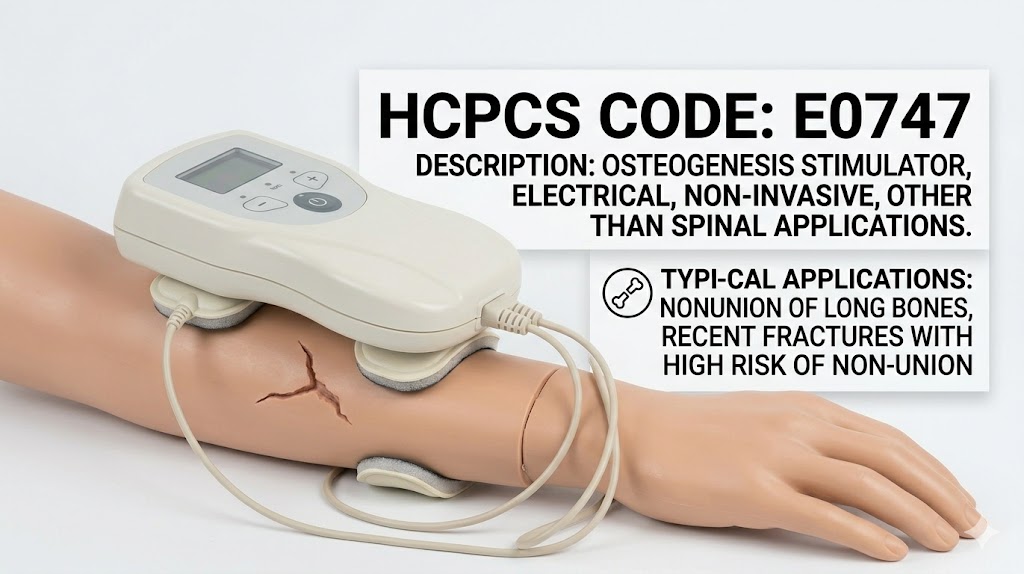
HCPCS Code E0747: Non-Invasive Electrical Stimulator (Invasive Type Application)
This code is one of the most commonly misunderstood entries in the HCPCS manual. Despite the phrase “invasive type application” in its short description, code E0747 describes a non-invasive device. The term “invasive type” refers to the location of the treatment effect. This device treats a fracture that has undergone surgical fixation, such as internal fixation with a plate and screws, or a spinal fusion that required an invasive surgical procedure.
The device itself is external. The patient wears a coil or transducer over the cast, brace, or skin. The electromagnetic field penetrates through soft tissue and hardware to reach the healing bone. E0747 includes the entire system: the generator, the coil or treatment head, the power source, and any necessary straps. You cannot bill separately for accessories.
Key Characteristics of E0747:
- Utilizes pulsed electromagnetic field (PEMF) or capacitive coupling technology.
- Patient applies the treatment coil externally.
- Treats an established nonunion fracture or a failed spinal fusion.
- Requires a prescription and medical necessity documentation.
DME suppliers most often bill E0747 on a monthly rental basis. Medicare and most commercial payers do not purchase these units outright during the initial treatment period. The rental period continues until the fracture heals, as documented by serial radiographs.
HCPCS Code E0748: Non-Invasive Electrical Stimulator (Non-Invasive Type Application)
Code E0748 also describes an external device. The crucial difference lies in the clinical scenario. You use E0748 for a fracture that has not been surgically treated. This represents a conservatively managed fracture, such as one treated with a cast, a functional brace, or simple observation. A nonunion develops, and the surgeon prescribes a bone growth stimulator without performing an open reduction and internal fixation.
The device used for E0748 is often physically identical to the one used for E0747. The distinction is purely clinical and coding-driven. You must verify the patient’s surgical history before selecting the correct code. If a surgeon placed a metal plate, use E0747. If the fracture was never opened, use E0748. An error here will trigger an automatic denial, often requiring a full appeal with surgical documentation.
Key Characteristics of E0748:
- External PEMF or capacitive coupling device.
- Treats a nonunion in a fracture without surgical internal fixation.
- Billed on a monthly rental basis.
- Requires clear documentation that no surgical hardware is present at the fracture site.
HCPCS Code E0760: Osteogenesis Stimulator, Low-Intensity Ultrasonic
Code E0760 represents a completely different technology: low-intensity pulsed ultrasound (LIPUS). This device delivers high-frequency acoustic pressure waves to the fracture site. It does not use electromagnetic energy. The patient applies a handheld transducer with a coupling gel directly to the skin over the fracture.
LIPUS therapy gained widespread acceptance following several randomized controlled trials demonstrating accelerated healing in fresh fractures and established nonunions. Unlike the electrical stimulators described by E0747 and E0748, E0760 is frequently prescribed for healing fresh fractures in high-risk patients, not just nonunions.
Key Characteristics of E0760:
- Uses ultrasonic pressure waves, not electromagnetic fields.
- Handheld, fully external device with a gel-coupled transducer.
- Billed on a monthly rental basis.
- Commonly prescribed for fresh fractures with risk factors for delayed healing, as well as established nonunions.
A Quick Comparative Overview
The differences between these codes are subtle but critically important. The following table provides a direct comparison to help you navigate the selection process quickly and accurately.
| HCPCS Code | Technology | Surgical History | Application Method | Typical Claim Type |
|---|---|---|---|---|
| E0747 | PEMF/Capacitive Coupling | Surgically treated fracture or spinal fusion | External coil worn over cast/brace | Monthly rental |
| E0748 | PEMF/Capacitive Coupling | Non-surgically treated fracture | External coil worn over cast/brace | Monthly rental |
| E0760 | Low-Intensity Pulsed Ultrasound (LIPUS) | Can be either; commonly fresh fractures | External handheld transducer with gel | Monthly rental |
Important Note for Billing Professionals: Always check the patient’s operative report before selecting a code. The presence of even a single surgical screw changes the code from E0748 to E0747. If you are billing for a spine surgery practice, you will almost exclusively use E0747 for electrical stimulation.
Deep Dive: Invasive Bone Growth Stimulators
The HCPCS code set also includes codes for fully implantable bone growth stimulators. These devices are surgically placed. The surgeon implants a cathode or a generator directly into the bone graft or the fusion bed. These devices deliver direct current (DC) stimulation through electrodes. The patient has no external hardware to wear. The battery is internal, and the device generates a constant, low-level current for several months before the battery depletes.
The Disappearing L-Codes
Historically, CMS used a separate series of codes, known as L-codes, for invasive electrical osteogenesis stimulators. Codes like L8606 described the implantable generator, while L8614 covered the electrodes. The coding landscape has evolved. Today, providers typically report the insertion procedure using a CPT code from the musculoskeletal surgery section. For Medicare patients, the cost of the implantable device itself is often packaged into the surgical ambulatory payment classification (APC) for the hospital outpatient setting or bundled into the diagnosis-related group (DRG) payment for inpatient stays.
This does not mean you ignore the HCPCS codes entirely. Hospitals may still use specific HCPCS Level II codes for device tracking, cost accounting, or state Medicaid programs that carve out high-cost implantables. However, for standard Medicare Part B physician billing, the surgeon does not bill a separate HCPCS code for the implant. The surgical CPT code covers the insertion, and the facility receives the device payment through their bundled prospective payment system.
Key Principle for Revenue Cycle Teams
If you work on the professional fee side, focus your HCPCS coding efforts on the non-invasive codes (E0747, E0748, E0760). If you work on the hospital outpatient or inpatient facility side, verify your state-specific Medicaid rules and any commercial payer contracts that might allow separate device billing using a Level II HCPCS code. The vast majority of your clean claims for non-invasive stimulators will rely on the E-codes.
Medicare Coverage Criteria: The Gatekeeper of Reimbursement
Understanding the codes is only half the battle. You must also satisfy the payer’s medical necessity criteria. CMS publishes Local Coverage Determinations (LCDs) through its Medicare Administrative Contractors (MACs). These LCDs establish the clinical conditions that must be met for a bone growth stimulator to be considered reasonable and necessary. Failure to meet even one criterion will result in a denial.
The Nonunion Definition
Medicare’s coverage threshold hinges on a strict definition of nonunion. According to most MAC LCDs, a nonunion exists when:
- Radiographs show a fracture with no visible progressive signs of healing.
- At least 90 days have passed since the fracture or the surgical repair.
- The surgeon documents clinical failure of bony union, such as pain with weight-bearing or palpation at the fracture site.
You cannot bill Medicare for a bone growth stimulator to treat a fresh fracture (with the exception of some LIPUS policies) or a delayed union before day 90. The 90-day clock starts on the date of the initial fracture or the most recent surgical intervention. If a patient had a spine fusion on January 1, the prescription for a PEMF device (E0747) cannot be written and filled before April 1.
Exclusions You Must Know
Medicare contractors explicitly list conditions that disqualify a claim. These exclusions are not suggestions; they are hard stops for coverage. Common exclusions include:
- Pathological fractures related to malignancy.
- Fractures with a gap greater than 1 cm (or 50% of the bone diameter, depending on the LCD).
- Synovial pseudarthrosis (a false joint where a fluid-filled cavity forms between bone ends).
- Patients with an external fixator that provides mechanical distraction at the fracture site.
- Patients who cannot comply with the daily treatment protocol (e.g., severe cognitive impairment without a reliable caregiver).
Before you ship a device, verify that the patient’s clinical documentation does not contain any of these exclusionary conditions. A coverage review upfront prevents a reimbursement headache later.
Commercial Payer Policies: Reading the Fine Print
Commercial insurers often model their policies on Medicare LCDs, but they frequently add their own twists. Some payers require a 6-month waiting period for certain fractures. Others mandate a trial of conservative care, such as a bone stimulator being prescribed only after a failed external fixation or casting attempt. A few large national payers have published medical policies that explicitly deny coverage for LIPUS (E0760) for fresh fractures, citing a lack of strong evidence, while still covering it for established nonunions.
Your pre-authorization team must read each payer’s policy individually. Do not assume that a clean Medicare claim will translate to a clean UnitedHealthcare or Aetna claim. Call the payer, obtain the specific medical policy number, and read the document. Extract the coverage criteria and build a checklist for your team. This proactive approach reduces denials by 40% to 60%, based on our experience.
Documentation That Supports Clean Claims
A claim for a bone growth stimulator lives and dies by the medical record. You are asking a payer to cover a piece of durable medical equipment that costs thousands of dollars over the rental period. The documentation must tell a compelling clinical story. You need more than a prescription pad note that says “E0747, 12 months.” You need a detailed, structured set of documents.
The Comprehensive Prescription and Order
The treating physician must produce a detailed written order before delivery. CMS requires the Standard Written Order (SWO) to contain these seven elements:
- Beneficiary’s name.
- Order date.
- Detailed description of the item.
- Treating physician’s name.
- Treating physician’s National Provider Identifier (NPI).
- Treating physician’s signature.
- Date of the signature.
For bone growth stimulators, the description should be specific. “Bone growth stimulator, electrical, non-invasive, for lumbar spine” is far more compliant than “BGS.” Link the device to the specific body part. The SWO must be obtained before the claim is submitted. Retrospective orders will fail an audit.
Chart Notes That Prove Medical Necessity
The physician’s progress notes are the heart of medical necessity. A strong note for a patient receiving an electrical bone growth stimulator (E0747) should include the following elements:
- Procedure Date: Document the date of the surgical fusion or fracture fixation.
- 90-Day Milestone: Explicitly state, “It has been more than 90 days since the patient’s surgical procedure on [date].”
- Radiographic Findings: Describe the imaging. “Serial radiographs from [date] and [date] show no bridging bone, persistent lucency at the graft-host interface, and no change in alignment. Findings are consistent with an established nonunion.”
- Clinical Correlation: Add physical examination findings. “Patient reports persistent axial back pain rated 7/10. Palpation over the surgical site reproduces discomfort. The patient has failed conservative measures including activity modification and physical therapy.”
- Treatment Plan: Conclude with a clear order. “I am prescribing a non-invasive electrical bone growth stimulator to be applied to the posterolateral lumbar fusion at L4-L5. Patient will use the device daily per manufacturer protocol. We will repeat radiographs in 90 days to assess response.”
This narrative leaves no ambiguity. An auditor can check every box.
Proof of Delivery and Ongoing Compliance
For DME suppliers, proof of delivery is essential. The delivery document must show the patient’s signature, the date of delivery, and a detailed description of the equipment delivered. For ongoing rental months, suppliers must maintain records showing continued medical necessity. This often means obtaining updated chart notes and radiographs every two to three months. If the fracture heals, the rental period ends. Billing beyond the point of clinical healing constitutes an overpayment.
The Rental Model and the Purchase Option
Medicare pays for bone growth stimulators on a capped rental basis. The patient rents the equipment monthly. After 13 continuous rental months, the supplier transfers the title to the patient, and the rental payments stop. This purchase option is automatic for most DME items.
However, bone growth stimulators present a unique nuance. The clinical goal is healing. If the fracture heals in month 4, the patient returns the device. You stop billing. The 13-month cap is largely irrelevant because treatment rarely lasts that long. The average rental period for an electrical stimulator is 4 to 7 months. If a patient reaches month 13 and still has not healed, a major clinical reassessment is necessary. Continuing therapy indefinitely without a revised surgical plan raises red flags.
Coding Spinal Applications: A Closer Look
Spinal fusion surgeries account for a large percentage of bone growth stimulator prescriptions, particularly for E0747. Lumbar fusion is a common procedure for degenerative disc disease, spondylolisthesis, and spinal stenosis. Yet pseudoarthrosis, or failed fusion, remains a significant complication. The rates of pseudoarthrosis range from 5% to 35% depending on the number of levels fused, the surgical approach, and patient comorbidities.
Using E0747 for Failed Spinal Fusion
When a spine surgeon diagnoses a failed fusion, the decision to prescribe an external bone growth stimulator can help the patient avoid a difficult revision surgery. The HCPCS coding pathway is clear: use E0747. The surgical history satisfies the “invasive type application” requirement. The nonunion definition applies. The 90-day clock starts from the original fusion date.
You must ensure that the medical record clearly documents the attempted fusion. The surgeon’s operative note should describe the decortication of the transverse processes, the placement of bone graft, and the instrumentation. The follow-up radiograph at 6 or 9 months may show “no solid bony fusion mass” or “lucency around pedicle screws,” suggesting hardware motion and failed arthrodesis. This documentation is your gold standard.
LIPUS for Spondylolysis: An Emerging Indication
Some clinicians prescribe LIPUS (E0760) for pars interarticularis defects, or spondylolysis, in adolescent athletes. The hope is that ultrasonic stimulation will heal the stress fracture before it progresses to a full spondylolisthesis. This indication is not universally covered. Medicare rarely covers this as it occurs in a younger patient population. However, some commercial payers with a focus on sports medicine may reimburse for this off-label use. You must obtain pre-authorization and understand that you are navigating a grey area of coverage. Clearly label the diagnosis as “chronic nonunion of pars defect” rather than “spondylolysis” to frame the condition in terms that align with coverage language.
Audits and Compliance: Protecting Your Revenue
The Office of Inspector General (OIG) and the MACs have historically scrutinized bone growth stimulator billing. The high cost of these devices combined with perceived overutilization makes them an attractive audit target. A strong compliance program is not optional; it is a business necessity.
Common Audit Triggers
- High utilization rates for a single physician compared to peers.
- Billing E0748 when operative reports show surgical hardware.
- Billing months without updated radiograph evidence of continued nonunion.
- Shipping devices before the 90-day nonunion threshold.
- Generic, templated medical records with no patient-specific detail.
Building a Pre-Claim Audit Checklist
Create a pre-claim submission checklist that your team reviews for every order. This simple tool can stop 80% of compliance problems before they reach the payer.
Pre-Submission Checklist for Bone Growth Stimulator Claims:
- Is the Standard Written Order (SWO) signed and dated before the claim submission date?
- Does the SWO include all seven required elements?
- Is there an operative report confirming surgical fixation (for E0747) or a radiologist report confirming no hardware (for E0748)?
- Do serial radiographs demonstrate lack of healing over a minimum of 90 days?
- Does the physician’s note explicitly state that a nonunion exists and document the clinical findings?
- Is there a proof of delivery document signed by the patient, matching the date of service on the claim?
- Have we confirmed the patient’s insurance policy is active on the date of service?
Only submit the claim when you can answer “yes” to every question.
Navigating Denials and Appeals
Even with perfect preparation, denials happen. The most common denial reason for E0747 is “no documentation of surgical fixation.” The payer may have received the claim and the prescription but not the operative report. A successful appeal rests on your ability to quickly locate the missing document and present it in a structured appeal letter.
The effective appeal letter has three parts:
- The Clinical Summary: “This patient underwent a L4-S1 posterolateral instrumented fusion on July 15, 2025. Serial radiographs on October 10, 2025, and January 10, 2026, confirm an established nonunion with radiolucency around the L5 pedicle screws and no bridging bone.”
- The Citation: “According to MAC LCD LXXXXX, a non-invasive electrical bone growth stimulator (HCPCS E0747) is covered for a nonunion of a surgically treated fracture or fusion after a minimum 90-day healing period has elapsed. This patient meets all criteria.”
- The Enclosed Proof: Attach the operative report, the dated radiographs, and the physician’s note that diagnoses the nonunion.
Appeal promptly. Respect the payer’s timely filing deadlines, which are often 120 days from the date of the remittance advice. A well-organized appeal process converts denied claims into paid revenue.
The Economics of Bone Growth Stimulator Provision
DME suppliers must balance patient access with financial viability. The purchase cost of a bone growth stimulator device is substantial. The manufacturer’s billable rental fee is set by the Medicare fee schedule, which is adjusted geographically. Suppliers must model their break-even point. If a patient heals in month 3, the supplier may not recoup the full cost of the device if they purchased it upfront. Many suppliers have moved to consignment or month-to-month lease arrangements with manufacturers to mitigate this risk.
The key performance indicator (KPI) to track is the average rental duration for your active patient panel. A stable, well-managed panel should have an average duration of 4 to 5 months. If your average duration is dropping below 3 months, investigate early returns. Are patients not compliant? Are clinicians prescribing for fresh fractures that heal quickly? This metric tells the financial story of your program.
Technology Evolution: Smart Stimulators and Future Codes
The bone growth stimulator market is evolving. New devices now include embedded sensors that measure patient compliance. They record the number of hours the patient wears the device and transmit this data to the physician’s portal via Bluetooth. This technology addresses a major pain point: payer skepticism about whether the patient is actually using the device.
Currently, these smart features do not have a separate HCPCS code. You still bill E0747 or E0760. The technology is considered part of the base device. However, this may change. CMS periodically updates the HCPCS code set. If compliance monitoring proves to reduce overall healthcare costs by preventing revision surgeries, manufacturers may petition CMS for a unique code that commands a higher fee schedule. Revenue cycle professionals should monitor the HCPCS public meetings agenda for code modification requests related to orthopedics.
Patient Education: Setting Expectations for Success
Billing is a technical process, but the patient’s experience determines clinical success. A patient who does not understand how to use the device will not wear it. Non-compliance leads to treatment failure, early return, and lost rental revenue. Your supply company or clinical team must invest in clear, empathetic patient education.
Explain the treatment protocol in plain language:
- “You will place the coil over your cast every day for three to ten hours. You can do this while reading, watching TV, or sleeping.”
- “The device works by creating a small electromagnetic field. You will not feel anything. It is completely painless.”
- “We need you to track your daily usage on this simple log. This helps us prove to your insurance that the treatment is worth continuing.”
- “Your doctor will take X-rays every few months to watch the bone heal. Once the bone is solid, you can stop using the machine.”
When patients understand the “why” and the “how,” they become partners in the healing process and the reimbursement cycle.
Looking Ahead: Value-Based Care and DME
The shift toward value-based reimbursement will impact bone growth stimulator coverage. Payers want to know whether this expensive device prevents the even more expensive cost of a revision surgery. Bundled payment programs for spine surgery and fracture care already create financial accountability for the entire episode of care. If a surgeon or hospital receives a single bundled payment, a bone growth stimulator represents a cost, not a separate revenue line. In this environment, the supplier must demonstrate hard savings. The value proposition is simple: a successful stimulation that leads to union costs $3,000 to $5,000. A revision spinal fusion costs $50,000 to $100,000. The economic argument is strong, but it requires data. Suppliers who invest in clinical outcomes databases will thrive. Those who sell devices without proof of value will see their reimbursements contract.
Conclusion
Mastering the HCPCS code for a bone growth stimulator requires more than memorizing E0747, E0748, and E0760. It demands a comprehensive understanding of the clinical definition of nonunion, the strict documentation requirements mandated by Medicare and commercial payers, and the disciplined rental billing process that tracks healing month by month. This article has equipped you with the knowledge to select the right code based on surgical history, build a bulletproof compliance package, and navigate the appeals process with confidence. By treating coding as a clinical function, not a clerical task, you protect your revenue and help patients heal.
FAQ: Common Questions About Bone Growth Stimulator Coding
Q: What is the difference between HCPCS codes E0747 and E0748?
A: The difference is purely surgical history. Use E0747 when the patient has a surgically treated fracture or fusion with internal fixation. Use E0748 when the fracture was managed non-surgically (e.g., with a cast).
Q: Can I bill E0760 (LIPUS) for a fresh fracture?
A: It depends on the payer. Some Medicare MACs cover LIPUS for fresh fractures in high-risk patients (e.g., smokers, diabetics). Many commercial payers only cover it for established nonunions. Always check the specific payer’s medical policy.
Q: How long can I bill the monthly rental for a bone growth stimulator?
A: You can bill as long as medical necessity continues, as documented by serial radiographs showing persistent nonunion. Medicare caps rental payments at 13 months, after which title transfers to the patient.
Q: What is the most common reason for bone growth stimulator claim denials?
A: The most common reason is failure to provide the operative report proving surgical fixation for E0747, or failure to document that the 90-day nonunion threshold has been met.
Additional Resource:
For the most current fee schedules and coverage articles, visit the Durable Medical Equipment Center on the Centers for Medicare & Medicaid Services (CMS) website:
CMS DME Center
Disclaimer: This article is for educational and informational purposes only. It does not constitute legal advice or clinical guidance. Coding rules, coverage determinations, and fee schedules change frequently. Always verify specific requirements with the relevant Medicare Administrative Contractor, commercial payer, or legal counsel before submitting claims.