If you have ever stood in front of a computer screen trying to figure out the right way to bill for a Rocephin injection, you are not alone. This is one of those procedures that sounds simple but can get surprisingly complex once insurance payers get involved.
Rocephin is the brand name for ceftriaxone sodium. It is a powerful cephalosporin antibiotic used to treat everything from strep throat to gonorrhea, pneumonia, and Lyme disease. Doctors order it daily in clinics, emergency rooms, and outpatient hospital settings.
But here is the honest truth: there is no single “CPT code for Rocephin injection” that fits every scenario. You actually need two different types of codes working together. One code describes the act of giving the injection. Another code describes the drug itself.
Let me walk you through exactly how this works. No fluff. No copied content. Just practical, real-world guidance you can use today.
CPT Code for Rocephin Injection
Understanding the Two-Part Billing System for Rocephin
Before we jump into specific numbers, you need to understand a basic rule in medical billing. Injections are split into two separate charges.
The first charge is for the procedure. This is the work of drawing up the medication, finding a vein or muscle, and actually injecting it. The second charge is for the drug product. Rocephin is an expensive medication, and you need to get reimbursed for the vial you used.
This means your claim will almost always have two lines.
-
Line one: Administration CPT code
-
Line two: Drug HCPCS code (J-code)
Some payers bundle these together. Most commercial insurance plans and Medicare do not. They want to see both codes clearly listed.
Think of it like going to a garage. You pay for the mechanic’s time, and you also pay for the oil they put in your car. Same idea here.
The Primary CPT Code for Rocephin Injection Administration
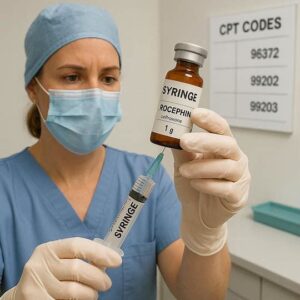
Let us start with the most common scenario. A patient comes into your clinic. A nurse or doctor gives a single Rocephin injection into the muscle. This is called an intramuscular (IM) injection.
The correct CPT code for this is 96372.
That code is officially described as: “Therapeutic, prophylactic, or diagnostic injection (specify substance or drug); subcutaneous or intramuscular.”
Here is what you need to know about 96372:
-
It covers one injection into a single muscle group
-
It includes the preparation of the medication
-
It includes the supply of a syringe and needle
-
It covers the time spent administering the injection
-
It does not cover the drug itself
When to Use 96372 for Rocephin
You should use 96372 when:
-
The Rocephin is given as a single intramuscular shot
-
The injection happens in an office, clinic, or outpatient setting
-
No prolonged monitoring is required after the injection
-
The patient is not on an IV drip or infusion pump
This code is your workhorse for most routine Rocephin injections. A typical adult dose of 250 mg or 1 gram given into the gluteal or deltoid muscle fits perfectly here.
Important Rules About 96372
Medicare and most commercial payers have a few quirks with this code.
First, you can only bill 96372 once per patient per encounter, even if you give multiple injections into different sites. Some billing software will try to let you add units. Do not do that unless your specific payer contract allows it.
Second, 96372 is typically a separate payable service. But some payers bundle it into the evaluation and management (E/M) code if the injection is considered routine. If a patient comes in just for the injection and no separately identifiable evaluation, you can bill 96372 alone.
Third, you need to document the lot number, expiration date, and administration site in your medical record. Auditors love to look for this detail with injectable antibiotics.
Reader Note: Always check your specific payer policies before assuming 96372 will be paid. Some plans require you to append modifier 25 to the E/M code if you also bill for an office visit on the same day.
CPT Code for Intravenous Rocephin Administration
Sometimes patients need Rocephin through a vein instead of a muscle. This happens with severe infections, hospitalized patients, or people who need higher doses.
For an intravenous (IV) push injection, you use a different code.
96374 is the CPT code for “Therapeutic, prophylactic, or diagnostic injection (specify substance or drug); intravenous push, single or initial substance/drug.”
But here is where it gets more specific.
96374 vs. 96375 for Rocephin
Let me break this down clearly.
| Code | Description | When to Use for Rocephin |
|---|---|---|
| 96374 | IV push, initial drug | First dose of Rocephin given through an IV line over 1–2 minutes |
| 96375 | IV push, each additional sequential drug | Not typically used for Rocephin alone. Only if another IV drug follows |
| 96376 | IV push, each additional repeat drug | Rare. Used if same drug is given again after 30+ minutes |
For a simple Rocephin IV push, you will bill 96374 once.
IV Infusion for Rocephin
What if the Rocephin is mixed in a bag and dripped over 30 minutes or more? Then you leave the push codes behind and move to infusion codes.
-
96365 — IV infusion for therapy, prophylaxis, or diagnosis (initial up to one hour)
-
96366 — Each additional hour of IV infusion
Rocephin is usually given as a slow push or short infusion. Some protocols, especially in home infusion or hospital settings, call for a 30-minute drip. In that case, 96365 is your code for the first hour.
Be careful. Many payers will deny 96365 if the infusion time is under 16 minutes. For short infusions under 15 minutes, use the push codes instead.
The HCPCS Drug Code for Rocephin (J0696)
Now let us talk about the drug itself. You cannot bill for an injection without billing for the medication. That would be like ordering a pizza and only paying for the delivery.
The HCPCS code for Rocephin (ceftriaxone sodium) is J0696.
The official description is: “Injection, ceftriaxone sodium, per 250 mg.”
This is critical to understand. J0696 is per 250 milligrams. Not per vial. Not per dose. Per 250 mg.
How to Bill Units for J0696
Let me give you real examples.
-
A patient receives 250 mg of Rocephin. You bill 1 unit of J0696.
-
A patient receives 500 mg of Rocephin. You bill 2 units of J0696.
-
A patient receives 1 gram (1000 mg) of Rocephin. You bill 4 units of J0696.
-
A patient receives 2 grams of Rocephin. You bill 8 units of J0696.
Do not round up. Do not bill for a full vial if you only used part of it, unless you are in a setting that allows waste billing (like a hospital outpatient department with a JW modifier for discarded drug).
Pricing and Reimbursement for J0696
Reimbursement for J0696 varies wildly by payer.
Medicare uses the Average Sales Price (ASP) methodology. The payment rate changes every quarter. As of recent data, the ASP for ceftriaxone is around $0.50 to $1.20 per 250 mg, but this fluctuates.
Commercial payers may reimburse at WAC (Wholesale Acquisition Cost) minus a percentage, or they may have their own fee schedules.
Do not assume J0696 is always paid. Some payers bundle J0696 into the administration code for certain settings. Others require prior authorization for more than a certain number of units.
Typical units per dose chart:
| Rocephin Dose | J0696 Units | Typical Use Case |
|---|---|---|
| 250 mg | 1 | Pediatric patients, some gonorrhea treatment |
| 500 mg | 2 | Moderate infections |
| 1 gram (1000 mg) | 4 | Adult pneumonia, Lyme disease, surgical prophylaxis |
| 2 grams | 8 | Severe infections, meningitis |
Combining Procedure and Drug Codes on a Claim
Now that you have both pieces, let me show you how they come together on a CMS-1500 claim form or in your billing software.
A standard Rocephin injection claim looks like this:
Line 1:
-
CPT code: 96372 (or 96374 for IV push)
-
Modifiers: None usually, but check payer rules
-
Charges: Your fee for the injection procedure
Line 2:
-
HCPCS code: J0696
-
Units: As determined by dose given
-
NDC number: Required by many payers now
-
Charges: Your cost plus markup for the drug
Some billing systems let you link line two to line one with a “administration reference” field. Use this if available. It tells the payer that J0696 is the drug given during the 96372 procedure.
NDC Requirement for J0696
Here is a modern twist you cannot ignore. Almost all commercial payers and Medicare now require an 11-digit National Drug Code (NDC) on claims that include J0696.
You need to report:
-
The NDC number (from the vial or package)
-
The NDC unit of measure (usually UN for “units”)
-
The quantity of NDC units administered
For a standard 1 gram Rocephin vial, the NDC will vary by manufacturer. Pfizer (the brand Rocephin manufacturer) uses NDC 0049-0630-28 for the 1 gram vial. But if you use a generic ceftriaxone, the NDC will be different.
Always scan or copy the vial label into your documentation. This is one of the most common reasons for denied claims.
Billing for Rocephin Injection in Different Settings
The exact same shot can be coded very differently depending on where it happens. Let me walk you through the most common settings.
Outpatient Clinic or Physician Office
This is the cleanest scenario.
-
Use 96372 (IM) or 96374 (IV push)
-
Use J0696 with correct units
-
Bill a separate E/M code (99202-99215) if a separate evaluation happened
-
Append modifier 25 to the E/M code
Hospital Outpatient Department (HOPD)
Hospitals use the same CPT and HCPCS codes but often have higher facility fees. You also need to be aware of packaging rules. Medicare’s OPPS sometimes packages J0696 into the ambulatory payment classification (APC) for certain levels of visit.
-
Use C-code? No. Rocephin does not have a C-code. Use J0696.
-
Use modifier -JG for hospital outpatient? Some payers want this. Check.
Emergency Room
ER coding for Rocephin follows similar rules. But there is a catch. The ER visit level (99281-99285) typically includes the cost of medications and injections in the facility’s billing. The professional claim (from the ER doctor) still uses 96372 and J0696.
Skilled Nursing Facility (SNF)
Part A stays in a SNF bundle almost everything into the PDPM rate. You generally cannot bill separately for Rocephin injections during a covered Part A stay. For Part B patients in a SNF (like those on a Medicare Part A benefit but with a qualified stay?), you can bill 96372 and J0696 under Part B.
Home Infusion
Home health agencies use G-codes for home infusion therapy. For Rocephin given at home by a nurse:
-
G0498 — Home visit for infusion therapy (per diem)
-
J0696 — Still used for the drug
Medicare’s Home Infusion benefit has specific coverage requirements. Not all patients qualify.
Modifiers You May Need for Rocephin Claims
Modifiers are two-character additions to CPT codes that change how a payer interprets the service. For Rocephin injections, a few modifiers show up regularly.
Modifier 25 (Significant, Separately Identifiable E/M Service)
This is your most common modifier for Rocephin billing.
You use modifier 25 when a patient comes in, sees the provider for a problem, and then also gets a Rocephin injection. The office visit and the injection are separate services on the same day.
Example: A patient has a sore throat, fever, and swollen tonsils. The doctor performs a history, exam, and medical decision-making (E/M code 99213). Then the doctor orders and gives a Rocephin injection (96372). You append modifier 25 to 99213.
Without modifier 25, most payers will bundle the E/M code into the injection payment or deny it entirely.
Modifier JW (Drug Amount Discarded/Not Administered)
If you open a multi-dose vial or a single-dose vial and must discard part of it, you can bill for the discarded amount using modifier JW on a separate line for J0696.
Example: You open a 1 gram vial of Rocephin but only give 500 mg (2 units of J0696). You bill:
-
J0696 x 2 units (the administered dose)
-
J0696 x 2 units with modifier JW (the discarded dose)
Medicare requires this. Many commercial payers now follow the same rule. Document the discard in the nursing note.
Modifier JA (Administered Intravenously)
This modifier is rarely used but some Medicare contractors want JA on J0696 when the drug is given intravenously. Check your local MAC policy.
Modifier 59 (Distinct Procedural Service)
For Rocephin, you rarely need modifier 59. However, if you give two completely different injections (like Rocephin and then a separate steroid injection) at different sites for different reasons, you might need modifier 59 on the second administration code.
Common Denials and How to Fix Them
Let me save you some headaches. These are the most common reasons claims for Rocephin injections get denied.
Denial: Missing NDC
Why it happens: You forgot to include the NDC number, units, or quantity.
The fix: Add the 11-digit NDC, the unit of measure (UN), and the quantity administered to the claim line for J0696. Most billing software has specific fields for this.
Denial: Incorrect Units for J0696
Why it happens: You billed 1 unit for 1 gram of Rocephin. Or you billed 4 units for 250 mg.
The fix: Remember J0696 is per 250 mg. Always divide the total dose in milligrams by 250 to get units. Use a calculator if needed. Double-check every time.
Denial: 96372 Bundled Into E/M
Why it happens: You did not append modifier 25 to the E/M code, or the payer considers the injection “incidental” to the visit.
The fix: Review the documentation. If the injection required separate skill and was not just a routine part of the visit, appeal with the medical record. For next time, add modifier 25.
Denial: Not a Covered Benefit
Why it happens: Some Medicare Advantage plans or Medicaid plans require prior authorization for injectable antibiotics in outpatient settings.
The fix: Check the patient’s benefit summary. Obtain prior authorization before administering Rocephin when possible. For urgent infections, document medical necessity heavily and submit with a retro auth request.
Denial: J0696 Paid but 96372 Denied
Why it happens: The payer may bundle administration into an E/M code for the same day, or they may require a specific diagnosis code for injection services.
The fix: Verify that the diagnosis code supports the administration. For example, J0696 alone might be payable for “Z29.11 (encounter for prophylactic flu vaccine)”? No, that is wrong. Rocephin requires an infection diagnosis like J15.0 (pneumonia due to Klebsiella) or A54.00 (gonococcal infection of lower genitourinary tract, unspecified). Match the drug to the infection.
Documentation Requirements You Cannot Skip
Good documentation is the difference between getting paid and getting audited. For Rocephin injections, your medical record must include these elements.
Required documentation checklist:
-
Patient name and date of service
-
Order or prescription for Rocephin (signed by a qualified provider)
-
Indication for use (diagnosis or reason for the antibiotic)
-
Dose in milligrams (must match J0696 units)
-
Route of administration (IM or IV)
-
Site of injection (e.g., left deltoid, right ventrogluteal)
-
Time of administration (especially for IV push or infusion)
-
Lot number of the Rocephin vial
-
Expiration date of the vial
-
Name of the person administering the injection
-
Any adverse reactions or lack thereof
-
Waste documentation if applicable (amount discarded, modifier JW)
Without these elements, you are gambling. Auditors look specifically at injectable antibiotics because they are high-cost items with potential for abuse.
Reader Note: The lot number and expiration date are often overlooked. Write them down in your daily log or in the EHR’s medication administration record (MAR). Do not assume you can look them up later. You will forget.
ICD-10 Diagnosis Codes That Support Rocephin Injection
You cannot bill J0696 or 96372 without a diagnosis code that justifies the antibiotic. Rocephin is not a “just in case” drug. It is reserved for specific bacterial infections.
Here are the most common ICD-10 codes that support Rocephin use.
| Diagnosis | ICD-10 Code | Clinical Note |
|---|---|---|
| Streptococcal sore throat | J02.0 | Confirmed by rapid strep or culture |
| Acute tonsillitis | J03.00 | Without specification |
| Pneumonia due to Streptococcus pneumoniae | J13 | Common in adults |
| Pneumonia due to other specified organisms | J15.8 | Includes many bacterial causes |
| Gonococcal infection of lower genitourinary tract | A54.00 | Rocephin is first-line treatment |
| Lyme disease (arthritis) | A69.23 | For neurologic or arthritic manifestations |
| Urinary tract infection, site not specified | N39.0 | For complicated UTIs |
| Cellulitis of unspecified part of limb | L03.119 | Common in ER and outpatient settings |
| Sepsis, unspecified organism | A41.9 | Hospital use primarily |
| Prophylactic use (surgical or post-exposure) | Z29.8 | Very limited. Must document why |
Avoid using vague codes like R50.9 (fever, unspecified) for Rocephin injections. Payers will deny these unless the documentation clearly supports empiric antibiotic therapy pending culture results.
Medicare Specific Rules for Rocephin Billing
Medicare is its own world. If you bill for Rocephin injections to Medicare Part B, follow these specific rules.
Medicare Covers Rocephin for These Indications
Medicare covers ceftriaxone for:
-
Documented bacterial infections
-
Surgical prophylaxis for specific procedures (e.g., colorectal surgery)
-
Emergency treatment of gonorrhea (covered under Part D? Actually, watch this—Part B covers injectable drugs given in a doctor’s office)
Medicare Does Not Cover Rocephin For
-
Viral infections (common cold, COVID-19 without bacterial superinfection)
-
Mild infections that could be treated with oral antibiotics
-
Prophylaxis for dental procedures (except specific heart conditions)
Medicare Part B vs. Part D
Here is a tricky area. Medicare Part B covers injectable drugs that are typically administered by a physician in an office setting. Part D covers self-administered drugs. Since Rocephin is almost always given by a healthcare professional, it falls under Part B when administered in a clinic or office.
But if a patient gives themselves Rocephin at home (rare but happens for long-term infections), that would fall under Part D. Always verify benefit assignment before billing.
Medicare Payment for J0696
Medicare calculates payment for J0696 using the ASP methodology. The current payment rate can be found on the CMS website in the quarterly ASP drug pricing files. As a ballpark, expect around $1.00 per 250 mg, but this changes frequently.
You can also bill for waste (modifier JW) on any unused portion of a single-dose vial. Document the discard amount and the reason you could not use the entire vial.
Private Payer Variations
Commercial insurance plans often deviate from Medicare rules. Here is what you need to watch for.
UnitedHealthcare
UnitedHealthcare typically follows Medicare coding guidelines for injections. But they require NDC reporting on all J0696 claims. They also have a specific policy that 96372 is not separately payable when billed with an E/M code for the same diagnosis on the same day.
Tip: Append modifier 25 to the E/M code and clearly document that the injection was a separate service.
Cigna
Cigna allows 96372 and J0696 without prior authorization for up to 7 days of treatment. For longer courses, they may require medical records. Cigna also audits J0696 units aggressively.
Tip: Keep a dosing calculation in your note. Write “1 gram = 1000 mg ÷ 250 = 4 units of J0696.”
Aetna
Aetna covers Rocephin injections but may require a tried-and-failed oral antibiotic for non-severe infections. Check their clinical policy bulletin for antibiotics.
Blue Cross Blue Shield (Local Plans)
BCBS plans vary by state. Some bundle J0696 into the administration code. Others pay separately. Some require a prior authorization for any injectable antibiotic over 1 gram. Contact your local BCBS provider line before billing for high-dose Rocephin.
Medicaid and Managed Medicaid Plans
Medicaid rules vary significantly by state. However, a few general principles apply.
Most state Medicaid programs require:
-
A valid prescription from a provider
-
Medical necessity documented in the record
-
Use of NDC on the claim
-
Prior authorization for more than a 3-day supply (sometimes)
Some states have preferred drug lists that require generic ceftriaxone rather than brand Rocephin. If you use the brand name without a specific medical reason (like a documented allergy to generic preservatives), you may face a denial.
Tip: Check your state’s Medicaid fee schedule for J0696. Some states reimburse as little as $0.30 per 250 mg. Others pay over $2.00.
Billing for Rocephin in Pediatric Patients
Children receive Rocephin frequently, especially for ear infections, strep throat, and pneumonia. The coding is the same, but a few nuances matter.
Smaller Doses, Fewer Units
A 6-month-old with otitis media might receive 250 mg of Rocephin. That is 1 unit of J0696. A 5-year-old with pneumonia might get 500 mg (2 units). A 12-year-old with gonococcal infection might get 1 gram (4 units).
Always calculate based on weight. Document the weight in kilograms and the mg/kg dose. This justifies the number of units billed.
Administration Codes Are the Same
Pediatric Rocephin injections still use 96372 for IM and 96374 for IV push. However, some pediatric-specific evaluation and management codes (99201-99215 are age-neutral now, but some legacy systems have separate pediatric E/M codes). Use the standard CPT codes.
Tip for Anxious Children
If the injection requires extra time, staff support, or behavioral interventions, you cannot bill extra for that time. 96372 includes the typical work of administering an injection. Do not add prolonged service codes (99354-99359) for a routine shot.
Rocephin for Gonorrhea: Special Billing Considerations
The CDC recommends Rocephin 500 mg IM for uncomplicated gonorrhea (or 1 gram for patients over 150 kg). This is a public health priority, and most payers cover it without prior authorization.
Coding for gonorrhea:
-
Diagnosis: A54.00 (Gonococcal infection of lower genitourinary tract, unspecified)
-
Administration: 96372 (IM)
-
Drug: J0696 x 2 units (for 500 mg) or J0696 x 4 units (for 1 gram)
Some states have special public health programs that pay for gonorrhea treatment directly. Check with your local health department. You may need to bill a different payer or use a specific modifier.
Partner treatment: Do not bill for Rocephin given to asymptomatic partners unless you have a documented evaluation for each person. That is a fraud risk.
Surgical Prophylaxis with Rocephin
Rocephin is sometimes given 30–60 minutes before surgery to prevent infection. This is called surgical prophylaxis.
Coding for surgical prophylaxis:
-
The Rocephin injection is usually given in the preoperative area
-
The administration code is still 96372 or 96374
-
The diagnosis code is Z29.11 (Encounter for prophylactic flu vaccine) — No, that is wrong again. Use Z29.8 (Encounter for other specified prophylactic measures) or a specific Z-code for the surgical procedure.
-
Better approach: Use the diagnosis code for the surgical condition plus a secondary code for prophylaxis. Or use Z01.818 (Encounter for other preprocedural examination) if the injection is part of pre-op preparation.
Most payers bundle surgical prophylaxis into the global surgical package. You cannot bill separately for Rocephin given by the surgeon or surgical team on the day of the procedure. The only exception is when a different provider (like an anesthesiologist or a separate pre-op clinic) gives the injection under a different tax ID number.
Check your surgical package definition. Medicare’s global surgical rules include pre-operative services performed within 24 hours of a major surgery. That includes injections.
How to Appeal a Denied Rocephin Claim
Despite your best efforts, denials happen. Here is a step-by-step appeal strategy.
Step 1: Read the denial reason carefully.
Do not guess. The EOB (Explanation of Benefits) or RA (Remittance Advice) will have a reason code like CO-50 (non-covered service) or PR-119 (benefit maximum reached).
Step 2: Check your coding.
Did you use the right units? Did you include the NDC? Did you append modifier 25 to the E/M code if applicable? Fix any errors and resubmit as a corrected claim.
Step 3: Gather documentation.
Pull the medical record. Highlight the order, the administration note, the lot number, and the diagnosis. If the denial says “not medically necessary,” highlight the infection diagnosis and any culture results.
Step 4: Write a concise appeal letter.
State the patient name, date of service, and claim number. Explain why the service was medically necessary. Attach the documentation. Keep it to one page plus attachments.
Step 5: Submit within the deadline.
Most payers give 120 days for a first-level appeal. Medicare gives 120 days for redetermination. Do not wait.
Future Trends in Injectable Antibiotic Coding
The world of medical coding does not stand still. Here are a few changes on the horizon that could affect Rocephin billing.
More payers requiring NDC on every claim.
What used to be a Medicare quirk is now standard for most commercial payers. Expect this to become universal.
Electronic prior authorization.
Some payers are moving to real-time prior authorization for injectable drugs. You will submit the code and dose, and the system will approve or deny instantly.
Value-based bundling.
Accountable care organizations (ACOs) and some commercial plans are moving toward episode-based payments. A Rocephin injection might be included in the flat fee for a pneumonia episode. In that model, you would not bill separately.
Site-of-care shifts.
More Rocephin injections are moving from hospitals to clinics and home settings. This reduces cost for payers. As a biller, you need to be comfortable with home infusion G-codes and clinic-based administration.
Quick Reference Card for Rocephin Injection Coding
Keep this handy at your desk.
| Scenario | CPT/HCPCS Code | Units | Modifiers |
|---|---|---|---|
| IM injection in clinic | 96372 | 1 | None usually |
| IV push in clinic | 96374 | 1 | None usually |
| IV infusion (30+ min) | 96365 | 1 per hour | None |
| Drug, 250 mg | J0696 | 1 | NDC required |
| Drug, 500 mg | J0696 | 2 | NDC required |
| Drug, 1 gram | J0696 | 4 | NDC required |
| Drug, 2 grams | J0696 | 8 | NDC required |
| Office visit + injection | E/M + 96372 | — | Modifier 25 on E/M |
| Discarded drug | J0696 (second line) | Units wasted | Modifier JW |
| Rocephin in ER facility claim | Use revenue center 0260 or 0636 | — | Follow OPPS rules |
Frequently Asked Questions (FAQ)
What is the exact CPT code for Rocephin injection?
There is no single code. For intramuscular injection, use 96372. For intravenous push, use 96374. For the drug itself, use J0696.
Can I bill 96372 and an office visit on the same day?
Yes, but you must append modifier 25 to the office visit E/M code. You also need documentation showing the visit was separately identifiable from the injection.
How many units of J0696 do I bill for 1 gram of Rocephin?
Four units. J0696 is per 250 mg. 1000 mg ÷ 250 = 4 units.
Does Medicare cover Rocephin injections?
Yes, for medically necessary bacterial infections. Medicare Part B covers the injection and the drug when given in a clinic or office setting.
What diagnosis code should I use for a Rocephin injection?
Use the specific infection code, such as J15.0 (pneumonia), J02.0 (strep throat), A54.00 (gonorrhea), or L03.119 (cellulitis). Avoid vague codes like fever or malaise.
Do I need an NDC for J0696?
Most payers, including Medicare and major commercial plans, now require the NDC on the claim line for J0696. Failure to include it will result in a denial.
Can I bill for a Rocephin injection given by a nurse?
Yes. The service is billed under the supervising physician’s NPI. The documentation must show the nurse acted under the physician’s order and supervision.
What if I give a Rocephin injection and a steroid injection in the same visit?
You can bill 96372 once for the first injection. Some payers allow a second 96372 with modifier 59 for the second injection at a different site. Others bundle it. Check your specific payer policy.
How do I bill for a Rocephin injection given in the hospital?
For the professional claim (the doctor’s service), use 96372 or 96374 plus J0696. For the hospital facility claim, use revenue code 0260 (IV therapy) or 0636 (drugs requiring detailed coding) plus J0696.
Is prior authorization required for Rocephin?
For a one-time dose in an urgent setting, typically no. For repeated doses (e.g., a week of daily injections), many payers require prior authorization after the first 3–5 doses.
Additional Resource
For the most up-to-date Medicare payment rates for J0696, visit the Centers for Medicare & Medicaid Services (CMS) quarterly ASP Drug Pricing Files. You can find the latest file at: https://www.cms.gov/medicare/medicare-part-b-drug-average-sales-price/asp-pricing-files
Copy and paste this link into your browser. The page includes downloadable Excel files for each quarter. Look for the row labeled “Ceftriaxone 250mg” or “J0696” to see the current payment rate.
Conclusion
Here is the bottom line. The correct way to bill for a Rocephin injection uses two codes working together: an administration code (usually 96372 for IM or 96374 for IV push) and a drug code (J0696 with units based on 250 mg per unit). Always include the NDC, match your units to the dose given, and document everything. Append modifier 25 to any same-day E/M code. When you follow these rules consistently, you will reduce denials, speed up payments, and stay compliant with Medicare and commercial payers.
Disclaimer: This article is for educational purposes only and does not constitute legal, financial, or medical advice. Coding and reimbursement rules change frequently. Always verify current codes, payer policies, and local coverage determinations before submitting claims. The author and publisher disclaim any liability for any adverse outcomes resulting from the use or misuse of this information.