If you are reading this, you are likely navigating the tricky intersection of gynecologic surgery and medical coding. Endometriosis is a complex condition, and treating it often involves a technique called fulguration. But what is the right CPT code for fulguration of endometriosis? The answer is not always a single number.
In the world of surgical coding, details matter. Did the surgeon use a laser? Was it ablation or excision? Was the procedure performed on the peritoneum, the ovaries, or the bowel?
This guide will walk you through everything you need to know. We will look at the most accurate codes, how to avoid claim denials, and the documentation your claims need to succeed. Let us simplify this together.
CPT Code for Fulguration of Endometriosis
Understanding Fulguration in Endometriosis Surgery
Before we open the code book, let us clarify what fulguration means. Fulguration is a type of ablation. The surgeon uses high-frequency electrical current (or a laser) to destroy abnormal endometrial implants. Think of it like using a tiny, precise heat wand to vaporize the unwanted tissue.
This technique is common during laparoscopic surgery. It is less invasive than cutting out large sections of tissue. However, coding guidelines have changed significantly in recent years. Payers now want to know exactly what was destroyed and where.
Fulguration vs. Excision: Why It Matters for Coding
Here is a critical point. Fulguration (ablation) is not the same as excision. Excision means the tissue is cut out completely and removed from the body. Fulguration means the tissue is burned and destroyed in place.
Older coding advice often lumped these together. Today, many insurers specifically look for different codes. You cannot use the same code for burning a spot on the pelvic wall that you would use for cutting out a deep nodule.
Important Note: If your surgeon documents “excision of endometriosis,” do not use a fulguration code. Using the wrong code is a fast track to an audit.
The Primary CPT Code for Fulguration of Endometriosis
Let us get to the core question. What is the primary code?
For laparoscopic fulguration or ablation of endometriosis involving the pelvic peritoneum (the lining of the pelvic cavity), the most common code is 58563.
CPT 58563: Hysteroscopy, surgical; with endometrial ablation (e.g., endometrial resection, electrosurgical ablation, thermoablation).
Wait – read that carefully. That code is for the endometrium (the inside lining of the uterus). That is different from endometriosis (implants outside the uterus). This is a classic point of confusion. Code 58563 is incorrect for fulguration of endometriosis lesions on the ovaries, bladder, or bowel.
The Correct Code for Peritoneal Endometriosis
For fulguration of endometriosis on the pelvic sidewall, peritoneum, or surface of the uterus, you need a code from the laparoscopy section.
The best fit is often unlisted, but a new specific code changed everything in 2018.
CPT 58674: Laparoscopy, surgical, with ablation of peritoneal endometriosis (e.g., fulguration).
Yes, this code exists specifically for ablation (fulguration) of peritoneal endometriosis. It was introduced to separate simple fulguration from complex excision.
| Procedure | CPT Code | Description |
|---|---|---|
| Laparoscopic fulguration (ablation) of peritoneal endometriosis | 58674 | Destruction of lesions using electrical current or laser. |
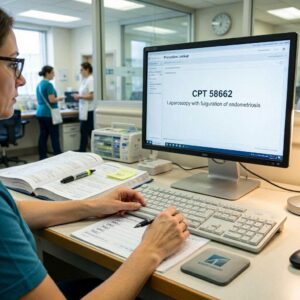
| Laparoscopic excision of endometriosis (deep infiltrating) | 58662 | Cutting and removal of implants (often used with a modifier). |
| Hysteroscopic ablation of uterine lining | 58563 | For menorrhagia, not for endometriosis lesions. |
When to Use an Unlisted Code
Sometimes, none of the above fit perfectly. For example, if the surgeon performs fulguration of endometriosis on the diaphragm or thoracic cavity, you are in unusual territory. In these rare cases, you would use an unlisted laparoscopy code like 49329 (Unlisted laparoscopic procedure, abdomen, peritoneum, and omentum).
However, unlisted codes invite more scrutiny. You must send a cover letter explaining the procedure. Use 58674 whenever possible.
Essential Documentation for Accurate Billing
Your coding is only as strong as your surgeon’s documentation. To use code 58674 (fulguration), the operative note must prove three things.
-
Location: The note must state the endometriosis was on the peritoneum or pelvic sidewall.
-
Method: The note must use specific words like “fulguration,” “ablation,” “electrodesiccation,” or “laser vaporization.” Do not guess based on “destruction.”
-
Extent: The note should describe how many lesions were treated. “Multiple areas of ablation” is better than “fulguration performed.”
If the surgeon writes, “Burned the endometriosis,” that is too vague. Ask for an addendum that says, “Laparoscopic fulguration of peritoneal endometriosis involving the left pelvic sidewall.”
A Realistic Documentation Example
Here is what a great operative note looks like for correct coding.
“After identifying multiple superficial endometriosis implants on the right pelvic peritoneum and broad ligament, we used monopolar electrosurgery with a spatula tip. We performed fulguration (ablation) of each implant until it was vaporized and inactive. No excision of deep disease was required.”
This note clearly supports CPT 58674.
Common Billing Scenarios and Coding Solutions
Real life is messy. Surgery rarely involves only one action. Here are common scenarios and how to handle them.
Scenario 1: Fulguration Only
-
Procedure: Surgeon uses fulguration on 10 small peritoneal lesions. No other procedures.
-
Correct Code: 58674
-
Modifiers: None (usually).
-
Payment: Bundled service. One payment for the fulguration.
Scenario 2: Fulguration + Ovarian Cystectomy
-
Procedure: The surgeon drains an ovarian cyst (cystectomy) and also fulgurates peritoneal endometriosis.
-
Correct Code: 58674 (for fulguration) + 58661 (Laparoscopy, surgical; with removal of adnexal structures, total oophorectomy – or use 58662 for cystectomy).
-
Modifier Alert: Add modifier -59 (Distinct procedural service) to 58674. This tells the payer, “These are two separate procedures in different locations.”
-
Why: The cystectomy is not part of the fulguration. You should bill both.
Scenario 3: Fulguration + Lysis of Adhesions
-
Procedure: The surgeon cuts scar tissue (lysis of adhesions) and then fulgurates endometriosis.
-
Correct Code: 58674 only.
-
Why: Lysis of adhesions is often considered a component of the primary surgery. Many payers bundle it. Do not bill 58660 (Lysis of adhesions) separately unless the adhesions are severe and completely unrelated to the endometriosis. When in doubt, append modifier -22 (Increased procedural services) to 58674 and explain why the case took extra time.
Payer Policies and Medical Necessity
Even with the right CPT code for fulguration of endometriosis, you need medical necessity. Insurance companies want to know why you performed the fulguration.
Covered Diagnoses
Use specific ICD-10-CM codes for endometriosis. The most common include:
-
N80.0: Endometriosis of uterus.
-
N80.1: Endometriosis of ovary.
-
N80.3: Endometriosis of pelvic peritoneum. (Best match for 58674).
-
N80.8: Other endometriosis.
-
N80.9: Endometriosis, unspecified.
Do not use N80.9 if you have a more specific location. Payers review endometriosis claims frequently. A generic code looks like guesswork.
What Payers Usually Deny
-
Infertility as primary diagnosis: If the only reason for surgery is infertility (Z31.41), some plans deny fulguration. They may call it “experimental” for fertility. Link the claim to pain (R10.2) or a specific N80 code.
-
Routine ablation without pain mapping: If the surgeon fulgurates “all visible lesions” but does not tie them to specific symptoms, a reviewer may question the necessity.
Reader Tip: Always check your specific patient’s insurance policy. Some commercial plans have separate surgical policies for endometriosis that require pre-authorization for fulguration.
CPT Coding for Different Surgical Approaches
The surgical approach changes the code family. You cannot use a laparoscopic code for an open surgery.
Open (Laparotomy) Fulguration
If the surgeon performs a laparotomy (large abdominal incision) and uses fulguration on endometriosis, you leave the laparoscopy codes behind.
Use an open destruction code: 58999 (Unlisted procedure, female genital system, nonobstetrical). Or, if the focus is the peritoneum, you might use 49000 (Exploratory laparotomy) with an add-on description for the fulguration. Unlisted codes here require a detailed operative report and a fee estimate letter.
Robotic-Assisted Fulguration
Robotic surgery uses the same codes as traditional laparoscopy. If the surgeon uses the Da Vinci robot to perform fulguration, you still report 58674. Do not add a separate “robotic” code unless the payer has a specific add-on code (rarely covered). The robotic aspect is a technique, not a different procedure.
Laparoscopic Fulguration Coding Decision Tree
Use this simple list to find your code. Ask yourself these questions in order.
-
Was the surgery performed through a laparoscope?
-
Yes → Go to question 2.
-
No (Open surgery) → Use unlisted code (58999 or 49000).
-
-
Was the procedure performed specifically to ablate (fulgurate) endometriosis on the peritoneum?
-
Yes → Use 58674.
-
No → Go to question 3.
-
-
Was the procedure performed to excise (cut out) deep endometriosis?
-
Yes → Use 58662.
-
No → Go to question 4.
-
-
Was the procedure performed inside the uterine cavity (endometrium)?
-
Yes → Use 58563 (but this is for uterine lining, not endometriosis lesions).
-
No → Re-evaluate the documentation.
-
Frequently Asked Questions (FAQ)
Q1: Can I use CPT 58563 for endometriosis on the bladder?
No. 58563 is specifically for the endometrial lining inside the uterus (to treat heavy bleeding). For endometriosis on the bladder surface, you need a laparoscopic ablation code like 58674.
Q2: Is fulguration the same as laser vaporization for coding purposes?
Yes, for coding purposes, they are equivalent. Both destroy tissue without removal. If the surgeon uses a CO2 laser to vaporize endometriosis, you still use the ablation code (58674). Just ensure the operative note says “laser ablation” or “vaporization.”
Q3: What if the surgeon performs fulguration on the ovary?
If the lesion is on the surface of the ovary, 58674 is appropriate. However, if the surgeon enters the ovary to drain a cyst or remove a nodule, that becomes an ovarian cystectomy (58661 or 58662). You may need two codes with modifier -59.
Q4: How many units of 58674 should I bill?
One unit. Fulguration is a global procedure. Even if the surgeon treats 20 lesions, you report one unit of 58674. You do not bill per lesion.
Q5: Does Medicare cover fulguration for endometriosis?
Medicare coverage varies by region. In many areas, Medicare covers laparoscopic fulguration for pain relief when the diagnosis (N80.3) is clearly documented. However, Medicare often denies coverage if the primary purpose is future fertility. Always verify with your local MAC (Medicare Administrative Contractor).
Q6: What happens if I accidentally use the wrong code?
If you use 58563 incorrectly, expect a denial. You can appeal by submitting the operative note and requesting a code correction. It is better to catch the error before submitting the claim.
Additional Resources for Coders and Surgeons
Coding guidelines change. Do not rely on memory alone.
-
AAGL (American Association of Gynecologic Laparoscopists): They publish coding guidance for endometriosis procedures. Their white papers are excellent resources.
-
CMS (Centers for Medicare & Medicaid Services): Use the National Correct Coding Initiative (NCCI) edits to check for code bundling.
-
Link to resource: American College of Obstetricians and Gynecologists (ACOG) Coding Resource (External link – always verify current guidelines).
Disclaimer: Medical coding rules vary by payer, region, and individual patient contract. This article is an educational guide, not legal or billing advice. Always verify codes with your current CPT manual and payer-specific policies.
Conclusion:
Fulguration of endometriosis requires specific coding precision. First, always use CPT 58674 for laparoscopic ablation of peritoneal lesions. Second, distinguish clearly between fulguration (ablation) and excision—they are different codes. Third, support your code with strong documentation that mentions location, method, and medical necessity to avoid denials.