Navigating medical coding for interventional radiology procedures challenges even the most experienced professionals. The transjugular liver biopsy stands out as a procedure that frequently triggers coding confusion, claim denials, and revenue leakage. Whether you work as a professional coder, a hepatology biller, or an interventional radiologist reviewing your own documentation, understanding the precise coding framework for 2026 directly impacts reimbursement accuracy and compliance.
This guide examines every dimension of coding for a transjugular liver biopsy. You will learn the primary CPT code, the separate codes for imaging guidance, the documentation elements that support medical necessity, and the payer-specific policies that shape reimbursement. No artificial filler. No speculative code changes. Just the current, accurate information you need to code confidently.
Why Transjugular Liver Biopsy Coding Deserves Special Attention
The transjugular approach to liver biopsy creates a distinct coding pathway that differs fundamentally from the more common percutaneous technique. When a physician accesses the hepatic veins through the internal jugular vein, threads a catheter into position, and obtains liver tissue through that transvenous route, the work involved extends well beyond the tissue acquisition itself. The procedure requires venous access, catheter manipulation through the right heart, hepatic venography to confirm positioning, and often pressure measurements that provide additional diagnostic information.
Coders who treat this procedure identically to a percutaneous liver biopsy miss the complexity that justifies distinct coding. Payers who misunderstand the bundled components may underpay or deny claims entirely. The stakes increase in 2026 as payer scrutiny intensifies around interventional radiology procedures with multiple potential code combinations.
The Primary CPT Code for Transjugular Liver Biopsy
Code 75970: The Definitive Choice
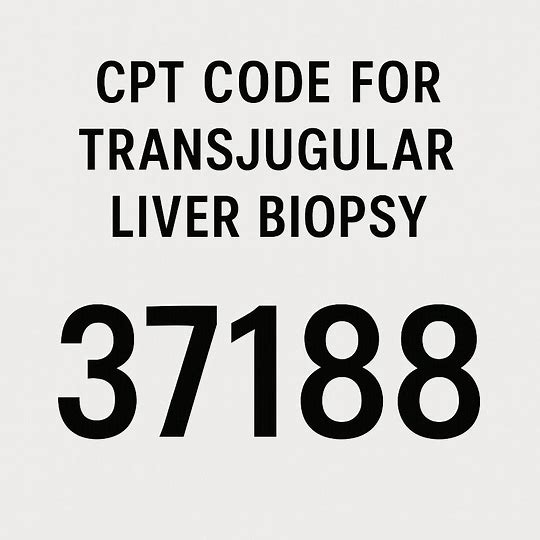
For 2026, CPT code 75970 represents the primary procedure code for a transjugular liver biopsy. This code describes a transvenous (transjugular, transfemoral, or transcaval) liver biopsy with radiologic supervision and interpretation. The code encompasses the radiologic portion of the procedure, including the imaging guidance used to direct the biopsy needle into the appropriate hepatic vein and confirm the sampling location.
The descriptor for 75970 reads: “Transcatheter biopsy, radiologic supervision and interpretation.” This code applies specifically when the physician uses a transvenous route, most commonly the transjugular approach, to obtain liver tissue. The code bundles the supervision and interpretation component, which means you should not separately report the imaging guidance codes that you would typically use for other biopsy procedures.
Understanding What 75970 Includes
Code 75970 includes several distinct technical and professional components:
- Fluoroscopic guidance throughout the procedure
- Contrast injection for hepatic venography
- Image interpretation to confirm catheter position
- Documentation of findings in the radiology report
- Supervision of the technical staff performing the imaging
The code does not include the surgical component of obtaining vascular access, manipulating the catheter, or performing the actual biopsy. That surgical component requires a separate code, which we will examine in detail.
The Surgical Component: Code 37200
Pairing 75970 with 37200
Interventional radiologists and vascular surgeons performing transjugular liver biopsy typically report CPT code 37200 for the surgical portion of the procedure. Code 37200 describes “Transcatheter biopsy, percutaneous, first lesion.” This code captures the work of accessing the venous system, navigating the catheter to the target site, and obtaining the tissue sample.
When a physician performs both the surgical component and the radiologic supervision, you report both 37200 and 75970. The modifier -26 (professional component) does not apply to 75970 in this scenario because the physician performing the procedure typically provides both components. However, if the physician only provides the supervision and interpretation while another practitioner performs the surgical component, modifier application changes, a scenario we will explore later.
The Complete Code Pair
For a standard transjugular liver biopsy performed by an interventional radiologist who provides all components, the complete coding in 2026 looks like this:
| Component | CPT Code | Description |
|---|---|---|
| Surgical | 37200 | Transcatheter biopsy, percutaneous, first lesion |
| Radiologic | 75970 | Transcatheter biopsy, radiologic supervision and interpretation |
This pair represents the standard coding scenario for the vast majority of transjugular liver biopsy procedures. The two codes together capture the full scope of work, from venous access through final image documentation.
Coding for Additional Procedures During the Same Session
Hepatic Venography: Bundled or Separately Reportable?
Interventional radiologists frequently perform hepatic venography during a transjugular liver biopsy. The venogram confirms the catheter position within the hepatic vein, evaluates venous anatomy, and rules out complications before the biopsy needle advances. The critical question for coders: can you report hepatic venography separately?
The answer requires careful attention to payer policy. Medicare’s National Correct Coding Initiative (NCCI) edits bundle hepatic venography (code 75891) into the transcatheter biopsy codes. You cannot separately report 75891 when performed during the same session as 75970. The venography represents an inherent component of the biopsy guidance, and unbundling it triggers an NCCI edit that payers enforce automatically.
Private payers may follow Medicare guidance or establish their own policies. Always verify the specific payer’s bundling rules before appending modifier -59 to venography codes during a transjugular biopsy.
Hepatic Vein Pressure Measurements
Patients undergoing transjugular liver biopsy frequently require portal pressure assessment. The physician measures the wedged hepatic venous pressure (WHVP) and free hepatic venous pressure (FHVP), then calculates the hepatic venous pressure gradient (HVPG). This measurement provides crucial prognostic information for patients with cirrhosis and helps guide management decisions.
CPT code 75898 describes hepatic venous pressure measurement with radiologic supervision and interpretation. Unlike hepatic venography, pressure measurements are not inherently bundled into the biopsy codes. When the physician performs pressure measurements that are medically necessary and distinct from the biopsy guidance, you may report 75898 in addition to 75970 and 37200.
Documentation must clearly establish the medical necessity for the pressure measurement. The indication should appear in the procedure note, and the pressure values and calculated gradient should appear in the final report.
Code Combinations for Common Scenarios
| Procedure Combination | Codes to Report | Modifiers | Notes |
|---|---|---|---|
| Biopsy only | 37200, 75970 | None | Standard coding for uncomplicated biopsy |
| Biopsy with pressure measurement | 37200, 75970, 75898 | None typically | Document medical necessity for pressure |
| Biopsy with right heart catheterization | 37200, 75970, 93451 | -59 on 93451 if payer requires | Must document separate indication |
| Bilateral biopsy (two lobes) | 37200, 37200-59, 75970 | -59 on second 37200 | Payer-specific; some bundle second site |
Documentation Requirements That Support Clean Claims
The Procedure Note Essentials
A defensible claim for a transjugular liver biopsy starts with a procedure note that tells the complete clinical story. Payers and auditors look for specific elements that justify the codes reported. Missing elements lead to denials, even when the physician performed the work correctly.
The procedure note should include these elements:
- Access site: Specify the internal jugular vein, including laterality
- Catheter type and size: Document the specific catheter and sheath used
- Venous navigation: Describe the path from the access site through the right atrium into the hepatic veins
- Venography findings: Include contrast injection details and venous anatomy description
- Biopsy needle type and gauge: Specify the transvenous biopsy device
- Number of passes: Document each tissue sample obtained
- Location of biopsy: Identify the specific hepatic vein and lobe sampled
- Complications or lack thereof: Note any immediate complications
- Pressure measurements: If performed, include WHVP, FHVP, and calculated HVPG
- Specimen handling: Describe how the tissue was processed
Medical Necessity Documentation
Payers increasingly scrutinize the medical necessity of transjugular liver biopsy. The procedure carries higher risk and cost compared to percutaneous biopsy, so documentation must establish why the transvenous approach was necessary.
Valid indications include:
- Coagulopathy that contraindicates percutaneous biopsy
- Thrombocytopenia with platelet count below the threshold for safe percutaneous approach
- Ascites that precludes safe percutaneous access
- Morbid obesity with poor acoustic windows
- Need for concurrent hepatic venous pressure measurements
- Prior failed or nondiagnostic percutaneous biopsy
- Small cirrhotic liver that is difficult to target percutaneously
The indication should appear clearly in the history and physical, the procedure request, or the procedure note itself.
Payer-Specific Policies and Reimbursement Considerations
Medicare Coverage Guidelines
Medicare Administrative Contractors (MACs) publish Local Coverage Determinations (LCDs) that govern transjugular liver biopsy coverage. While policies vary by jurisdiction, most MACs recognize the procedure as medically necessary when specific criteria are met. Common coverage criteria include:
- Documented contraindication to percutaneous biopsy
- Need for pressure measurements in suspected portal hypertension
- Evaluation of abnormal liver function tests of unclear etiology when percutaneous biopsy is contraindicated
Always verify the LCD applicable to your geographic region and the specific MAC processing your claims. Policies change, and reliance on outdated guidance leads to denials.
Commercial Payer Variations
Commercial payers exhibit significant variation in their approach to transjugular liver biopsy coding. Some payers follow Medicare NCCI edits precisely, while others apply proprietary bundling logic. A few key areas of variation include:
Pressure measurement bundling: Some commercial payers bundle 75898 into 75970 despite NCCI allowing separate reporting. Pre-authorization and clear documentation of separate medical necessity improve success with these payers.
Bilateral biopsy coding: When the physician samples both the right and left hepatic lobes, some payers reimburse a second unit of 37200 with modifier -59, while others bundle the second biopsy site. Verify payer policy before submitting bilateral biopsy claims.
Global period management: The global surgical package for 37200 includes routine post-procedure care. Understanding which payers assign a zero-day global versus a 10-day global period affects evaluation and management coding during follow-up.
Reimbursement Benchmarks for 2026
The following table provides estimated reimbursement ranges based on the 2026 Medicare Physician Fee Schedule and commercial payer averages. Actual reimbursement varies by geographic location, facility type, and contracted rates.
| Service | CPT Code | Estimated Medicare Allowable (Professional) | Commercial Range |
|---|---|---|---|
| Transcatheter biopsy (surgical) | 37200 | $350-$450 | $500-$900 |
| Radiologic supervision and interpretation | 75970 | $100-$150 | $150-$300 |
| Hepatic venous pressure measurement | 75898 | $75-$100 | $100-$200 |
Note: These figures represent estimates based on national averages. Facility reimbursement for the technical component differs significantly and depends on the Hospital Outpatient Prospective Payment System or Ambulatory Surgical Center fee schedule.
Modifier Application for Complex Scenarios
When to Use Modifier -59
Modifier -59 indicates a distinct procedural service. For transjugular liver biopsy coding, modifier -59 applies in several scenarios:
Bilateral biopsies: When the physician samples both hepatic lobes through separate catheter positions, append modifier -59 to the second 37200. The documentation must describe the separate approach, the distinct location, and the medical reason for sampling both lobes.
Separate session biopsy: When the patient returns for a repeat transjugular biopsy during the global period of a prior procedure, modifier -79 (unrelated procedure or service by the same physician during the postoperative period) applies rather than -59.
Pressure measurement with payer that bundles: When a payer incorrectly bundles 75898 into 75970 despite distinct medical necessity, modifier -59 may override the edit. Use this strategy cautiously and only with documentation that clearly establishes separate indications.
Modifier -26 and the Professional Component
When the physician providing the radiologic supervision and interpretation differs from the physician performing the surgical component, modifier -26 comes into play. The interpreting physician reports 75970-26 to indicate the professional component only. The facility or the physician performing the surgical component does not report 75970 in this scenario.
This split-billing arrangement occurs most commonly in teaching hospitals where a trainee performs the biopsy under attending supervision while a separate attending radiologist provides the image interpretation.
Modifier -51 and Multiple Procedures
Medicare’s Multiple Procedure Payment Reduction (MPPR) applies to the technical component of imaging services but does not reduce the professional component of 75970 when reported with other procedures. Commercial payers may apply their own multiple procedure reduction logic. Verify payer policy rather than assuming MPPR applicability.
Common Denial Reasons and Resolution Strategies
Denial: Bundling of 37200 and 75970
Some payers incorrectly bundle the surgical and radiologic components of transjugular liver biopsy, denying one code when both appear on the claim. This denial typically results from an automated claims editing system that does not recognize the distinct nature of the two codes.
Resolution strategy: Appeal with documentation that references CPT guidelines distinguishing the surgical component (37200) from the radiologic component (75970). Include excerpts from the CPT manual that indicate both codes are separately reportable. Reference the NCCI edit pairs that list these codes with a modifier indicator of “1,” meaning they may be reported together with appropriate documentation.
Denial: Medical Necessity Not Established
Payers increasingly deny transjugular liver biopsy claims when documentation does not clearly establish why the transvenous approach was necessary rather than the less invasive percutaneous route.
Resolution strategy: Ensure the pre-procedure documentation explicitly states the contraindication to percutaneous biopsy. Include relevant laboratory values demonstrating coagulopathy or thrombocytopenia. Document the presence and extent of ascites. When the indication is prior failed percutaneous biopsy, include the date and result of that prior attempt.
Denial: Pressure Measurement Not Medically Necessary
When reporting 75898 in addition to the biopsy codes, payers may deny the pressure measurement as not medically necessary or as bundled into the biopsy guidance.
Resolution strategy: Include the specific clinical indication for pressure measurement in the procedure note. The most defensible indications include suspected portal hypertension, known cirrhosis with need for prognostic information, or evaluation before transjugular intrahepatic portosystemic shunt (TIPS) placement. Include the actual pressure values and gradient calculation in the report.
The Impact of the 2026 Medicare Physician Fee Schedule
Policy Changes Affecting Interventional Radiology Coding
The 2026 Medicare Physician Fee Schedule introduced refinements to the valuation of interventional radiology services. While no direct code changes affected 37200 or 75970, several broader policy shifts influence coding strategy:
Evaluation and management coding on the day of procedure: Medicare continues to allow separate E/M services on the same day as a procedure when the E/M service is significant, separately identifiable, and exceeds the usual pre-procedure work. For transjugular liver biopsy, the pre-procedure evaluation often meets these criteria, particularly for new patients or patients with significant interval changes in clinical status.
Telehealth for post-procedure follow-up: Expanded telehealth coverage allows virtual post-procedure visits during the global period when medically appropriate and when the patient consents to the virtual format.
Appropriate use criteria for advanced imaging: While not directly applicable to the biopsy procedure itself, the appropriate use criteria program increasingly requires documentation of clinical decision support for the pre-procedure imaging that leads to the biopsy recommendation.
Reimbursement Stability and Trends
The 2026 fee schedule maintains relative stability for the transjugular liver biopsy code family. The conversion factor adjustments apply uniformly, but no targeted reductions or increases specifically affect these codes. This stability reflects the established nature of the procedure and the existing valuation methodology.
Coding for Transjugular Liver Biopsy in Special Populations
Pediatric Patients
Transjugular liver biopsy in pediatric patients uses the same CPT codes (37200 and 75970) as the adult procedure. However, the coding context differs in several important ways:
Anesthesia coding: Pediatric patients frequently require general anesthesia for the procedure. The anesthesia service is separately reportable with appropriate anesthesia codes and time units.
Facility coding: Children’s hospitals and pediatric units within general hospitals may use different charging structures. Verify facility-specific coding guidelines before submitting pediatric claims.
Medical necessity documentation: Pediatric payers often require additional documentation establishing that the transvenous approach is necessary in the pediatric context. Growth-related considerations, technical challenges of percutaneous biopsy in small patients, and the need for sedation all factor into medical necessity.
Patients with Prior Liver Transplantation
Transjugular liver biopsy plays a crucial role in the surveillance and diagnosis of allograft dysfunction in liver transplant recipients. Coding for these patients follows the same structure as native liver biopsy, but documentation should specify:
- The transplant status of the patient
- The specific indication for biopsy (e.g., suspected rejection, biliary complications, recurrent disease)
- Any prior biopsy results that inform the current procedure
- The specific vascular anatomy that may have been altered by the transplant surgery
Patients Undergoing Concurrent TIPS Evaluation
When the physician performs a transjugular liver biopsy during the same session as evaluation for potential TIPS placement, the coding becomes more complex. The TIPS evaluation typically includes hepatic venography, pressure measurements, and sometimes balloon occlusion venography. Each component must be coded separately when documentation supports distinct medical necessity.
The combination of transjugular biopsy and TIPS evaluation in a single session requires careful unbundling with appropriate modifiers. The medical necessity for both procedures must be clearly documented, and the procedures must represent distinct services rather than components of a single procedure.
Global Period Management and Post-Procedure Coding
Understanding the Global Surgical Package
CPT code 37200 carries a global surgical period, which varies by payer. Medicare assigns a 90-day global period to some surgical procedures, but 37200 typically carries a 0-day or 10-day global period depending on the specific payer’s interpretation. Verify the global period assignment for each major payer in your practice.
During the global period, evaluation and management services related to the procedure are bundled into the surgical payment. However, E/M services for unrelated problems or for significant, separately identifiable services remain separately reportable with modifier -24.
Post-Procedure Complication Management
Complications of transjugular liver biopsy, including neck hematoma, cardiac arrhythmia, capsular perforation, and intraperitoneal hemorrhage, require appropriate coding when they occur. The coding approach depends on the severity of the complication, the setting of treatment, and the timing relative to the original procedure.
Complications managed during the same session as the biopsy are bundled into the primary procedure codes. Complications requiring return to the procedure room or a separate procedure on a subsequent day are separately reportable. Complications managed medically without a return to the procedure room may be captured through E/M coding with appropriate modifiers.
Technology and Tool Considerations in 2026
The Role of Cone-Beam CT Guidance
Advanced imaging guidance, including cone-beam CT, increasingly supplements conventional fluoroscopy during transjugular liver biopsy. This technology provides three-dimensional visualization of the hepatic venous anatomy, potentially improving sampling accuracy and reducing complication rates.
From a coding perspective, cone-beam CT guidance during a transjugular liver biopsy does not warrant a separate code. The guidance is considered part of the 75970 service, which includes all radiologic supervision and interpretation regardless of the specific imaging modality used. Attempts to separately code cone-beam CT alongside 75970 typically result in denials.
Intravascular Ultrasound
Intravascular ultrasound (IVUS) occasionally assists with hepatic vein identification and biopsy guidance in challenging anatomy. Unlike cone-beam CT, IVUS may be separately reportable with code 37252 or 37253 when documentation supports its medical necessity.
The documentation must establish why IVUS was necessary beyond standard fluoroscopic guidance. Acceptable indications include distorted venous anatomy from prior surgery, inability to cannulate the hepatic veins under fluoroscopy alone, or evaluation of venous stenosis before biopsy. Routine use of IVUS for all transjugular biopsies lacks medical necessity support and invites denial.
Compliance and Audit Readiness
Preparing for Payer Audits
Transjugular liver biopsy claims attract audit attention because of the multiple code combinations possible and the high reimbursement relative to percutaneous biopsy. Preparing for potential audits requires systematic documentation practices.
Create an audit file for each transjugular liver biopsy claim that includes:
- The signed procedure note with all required elements
- The signed radiology report if separate from the procedure note
- The pre-procedure history and physical documenting medical necessity
- The informed consent form
- Any prior authorization documentation
- Relevant laboratory values supporting the transvenous approach
- Pathology reports confirming adequate tissue sampling
Maintaining organized, complete documentation supports rapid response to audit requests and increases the likelihood of a favorable audit outcome.
Internal Auditing Best Practices
Implement periodic internal audits of transjugular liver biopsy coding to identify patterns of error before external auditors find them. Focus internal audits on these high-risk areas:
- Unbundling of hepatic venography from the biopsy codes
- Reporting pressure measurements without documented medical necessity
- Missing documentation of contraindication to percutaneous biopsy
- Incorrect modifier application for bilateral procedures
- Inconsistent documentation of the number of biopsy passes
Educational Resources for Coders and Physicians
Professional Society Guidance
Several professional societies publish guidance relevant to transjugular liver biopsy coding:
The Society of Interventional Radiology (SIR) provides coding resources, webinars, and position statements on interventional radiology coding. Their annual coding update covers changes affecting vascular interventional procedures.
The American Association for the Study of Liver Diseases (AASLD) publishes clinical practice guidelines that establish the indications for transjugular liver biopsy. These guidelines support medical necessity documentation.
The American Medical Association (AMA) publishes the CPT code set with official descriptors, guidelines, and parenthetical notes. The CPT manual remains the authoritative source for code selection guidance.
Continuing Education Opportunities
Coders and physicians benefit from ongoing education specific to interventional radiology coding:
- Annual coding updates from SIR and other specialty societies
- Local chapter meetings of the American Academy of Professional Coders (AAPC)
- Payer-sponsored webinars on coverage policy changes
- In-service training sessions with interventional radiology physicians to align documentation with coding requirements
Looking Ahead: Potential Future Changes
Code Set Evolution
While no immediate changes to 37200 or 75970 appear on the horizon for 2027, the CPT Editorial Panel continuously evaluates the code set for opportunities to improve accuracy. Potential future changes might include:
- Creation of bundled codes that combine the surgical and radiologic components into a single comprehensive code
- Development of separate codes for specific transvenous approaches (transjugular, transfemoral, transcaval)
- Addition of codes that capture advanced imaging guidance techniques separately
- Refinement of pressure measurement coding to better reflect the work involved
Staying informed about CPT Editorial Panel activities through professional society communications helps coders anticipate and prepare for changes.
Shifting Payment Models
The ongoing transition from fee-for-service to value-based payment models affects all procedural specialties, including interventional radiology. Bundled payments for episodes of care may eventually encompass liver biopsy as part of broader hepatology care packages. Understanding these payment model shifts helps practices prepare for coding and billing evolution.
Practical Coding Scenarios and Examples
Scenario 1: Standard Transjugular Liver Biopsy
A 58-year-old patient with chronic hepatitis C, cirrhosis, and thrombocytopenia (platelet count 48,000) undergoes transjugular liver biopsy to assess fibrosis stage before antiviral therapy. The interventional radiologist accesses the right internal jugular vein, performs hepatic venography confirming position in the right hepatic vein, and obtains three core biopsy samples. No pressure measurements are performed. The radiologist provides all components of the service.
Correct coding: 37200, 75970
Rationale: Standard transjugular biopsy with no additional procedures. Both the surgical and radiologic components are separately reportable. Medical necessity is supported by thrombocytopenia contraindicating percutaneous biopsy.
Scenario 2: Biopsy with Hepatic Venous Pressure Measurement
A 62-year-old patient with alcohol-related cirrhosis and suspected portal hypertension undergoes transjugular liver biopsy and hepatic venous pressure measurement. The physician documents WHVP of 28 mmHg, FHVP of 8 mmHg, and calculated HVPG of 20 mmHg, confirming clinically significant portal hypertension. Three biopsy cores are obtained from the right hepatic vein.
Correct coding: 37200, 75970, 75898
Rationale: Pressure measurement is distinct from the biopsy guidance and is separately reportable. Documentation includes the specific pressure values and confirms medical necessity for portal hypertension assessment.
Scenario 3: Bilateral Lobe Biopsy
A 45-year-old patient with autoimmune hepatitis and heterogeneous disease on imaging undergoes biopsy of both the right and left hepatic lobes to assess disease distribution. The physician accesses the right hepatic vein, obtains three cores, repositions the catheter into the left hepatic vein, and obtains two additional cores. Hepatic venography is performed for each lobe.
Correct coding: 37200, 37200-59, 75970
Rationale: Biopsy of two distinct anatomic locations warrants two units of 37200 with modifier -59 on the second unit. Code 75970 is reported once because the radiologic supervision covers the entire procedure. Documentation must establish the medical necessity for bilateral sampling.
Scenario 4: Biopsy During TIPS Evaluation
A 55-year-old patient with cirrhosis and recurrent ascites undergoes evaluation for TIPS placement. During the same session, the physician performs transjugular liver biopsy, hepatic venography, hepatic venous pressure measurements, and balloon occlusion venography to evaluate the hepatic vein for TIPS suitability.
Correct coding: 37200, 75970, 75898, and the appropriate TIPS venography codes with modifiers as needed
Rationale: This complex combination requires careful code selection and modifier application. The biopsy codes remain 37200 and 75970. The pressure measurement is 75898. The TIPS-specific venography codes are reported with documentation supporting distinct medical necessity for the biopsy beyond the TIPS evaluation.
Patient Communication and the Coding Connection
Explaining the Procedure and Its Necessity
While coders rarely interact directly with patients, the documentation that flows from patient encounters determines coding accuracy. When physicians explain the procedure clearly to patients, they simultaneously document the medical necessity that supports coding.
Patients should understand:
- Why the transjugular approach is necessary instead of the percutaneous method
- What the procedure involves, including the neck access site
- The risks specific to the transvenous approach
- The expected recovery and activity restrictions
- When biopsy results will be available
Informed Consent Documentation
The informed consent process generates documentation that supports coding. The consent form should specify the transjugular approach, acknowledge the specific risks of transvenous liver biopsy, and confirm that the patient understands the alternatives. This documentation reinforces the medical necessity for the chosen approach.
Conclusion
The CPT code for transjugular liver biopsy in 2026 remains 75970 for the radiologic supervision and interpretation component, paired with 37200 for the surgical component of the transcatheter biopsy. Accurate coding requires understanding this code pair relationship, recognizing which additional procedures warrant separate reporting, and maintaining documentation that clearly establishes medical necessity for the transvenous approach. Coders who master these elements, stay current with payer-specific policies, and implement systematic audit practices will achieve clean claims, appropriate reimbursement, and compliance with evolving regulatory requirements.
Frequently Asked Questions
Q: Can I report hepatic venography (75891) separately during a transjugular liver biopsy?
A: No. NCCI edits bundle hepatic venography into the transcatheter biopsy codes. The venography represents an inherent component of the biopsy guidance, and separate reporting triggers an edit that payers enforce automatically.
Q: What code should I use if the physician performs transjugular liver biopsy with concurrent hepatic venous pressure measurement?
A: Report 37200 and 75970 for the biopsy, plus 75898 for the pressure measurement. Documentation must establish separate medical necessity for the pressure assessment, and the pressure values must appear in the final report.
Q: Does modifier -26 apply to 75970?
A: Yes, but only when the physician providing the radiologic supervision and interpretation differs from the physician performing the surgical component. In the typical scenario where one physician performs both components, modifier -26 does not apply.
Q: How do I code bilateral transjugular liver biopsy?
A: Report 37200, 37200-59, and 75970. Modifier -59 indicates the second biopsy as a distinct procedural service. Verify individual payer policies, as some bundle the second biopsy site.
Q: What documentation elements are most important for avoiding denial?
A: The procedure note must clearly establish the contraindication to percutaneous biopsy (coagulopathy, thrombocytopenia, ascites, etc.), document venous access and catheter navigation, and include biopsy needle details, number of passes, and specific location sampled.
Additional Resource
For the most current and authoritative coding guidance on interventional radiology procedures, visit the Society of Interventional Radiology’s Coding and Reimbursement resource page at:
https://www.sirweb.org/practice-resources/coding-reimbursement/
This resource provides coding updates, frequently asked questions, payer policy summaries, and educational materials specific to interventional radiology coding, including transjugular liver biopsy.
Disclaimer: This article provides general information about medical coding for educational purposes. Coding requirements vary by payer, geographic location, and individual patient circumstances. The information presented does not constitute legal or professional coding advice. Always verify coding guidance with current CPT manuals, payer policies, and qualified coding professionals. CPT codes and descriptors are copyright 2026 American Medical Association. All rights reserved.