Finding the right code for a dental procedure can sometimes feel like trying to solve a puzzle where the pieces keep changing shape. If you are a dental professional, a billing specialist, or even a patient trying to understand a treatment plan, you know how important precision is. When it comes to removing a fibroma—a common, benign, tumor-like growth in the mouth—using the correct Current Dental Terminology (CDT) code is essential for accurate billing, insurance reimbursement, and maintaining a clean patient record.
This guide is designed to walk you through everything you need to know about the ADA codes used for fibroma removal. We will break down the specific codes, explain when to use each one, and clarify the clinical nuances that determine the correct selection. By the end of this article, you will have a clear roadmap for navigating this common but often misunderstood procedure coding.
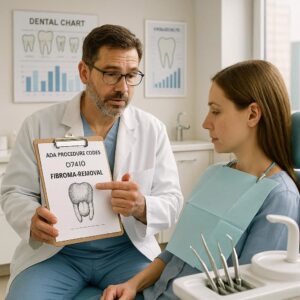
ADA Codes for Fibroma Removal
Understanding the Basics: What Is an Oral Fibroma?
Before we dive into the codes, it is helpful to take a moment to understand what we are actually treating. An oral fibroma, often referred to as an irritation fibroma, is a benign growth found inside the mouth. It is typically a reactive lesion, meaning it forms in response to chronic, low-grade trauma or irritation.
Think of it as the body’s way of building a little cushion. If a person constantly bites the inside of their cheek or if a rough tooth or denture rubs against the gum tissue, the body may respond by forming a firm, smooth, pink nodule. These growths are not cancerous, and they rarely pose any serious health risk. However, they can be annoying, interfere with eating or speaking, or simply be a cosmetic concern for the patient.
The removal of these lesions is a routine procedure in general dentistry and oral surgery. Because the tissue is sent to a pathologist for a definitive diagnosis, the coding for this procedure relies heavily on the nature of the excision and the complexity of the case.
The Core ADA Codes for Fibroma Removal
The American Dental Association (ADA) maintains the CDT code set. For fibroma removal, you will typically be looking at a family of codes under the “Excision” category. These codes are not interchangeable; they are designed to represent different clinical scenarios.
Here are the primary codes you will encounter:
D7410: Excision of Benign Lesion, up to 1.25 cm
This is often the most frequently used code for a standard fibroma removal. D7410 is designated for the excision of a benign lesion, such as a fibroma, where the greatest diameter of the lesion, including the margins, is less than or equal to 1.25 centimeters.
This code typically applies to simple, straightforward excisions. The lesion is usually located in an easily accessible area like the buccal mucosa (inner cheek), the labial mucosa (inner lip), or the attached gingiva. The procedure often involves a simple elliptical incision, removal of the tissue, and a few simple sutures to close the wound.
D7411: Excision of Benign Lesion, greater than 1.25 cm
When a fibroma grows larger than 1.25 centimeters in its greatest dimension, the complexity of the procedure increases. D7411 is the code used for these larger lesions. The removal requires more surgical skill, a larger dissection area, and often more complex closure techniques.
A larger fibroma might have a broader base of attachment or may have been present for a longer time, leading to more significant tissue involvement. The increased size also means a larger wound that needs to be managed carefully to ensure proper healing and minimal scarring.
D7412: Excision of Benign Lesion, Complicated
Sometimes, a lesion is not defined by size alone but by its location or the complexity of the surgery required to remove it. Code D7412 is used for the excision of a benign lesion that is considered complicated.
What makes a case “complicated”? Several factors come into play. The lesion might be located in a challenging area, such as the floor of the mouth, the ventral surface of the tongue, or the retromolar pad area. These locations contain critical anatomical structures like nerves, salivary gland ducts, or major blood vessels. A complicated excision might also involve significant involvement of underlying structures, requiring more than just a superficial soft tissue removal. In some cases, a biopsy that requires extensive dissection or a specialized surgical approach also falls under this code.
D7413: Excision of Malignant Lesion, up to 1.25 cm
It is important to include this code for context, though it does not apply to a benign fibroma. D7413 is used when the lesion is suspected or confirmed to be malignant. While a fibroma is benign, if the clinical presentation is atypical or if the pathology report reveals something unexpected, this code might become relevant for a secondary procedure or a re-excision. However, for a standard fibroma removal, you will not use this code unless the diagnosis changes.
How to Choose the Right Code: A Clinical Decision Tree
Choosing the correct code is not a guessing game. It should be a logical process based on the clinical findings and the treatment performed. Let’s break down the decision-making process into a simple flow.
Step 1: Identify the Lesion Type
Is the lesion clinically consistent with a benign fibroma? If the answer is yes, you will be looking at the “benign lesion” codes (D7410, D7411, D7412). If there is any suspicion of malignancy, you would typically perform an incisional biopsy first, using a different code (D7288 or D7287), before proceeding with a definitive excision.
Step 2: Measure the Lesion
Accurate measurement is critical. You need to measure the greatest diameter of the lesion including the planned surgical margins. For a fibroma, a standard surgical margin is often 1 to 2 millimeters of healthy tissue around the lesion.
-
If the total excised diameter (lesion + margins) is 1.25 cm or less, you are likely in the D7410 category.
-
If the total excised diameter is greater than 1.25 cm, D7411 is the appropriate choice.
Step 3: Assess the Complexity
Even if the lesion is small, it might be complicated by its location. Ask yourself these questions:
-
Is the lesion located near a major nerve (e.g., inferior alveolar nerve, lingual nerve)?
-
Is it in a functionally sensitive area like the floor of the mouth or the tongue?
-
Does it require a flap or extensive undermining of tissue to close the wound?
-
Does the patient have a medical condition that complicates the surgery (e.g., anticoagulant therapy requiring special management)?
If you answer “yes” to any of these, D7412 might be the most accurate code, regardless of the size.
A Comparative Table for Quick Reference
To help visualize the differences, here is a comparative table summarizing the three primary codes for benign lesion excision.
| ADA Code | Description | Typical Size (including margins) | Complexity Level | Common Examples |
|---|---|---|---|---|
| D7410 | Excision of Benign Lesion, up to 1.25 cm | ≤ 1.25 cm | Simple | Small fibroma on the buccal mucosa, a small papule on the gingiva. |
| D7411 | Excision of Benign Lesion, greater than 1.25 cm | > 1.25 cm | Moderate | A larger, longstanding fibroma on the alveolar ridge or lip. |
| D7412 | Excision of Benign Lesion, Complicated | Any size | High | Fibroma on the floor of the mouth, a lesion requiring nerve dissection, or a case with excessive bleeding. |
The Importance of Documentation
In the world of dental coding, the old saying “if it wasn’t documented, it wasn’t done” holds immense weight. Insurance companies and auditors rely heavily on the clinical notes to justify the code submitted. When you are performing a fibroma removal, your documentation should tell the complete story.
What to Include in Your Clinical Notes
Your documentation should be thorough and clear. Here are the key elements to include:
-
History of the Lesion: Note how long the patient has noticed the growth, any history of trauma in the area, and the patient’s chief complaint (e.g., “Patient presents with a firm nodule on the left buccal mucosa, present for 6 months. Reports chronic cheek biting.”).
-
Clinical Description: Describe the lesion in detail. Include its location, size, color, texture, and whether it is sessile (broad base) or pedunculated (on a stalk).
-
Measurement: Clearly document the size of the lesion and the planned margins. For example: “Lesion measures 0.8 cm in greatest diameter. Excision planned with 0.2 cm margins, for a total excised diameter of 1.0 cm.”
-
The Procedure: Detail the steps of the surgery. Include the type of anesthesia used (e.g., “2% lidocaine with 1:100,000 epinephrine, 1.2 mL”), the type of incision (e.g., “elliptical incision”), the instruments used, and the closure method (e.g., “closed with 3-0 chromic gut sutures”).
-
Specimen Handling: Document how the specimen was handled. “Specimen placed in 10% formalin, labeled, and sent to pathology for histologic evaluation.”
-
Complexity Factors: If you are using D7412, explicitly state why the case was complicated. For instance: “Due to the lesion’s proximity to the lingual nerve, careful dissection was performed to avoid nerve injury.”
Note for Readers: If you are a patient reviewing your treatment plan, do not hesitate to ask your dentist or oral surgeon about the code they are using. A clear explanation of why a specific code was chosen is a sign of good communication and ethical practice.
Billing and Insurance Considerations
Understanding the codes is one thing. Getting the claim paid is another. Insurance companies evaluate claims based on medical necessity, documentation, and the accuracy of the code. Here are some considerations for the billing process.
Medical vs. Dental Insurance
This is a common area of confusion. The removal of a fibroma is often considered a medical procedure, even though it is performed by a dentist. Many dental insurance plans have limited coverage for soft tissue pathology. As a result, you may need to submit the claim to the patient’s medical insurance.
Here are a few tips for navigating this:
-
Verify Coverage: Before the procedure, check with both the dental and medical insurance carriers to understand where the coverage lies.
-
Use Medical Codes: If billing medical insurance, you will likely need to use a CPT (Current Procedural Terminology) code in addition to the ADA code. The most common CPT code for this procedure is 40810 (Excision of lesion, mucosa, vestibule of mouth).
-
ICD-10 Diagnosis Code: Regardless of the insurance type, a diagnosis code is always required. For a fibroma, the appropriate ICD-10 code is often D10.39 (Benign neoplasm of other parts of mouth). It is important to wait for the pathology report to confirm the diagnosis, but a preliminary code can be used for the claim.
Common Reasons for Claim Denials
Even with the correct ADA code, claims can be denied. Being aware of the common pitfalls can help you avoid them.
-
Lack of Medical Necessity: The insurance company may argue that the removal was cosmetic or not medically necessary. Strong documentation about the lesion interfering with function (chewing, speaking) or causing pain is crucial.
-
Code Mismatch: Using D7410 when the excised diameter was actually 1.3 cm is a common error. Ensure your measurements are accurate.
-
Incomplete Documentation: If the clinical notes do not support the complexity of the procedure (e.g., using D7412 without explaining the complications), the claim may be downgraded or denied.
-
Missing Pathology Report: If you bill for an excision, insurance will often expect a final pathology report to confirm the diagnosis. If the diagnosis is not consistent with a benign lesion, it may affect coverage or future treatment.
Step-by-Step: What to Expect During a Fibroma Removal Procedure
Understanding the procedure itself can provide context for why certain codes are used. Whether you are a patient or a new dental professional, knowing the flow of the appointment helps clarify the coding logic.
Pre-Operative Assessment
The dentist will review the patient’s medical history, paying special attention to any bleeding disorders or medications like blood thinners. They will then examine the lesion, measure it, and discuss the treatment plan. This is when the ADA code is selected based on the initial assessment.
Anesthesia
Local anesthesia is administered to numb the area. The type and amount of anesthetic used are part of the clinical documentation.
The Excision
The surgeon will make an incision around the fibroma, usually in an elliptical shape to facilitate closure. The lesion is carefully dissected from the underlying tissue. The total area removed includes the lesion itself and a small margin of healthy tissue. This total diameter determines whether D7410 or D7411 is used.
Hemostasis and Closure
After the lesion is removed, pressure is applied to control bleeding. The wound is then closed with sutures. The complexity of this closure—whether it requires advanced flap techniques—can influence the use of D7412.
Post-Operative Care
The patient receives instructions for care, including information about eating, oral hygiene, and signs of infection. A follow-up appointment is typically scheduled for suture removal and to discuss the pathology results.
The Role of Pathology in Coding
One of the most critical aspects of this procedure is the pathology report. The final diagnosis directly impacts the accuracy of your code and the justification for the procedure.
You might have used D7410 based on a clinical diagnosis of a fibroma. However, if the pathology report comes back as something else, like a neurofibroma, lipoma, or even a squamous papilloma, you still used the correct procedure code for the excision of the benign lesion. The code reflects what you did, not necessarily what you thought it was, as long as the procedure was consistent with a benign excision.
If the pathology report reveals malignancy in a lesion you thought was benign, that is a different clinical scenario. The original excision code (D7410, D7411, or D7412) is still correct for the procedure you performed. However, the patient may now require a second, more extensive procedure, which would be coded as a malignant lesion excision (D7413, D7414, or D7415), depending on the new margins required.
Important Note: It is a standard of care to send all excised tissue for histopathologic examination. This is not optional. The pathology report provides the definitive diagnosis and protects both the patient and the clinician. Without it, you cannot confirm the nature of the lesion, and insurance claims may be jeopardized.
Frequently Asked Questions (FAQ)
Let’s address some of the common questions that arise regarding the ADA code for fibroma removal.
Q1: Can I use D7410 for a biopsy?
No. D7410 is for a complete excision. If you are only taking a small piece of a larger lesion for diagnostic purposes, you should use an incisional biopsy code, such as D7288 (Biopsy of oral tissue – hard) or D7287 (Biopsy of oral tissue – soft).
Q2: What if the fibroma is on the tongue? Does that automatically make it complicated?
Not always. A small, superficial fibroma on the dorsal or lateral tongue that can be easily accessed and closed with simple sutures may still qualify for D7410. However, lesions on the ventral surface (underside) of the tongue or those that involve the muscle tissue are typically more complex and may be better suited for D7412 due to the risk of nerve damage and the complexity of closure.
Q3: My patient has a fibroma, but they are on blood thinners. Which code should I use?
The code itself is not determined by the patient’s medications, but the complexity of the procedure may increase. If the patient is on anticoagulants, the dentist may need to perform additional steps to manage bleeding, such as using local hemostatic agents or consulting with the patient’s physician. This increased complexity might justify the use of D7412, especially if it significantly alters the surgical approach. This should be clearly documented.
Q4: Does the ADA code include the cost of the pathology report?
No. The ADA code D7410, D7411, or D7412 covers the surgical procedure only. The pathology report is a separate service provided by a third-party laboratory. It is billed separately, either by the lab directly or by the dental office if they are processing it in-house.
Q5: What is the difference between a “lesion” and a “tumor” in coding?
In the CDT code set, you will see codes for both “lesion” and “tumor.” The difference is often based on the clinical presentation and the definitive diagnosis. For a fibroma, which is a benign neoplasm, you would use the “excision of benign lesion” codes. “Tumor” codes (like D7414, D7415) are often used for malignant or more aggressive neoplasms. The benign lesion codes are the appropriate choice for a standard fibroma.
Best Practices for Accurate Coding
To wrap up the clinical and administrative side, let’s consolidate some best practices that will help ensure your coding is always accurate and defensible.
-
Measure Twice, Code Once: Before you make the incision, measure the lesion with a periodontal probe or a ruler. Plan your margins and make a note of the total excised diameter. This measurement is your primary guide for choosing between D7410 and D7411.
-
Photodocumentation: A picture is worth a thousand words. Taking a clinical photograph of the lesion before excision and after closure can be invaluable if an insurance audit occurs. It provides visual proof of the lesion’s size, location, and complexity.
-
Use a Surgical Checklist: Create a simple checklist for your clinical notes that ensures you never miss a critical element. Include boxes for size, location, margins, anesthesia, complications, and specimen handling.
-
Stay Updated: CDT codes are updated every year. While the codes for benign lesion excision have been stable, it is always good practice to verify that you are using the most current version of the code set. The ADA publishes updates annually.
-
Communicate with Your Team: If you are a dentist, ensure your billing staff understands the nuances of these codes. If you are a biller, do not hesitate to ask the clinician for clarification if the notes seem ambiguous. A quick conversation can prevent a denied claim.
The Patient’s Perspective: Understanding Your Bill
If you are reading this as a patient who has just had a fibroma removed, or you are about to have one removed, you might be looking at a treatment plan with codes and fees. Here is a little guidance to help you understand what you are seeing.
Your treatment plan will likely list the ADA code (like D7410) along with a fee. This fee covers the surgeon’s time, the use of the facility, the instruments, the anesthesia, and the surgical expertise. You may also see a separate line item for a “pathology” or “laboratory” fee. This is for the pathologist to examine the tissue under a microscope and provide a definitive diagnosis.
If you have insurance, your plan may cover a portion of these fees, depending on your benefits. Some plans cover soft tissue excisions well, while others may consider them a “major” service with a lower coverage percentage. It is always a good idea to call your insurance company before the procedure to understand your estimated out-of-pocket cost.
Here are a few questions you might ask your dental office:
-
“Which ADA code are you using for my procedure, and why is that the right one for my case?”
-
“Will you be submitting this to my dental or medical insurance?”
-
“Is the pathology fee included, or is that separate?”
A good dental office will be happy to answer these questions and help you navigate the process.
Conclusion
Finding the correct ADA code for fibroma removal is a process that blends clinical knowledge, precise measurement, and clear documentation. By understanding the distinctions between D7410 for smaller lesions, D7411 for larger ones, and D7412 for complicated cases, dental professionals can ensure their coding is both accurate and defensible.
For patients, understanding these codes can demystify the treatment plan and open a clear line of communication with your dental care provider. Ultimately, accurate coding supports a smooth billing process, reduces the risk of claim denials, and, most importantly, reflects the high standard of care provided to the patient.
Additional Resource
For the most up-to-date information on CDT codes and coding guidelines, the American Dental Association (ADA) is the definitive source. You can access their resources and purchase the current CDT manual directly from their website.
Disclaimer: This article is intended for informational and educational purposes only. It does not constitute medical, legal, or billing advice. Dental coding can be complex and subject to change. Clinicians should consult the most current CDT code set and verify coverage with individual payers. Always rely on your clinical judgment and the specific circumstances of each patient.
Author: A professional dental writer specializing in clinical accuracy and clear communication.
Date: March 21, 2026