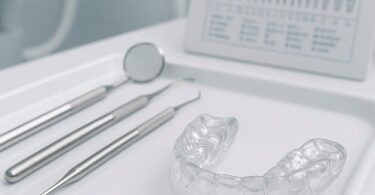
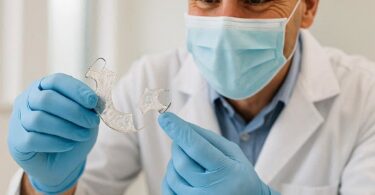
If you have recently been diagnosed with sleep apnea or chronic snoring, your dentist or sleep specialist may have recommended an oral appliance. It sounds simple enough: you get a custom-made device that looks a bit like a mouthguard, you wear it at night, and you sleep better. But when the bill arrives or when you start looking at your insurance explanation of benefits, you suddenly encounter a confusing string of numbers and letters: the dental code.
Understanding the dental code for a snoring appliance can feel like learning a new language. But it is essential knowledge. The code determines how your insurance processes the claim, how much you might pay out of pocket, and even what kind of appliance you receive.
In this guide, we will demystify these codes. We will look at the different types of codes used in dentistry and medicine, explain how they work, and give you the tools you need to have an informed conversation with your dentist and your insurance company.
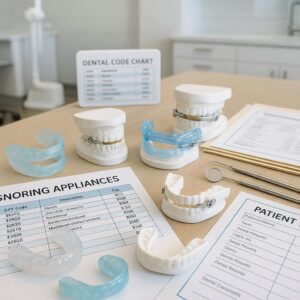
Dental Codes for Snoring Appliances
Why Dental Codes Matter for Snoring Appliances
Before we dive into the specific numbers, let’s talk about why this matters to you. A snoring appliance is a unique piece of dental equipment. It sits at the intersection of dentistry and medicine. Dentists make them, but they treat a medical condition: Obstructive Sleep Apnea (OSA).
Because of this crossover, the billing process can get complicated. The code used tells the insurance company what the appliance is for and how it should be covered. Using the wrong code can lead to a denied claim, leaving you with a surprise bill. Understanding the correct terminology empowers you to advocate for yourself and ensure your treatment is covered as intended.
The Different Types of Codes You Will Encounter
In the world of dental and medical billing, there are three main coding systems you will hear about. They all work together to tell a complete story about your health and treatment.
CDT Codes (Current Dental Terminology)
These are the codes used by dentists. They are managed by the American Dental Association (ADA). When a dentist provides a service, they use a CDT code to describe it. For snoring appliances, the CDT codes are the primary language of the dental office.
HCPCS Codes (Healthcare Common Procedure Coding System)
These are medical codes. Since sleep apnea is a medical condition, medical insurance (like Blue Cross, Aetna, or Medicare) often prefers to use HCPCS codes. These codes are used by physicians, sleep labs, and sometimes dentists when they are billing a medical insurance plan instead of a dental insurance plan.
ICD-10 Codes (International Classification of Diseases, 10th Revision)
These are diagnosis codes. They don’t describe what the dentist did; they describe why the patient needs the treatment. A diagnosis code for snoring is different from one for severe obstructive sleep apnea. The diagnosis code is the “reason” for the procedure code.
The Primary CDT Codes for Snoring Appliances
Let’s focus on the codes you are most likely to see on a dental claim form. The ADA has specific codes for oral appliances used to treat sleep-disordered breathing.
D9940: The “Old Standard”
For a long time, D9940 was the main code used for snoring and sleep apnea appliances. It is defined as “oral device for sleep-disordered breathing.” Many dental offices still use this code because it is straightforward.
However, this code has a limitation. It is a “catch-all” code. It doesn’t differentiate between a simple snoring device and a complex, adjustable oral appliance for severe sleep apnea. Consequently, some insurance companies view this code as “not medically necessary” or they bundle it with other services, leading to lower reimbursement.
D9941: The Modern Alternative
In recent years, the ADA introduced a more specific code: D9941. This code is defined as “adjustable oral device for sleep-disordered breathing.” The key word here is adjustable.
Most modern, effective oral appliances for sleep apnea are adjustable. They allow the dentist to gradually move the lower jaw forward to open the airway. Using D9941 tells the insurance company that the appliance is a sophisticated, titratable (adjustable) device, which is often considered the standard of care for treating obstructive sleep apnea.
D9942 and D9943: Maintenance and Adjustments
Getting the appliance is just the beginning. These devices require maintenance and adjustments to ensure they remain comfortable and effective. The codes for these services are:
-
D9942: Repair or adjustment of an oral device for sleep-disordered breathing. This is used for in-office adjustments, especially during the first few months of treatment.
-
D9943: Reline or replacement of an oral device for sleep-disordered breathing. Over time, the appliance may need to be “relined” to fit your changing dental structure, or replaced entirely after a few years.
A Comparative Look at Dental Codes
To make this clearer, here is a quick reference table showing the primary dental codes and their typical uses.
| CDT Code | Description | Typical Use Case |
|---|---|---|
| D9940 | Oral device for sleep-disordered breathing (non-adjustable) | Used for simple, one-piece snoring devices or legacy appliances that do not allow for mandibular advancement adjustments. |
| D9941 | Adjustable oral device for sleep-disordered breathing | Used for modern, custom-made, titratable appliances (like SomnoDent, Herbst, or EMA) for mild to severe obstructive sleep apnea. |
| D9942 | Repair or adjustment of oral device | Used for follow-up visits to adjust the appliance, tighten components, or make small repairs. |
| D9943 | Reline or replacement of oral device | Used when the appliance no longer fits due to dental changes or after the device has reached the end of its lifespan (typically 3-5 years). |
The Role of HCPCS (Medical) Codes
If you have medical insurance that covers sleep apnea treatment, your dentist’s office might use a medical code instead of a dental code. This is common because many medical plans offer better coverage for sleep apnea than standard dental plans.
The primary HCPCS code for a snoring appliance is E0486. This code stands for “Oral device/appliance used to reduce upper airway collapsibility, adjustable or non-adjustable, prefabricated or custom-fitted.”
When a dentist bills your medical insurance, they will typically use:
-
E0486 for the appliance itself.
-
An appropriate ICD-10 diagnosis code (which we will cover next) to justify the medical necessity.
Billing medical insurance for a dental appliance is often more complex, but it can lead to significantly lower out-of-pocket costs if your medical plan has durable medical equipment (DME) benefits.
The Critical Link: ICD-10 Diagnosis Codes
A procedure code without a diagnosis code is like a key without a lock. It doesn’t open the door to coverage. The diagnosis code is arguably the most important part of the billing process. It tells the insurance company why the procedure was necessary.
If you snore but do not have sleep apnea, the diagnosis code might be R06.83 (Snoring). Unfortunately, most insurance companies consider snoring alone to be a cosmetic or lifestyle issue and will not cover the appliance.
For medical necessity, you need a diagnosis of Obstructive Sleep Apnea. The common ICD-10 codes for OSA are:
-
G47.33: Obstructive Sleep Apnea (adult)
-
G47.30: Sleep Apnea, unspecified
If you have a diagnosis of OSA confirmed by a sleep study (polysomnogram), your dentist will pair the CDT code (D9941) or the HCPCS code (E0486) with one of these G-codes. This combination is what triggers coverage from most medical insurance plans.
How Insurance Views Snoring Appliances
This is where the path can fork. Understanding how insurance views these appliances will help you prepare financially.
Medical Insurance vs. Dental Insurance
Most dental insurance plans do not cover oral appliances for sleep apnea. They are designed for preventive care (cleanings, fillings) and restorative work (crowns, bridges). A sleep apnea device is considered a medical device, so it falls outside the scope of many dental policies.
Medical insurance, on the other hand, is much more likely to cover an oral appliance. However, they will require proof of medical necessity. This usually means:
-
A confirmed diagnosis of Obstructive Sleep Apnea via a sleep study.
-
A letter of medical necessity from your dentist or sleep physician.
-
Documentation that you cannot tolerate a CPAP (Continuous Positive Airway Pressure) machine, which is often the first-line treatment.
Medicare and Snoring Appliances
Medicare (in the United States) does cover oral appliances for obstructive sleep apnea. They have very specific rules. For coverage, you must:
-
Have a diagnosis of OSA.
-
Have tried and failed or cannot tolerate CPAP.
-
Receive the appliance from a qualified dentist who is enrolled in Medicare.
-
Have the appliance billed under the medical code E0486.
Medicare does not cover appliances for simple snoring (R06.83). They also require a face-to-face evaluation and a 90-day trial period to ensure the device is working.
The Patient Journey: From Consultation to Code
To understand how these codes come to life, it helps to walk through the typical patient journey. Let’s imagine a patient named Sarah.
Step 1: Diagnosis
Sarah has been tired for years. Her husband says she snores loudly. She undergoes a sleep study, and the results show severe Obstructive Sleep Apnea (G47.33). She tries a CPAP machine but finds it uncomfortable and stops using it.
Step 2: Dental Consultation
Sarah’s sleep physician refers her to a dentist who specializes in sleep medicine. The dentist performs an exam, takes impressions of her teeth, and discusses the different types of adjustable appliances.
Step 3: Pre-Authorization
The dental office submits a pre-authorization request to Sarah’s medical insurance. They use the HCPCS code E0486 for the appliance and the ICD-10 code G47.33 for the diagnosis. They also include a letter stating she cannot tolerate CPAP.
Step 4: Approval and Delivery
The insurance approves the claim, subject to her deductible and coinsurance. The dentist fabricates the appliance and delivers it. On the claim form submitted after delivery, the dentist uses D9941 (if billing dental) or E0486 (if billing medical) to get reimbursed.
Step 5: Follow-up Adjustments
Sarah returns for follow-up visits to adjust her appliance. The dentist uses D9942 for these adjustment visits. Some insurance policies cover these follow-ups; others do not.
Costs and What to Expect
One of the biggest questions patients have is, “How much will this cost me?” The answer depends entirely on the code used and the insurance coverage.
If a medical insurance plan covers the appliance (E0486 or D9941 with a G47.33 diagnosis), you will likely be responsible for your deductible and a percentage of the allowed amount (coinsurance). This can range from a few hundred to a couple of thousand dollars.
If a dental insurance plan covers it (rare, but possible), it will often be under the “major services” category, covering 50% of the cost after a deductible.
If no insurance covers the appliance, the out-of-pocket cost for a custom, adjustable oral appliance (D9941) typically ranges from $1,800 to $3,500. This usually includes the appliance and a series of follow-up adjustments.
Important Note: Always ask for a “predetermination” or “pre-authorization” before you begin treatment. This is a request your dentist sends to the insurance company to find out exactly what they will pay. It is the best way to avoid surprise bills.
Tips for Navigating the Coding Process
You don’t need to become a billing expert, but a few proactive steps can save you time, money, and frustration.
-
Ask Your Dentist About Their Billing Approach. Before agreeing to treatment, ask the office manager: “Will you be billing my medical insurance or my dental insurance for this appliance?” A good office will know which code (D9941 or E0486) is most likely to be accepted by your specific plan.
-
Confirm Your Diagnosis Code. Ensure you have a copy of your sleep study results and a clear diagnosis. If the diagnosis is “snoring” (R06.83) and not “obstructive sleep apnea” (G47.33), you are far less likely to receive coverage.
-
Document CPAP Intolerance. If you tried CPAP and it did not work for you, make sure this is clearly documented in your medical record. Many insurance companies require this documentation before approving an oral appliance.
-
Understand Your Benefits. Call your medical insurance company and ask two specific questions: “Does my plan cover durable medical equipment (DME)?” and “What is my coverage for an oral appliance for sleep apnea under HCPCS code E0486?”
Common Misconceptions About Dental Codes for Snoring Appliances
There is a lot of confusion surrounding these codes. Let’s clear up a few common myths.
Myth: “Any dentist can use any code to get it covered.”
Reality: Insurance companies audit claims. Using the wrong code for the wrong appliance (e.g., using D9941 for a non-adjustable device) is insurance fraud. Dentists must use the code that accurately reflects the service provided.
Myth: “If I have dental insurance, the appliance is covered.”
Reality: Most standard dental plans explicitly exclude “sleep apnea appliances” from coverage because they are considered medical devices. You will often need to rely on your medical insurance.
Myth: “The code for a snoring appliance is the same for everyone.”
Reality: The code depends on the type of appliance. A simple, non-adjustable device for mild snoring might use D9940. A complex, adjustable device for moderate to severe sleep apnea will use D9941 or E0486.
The Future of Sleep Apnea Coding
The coding landscape is constantly evolving. As more research highlights the effectiveness of oral appliances and as the link between oral health and systemic health becomes stronger, we may see changes in how these procedures are coded and covered.
There is a growing push for medical insurance to cover the dental services associated with sleep apnea treatment (like the dental exams and follow-up adjustments) as part of the overall medical management of the condition. While this is not yet widespread, it represents a positive trend toward integrated care.
For now, the best approach remains clear communication between the patient, the dentist, and the insurance carrier, anchored by the correct use of D9941 for dental billing and E0486 for medical billing.
Additional Considerations: Replacement and Repair
Appliances do not last forever. Most have a lifespan of 3 to 5 years, depending on how well they are cared for and how much you grind or clench your teeth. When your appliance needs to be replaced, the same coding rules apply.
-
A replacement appliance will typically be billed under the same code as the original (D9941 or E0486).
-
Many insurance companies have a “frequency limit,” meaning they will only cover a new appliance once every 3 or 5 years.
-
If the appliance just needs a new soft lining because it has become loose, the dentist may use D9943 (reline) instead of a full replacement code.
Conclusion
Navigating the world of dental and medical codes for a snoring appliance can initially seem daunting, but it becomes manageable once you understand the key players. Remember that the primary codes you will encounter are D9941 (for adjustable dental devices in a dental setting) and E0486 (for medical insurance billing). The success of your insurance claim hinges on a correct diagnosis of Obstructive Sleep Apnea (G47.33), a clear medical necessity, and choosing a dental provider experienced in medical billing. By asking the right questions and understanding these codes, you can confidently move toward a quieter, healthier night’s sleep.
Frequently Asked Questions (FAQ)
1. What is the most common dental code for a snoring appliance?
The most common dental code for a modern, adjustable oral appliance used to treat sleep apnea is D9941. For older or non-adjustable devices, D9940 may be used.
2. Will my medical or dental insurance cover the appliance?
Medical insurance is far more likely to cover the appliance, especially if you have a diagnosis of Obstructive Sleep Apnea (G47.33). Dental insurance typically excludes coverage for these devices.
3. What is the HCPCS code for a sleep apnea oral appliance?
The HCPCS (medical) code for an oral appliance used to reduce upper airway collapsibility is E0486. This is the code used when billing medical insurance, including Medicare.
4. Does Medicare cover snoring appliances?
Medicare covers oral appliances (under code E0486) for the treatment of Obstructive Sleep Apnea only if you have a confirmed diagnosis and cannot tolerate CPAP. Medicare does not cover appliances for simple snoring.
5. Why did my dentist use D9940 instead of D9941?
Your dentist likely used D9940 if the appliance provided is non-adjustable or if they are billing under an older protocol. If you have a modern, adjustable device, you should ask why D9941 was not used, as it is often more accurate for current standards of care.
Disclaimer: This article is for informational purposes only and does not constitute medical, dental, or insurance advice. Codes, coverage policies, and reimbursement rates vary by insurer and location. Always consult with your dental provider and insurance carrier for specific details regarding your treatment plan.
Author: A professional technical writer specializing in dental and healthcare topics.
Date: March 21, 2026