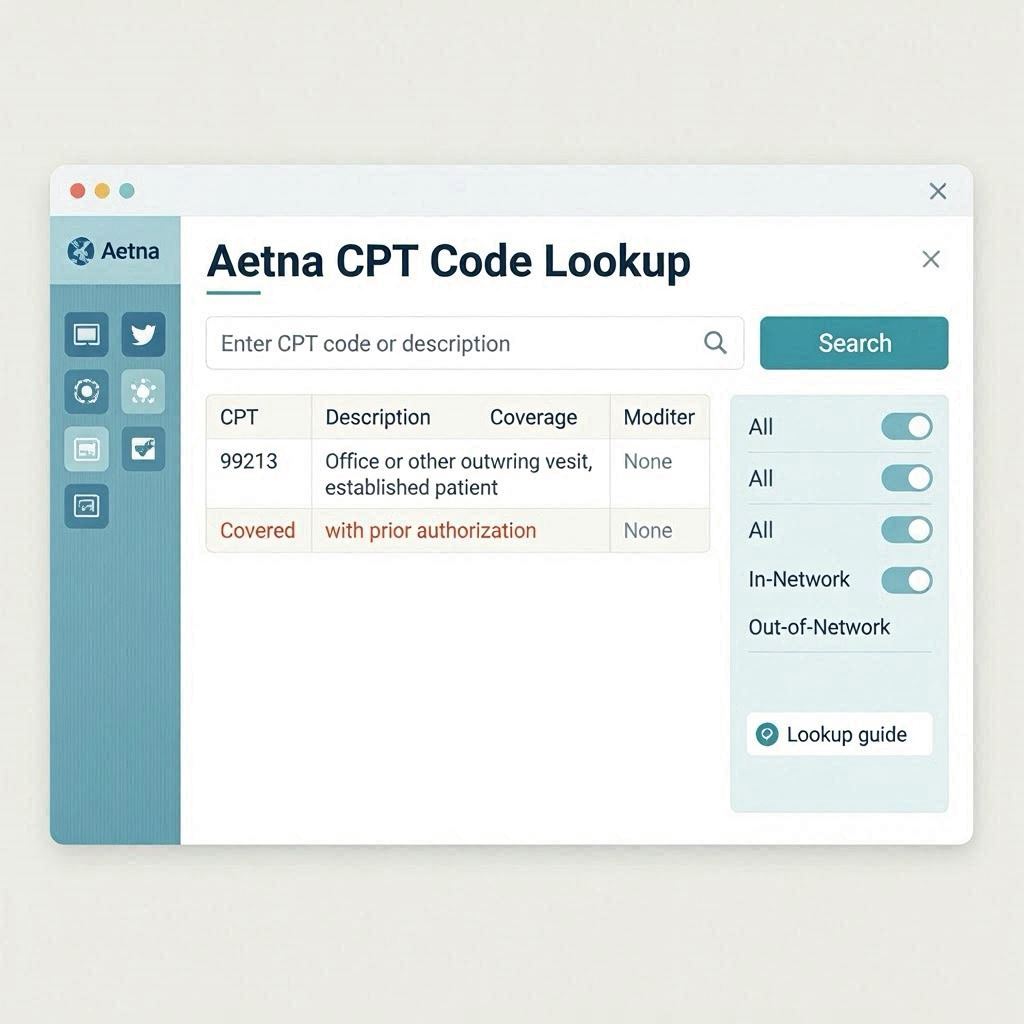
You scheduled a medical appointment. You feel prepared. Then, a letter arrives weeks later stating your insurance denied the claim. The reason often boils down to a simple string of numbers: the CPT code. If you have an Aetna plan, knowing how to perform an Aetna CPT code lookup transforms you from a passive patient into an informed healthcare consumer. It gives you the power to predict your costs and fight billing errors before they damage your credit score.
This guide cuts through the confusion. We will walk through every practical method to check how Aetna covers a specific procedure code. You will learn how to use digital portals, read physical documents, and talk to representatives effectively. Crucially, you will learn how to translate the results into real-dollar estimates.
Understanding the Foundation: What a CPT Code Really Is
Before we dive into the mechanics of the look-up process, you must understand the language of the billing world. Many people confuse diagnosis codes with procedure codes, which leads to panic when scanning an Explanation of Benefits (EOB).
A Current Procedural Terminology code, or CPT code, describes what the provider did to you. It represents the specific medical service. This includes an office visit, a surgical repair, a blood test, or a vaccine shot. Aetna’s computer system does not read doctor’s notes. It reads the CPT code. It instantly checks this code against your benefits package to decide if the service requires a copay, falls under a deductible, or sits completely outside your coverage.
Category I, II, and III Codes
The American Medical Association maintains a massive, copyrighted database of these numeric identifiers. Most common services fall into Category I. These codes usually have five digits. For example, 99213 represents a standard, mid-level established patient office visit. Category II codes contain letters and track quality performance; you rarely need to worry about these as a consumer. Category III covers emerging technologies. An Aetna medical director may review services linked to a Category III code more strictly because they represent experimental procedures.
The HCPCS Level II Distinction
You will often see a similar looking set of letters and numbers, like J1100 or G0008, on your paperwork. Payers label these as Healthcare Common Procedure Coding System codes. Private practices use CPT for the actual work, but they use HCPCS for items not covered by the AMA’s standard book. This includes injectable drugs, durable medical equipment like wheelchairs, and Medicare-specific services. When you perform an Aetna CPT code lookup, remember that the tool likely processes both CPT and HCPCS. If a code starts with a letter, it is likely a HCPCS code, not a traditional CPT, but the search function often works identically.
Note: CPT codes are copyrighted by the American Medical Association. Aetna licenses the right to use these codes within their policies. You cannot simply pull a complete, searchable database from a public government site the way you can with ICD-10 diagnosis codes.
Why an Aetna CPT Code Lookup Is Your Financial Safety Net
A desperate call to member services often starts with the phrase, “But my doctor said it was medically necessary.” A physician’s judgment regarding medical necessity does not always align with a payer’s coverage determination. Medical necessity connects the procedure to a diagnosis. Coverage connects the procedure to your specific insurance contract.
By performing the lookup yourself, you shatter the illusion that a referral equals a guarantee of payment. Let’s say your orthopedic surgeon schedules an arthroscopic knee procedure. The surgeon’s office verifies your eligibility. They see you have active coverage. They do not necessarily check the specific CPT code against Aetna’s vast library of Clinical Policy Bulletins. They submit CPT 29881 (a meniscectomy), and it pays without issue. But perhaps they also perform a concurrent procedure using a microfracture technique with a graft. Aetna might classify that specific second code as experimental for your age group. The operating room time gets billed, the implant gets billed, and you receive a staggering statement.
This is not a hypothetical horror story; it plays out daily in surgical centers across the country. An Aetna CPT code lookup serves as a shield. It catches the “non-covered” designation before the scalpel touches your skin.
The Real Cost of “Usual and Customary”
Without a lookup, you only see the sticker price. A provider may bill $2,500 for a head CT scan. Aetna’s contract with the radiology group might adjust that down to $650. If you have a high-deductible plan, you pay the $650, not the $2,500, because the network agreement writes off the rest. If you skipped the lookup and went to an out-of-network facility that offers “same-day appointments,” you become responsible for the full $2,500 because Aetna has no leverage to discount the rate. A network status check alone is not enough. You must verify that the specific service (the CPT code) enjoys a negotiated rate at that specific location.
Method One: The Aetna Member Website (The Direct Source)
The most authoritative digital resource sits behind the secure login wall of Aetna.com. Third-party aggregator sites often pull generic Medicare fee schedules. These have no relevance to a commercial Aetna policy. You must access the proprietary engine built for your specific plan.
Navigating to the Cost Estimator
After logging into your member portal, locate the main menu. The labeling changes slightly depending on whether your plan comes from an employer or the individual marketplace, but you usually seek a section labeled “Find Care & Pricing” or “Estimate Costs.” This internal tool links directly to your accumulated deductible and coinsurance status.
The interface prompts you to type a keyword, not necessarily a code. You can type “colonoscopy,” and the system translates this into the relevant billing codes behind the scenes. However, for accuracy, you should enter the exact five-digit number provided by your doctor’s billing department. If you type the code and the site returns zero results, do not assume the service is not covered. The internal search function sometimes disconnects from the policy database. A blank search result demands a direct phone call to the number on the back of your ID card.
Important: The estimator relies on the place of service. A 15-minute EKG interpretation (CPT 93010) in a hospital outpatient department costs significantly more in total allowed charges than the same code performed in a cardiologist’s private office. The tool may ask you to specify the setting to generate an accurate breakdown.
Reading the Policy Bulletin
Aetna publishes a searchable library of Clinical Policy Bulletins (CPBs). These documents are dense, but they hold absolute truth. If a CPB states that CPT 87635 is “medically necessary” only for specific viral panels and a negative patient history, you have discovered a coverage trigger. You can find the CPB section usually at the bottom of the main member page under “Policies & Guidelines” or by searching “Aetna CPB” plus the code number in a general web search. While the public web search violates the “closed loop” security, it often brings up these public-facing policy pages faster than the internal portal navigation. Just remember to verify the policy’s effective date. A policy from three years ago might no longer hold.
Method Two: The Physical Evidence of Coverage Document
Every Aetna member receives a massive booklet upon enrollment. Most people throw it away. If you still have it, or if you download the 120-page PDF from your online account, you hold a tangible contract. This “Evidence of Coverage” (EOC) or “Summary Plan Description” (SPD) lists benefit limitations.
When you open this document, use the “Ctrl+F” (or “Command+F”) function to search for keywords like “surgery,” “inpatient,” or “excluded services.” The document rarely lists 10,000 individual CPT codes line by line. Instead, it groups them. It states that outpatient surgery requires preauthorization. If the Aetna CPT code lookup tool online flags the code as “requires notification,” the EOC defines the penalty for skipping that step. This could mean a flat $500 reduction in benefits or a complete denial. The member website shows the status; the EOC defines the financial consequence.
The Schedule of Benefits Grid
Buried inside the EOC sits a grid. This grid lists copayments by service category. A visit to a specialist might list a $60 copay. Does CPT code 99205 (a high-level new patient visit) fall under that specialist copay, or does it fall under a higher tier because of complexity? Generally, the classification “specialist visit” captures all outpatient E/M (evaluation and management) codes. However, if the specialist performs a minor surgical procedure in the office, represented by a code from the 10000-69999 surgical range, the specialist copay might not apply. Instead, the outpatient surgery deductible and coinsurance clause kicks in. Your lookup strategy must bridge the gap between the numeric code and the benefit category in the grid.
Method Three: The Aetna Health App (Mobile Lookup)
The smartphone application offers a streamlined version of the cost estimator. The mobile interface prioritizes speed and simplicity. You can type “MRI” and get a map of nearby facilities with their estimated out-of-pocket costs. For an explicit Aetna CPT code lookup, the app hides the search bar somewhat. You usually tap a magnifying glass icon or a “Search” tab. Then you switch the filter from “Doctor Name” to “Procedure Code.” The app may prompt you with a warning: “This estimate is based on your current plan status.” Heed this warning. If you check the estimate in January before paying a cent toward your deductible, the app displays the full negotiated rate. If you check it again in November after meeting your out-of-pocket maximum, it displays a zero-dollar responsibility. The app reflects a snapshot in time.
Method Four: Calling Provider Relations (When the Machine Fails)
Algorithmic lookups fail when a procedure bundles a mix of professional and technical components. Let’s consider a sleep study. The facility bills the technical component (the use of the room and machine) using one code, while the interpreting physician bills the professional component using the same base code with a -26 modifier. The member portal might not recognize a five-digit code with a modifier appended. It might return an error or, worse, an inaccurate estimate that assumes the global service.
In these cases, you must call Aetna. Dial the number on your ID card. Speak clearly. State, “I am requesting a pre-treatment coverage review for CPT code [number] with modifier [modifier], to be performed by provider [NPI number] at facility [address].” The representative may resist providing a guarantee. They often say, “This is not a guarantee of payment.” This protects Aetna legally if the medical records later fail to support medical necessity. However, the representative can read the “covered/not covered” status and the “preauthorization required” flag directly from the claims editing software. Document the call reference number. Write it on your calendar. If a claim denies later, you have a legal anchor for an appeal.
Quotation to Remember: “A pre-service determination is not a guarantee of payment, but it is the closest thing to a safety certificate a patient can hold before a high-cost procedure.”
The CPT Code Lookup Comparison: Member Portal vs. Phone vs. EOC
| Method | Accuracy | Speed | Best Use Case |
|---|---|---|---|
| Member Portal | High (reflects accumulators) | Instant | Quick estimates for standard, unmodified codes. |
| Phone Call | Very High (human verification) | Slow (hold times) | Complex surgeries with multiple modifiers or obscure codes. |
| EOC/SPD Booklet | Medium (generic categories) | Slow (manual reading) | Understanding penalty risks and broad plan exclusions. |
| Mobile App | High (location-aware) | Instant | Finding the cheapest facility for a high-volume imaging code. |
| Provider’s Office | Low (financial bias) | Variable | Never rely solely on this. Always verify independently. |
Deep Dive: Deciphering Aetna’s Clinical Policy Bulletins (CPBs)
We touched on CPBs earlier. They deserve a dedicated section because they constitute the legal backbone of medical necessity for Aetna. A CPB is a document that references peer-reviewed medical literature. Aetna’s pharmacy and therapeutics committee or clinical policy team writes these bulletins. They map specific CPT codes to specific ICD-10 diagnosis codes. If the link does not meet their criteria, the system auto-denies the claim.
How to Read a CPB Entry
Imagine you need a genetic test. Your doctor hands you a lab requisition with CPT 81479. This is an unlisted molecular pathology procedure. Unlisted codes rarely have a fixed price. They always demand a manual review. The CPB for genetic testing might list hundreds of specific genes that map to this unlisted code. If your particular gene does not appear on the “Medically Necessary” list, Aetna considers the test experimental. You find this out not by calling the lab, which often promises to “bill insurance and write off the rest”—an illegal or misleading promise in many contexts—but by reading the CPB yourself.
Scroll to the bottom of the CPB. Look for a table titled “CPT Codes Covered When Selection Criteria Are Met.” This table lists the numeric codes. Next, find the “Background” section. It describes the criteria. For example, a cardiac CT angiogram (CPT 75574) often requires a specific heart rate threshold or a failed stress test. If your medical record does not contain evidence of that failed stress test, the imaging center should not book the procedure. Your Aetna CPT code lookup combined with the CPB reading reveals these pre-conditions.
The Danger Zone: Modifiers and Their Impact on Lookups
One of the gravest errors in a manual lookup involves ignoring the modifier. Modifiers are two-character suffixes (numeric or alphanumeric) that append to a CPT code. They tell a critical story. They signal that a service took a different route or that a provider performed a distinct, separate service on the same day.
The -25 Modifier Paradox
A common example: You visit the dermatologist for a rash (E/M code 99213). During the exam, the doctor spots a suspicious mole and freezes it (destruction code 17000). The office files 99213-25 and 17000. Aetna’s claims system separates these. The -25 modifier saves the office visit from being bundled into the procedure. If you perform a manual Aetna CPT code lookup on 99213 alone, the tool shows a $30 copay. If you look up 17000 alone, it shows a $75 surgical copay. However, the real cost might involve both copays applied independently, or the 17000 may apply to your deductible. The digital tool might not simulate the combination of a same-day E/M and procedure perfectly. You must ask the provider, “Will you use a modifier on the visit code?” and if so, verify coverage for the specific combination.
Laterality Modifiers and Medical Equipment
RT and LT modifiers (right and left) matter hugely for durable medical equipment (DME). If Aetna covers one breast pump per pregnancy, a billing for E0604-RT and E0604-LT on the same claim could trigger a denial as a duplicate service. Your lookup must consider the unit limits. The provider portal shows “allowed units” per lifetime or per plan year. A code lookup that ignores unit limits is dangerously incomplete.
Handling the “No Results Found” Scenario
You type a code into the Aetna portal, and the spinning wheel eventually resolves to a blank screen or a red error banner. This moment defines the proactive patient. Many people interpret “no results” as “no coverage.” This interpretation is usually wrong. It usually means the code entered does not match the code set loaded into the consumer-facing estimator tool. Consumer tools pull from a simplified database. They often drop codes considered “low volume” or “provider-bill only.”
Immediate Steps to Take
First, confirm you typed the code correctly. A 99214 visit is common. A 99215 visit is also common. But if you misplace a digit and type 99241, you are looking at a consultation code for an office visit that many payers stopped recognizing for payment. Check the AMA website or a reliable medical coding reference to ensure the code exists and matches the service description your doctor gave you. If the code is valid but still absent, immediately shift to the pre-certification phone line. Aetna maintains a separate phone number for pre-certification and pre-authorization. This team works with the full code database, not the consumer-facing estimator. They can see if the code requires pre-certification. They can even initiate a medical necessity review based on the diagnosis your doctor plans to submit.
CPT Codes vs. ICD-10 Codes: Don’t Confuse the Two
Patients often receive a piece of paper with a mix of letters and numbers. They frantically try to perform an Aetna CPT code lookup on an ICD-10 code, and the system rejects it. Remember this rule: ICD-10 codes explain the “why.” They are the diagnosis. CPT codes explain the “what.” They are the treatment.
A physician might list “M17.11” on your superbill. This is the ICD-10 code for unilateral primary osteoarthritis of the right knee. It is vital for establishing medical necessity, but you do not run it through the cost estimator. The CPT code for the actual knee replacement surgery, 27447, is what drives the payment calculation. When speaking to a scheduler, clarify your request: “Can I have the planned surgical CPT code, not just the diagnosis description?” The scheduler may be more comfortable giving out the diagnosis, but you need the procedure code to talk money with Aetna.
Critical Distinction: Medical necessity links an ICD-10 code to a CPT code. If you know both, you can read the Clinical Policy Bulletin and predict approval with high confidence.
Using Third-Party Lookup Tools Wisely
A Google search for “CPT code 99214 reimbursement” pulls up a dozen third-party sites. They claim to show the Aetna allowed amount. You must treat these numbers with extreme skepticism. Aetna does not publish a single national fee schedule. The network management team negotiates thousands of distinct contracts. A gastroenterology group in Manhattan commands a vastly different rate for a colonoscopy (CPT 45378) than a rural clinic in Idaho.
Third-party tools usually report the Medicare Physician Fee Schedule (MPFS) rate for a specific locality. They then apply a generic “commercial multiplier” (often 120% to 150% of Medicare). Aetna’s actual contract might pay 110% of Medicare in a competitive urban market or 180% of Medicare in a high-cost rural area where a hospital system holds a monopoly. If you rely on a public website’s generic number, you might underestimate your 20% coinsurance obligation by hundreds of dollars. Use those tools only to understand the relative value—to see that surgery A pays roughly twice what surgery B pays. Do not use them for hard financial planning. Only the real-time portal or a written pre-determination letter from Aetna can bind the company to a dollar amount.
A Deep Dive into Behavioral Health Codes
Mental health coverage often involves a distinct network and distinct lookup logic within Aetna. You might hold an Aetna medical card, but the behavioral health benefits might fall under a carve-out to a subsidiary or an entirely separate vendor. This means a standard Aetna CPT code lookup on the main medical portal might incorrectly suggest a benefit applies universally.
Psychotherapy Add-On Codes
Look at codes like 90837 (60-minute individual psychotherapy) and 90847 (family psychotherapy with the patient). The medical portal might recognize these codes. It might even show a specialist copay. However, if your employer’s plan carves out mental health to a vendor like Optum or Magellan, that copay display on Aetna’s site is misleading. You must call the number specifically designated for behavioral health. Additionally, many plans enforce visit limits strictly via CPT code frequency edits. You might have unlimited sick visits, but the plan only covers 20 psychotherapy sessions per year. The code lookup tool might not flag this until you hit the limit and a claim denies with a “maximum benefit exceeded” remark code. Therefore, in the behavioral health space, your phone inquiry must include the question: “What is my remaining visit balance for CPT 90837 for this calendar year?”
Preventive vs. Diagnostic: The Unseen Trap
This is the most painful coding trap in primary care. You schedule your “free” annual physical. The Affordable Care Act mandates that Aetna cover one annual preventive visit without cost-sharing. The preventive visit falls under a specific set of codes, usually 99385-99387 for new patients or 99395-99397 for established patients. During this visit, you mention your knee has been hurting. The doctor examines the knee and orders an X-ray. The office codes the visit as 99214 (a diagnostic E/M visit) with a diagnosis of knee pain, and they might also bill the preventive code with a -25 modifier. The payer processes the 99214 as a standard sick visit, subjecting you to a copay or deductible.
A pre-service Aetna CPT code lookup allows you to ask the scheduler a powerful question: “If I bring up a new problem, will you split the billing?” The answer forces a transparent conversation. Some offices refuse to split-bill, stating that the medical decision-making elevates the visit to a diagnostic level. This is legally correct within coding guidelines. You then have the choice to schedule a separate sick visit on a different day, preserving the free preventive visit and paying a standard copay for the knee evaluation, rather than receiving a surprise bill for the “free” check-up.
Laboratory Codes and Reference Lab Networks
Lab panels often stack multiple CPT codes on a single requisition. A metabolic panel (CPT 80053) and a lipid panel (CPT 80061) form the backbone of routine blood work. Most Aetna plans have a dedicated, exclusive laboratory network, typically Quest Diagnostics or Labcorp. The financial penalty for using the wrong lab bankrupts patients.
Your Aetna portal lookup for CPT 80053 might show “Covered: 100% after deductible” when performed at Labcorp. If the same code gets processed for a hospital-based lab, the portal might show “Covered: 70% after deductible,” or worse, “Non-Covered” if the hospital lab is out-of-network. The national reference labs offer heavily discounted rates to Aetna. When you do your lookup, always filter by the specific lab’s Tax ID or NPI number if the tool allows that granularity. Never hand your blood to a random draw station without checking that the station’s billing entity participates in the “Aetna Laboratory Network.”
Emergency Medicine and the Prudent Layperson Standard
Emergency room visits (CPT 99281-99285) follow a different lookup logic. Federal and state laws enforce the Prudent Layperson Standard. Aetna cannot require preauthorization for an emergency room visit. But this protection stops at the door of stabilization. A CT scan performed in the ER (CPT 70450) for a headache might bypass pre-certification. However, if the ER admits you to observation status, the hospital now performs an Aetna CPT code lookup or submits an electronic notification. The rules change.
Observation codes (usually 99217-99220 or G0378) represent outpatient status, even though you sleep in a hospital bed. You must understand this because Aetna’s cost-sharing for observation often differs dramatically from inpatient care. A patient who looks up “emergency room coverage” and sees a $500 copay might assume the whole stay costs $500. In reality, the ER doctor bills a professional fee, the radiologist bills a professional fee for reading the CT, and the hospital bills a technical fee for the observation stay. Each of those lines is a distinct CPT code. Your final bill for a “simple ER visit” could include fifteen different CPT codes, each adjudicated separately against your outpatient benefits. The global “ER copay” in your EOC only covers the facility fee for the lowest-level ER visit codes.
The Reality of Reimbursement Rates for Common Codes
The following table provides a conceptual illustration of how Aetna’s in-network rates often compare to billed charges. These figures are fictionalized composites designed to show the discount logic, not real Aetna rates, which are contractually secret. Use this to understand the power of the in-network discount that a proper lookup ensures you receive.
| Service Description | CPT Code | Typical Provider Billed Charge | Conceptual Aetna Allowed Amount | Network Discount % |
|---|---|---|---|---|
| Mid-Level Office Visit | 99213 | $350 | $105 | 70% |
| Complete Abdominal Ultrasound | 76700 | $1,200 | $210 | 82.5% |
| Colonoscopy, Diagnostic | 45378 | $4,500 | $650 | 85.5% |
| Knee MRI without Contrast | 73721 | $3,000 | $540 | 82% |
| Cataract Surgery (IOL insertion) | 66984 | $5,500 | $900 | 83.6% |
Analysis: The “Allowed Amount” column represents the money Aetna actually uses to calculate your coinsurance. If your coinsurance is 20%, you pay 20% of the $900 for the cataract surgery, not 20% of $5,500. This is the mathematics of survival under a high-deductible plan.
The Authorization Conundrum: Lookup Outcome Triggers Action
After completing an Aetna CPT code lookup, the tool provides a status message. You must understand the nuance of these statuses. “No authorization required” means the code automatically pays if billed with a payable diagnosis. “Authorization may be required” demands immediate action. “Pre-certification required” means failure to obtain the approval results in a claim denial.
The Retrospective Authorization Myth
A provider might say, “We will just do the surgery and get a retro-authorization if it denies.” This strategy fails frequently. Aetna’s provider manual explicitly states that retrospective authorization is the exception, not the rule. For many surgical codes, the window for notification closes on the date of service. If the provider waits for the denial and then begs for a retro-review, the answer is often a permanent “uphold denial.” The provider then invokes a waiver of liability form they slipped into your intake paperwork, and you become liable for the full charge. Your independent code lookup breaks this chain of trust only when it forces a pre-service discussion.
Radiology and Advanced Imaging: A Special Lookup Protocol
Radiology benefit managers (RBMs) like eviCore healthcare manage many Aetna advanced imaging benefits. If your doctor orders a CT scan, MRI, or nuclear stress test, your direct Aetna portal lookup might redirect you to eviCore’s portal. This handoff confuses many consumers.
The RBM uses proprietary clinical decision support software. When your provider’s office enters the order, the software assesses the ICD-10 code against the CPT code. If the system shows a green “medically necessary” result, the provider receives a transaction number. This number is your authorization. If you perform an independent Aetna CPT code lookup and see no authorization requirement on Aetna’s side, do not assume the test is cleared. Call the radiology scheduling department. Ask, “Did you obtain an eviCore authorization number for CPT 78815 (PET scan)?” If the answer is no, tell them to stop the scheduling process until they secure it. A head-in-the-sand approach leads to bills exceeding $5,000 for a single scan.
Physical Therapy and Chiropractic: The Unit and Code Limits
Rehabilitation services function under strict plan maximums. Aetna may limit physical therapy to 30 visits per year. A physical therapist evaluates you and bills CPT 97110 (therapeutic exercise) in 15-minute units. A one-hour session generates four units of 97110.
Your manual lookup of CPT 97110 returns a $25 copay per session. However, the system tracks “units” for the annual maximum, not just distinct dates of service. If a manual therapist bills four units of 97110 and two units of 97140 (manual therapy), you have used six units of your annual allowance in one day. The digital member portal often struggles to display “units remaining.” It shows a confusing “visits used” counter. You must ask the physical therapy billing office to print your Aetna benefits summary, which breaks down used units by CPT code. The phone representative can also read this granular data. Do not settle for the portal’s simplified dashboard. Demand the raw unit count.
Durable Medical Equipment (DME): The Rental vs. Purchase Nightmare
CPT codes for equipment introduce an “RR” or “NU” modifier distinction. Aetna often requires that providers rent expensive equipment first. A CPAP machine (E0601) usually starts as a rental. The provider delivers the machine, and you wear it nightly. The device transmits usage data. If you fail to meet compliance thresholds (often four hours of use per night for 70% of nights), Aetna stops paying the monthly rental fee.
A standard Aetna CPT code lookup for E0601 might show “Covered: subject to rental and compliance.” The code lookup does not explain the strict compliance clock. If you purchase the machine outright online to avoid the rental hassle, Aetna will likely deny the claim completely because you bypassed the contracted DME provider’s rental agreement. The code is covered, but only under the specific purchasing pathway dictated by the plan. You must ask the DME supplier: “Are you contracting with Aetna for a capitated rental arrangement for this CPT code, or are you trying to sell it to me directly?” The difference determines whether you pay a small copay or the full $900 retail price.
Telehealth Codes: The New Permanent Landscape
The explosion of telehealth created a distinct subset of codes. Many Aetna plans initially waived cost-sharing for virtual visits. Those waivers expired. Now, an Aetna CPT code lookup for a telehealth service requires attention to the place of service code “02” (telehealth provided other than in patient’s home) or “10” (telehealth provided in patient’s home).
The CPT codes for telehealth often mirror the in-person E/M codes (99201-99215), but Aetna’s reimbursement engine applies a different fee schedule if the claim indicates a telehealth location. Your financial responsibility might be lower. Aetna might have introduced a “Virtual Primary Care” copay tier as low as $0 or $10. If the provider’s billing office incorrectly uses the standard code without the telehealth modifier (95 or GT), the claim might process at the higher in-person specialist rate. Comparing the in-person cost versus the telehealth cost in the portal before booking a virtual visit saves money. Always confirm the final copay tier by simulating the look-up twice: once for office and once for telehealth.
The Role of the Aetna Provider Portal (For Empowered Patients)
You cannot log in to the provider portal, but you can ask the provider to screen-share or provide PDF outputs. The provider’s portal, Navinet or the Availity platform, contains a “Coverage Discovery” or “Patient Care” tool. This tool shows an “eligibility and benefits” summary that includes a detailed grid. It breaks down the patient’s financial responsibility by service category and, sometimes, by common CPT codes.
A truly cooperative billing manager can run a “test claim” or a “benefits quote” using your ID and the exact CPT code. This produces a breakdown more accurate than the consumer-facing estimator because it considers the provider’s specific contract fee schedule. Request a copy of this “Estimated Patient Responsibility” calculation. The document states the deductible applied, the copay, and the estimated coinsurance. If the provider refuses to provide this, citing “we don’t know the allowed amount,” they are technically correct—the contract prohibits them from disclosing the exact dollar amount publicly—but they can calculate the percentage. They know a CPT 99213 pays $105. They can tell you, “Your 20% coinsurance is $21.” The secrecy surrounding allowed amounts is a policy barrier erected by the contract, not a mathematical impossibility.
International Claims and CPT Code Translation
If you seek care overseas, the billing office will not use AMA CPT codes. They use local fee schedules. However, for an Aetna international claim to process, someone must translate the foreign service into a standard American CPT code. Many international hospitals in popular medical tourism destinations employ American coding staff to produce a “shadow” superbill for U.S. insurers.
Before you fly to Costa Rica for a dental implant surgery (which might map to CPT 21248 or 21249, depending on complexity), perform the Aetna CPT code lookup as if the surgery were happening locally. Aetna’s out-of-network international reimbursement usually pays based on the “recognized charge” or a fixed global fee. If the procedure is entirely non-covered, the international angle does not magically create a benefit. The only exception involves emergency stabilization. Aetna’s international travel assistance partner might guarantee payment for an emergency appendectomy using a CPT code 44970. The local hospital does not know this code; Aetna’s partner interprets the operative report and creates it. This guarantees coverage, albeit often at out-of-network levels, protecting you from the most extreme financial ruin.
Preventive Service Codes and the Grandfathering Issue
We touched on preventive codes earlier, but a specific lookup nuance involves the US Preventive Services Task Force (USPSTF) rating system. Aetna updates its preventive coverage mandates annually. If the USPSTF upgrades a screening test from a “B” rating to an “A” rating, Aetna must cover that specific CPT code without cost-sharing. This change might happen mid-plan year.
For colorectal cancer screening, the landscape is particularly volatile. A colonoscopy starts as a screening (using a modifier to indicate screening intent), but if the doctor removes a polyp, the coding flips to a diagnostic polypectomy. The federal government issued guidance to reduce “surprise billing” for these conversions, but some older Aetna plans still process the diagnostic code with a deductible. Your Aetna CPT code lookup for a screening colonoscopy must consider both codes: the screening code (45378) and the possible surgical code (45385, snare removal). Ask Aetna, “If my screening colonoscopy converts to a polypectomy, is my plan subject to the grandfathered rule or the current mandate waiving cost-sharing?” The answer may save you $800.
When Aetna Requests Medical Records Post-Payment
A code lookup is not a one-time event. Aetna’s Special Investigations Unit (SIU) and post-payment review department audit claims. They issue a letter requesting medical records for a specific CPT code. If you receive this letter, a provider has already received payment, and Aetna now wants to verify the code level.
This typically happens with high-level E/M codes. A clinic consistently billing 99215 (the highest level office visit) for every established patient triggers an outlier algorithm. Aetna requests the clinic’s notes. If the notes do not support the level of medical decision-making or time required for 99215, Aetna demands a refund from the provider. More dangerously, if the provider deems the refund demand unfair, they might bill you for the difference, claiming the lower allowed amount still leaves a balance. Your prior Aetna CPT code lookup activity, combined with a pre-service benefits quote showing that 99215 was a payable code for your plan, helps you fight this balance billing. The lookup confirmed the benefit exists; the coding dispute lies strictly between the provider and the payer, not you.
How Billing Errors Corrupt the Lookup Result
You might do everything perfectly. The code lookup shows a $50 copay. The provider submits the claim, and you receive a $500 bill. The reason is often a data entry error. The billing clerk enters CPT 99204 (new patient, high severity) instead of 99214 (established patient, moderate severity). Aetna’s system processes the new patient code at a higher reimbursement. The portal’s estimator reflects the correct code 99214, but the actual claim hits with 99204. The allowed amount jumps, your coinsurance rises, and you pay more.
Your only defense is the Explanation of Benefits (EOB). Read every line on the EOB. Compare the code printed on the EOB to the code you looked up before the visit. If they do not match, call Aetna and state, “The provider’s billing code does not reflect the service performed. Please initiate a provider education or claim review.” Aetna rarely changes the code unilaterally; they often require the provider to submit a corrected claim. The power of your initial correct lookup is that it provides the baseline truth. You know the cost for 99214 should have been $105. The bill for 99204 at $180 is objectively wrong.
Mastering the Fine Art of the Pre-determination Letter
For high-cost elective surgeries, do not just look at the screen. Request a formal pre-determination. Mail or fax a letter to Aetna’s pre-determination department. Include the CPT code, the ICD-10 code, the provider’s NPI, and the planned date of service. Aetna responds with a formal letter stating whether the service is covered, what your estimated responsibility is, and what limits apply.
This letter carries heavier weight in an appeal than a phone call reference number. If the claim later processes incorrectly, you attach the pre-determination letter to your appeal and state, “Aetna provided a written coverage determination prior to service.” The appeals department almost always honors this unless the provider materially changed the scope of the surgery. Even then, the change must be drastic. The pre-determination request process takes approximately two weeks, so plan accordingly. An Aetna CPT code lookup on the portal takes two minutes; the formal letter takes two weeks. Both tools belong in your financial toolbox.
Genetic Testing and the Proliferation of Unlisted Codes
We discussed 81479 earlier, but genetic testing deserves its own space because the volume of unlisted codes overwhelms the lookup tool. Laboratories often sequence entire exomes. They bill a series of Tier 1 and Tier 2 molecular pathology codes, or they dump everything under 81479.
If a lab tells you “This test is covered by Aetna,” demand the exact billing code list. If they list five codes, perform an Aetna CPT code lookup on each. If one of the five codes comes back as “experimental” or “non-covered,” clarify whether the lab will bill Aetna for that specific code. If the answer is yes, your finances are at risk. Many expensive genetic panels include a few genes that the payer considers experimental, dragging the entire claim into a partial denial. The lab’s billing department sometimes “balances” the denial by billing the insurance contract rate for the patient. This is illegal in many states if the lab is in-network, but out-of-network labs can often pursue the patient for the full balance. A granular code lookup prevents this genetic testing ambush.
The Intersection of Pharmacy and Medical Codes
Some drugs fall under the pharmacy benefit, billed via NDC (National Drug Code) at the pharmacy counter. Others, administered in a doctor’s office, fall under the medical benefit and use J-codes (HCPCS). An infusion of a biologic drug, like Remicade, uses J1745. This is an HCPCS code, but the Aetna CPT code lookup tool often includes J-code lookups.
You must check two things: the drug code (J1745) and the administration code (96413, chemotherapy admin, or 96365, therapeutic infusion). The drug itself may cost $3,000 per unit. Aetna’s medical benefit covers it at 80%, leaving you with a 20% coinsurance of $600 per dose. The administration code adds another facility fee or provider charge. If you only look up the administration code and not the J-code, your financial estimate misses the largest cost driver. The infusion center usually handles the authorization, but the EOB eventually shows the split. Knowing both codes before starting therapy prevents a devastating mid-year financial shock.
The “Site of Service” Optimization Strategy
The Aetna CPT code lookup tool often reveals drastic cost differences between a hospital outpatient department and a freestanding ambulatory surgery center (ASC). Consider a knee arthroscopy (CPT 29881). The surgeon might hold privileges at both a local hospital and an ASC.
Simulate the look-up twice. Enter the code and select the hospital. The tool spits out an estimated facility charge: $15,000, with your coinsurance at $3,000. Enter the same code and select the ASC. The facility charge drops to $5,000, with your coinsurance at $1,000. The surgeon’s professional fee remains identical in both locations. By choosing the ASC, you just saved $2,000. This is the true power of mastering the code lookup engine. It allows you to redirect care to the most efficient, lowest-cost setting without sacrificing quality. Many surgeons prefer the ASC for its efficiency anyway. The only barrier is often a scheduling habit. Break that habit with data.
Steps to Take When a Code Transitions from Covered to Non-Covered Mid-Year
Insurance plan documents change. Aetna releases updated clinical policies that may downgrade a previously covered CPT code. If you undergo a series of treatments, like a long-term nerve block series, check the coverage at the start of each month. A sudden non-covered status means you either halt the treatment or prepare to pay cash.
Cash pay pricing often provides a viable alternative. If the code becomes non-covered, ask the provider for the cash rate. Because the insurer no longer dictates the price, providers often charge a lower, transparent fee. However, be aware that cash payments often do not apply to your deductible. This is the trade-off. The continuity of care protocols within Aetna allow for transitional coverage under certain circumstances. If a policy change materially harms an ongoing treatment plan, your doctor can request a continuity of care exception. The phone representative processing your Aetna CPT code lookup inquiry may not volunteer this option. You must specifically ask, “Is a transitional care appeal available for this now non-covered CPT code?”
Real-World Scenario: The Failed Lookup and the Unexpected Bill
Consider this story: Sarah, an Aetna member, scheduled a breast ultrasound (CPT 76641) because her mammogram was dense and she found a lump. She performed a website lookup. The portal said “Covered: $75 specialist copay.” The radiology center, an in-network facility, performed the ultrasound. A few weeks later, Sarah received a bill for $950. She was shocked.
What went wrong? The radiologist’s scheduler registered the appointment as “diagnostic, breast mass.” The billing office used a diagnosis code that, while clinically correct, paired with a CPT code that Aetna’s clinical policy flagged as requiring preauthorization for that specific diagnostic combination in women under 35. Sarah’s online lookup did not incorporate the ICD-10 code. The CPT code was covered in the abstract; the combination was not. She fought the denial. She proved that the radiologist’s report confirmed a high-risk finding, meeting the retroactive medical necessity criteria. Aetna overturned the denial on appeal. The lesson: The code lookup is only as strong as the diagnostic context. Always check if the CPT-ICD-10 pair requires a special ticket.
How to Build Your Own “Bible” of Covered Codes
Serious healthcare consumers treat their Aetna policy like a business. They keep a spreadsheet. They list common codes their family uses. The pediatrician’s well-child visit codes. The dermatologist’s shave biopsy code. The allergist’s skin prick test codes.
Year over year, perform the Aetna CPT code lookup for these staple codes during open enrollment. If the specialist copay jumps from $50 to $75, or if the deductible now applies where it did not before, you can change plans or budget accordingly. This proactive audit prevents January surprises. Most Aetna renewal documents highlight premium changes but bury the structural benefit changes deep in a 40-page “Benefit Change” PDF. Your spreadsheet, powered by manual code lookups, quantifies the real-dollar impact of those changes on your family’s specific health profile.
Note: This practice is not obsessive. It is modern financial literacy, as essential as tracking credit card interest rates.
The Future of CPT Code Lookups: AI and Real-Time Adjudication
Aetna invests heavily in real-time claim adjudication. The goal involves a provider obtaining an instant, binding payment amount at the point of care. The technology exists. The barriers remain contractual secrecy and the complexity of modifier logic. As a patient, you will see these tools emerge as “Cost Transparency” dashboards with enhanced specificity. The core skill you have learned here—connecting a CPT code, a modifier, a place of service, and a diagnosis—will not change. The user interface becomes prettier; the underlying data rules remain the same. Do not let a sleek dashboard lull you into complacency. Continue to verify, document, and ask hard questions.
Conclusion
- An Aetna CPT code lookup gives you the power to verify coverage, estimate your exact financial responsibility, and prevent surprise claims denials before receiving medical care.
- By combining the member portal, Clinical Policy Bulletins, and direct phone inquiries, you create a complete safety net that protects you from billing errors and plan exclusions.
- Mastering this process transforms healthcare from a passive financial risk into a predictable, manageable part of your budget.
Frequently Asked Questions (FAQ)
Q: Why does my Aetna portal show a different cost than what the doctor’s office quoted?
A: The doctor’s office often quotes the billed charge. The Aetna portal shows the allowed amount, which is the discounted rate after network contracts, minus your deductible and coinsurance. Always trust the allowed amount from the portal over the provider’s full charge.
Q: Can Aetna guarantee that a CPT code will be paid?
A: No. The phrase “coverage verification” represents a non-binding review. Medical necessity depends on the diagnosis code linked to the service and the medical records. A pre-service determination provides a strong written assurance but still carries this limitation.
Q: What happens if Aetna denies my claim for a code the portal said was covered?
A: File an immediate appeal. Print the portal page showing the coverage status. Request a copy of the recorded call if a phone representative confirmed coverage. Aetna has an internal appeals process, and many states provide an external independent review if the internal appeal fails.
Q: Do I need to know the CPT code to schedule an appointment?
A: Not for routine visits, but it is highly recommended for any surgery, imaging, or invasive diagnostic test. Ask the provider’s billing office for the proposed codes before you schedule.
Q: How often does Aetna update its CPT code database?
A: Aetna updates clinical policies continuously throughout the year. Major fee schedule updates often align with the Medicare Physician Fee Schedule release, typically effective January 1st. Always re-check codes for a new plan year.
Additional Resource
Aetna Clinical Policy Bulletin Search:
https://www.aetna.com/health-care-professionals/clinical-policy-bulletins.html
(Use this official page to search for the medical necessity criteria tied directly to the CPT codes relevant to your care.)
Copied from: CPT Code 90961 Comprehensive Guide – DeepSeek – <https://chat.deepseek.com/a/chat/s/1683e980-4086-44f0-905b-949aecdd2e9f>