Imagine standing at the intersection of clinical medicine and administrative complexity. On one side, you have a patient presenting with claudication, a non-healing wound, or discolored toes—symptoms that scream for a clear vascular assessment. On the other side, you face a billing sheet populated by seemingly cryptic numerical codes. Selecting the wrong sequence isn’t just an administrative hiccup; it can trigger a chain reaction of claim denials, delayed care, and frustrated patients.
This guide serves as your definitive map through the labyrinth of Current Procedural Terminology (CPT) codes specifically for lower extremity arterial Doppler studies. We move beyond the sterile listing of numbers to examine the “why” behind the code. We explore the physiological logic, the anatomical distinctions, and the documentation nuances that separate a clean, payable claim from a compliance risk.
You will notice we do not just throw code definitions at you. We build context. By the time you finish reading, the distinction between a single-level study and a full bilateral exam won’t just be memorized—it will be intuitive.
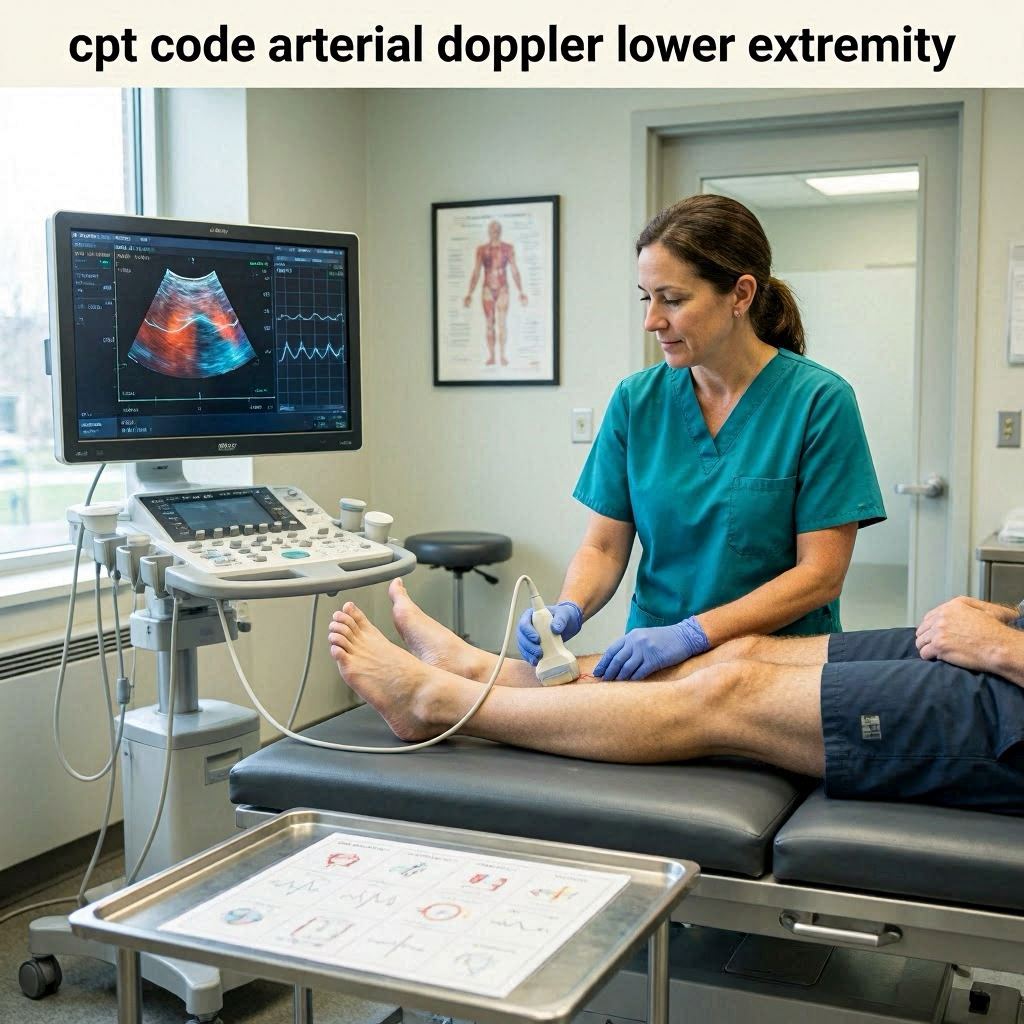
Laying the Foundation: What is an Arterial Doppler, Really?
Before we dissect the code book, we must agree on the clinical service we are describing. A lower extremity arterial Doppler examination is not a singular test. It is a multi-component physiological evaluation that uses sound waves to map the hemodynamics of blood flow in the legs.
Physicians order this study to answer a critical question: Is there occlusive disease, and if so, where is it and how bad is it? Unlike a CT angiogram that shows the anatomy of the vessel wall, a Doppler study evaluates the functional significance of a blockage by measuring how blood flows in real time.
The technical component relies on the Doppler effect. As ultrasound waves bounce off moving red blood cells, the frequency of the returning wave shifts. The system converts this shift into an audible signal and a graphic waveform. A triphasic waveform suggests healthy, elastic vessels. A monophasic, dampened waveform suggests proximal obstruction and poor perfusion.
However, the term “arterial Doppler” is often used colloquially to describe two distinct, often paired, procedures that have different billing rules:
- Physiologic Testing: Segmental pressure measurements and waveform analysis (plethysmography).
- Duplex Scanning: A combination of real-time B-mode ultrasound imaging (grayscale anatomy) and pulsed Doppler (color flow and velocity measurement).
Understanding this duality is the first secret to mastering the CPT codes. When a clinician scrawls “rule out PAD” on an order, you must identify if they need the pressures or the picture, or both.
The Code Architects: Understanding the AMA’s Structural Logic
The American Medical Association (AMA) maintains the CPT code set. They don’t assign numbers randomly. For peripheral arterial studies, they group codes based on the extent of the examination: limited versus complete, unilateral versus bilateral.
If you try to memorize the codes without the anatomical rules, you will inevitably mix them up under the pressure of a busy office. Instead, let’s implant a mental model. Think of the lower extremity arterial tree as a map of highways.
- The Highways (Aorta/Iliac): The interstate freeways delivering blood out of the trunk.
- The Avenues (Femoral/Popliteal): The major city streets traversing the thigh and knee.
- The Side Streets (Tibial/Peroneal): The narrow, branching roads of the calf.
- The Driveways (Digits): The final destination at the toes.
CPT codes generally ask two questions: “How many highways did you scan?” and “Did you map the destination (the toes)?” If you use a duplex scanner to look at a short segment of the femoral artery, that is one service. If you use a blood pressure cuff to generate waveforms from the thighs down to the ankles, that is a different service entirely. We will dissect them layer by layer.
The Core Code Set: The Physiology Codes (93922 to 93924)
We begin with the codes that evaluate function, not structure. These studies typically utilize blood pressure cuffs placed at multiple levels on the legs, connected to a plethysmography device. The provider inflates the cuffs to measure systolic pressure at the high thigh, low thigh, calf, and ankle. They calculate the Ankle-Brachial Index (ABI), a ratio that compares the ankle pressure to the arm pressure.
These tests are purely physiological. They do not generate images of the artery wall.
CPT 93922: The Limited Bedside Study
Picture a podiatrist evaluating a patient with a small toe ulcer. The clinical question is narrow: Does blood reach the foot at a high enough pressure to heal this wound? The physician might not need a full leg workup. They only need the ankle pressure.
CPT 93922 represents this targeted approach. The descriptor defines it as a “limited bilateral noninvasive physiologic studies of upper or lower extremity arteries.”
- The Scope: This usually involves a single-level assessment. For the lower extremity, this frequently means obtaining Doppler signals and pressures at the ankle level only.
- The Bilateral Nuance: This code is inherently bilateral. Whether you check one ankle or both ankles, the work is considered limited. You cannot bill 93922 twice (once for the left and once for the right). It’s a single charge for a limited, but bilateral, look.
- Who Uses It: This is common in wound care centers to establish a baseline ABI before applying compression therapy. If the ABI comes back severely abnormal or non-compressible due to calcified vessels, the physician then orders a more detailed study, but the limited screen served its initial triage purpose.
CPT 93923: The Comprehensive Workhorse
Now, let’s graduate to the complete evaluation. The patient walks into the vascular lab limping. The history suggests iliac disease, femoral disease, or maybe multi-level disease. You need a full map of the pressure gradients down the leg.
This is the domain of CPT 93923, defined as a “complete bilateral noninvasive physiologic study of upper or lower extremity arteries.”
- The Multi-Level Mandate: “Complete” is the operative word. To justify this code, the technician must obtain segmental pressures at three or more levels. The standard setup places large cuffs at the high thigh, low thigh, calf, and ankle. Some protocols add a metatarsal cuff. The machine records the volume of the limb changing with each pulse (Pulse Volume Recording, or PVR).
- Downstream Verification: The billing standard frequently requires recording the pressures at the level of the toes in specific populations, particularly if the ankle vessels are calcified (diabetes, renal failure), rendering the ABI falsely elevated. A complete exam often includes the toe-brachial index (TBI) when medically necessary.
- The Bilateral Rule: Just like 93922, this code is bilateral. You report it once when evaluating both legs. It is a flat rate for the global interpretation of the bilateral lower extremity pressures. If the ordering physician only asks for a unilateral study, you face a dilemma. You generally perform the test bilaterally because the asymptomatic leg often serves as the internal control for the patient. However, if the payer demands a unilateral code, you may need to append modifier -52 (Reduced Services) to 93923, though this is clinically awkward and often results in a lower payment. We discuss this payer quirk shortly.
CPT 93924: The Treadmill Stress Test
We cannot ignore the dynamic state of blood flow. A patient may have a normal ABI at rest but cramp violently after walking half a block. This is pseudo-claudication or true ischemic claudication that requires a stressor to unmask the pressure drop.
CPT 93924 describes a “noninvasive physiologic study, lower extremity arteries, at rest and following treadmill stress testing.”
- The Protocol: The lab measures resting pressures (complete, bilateral). The patient then walks on a treadmill at a defined speed and grade (usually 1.5 mph, 10-12% grade) until symptoms occur or a time limit is reached. Immediately post-exercise, the technician rapidly repeats the ankle pressures.
- The Hemodynamic Logic: In a healthy individual, exercise induces vasodilation, and ankle pressure stays the same or rises slightly. In a patient with iliac stenosis, the pressure drops dramatically post-exercise because the proximal narrowing steals the hyperemic flow needed by the distal muscle. The recovery time correlates with the severity of the disease.
- Code Separation: You do not report 93923 and 93924 together. The stress code (93924) includes the resting component. It is a bundled service covering the pre- and post-exercise assessment. This test is time-consuming and requires close monitoring, but it provides an invaluable functional benchmark.
The Anatomical Imaging Codes (93925 & 93926)
We now shift from the Doppler probe and blood pressure cuff to the actual ultrasound scanner. This is Duplex ultrasonography. The sonographer holds a transducer, looking at a grayscale image of the vessel wall, measuring the intima-media thickness, identifying plaque, and then placing the pulsed Doppler sample volume within the lumen to measure the velocity of the blood flow.
Changes in velocity predict the degree of stenosis. A velocity ratio of 2.0 (where the speed inside a narrowing is double the speed just before the narrowing) suggests a 50% diameter reduction. A ratio of 4.0 suggests a 75% or greater reduction.
CPT draws a hard line in the sand here between scanning the “big pipes” above the groin and the “narrow tubes” below it.
CPT 93925: The Inflow Study (Aorto-Iliac to Femoral)
Think of this as the scanner’s view of the trunk and upper thighs. The specific anatomical territory covered by CPT 93925 includes the distal aorta, the common iliac arteries, the external iliac arteries, and the common femoral arteries.
This is not a leg study for claudication in the calf. This is an inflow study. The technician places the transducer on the belly, pressing through bowel gas to visualize the bifurcation of the aorta. They slide down along the pelvic brim to trace the iliacs under the inguinal ligament to the groin.
The Requirements:
- Imaging: Grayscale visualization of the vessel walls.
- Velocity: Doppler waveforms at multiple specific sites in the external iliac and common femoral arteries.
- Purpose: To rule out inflow stenosis, aneurysm, or dissection.
- The “Bilateral” Logic: The code descriptor specifies “complete bilateral study.” Arterial disease is systemic. Even if the right leg hurts, you scan the left iliac system to compare velocities and detect asymptomatic disease. Bilateral scanning is the standard of care for a complete study.
Table 1: Arterial Segments Mapped by CPT 93925
CPT 93926: The Run-Off Study (Femoral to Pedal)
This is the actual “lower extremity” study most vascular surgeons crave when they say, “Check the patient’s run-off.” This code represents a complete duplex scan of the arteries of the leg from the groin down to the toes.
The AMA defines this territory as extending from the common femoral artery and branching through the entire infra-inguinal tree down to the tibial/peroneal vessels at the ankle and foot.
The True Complexity:
93926 is often undervalued by administrators because they see it as a single line item. However, the technical work is immense. The sonographer must image the superficial femoral artery (SFA) along its course through the adductor canal, find the popliteal artery behind the knee (often tortuous or partially occluded), and then trace the tibial vessels (anterior tibial, posterior tibial, and peroneal) through the leg compartments down to the tiny pedal arch on the top of the foot.
The Requirements:
- Inflow Baseline: The exam usually starts with a quick greyscale and velocity check of the common femoral artery to confirm the inflow is good before chasing the run-off.
- Mid-Vessel: Full B-mode and Doppler sweep of the SFA and popliteal.
- Tibial Mapping: This is the hardest part. The anterior tibial artery dips deep in the anterior compartment. The posterior tibial artery runs behind the medial malleolus. The peroneal artery is deep and medial to the fibula. The sonographer must find them, prove patency, and record the velocity profile. If the artery is occluded, they look for collateral refill.
- Documentation Note: If the tibial vessels are occluded and cannot be clearly visualized due to wall calcification (acoustic shadowing), the lab report should explicitly state this limitation. You still bill 93926 if the attempt to map them was genuine and complete, but the documentation must support the “complete” attempt.
The Great Coding Conundrum: Unilateral vs. Bilateral Services
Let’s address the elephant in the room that causes more compliance officers to lose sleep than any other vascular code: the unilateral versus bilateral designation.
The CPT manual, with a few exceptions, bundles most lower extremity arterial studies into bilateral codes. The physiological codes (93922, 93923) and the duplex codes (93925, 93926) specifically state “complete bilateral.”
So, what happens when a physician writes an order that says “Left lower extremity arterial duplex”?
The Payer Rules:
Medicare and many commercial payers look at the bilateral code and the unilateral order and see a mismatch. They view the bilateral code as the standard for a “complete” study.
- The “Wrong Code” Trap: You cannot bill 93926 (bilateral) with a -LT (Left) modifier. Why? Because the code is already bilateral. Slapping a -LT on it creates a contradiction that payers often deny.
- The Unilateral Code Absence: CPT does not provide a specific “93926-Left” code. This creates a coding gap.
- The Industry Solution: Most vascular labs proceed with the bilateral study if medically necessary (and often it is, to compare sides). If the medical necessity documentation strongly supports looking at only one leg—for example, a recent angiogram mapped the right perfectly, and only the left graft needs surveillance—you still have a problem coding for a unilateral study.
- Modifier -52 (Reduced Services): Some payers allow you to bill the bilateral code (e.g., 93923 or 93926) and append Modifier -52 to indicate a “reduced level of service.” You attach documentation proving medical necessity for a unilateral exam. This usually results in a percentage reduction in the fee schedule payment.
- The “Leg” Codes (93930/93931): We will dissect these codes later. They are specific to upper extremity or very targeted evaluations. Do not try to use them as a workaround for a unilateral lower extremity study. That is a misrepresentation of the service.
Important Note to the Reader:
Never assume you can “split” a bilateral code by reporting two line items with modifiers -LT and -RT. A bilateral code is paid as a single unit. Two lines will likely trigger a duplicate denial. Always check your specific Local Coverage Determination (LCD) for your Medicare Administrative Contractor (MAC). For instance, Novitas and First Coast have explicit instructions on this scenario, and they rarely agree entirely.
Limb-Specific Angiosomes: The Special Case of the Leg and Digits
We move to a distinct family of codes that looks specifically at the conduit vessels in a single limb or the microvascular supply of the digits. These codes involve photoplethysmography (PPG), a technique using a tiny infrared light-emitting diode taped to the skin to detect pulse waveforms.
CPT 93930: The Focused Single-Level Study
This code represents a “noninvasive physiologic study, upper or lower extremity arteries, single level.”
- The Distinction: Unlike 93922 (the limited bilateral), 93930 is strictly unilateral.
- The Use Case: A surgeon performs a specific bypass graft, say a femoral-to-posterior tibial bypass. The surgeon wants to compare the PVR waveform at the ankle to the arm, but only on the operated side. That is a single limb, single level.
- Duplex vs. Physiologic: Remember, 93930 is a physiologic code (waveforms/pressures), not an imaging code.
CPT 93931: The Detailed Limb Map (Multi-Level)
This is the unilateral cousin of the complete bilateral study 93923. It is a complete noninvasive physiologic study of a single limb at multiple levels.
- The Use Case: You have a patient with a previous above-knee amputation on the left. You physically cannot perform a bilateral study. The right leg has an ulcer. You perform high-thigh, low-thigh, calf, ankle, and toe pressures on the right leg only. This is a 93931 study.
- The Documentation Gold Standard: The report must specify why the other limb was absent or why a unilateral study was medically necessary. If you bill 93931 routinely without documenting the reason, an auditor will flag it as an unbundling of 93923. They will suspect you are taking a bilateral service, splitting it, and getting paid more for the sum of the parts. The compliance risk is high.
CPT 93986: The Digit Detective
Forget the leg. Zoom into the toe. CPT 93986 is an end-organ assessment. The descriptor reads: “Noninvasive physiologic study, upper or lower extremity arteries, complete bilateral study, digit only (e.g., waveform analysis with PPG).”
- The Technology: The technician tapes PPG sensors to the great toes (and maybe the second toes). They record the arterial waveforms at the digital level.
- The Clinical Signal: This is the gold standard for small vessel disease, Buerger’s disease, Raynaud’s, or evaluating scleroderma vasculopathy. It is also crucial for calculating the Toe-Brachial Index (TBI). A TBI < 0.7 is diagnostic for critical limb ischemia.
The “Black Box” List: CPT Codes You Need to Know
To truly master the billing for an arterial Doppler, you cannot just know the “A” codes (93922-93926). You must understand the adjacent codes that complete the diagnostic picture. Ordering the wrong combination can look like unbundling, and failing to order the right one can leave a clinical question half-answered.
Here is a curated reference list of the most frequently used codes in a vascular lab. Use this as a checklist to ensure your charge capture sheet is accurate.
| CPT Code | Descriptor (Shortened) | Bilateral/Unilateral | Modality | Typical Use Case |
|---|---|---|---|---|
| 93922 | Limited Physiologic Study | Bilateral (Bilat) | Physiologic (Pressures) | Quick ABI screen before compression wraps. |
| 93923 | Complete Physiologic Study | Bilateral (Bilat) | Physiologic (Segmental) | Full leg PVRs & Segmental Pressures; claudication workup. |
| 93924 | Stress Treadmill Study | Bilateral (Bilat) | Physiologic (Dynamic) | Resting ABI normal, high suspicion of iliac disease. |
| 93925 | Duplex Scan, Aorto-Iliac | Bilateral (Bilat) | Duplex (Imaging+Doppler) | Abdominal bruit, femoral pulse weak bilaterally. |
| 93926 | Duplex Scan, Full Lower Extremity | Bilateral (Bilat) | Duplex (Imaging+Doppler) | Mapping run-off vessels pre-bypass, femoral-popliteal disease. |
| 93930 | Physiologic Study, Single Limb, Single Level | Unilateral (Uni) | Physiologic | Post-op graft check, single ankle pressure. |
| 93931 | Physiologic Study, Single Limb, Multi-Level | Unilateral (Uni) | Physiologic | Contralateral amputation; localized limb trauma. |
| 93970 | Duplex Scan, Vein Mapping | Uni/Bilat | Duplex | Planning a bypass graft using the saphenous vein. |
| 93971 | Duplex Scan, Vein, Limited | Unilateral (Uni) | Duplex | Checking a single spot for DVT in a vein graft. |
| 93986 | PPG Digits, Bilateral | Bilateral (Bilat) | Physiologic (PPG) | Raynaud’s, Scleroderma, Blue Toe Syndrome. |
Expert Commentary: What the Clinicians Say
To give this article a grounded perspective, we consulted the clinical trenches. These are not formal citations but rather synthesized viewpoints reflecting the collective experience of a typical high-volume vascular department.
“The biggest mistake I see new coders make is thinking 93925 and 93926 are ‘upper’ and ‘lower.’ They are not. 93925 is the abdomen/pelvis inflow. 93926 is the leg. If the doctor wants the whole picture—from the aortic bifurcation down to the ankle—we bill both, but we append the -59 modifier to show they are distinct anatomical sites.”
— Lead Vascular Technologist, RVT
“We have a policy: If the ABI is over 1.3 (non-compressible), we stop. We don’t just bill the 93923 and guess. We convert the order to a toe pressure (93986) and a Duplex (93926). The physician must document the reason for the conversion. A calcified vessel is visible on the screen; you just can’t squeeze it with a cuff. That distinction alone saves us thousands of dollars in auditing risk.”
— Compliance Officer, Cardiology Practice
“I see the 93925 denied most often because the medical necessity isn’t clear. If you just write ‘PAD,’ they will pay for 93926 (the leg). But to pay for the iliac scan (93925), I need to see a clue: low femoral pulse, abnormal ABI with thigh-cuff attenuation, or post-angioplasty surveillance of a common iliac stent. I have to teach my doctors to write ‘suspected iliac disease’ or ‘aortoiliac duplex’ on the order, not just ‘vascular lab.’”
— Revenue Cycle Manager, Multi-Specialty Group
The Billing Sequence: How to Stack 93925 and 93926 Legally
One of the most common encounters in a vascular clinic is the patient who needs a “complete leg bypass mapping.” This means the physician wants to see the inflow pipes (the iliacs) and the outflow pipes (the femorals, popliteal, and tibials). The order is essentially a “whole limb” survey.
You correctly report this as two distinct services:
- CPT 93925 (Inflow)
- CPT 93926 (Run-off)
However, your billing software will immediately flag these two codes for bundling edits. The National Correct Coding Initiative (NCCI) considers the inflow part of a continuous vascular tree. You cannot simply list them side-by-side without a fight.
The Modifier -59 Defense:
To bypass the edit, you must append Modifier -59 (Distinct Procedural Service) to the code that is being bundled. Usually, you append it to 93925.
- Why? You must justify that the iliac artery evaluation (93925) was a distinct service, performed in a different anatomical location, for a different diagnostic purpose than the leg evaluation (93926).
- The Audit-Proof Scenario: A patient presents with thigh claudication. The ABI drops significantly from the high-thigh cuff to the low-thigh cuff. This points to Superficial Femoral Artery (SFA) disease. However, the femoral waveform is already dampened. The physician needs to know if the dampening is from an iliac lesion (treatable with a stent) or just poor cardiac output. The physician orders the iliac scan (93925) to answer that specific question, distinct from the leg scan (93926). That is the “distinct procedural service” narrative you need.
Do not use modifier -59 as a “get out of jail free” card. Auditors aggressively target 93925/93926 pairs. If the documentation for both studies merely regurgitates the same generic paragraph about peripheral vascular disease without specifying the separate anatomical focus, the auditor will strip the modifier and take back the payment for the inflow study.
The Duplex Danger Zone: Avoiding Common Pitfalls
The path to a clean claim is paved with vigilance against these recurring traps. Study this list carefully; it synthesizes the most frequent errors found in real-world audits.
Pitfall 1: The “Heavy Leg” Assumption
Do not assume that a non-compressible ABI automatically justifies a duplex scan. If you perform a physiologic study (93923) and the tibial vessels are calcified, the pressures are unreliable. The natural reflex is to scan (93926). While clinically correct, the billing documentation for the physiologic study must state it was uninterpretable. If you report both, some payers may bundle them, viewing the duplex as a corrective repeat of a failed physiological test. You need a note explaining the physiology was attempted and failed, and the duplex was performed to supply the missing diagnostic information.
Pitfall 2: Grayscale Image Only
To bill a Duplex code (93925 or 93926), you must produce a spectral waveform. Scanning a vessel, measuring its size, and printing a grayscale picture is a non-invasive ultrasound, but it is not a “duplex” study in the coding sense. The “duplex” requires that pulsed Doppler component. If the sonographer forgot to take a Doppler trace of the popliteal artery, that study fails the coding requirement. The billing code assumes the velocities, the ratios, and the waveform analyses exist.
Pitfall 3: The Incomplete “Complete”
The descriptor for 93926 says “complete.” If the report mentions “The peroneal artery was not visualized,” “The distal anterior tibial artery was obscured by shadowing,” or “The pedal arch could not be assessed,” you have a potential problem. You are reporting a complete code for an incomplete service. The vessel absence must be documented as a pathology (occlusion) rather than a technical limitation. “Vessel is occluded with refill via collaterals” is a finding. “Vessel not found” is a technical failure. The latter may require a Modifier -52 reduction or a different, limited code depending on the payer.
Setting Up the Lab for Success: A Practical Process Flow
If you manage a vascular laboratory, the accuracy of your coding reflects the design of your workflow. Relying on a super-coder to clean up a mess downstream is a recipe for burnout and delayed payments. Instead, build the code logic into the handoff between the ordering clinician and the technologist.
Step 1: The Smart Requisition
Do not give your providers a blank line that says “Test Ordered: ________.” Design a checklist that speaks in the language of CPT.
- Limited ABI (Ankle Only) (93922)
- Segmental Pressures/PVRs (Full Leg) (93923)
- Exercise Testing for Claudication (93924)
- Aorta/Iliac Inflow Duplex (Pelvis) (93925)
- Lower Extremity Runoff Duplex (Leg to Toe) (93926)
- Unilateral Study (Specify Limb & Medical Necessity): _______
This prompts the clinician to think anatomically. If they check the “Leg” box, you might ask: “Do you also suspect iliac disease (inflow)?” This simple prompt drives the medical necessity for the 93925/93926 combination before the patient even arrives.
Step 2: The Tech’s Coding Sheet
When the sonographer finishes the exam, they should fill out a technical worksheet, not just write a report. This worksheet should mirror the billing requirements.
- Vessels Insufflated: (High Thigh, Low Thigh, Calf, Ankle—Verifies 93923).
- ABI Level: (Verifies non-compressible status).
- Duplex Anatomy: Checkboxes for every segment from Aorta to Pedal Arch.
This forces the tech to realize during the exam, not after, that they missed a segment required for the ordered code. If the patient’s leg is heavy with edema and the peroneal is impossible, the tech tells the supervisor immediately, and they decide to bill a modified code.
Step 3: The Reason for the Encounter
An auditor reads the indication backwards. The ICD-10 code must match the CPT procedure intensity.
- 93923 (Segmental Pressures): I73.9 (Peripheral vascular disease, unspecified), I70.203 (Atherosclerosis of native arteries, bilateral legs, with ulceration).
- 93925 (Inflow Duplex): I74.09 (Embolism and thrombosis of abdominal aorta), I70.0 (Atherosclerosis of aorta), I70.213 (Atherosclerosis of native arteries with intermittent claudication, bilateral legs)—This code signals higher risk anatomy justifying the iliac scan.
- 93986 (Digit PVRs): I73.00 (Raynaud’s syndrome without gangrene), I75.89 (Atheroembolism of other sites).
Advanced Coding Scenarios: Grafts, Stents, and Catheters
We have established the rules for native arteries. But what happens when the plumber has visited previously? Bypass grafts and stents change the vascular architecture, and surprisingly, the CPT codes rarely describe the “graft” explicitly. The code remains based on the anatomic location of the vessel you are studying.
Surveillance of a Femoral-Popliteal Bypass
A patient returns for a six-month follow-up after a femoral-to-above-knee popliteal bypass using a synthetic graft. The surgeon needs to check the anastomoses and the velocities within the graft.
- The Code: You still report CPT 93926 (Lower extremity duplex).
- The Logic: The graft is now serving the function of the superficial femoral and popliteal arteries. You are performing a complete duplex of the leg vessels, which includes the graft conduit.
- The Nuance: The documentation must describe the graft: “PTFE graft originating from the CFA, terminating at the above-knee popliteal artery.” You measure peak systolic velocity (PSV) at the proximal anastomosis, mid-graft, and distal anastomosis. If the velocity ratio exceeds 3.5 at the distal hook-up, it signals failing patency. The CPT code doesn’t change because the vessel is prosthetic; the labor is the same anatomical mapping.
The Iliac Stent Surveillance
A patient with an occluded common iliac artery had a stent placed six months ago. The stent is in the pelvis.
- The Code: CPT 93925 (Inflow Duplex).
- The Challenge: Stents can be hard to see on ultrasound if they are deep. Metal struts cause acoustic shadowing. However, a skilled sonographer can angle the probe to find a window. They measure the PSV inside the stent and the turbulent “exit” flow in the distal native external iliac.
- If the Stent Cannot Be Seen: You cannot bill 93925 for “attempted but not visualized” standardly. You might bill for the physiologic pressure study (93923) if segmental pressures were taken instead, or a limited code if only the femoral areas were assessed. You must not report 93925 if you did not record diagnostic velocities in the iliac territory.
The Angular Catheterization Check (The Pseudoaneurysm)
After a femoral artery catheterization, the groin becomes swollen and pulsatile. The request is a “STAT groin ultrasound to rule out pseudoaneurysm.”
- The Mistake: Billing 93926 (complete lower extremity).
- The Correction: This is a limited, unilateral, focused exam. The appropriate code is typically 93971 (Duplex scan of extremity veins) if there is a question of DVT, but for an arterial pseudoaneurysm specifically, you step into tricky territory. Some use 93930 (Physiologic, single limb, single level) if they do a PVR, but a Duplex scan of a specific groin mass is anatomically localized.
- The Reality Check: Many labs use the general arterial duplex code 93925 (Inflow) with a -52 Modifier (Reduced Services) because the CFA is part of the inflow territory, but you only scanned a 5cm area of it, not the entire bilateral aortoiliac system. You must be very specific: “Duplex evaluation limited to the right common femoral artery injection site.”
Bridging the Gap with ICD-10-CM
The CPT code represents the “what.” The ICD-10-CM code represents the “why.” You cannot fully optimize your arterial Doppler coding without a mutualistic link between these two alphabets. Medical necessity is established by the “why.”
The ICD-10-CM classification for peripheral atherosclerosis has gained significant specificity. The days of simply using 440.20 are long gone. You need to capture:
- Native vs. Bypass Graft: Did the disease form in the original vessel, or is the bypass failing?
- Laterality: Right, Left, Bilateral, Unspecified (Avoid “unspecified” like the plague).
- Symptom Status: Is it claudication? Rest pain? Ulceration? Gangrene?
The Ideal Linkages
For a standard duplex of the legs (CPT 93926), you want a code that speaks to the infra-inguinal anatomy.
- I70.213 – Atherosclerosis of native arteries of bilateral legs with intermittent claudication.
- I70.233 – Atherosclerosis of native arteries of right leg with ulceration of ankle.
- I70.303 – Atherosclerosis of unspecified type of bypass graft(s) of the bilateral legs, with rest pain.
For an inflow duplex of the iliacs (CPT 93925), you need a code that points upstream.
- I70.0 – Atherosclerosis of aorta.
- I70.213 (again) – While a leg code, if the documentation states “likely iliac origin,” this supports the 93925. Better yet, I74.5 – Embolism and thrombosis of iliac artery, or I70.211 – Atherosclerosis of native arteries of right leg with claudication (intermittent claudication) is vague but suffices when the exact level is unknown.
- I77.4 – Celiac artery compression syndrome (if also assessing visceral arteries, which is a different code entirely).
The Asymptomatic Trap
You cannot screen a 65-year-old asymptomatic smoker for peripheral artery disease “just because” and expect Medicare to pay. There must be signs and symptoms.
- R00.0 – Tachycardia (not a leg reason).
- I73.9 – Peripheral vascular disease, unspecified. This is a weak code. Payers are increasingly looking for the more specific I70.x categories.
- The Symptom: The patient must complain of pain, numbness, coldness, discoloration, or have a non-healing wound. If the exam is purely a screening, it is often the patient’s financial responsibility via an Advance Beneficiary Notice (ABN).
The Financial Model: Understanding Relative Value Units (RVUs)
The previous chapters explained the clinical “what.” This chapter explains the financial “why” behind the pressure to code correctly. Every CPT code has a Relative Value Unit (RVU) assigned. The RVU consists of three components:
- Work RVU (wRVU): The physician’s time, skill, and cognitive effort in interpreting the study. For vascular studies, this covers reviewing the images and writing the report.
- Practice Expense (PE): The cost of the machine, the gel, the room, the technician’s salary, and the electricity.
- Malpractice (MP): The liability coverage cost.
When you are “down-coded” from a 93926 (full duplex) to a 93922 (limited physiological), the financial hit is catastrophic to a lab’s budget, not because the physician work drops dramatically, but because the Practice Expense plummets. The technical component for a bilateral full-leg duplex demands a high-spec machine and a 45-to-60-minute slot with a registered vascular technologist. A limited ABI can be done in 10 minutes with a handheld Doppler.
Table 3: Comparative Resource Burn (National Averages)
(Note: RVU values are abstracted from the Physician Fee Schedule and are intended to illustrate relative proportion, not provide exact 2025 dollar amounts, which vary by locality.)
| CPT Code | Total Facility RVU (Approx. Ratio) | Tech Time (Estimated) | Clinical Intensity |
|---|---|---|---|
| 93922 (Lim Physio) | 0.50 | 15 mins | Low: Single level, bilateral pressure. |
| 93923 (Comp Physio) | 1.20 | 30 mins | Medium: Multi-level cuffs, PVR analysis. |
| 93924 (Stress) | 2.00 | 60 mins | High: Requires continuous ECG monitoring, patient exertion. |
| 93925 (Aortoiliac Duplex) | 3.00 | 45 mins | High: Pre-fasting protocol, deep abdominal scanning. |
| 93926 (LE Duplex) | 4.50 | 60 mins | Very High: Complex anatomy, distal tibial mapping, collateral identification. |
The Revenue Leak:
If a lab performs 10 “complete” leg duplexes a week but bills them as something lower because of poor documentation, the annual revenue leak can exceed the salary of the sonographer. This is why mastering the difference between 93925 and 93926 is not just a compliance issue; it’s a survival issue for the department.
The Documentation Deep-Dive: Crafting the Narrative
The sonographer’s worksheet gives the data. The interpreting physician’s report gives the narrative. The narrative sells the code. If the narrative is thin, the claim is thin. If the narrative is precise, the claim is bulletproof.
Let’s look at a good report versus a great one for the same encounter.
Example: Post-Angioplasty Check
Bare Minimum Report:
“Duplex scan of left lower extremity. Patent SFA and popliteal. No stenosis seen. Single-vessel runoff.”
Coding Result: Billing for 93926. While the velocity ratio was absent, a lazy auditor might pass it.
Comprehensive Report:
“Complete bilateral lower extremity arterial duplex. Indication: I70.213 (Atherosclerosis, bilateral legs, claudication). Status post left superficial femoral artery angioplasty one month ago.
Findings:
- Right leg: Normal triphasic waveforms from CFA through popliteal. ATA and PTA triphasic.
- Left Leg (Post-intervention): CFA: PSV 90 cm/s, triphasic.
- Proximal SFA: PSV 110 cm/s.
- Distal SFA (angioplasty site): PSV 185 cm/s. Distal to the site, PSV is 95 cm/s. Velocity ratio (Vr) = 1.95. This indicates a residual 40-50% stenosis segment.
- Popliteal: Monophasic, dampened flow.
- Tibial Vessels: ATA is occluded mid-calf with distal refill. PTA is patent with high-resistance flow. Peroneal is dominant and patent.
- IMPRESSION: Patent left SFA stent/angioplasty with moderate restenosis at the distal stent edge. No hemodynamically significant femoropopliteal graft stenosis. Single-vessel runoff via the peroneal artery.”
Coding Result: 93926. The Vr confirms the Doppler was performed. The anatomical mapping is complete. No auditor can dispute the medical necessity or the code level.
The “Garbage In, Garbage Out” Rule:
If the tech hands you a sheet that says “Left leg checked, looks good,” do not try to craft a “Complete Bilateral” report. You cannot fabricate data. The integrity of the code rests on the integrity of the waveform tracings stored in the patient’s archive.
Anatomical Oddities and How They Impact Codes
The text of CPT assumes normal anatomy. But no patient reads the textbook. Anatomical variations challenge the rigid boundaries of the code descriptors.
The High Bifurcation
The popliteal artery usually divides below the knee joint. But in some patients, it divides much higher. The anterior tibial artery might branch off in the mid-thigh.
- The Coding Problem: You are scanning the “popliteal” segment behind the knee and see only two vessels. Where is the third? If you only scan down to the standard popliteal space and stop, you haven’t technically imaged the anterior tibial origin if it’s high.
- The Solution: The code 93926 requires a complete run-off. This means the sonographer must start the anatomical identification at the groin and follow the branches. If the vessel divides high, you document “high bifurcation of the popliteal artery, with anterior tibial artery originating in the distal thigh.” You still follow it down to the ankle. The code remains 93926. The documentation simply justifies the unusual mapping time.
Persistent Sciatic Artery
A rare but fascinating anomaly. The persistent sciatic artery is a continuation of the internal iliac artery that runs down the back of the thigh alongside the sciatic nerve. The femoral system may be hypoplastic.
- The Coding Problem: A standard 93926 says “femoral-popliteal-tibial.” The sciatic artery is none of these.
- The Solution: The intent of 93926 is the evaluation of the leg’s arterial supply. If the dominant supply is a sciatic artery, that is what you scan. You document the anomaly heavily. “The superficial femoral artery is present but diminutive. The dominant lower extremity inflow is via a persistent sciatic artery.” You still bill 93926 because you are performing the work of a complete leg duplex, and the anomaly represents the “leg vessels.”
The Pediatric Consideration
Vascular laboratories affiliated with children’s hospitals face a unique void. The CPT codes described so far assume atherosclerotic disease in adults. Children don’t get atherosclerosis.
Pediatric indications for a lower extremity arterial study include:
- Trauma: Knee dislocations can lacerate the popliteal artery. A 15-year-old with a football injury needs a stat duplex. You use the same 93930/93931 or 93926 codes.
- Cystic Adventitial Disease: A jelly-like cyst forms in the vessel wall, causing claudication in a 20-year-old. The duplex is the gold standard.
- Vascular Malformations: Klippel-Trenaunay syndrome (mixed malformations), Parkes Weber syndrome (AV fistulas).
When coding for vascular malformations, the line blurs. If you are evaluating an arteriovenous malformation (AVM) in the leg, you might be mapping feeding arteries and draining veins. The standard CPT arterial codes apply to the arterial components, but you might need to add venous codes (93970, 93971) to map the veins. The medical necessity must clearly reference the malformation ICD-10 code (Q27.3x), not PAD.
The Path to Denial Resolution: A Playbook
You’ve billed a 93926. The claim comes back denied. What now?
Denial Reason 1: CO-50 (Medically Not Necessary)
- The Problem: The payer doesn’t believe the patient’s symptoms warranted that level of study.
- The Play: Pull the patient’s clinical notes. Look for the ABI result. If the resting ABI was normal but symptoms are severe, and you only billed 93923, the denial is wrong. File an appeal with the specific claudication distance. “Patient limps at 100 feet; ABI drops from 1.10 to 0.60 post-exercise. Duplex was necessary to localize the lesion.”
Denial Reason 2: CO-97 (Bundled Service)
- The Problem: You billed 93925 and 93926, and the payer’s edit software claims the 93925 is included in 93926.
- The Play: Refer to the CPT manual. The NCCI edit pairs them, but the modifier is allowed. Submit a letter defining the distinct anatomical sites. Quote CPT Assistant guidance if available, which states that an aortoiliac evaluation (93925) is distinct from a lower extremity evaluation (93926) when performed for inflow assessment. Resubmit with modifier -59 and the anatomy chart.
Denial Reason 3: CO-16 (Lacks Information)
- The Play: Usually means the medical records sent in for the appeal were illegible or incomplete. Re-send a clean, typed version of the duplex report with the criteria for the code highlighted in yellow. Specifically highlight where the PVR was multi-level (for 93923) or where the spectral Doppler velocities were taken (for 93926).
Future Shifts: AI and the Vascular Lab
We close the technical portion of this guide by looking toward the horizon. The role of artificial intelligence (AI) in ultrasound is expanding. Software like “AI-assisted measurement” can automatically calculate intima-media thickness or trace the spectral waveform envelope to compute the velocity ratio.
How will this impact the CPT coding for an arterial Doppler?
- Work RVU Defense: As interpretation becomes assisted, payers may attempt to cut the Work RVU. The defense is clear: AI does not interpret. It measures. The physician still synthesizes the clinical history, the functional data, and the images. The code remains a professional interpretation, not a machine reading.
- Documentation Integrity: If AI generates a preliminary report, the physician must review and sign it. The billing rules do not change. You must retain the full image loop. A single screenshot from an AI platform is insufficient documentation for a complete study.
Summary and Conclusion
Mastering the CPT coding for lower extremity arterial Doppler studies is not a simple memory exercise; it is a clinical competency. We have navigated the physiological rationale behind the pressures (93922, 93923), the dynamic stress tests (93924), and the detailed anatomical imaging (93925, 93926). We have confronted the reality that billing a bilateral code for a unilateral order requires careful, documented justification rather than just a lateral modifier.
The most common source of claim failure is a disconnect between the clinical narrative and the code descriptor. You now know that a “complete” study requires a technically complete exam, and a “duplex” requires spectral Doppler waveforms, not just a pretty picture. By building internal protocols that link the ordering physician’s specific language to the sonographer’s checklist and the coder’s final output, you transform a potential audit risk into a seamless, payable workflow. Apply these standards consistently, and your revenue cycle will mirror the healthy, triphasic flow you seek in your patients.
Frequently Asked Questions (FAQ)
Q: Can I bill CPT 93922 (limited ABI) and CPT 93923 (complete PVRs) on the same day?
No. These services are hierarchical. If you start with a limited ABI and then decide to perform a complete study, you only bill the complete study (93923). Billing both would represent unbundling of the technical component.
Q: What is the specific CPT code for a toe-brachial index (TBI)?
While the physiological assessment is measured similarly to the ABI, the dedicated CPT code is 93986. This code represents a complete bilateral study of the digits using PPG (photoplethysmography) and is the correct code to use when the purpose of the test is solely digit assessment, often used when the ABI is non-compressible.
Q: If a physician orders a study of “the right leg only,” do I just append modifier -RT to 93926?
No. CPT 93926 is an inherently bilateral code. Appending -RT creates a contradiction that most payers deny. You must either perform the bilateral exam if medically indicated or, if truly limited to one leg, discuss reporting it with a -52 (Reduced Services) modifier and robust documentation, or use the unilateral physiological code 93931 if that fits the service.
Q: How do I code for a vein bypass graft surveillance in the leg?
A vein bypass graft in the leg (for example, a femoropopliteal or femorotibial graft) is coded with CPT 93926 (lower extremity duplex). The code covers the assessment of the native and bypass conduits in the infra-inguinal region. You should also ensure the graft is documented with the appropriate ICD-10 code for bypass graft surveillance (e.g., Z95.828).
Additional Resource:
For the most current National Correct Coding Initiative (NCCI) edits regarding bundling rules for 93925 and 93926, visit the official CMS NCCI edit page:
Medicare NCCI Code Pair Edits
Disclaimer:
This article is intended for informational and educational purposes only and does not constitute medical or legal advice. CPT codes and their descriptions are copyright of the American Medical Association. Billing rules and payer policies vary by jurisdiction and are subject to change. Always verify the specific policies of your local payer and Medicare Administrative Contractor (MAC) before submitting claims.
Copied from: CPT Code 90961 Comprehensive Guide – DeepSeek – <https://chat.deepseek.com/a/chat/s/1683e980-4086-44f0-905b-949aecdd2e9f>