If you are scheduling a test to find out why you have a cough or wheeze, you might come across the term “Methacholine Challenge.” For medical billers, coders, and respiratory therapists, the first question is always the same: What is the correct CPT code for methacholine challenge?
The short answer is CPT 94070. However, using this code correctly involves understanding how the test works, what documentation you need, and when insurance companies will actually pay for it.
In this guide, we will walk through everything you need to know. We will keep the language simple, avoid confusing medical jargon, and help you feel confident about this procedure.
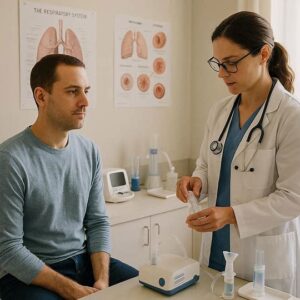
CPT Code for Methacholine Challenge
Table of Contents
ToggleWhat Is a Methacholine Challenge Test?
Before we talk about codes, let us understand the test itself. A Methacholine Challenge Test helps doctors figure out if a patient has asthma.
Sometimes, a patient has symptoms like coughing or shortness of breath, but their regular breathing test (spirometry) looks normal. In this situation, the lungs do not show a problem when the patient is resting. The doctor needs to “provoke” or “challenge” the lungs to see if they react.
Methacholine is a drug that causes the airway muscles to tighten slightly. In a healthy person, this causes no real problem. In a person with asthma, it causes a significant drop in lung function.
How the Test Works
-
Baseline Measurement: You first breathe into a machine (spirometer) to get a normal reading.
-
Inhalation: You inhale a small dose of methacholine.
-
Repeat Testing: You breathe into the machine again to see if your lung function changed.
-
Increasing Doses: You repeat this process with stronger doses until your lung function drops by 20% or you finish all doses.
-
Reversal: If your lungs react, you inhale a bronchodilator (like albuterol) to reverse the tightening.
Note for readers: This test is always supervised by a doctor or trained respiratory therapist. Emergency equipment is always nearby to keep you safe.
The Exact CPT Code for Methacholine Challenge
Let us get straight to the point. The primary and most accepted code is:
CPT 94070
The official descriptor for CPT 94070 is: “Bronchospasm provocation evaluation, multiple spirometric determinations, with administered agents (e.g., methacholine, histamine).”
This code covers the entire process. It includes the preparation of the methacholine doses, the multiple breathing tests, the monitoring of the patient, and the final interpretation of the data.
Is There More Than One Code?
Sometimes, people confuse this with other pulmonary function codes. Here is a quick comparison to avoid mistakes.
| CPT Code | Procedure Description | When to Use It |
|---|---|---|
| 94070 | Methacholine Challenge (provocation) | When you give methacholine to test for airway hyperreactivity. |
| 94060 | Bronchodilator response (before and after albuterol) | When you give albuterol to see if airways open up. |
| 94010 | Simple spirometry | Just the breathing test, no drugs given. |
| 95070 | Inhalation bronchial challenge testing (antigens) | When you use pollen or dust mites (allergy testing). |
Important Distinction: Do not use 94060 for a methacholine test. Code 94060 is for reversibility (giving medicine to open airways). Code 94070 is for provocation (giving medicine to test reactivity). They are opposites.
When Is This Code Used?
The cpt code for methacholine challenge (94070) is not used for every patient. There are very specific clinical situations where this code is appropriate.
Appropriate Uses (Medical Necessity)
Insurance companies require “medical necessity.” This means the test must be needed for a clear medical reason. You can use 94070 when:
-
A patient has symptoms of asthma (cough, wheeze, chest tightness).
-
Standard spirometry tests are normal or inconclusive.
-
The doctor needs to confirm or rule out a diagnosis of asthma.
-
The patient needs an objective assessment of airway hyperresponsiveness.
Inappropriate Uses (When Not to Bill)
You should not use code 94070 for:
-
Patients who already have a confirmed diagnosis of severe asthma (it is unnecessary).
-
Patients with very low lung function (baseline FEV1 less than 60% of predicted). This is dangerous.
-
Patients who have had a recent heart attack or stroke.
-
Pregnant patients (generally avoided unless absolutely necessary).
Realistic Advice: If a patient has a clear history of asthma and already uses a rescue inhaler every day, a methacholine challenge is usually not needed. The test is a diagnostic tool, not a routine monitoring tool.
How to Bill CPT 94070 Correctly
Billing for this procedure requires attention to detail. You cannot just send the code 94070 alone and expect payment. You need the right modifiers, place of service codes, and diagnosis codes.
Place of Service (POS)
-
POS 11: Office (if performed in a private practice pulmonary clinic).
-
POS 24: Ambulatory Surgical Center (less common).
-
POS 22: Outpatient Hospital (if performed at a hospital pulmonary lab).
Modifiers
Modifiers tell the insurance company if something was different about the test.
-
Modifier 26 (Professional Component): Use this if you are billing only for the doctor’s work (interpretation and supervision). The hospital or clinic owns the equipment.
-
Example: A doctor supervises the test and reads the results, but the hospital provides the room and the machine.
-
-
Modifier TC (Technical Component): Use this if you are billing only for the equipment, supplies, and technician’s time. The doctor’s work is billed separately.
-
Example: A billing company represents the clinic that owns the spirometer and pays the respiratory therapist.
-
-
No Modifier: If you bill globally (the same provider owns the equipment and provides the interpretation), you send 94070 with no modifier.
A Realistic Billing Example
Dr. Smith owns an independent pulmonary clinic. She has a spirometer and a technician. She supervises the methacholine challenge herself.
-
She bills: 94070 (no modifier)
-
She includes: The referring diagnosis (R06.2 – Wheeze, for example).
Dr. Jones works at a large hospital. The hospital owns the equipment and employs the technician. Dr. Jones only supervises and interprets.
-
The hospital bills: 94070 – TC
-
Dr. Jones bills: 94070 – 26
Required Diagnosis Codes (ICD-10)
You cannot bill 94070 alone. You must attach an ICD-10 diagnosis code that justifies the test. The most common and accepted codes include:
| ICD-10 Code | Diagnosis Description | Why It Works |
|---|---|---|
| R06.2 | Wheeze | Patient has a wheezing sound, cause unknown. |
| R05 | Cough | Persistent cough, possible asthma equivalent. |
| R06.89 | Other abnormalities of breathing | Chest tightness or shortness of breath. |
| J45.901 | Unspecified asthma, uncomplicated | Suspicion of asthma needing confirmation. |
| J45.990 | Exercise induced bronchospasm | Methacholine mimics exercise effects. |
Pro Tip: Avoid using chronic or stable asthma codes (like J45.40 – Moderate persistent asthma) for this test. If the patient already has a specific, severe asthma code, the insurance company will ask: “Why are you testing for asthma if they already have it?”
Documentation Requirements for Reimbursement
Insurance auditors love to deny methacholine challenge claims. Why? Because it is an expensive test, and they want to be sure it was necessary.
To ensure you get paid for cpt code 94070, your medical record must include these five items:
1. The Baseline Values
You must record the patient’s FEV1 (forced expiratory volume in one second) before giving any methacholine. Usually, the test requires a baseline FEV1 of at least 60% to 70% of the predicted value.
2. The Doses Used
Document exactly how many doses you gave. The standard protocol usually starts with diluent, then 0.03 mg/mL, 0.06 mg/mL, 0.125 mg/mL, 0.25 mg/mL, 4 mg/mL, and 8 mg/mL. Write down the final dose that caused a 20% drop in FEV1, or note that the test was “negative” after the highest dose.
3. The Response
Record the FEV1 after each dose. The test is “positive” if FEV1 drops by 20% or more from baseline. The test is “negative” if the drop is less than 20% after the highest concentration.
4. Reversal Documentation
After the test is complete, you must record that you gave a bronchodilator (like albuterol) and that the patient’s FEV1 returned to within 10% of the baseline value. This is a critical safety step.
5. Interpretation and Signature
A qualified physician or pulmonologist must write a short interpretation paragraph. For example: *“The patient demonstrated a 22% drop in FEV1 at a methacholine dose of 4 mg/mL, consistent with airway hyperresponsiveness. Test positive for asthma.”* This note needs a signature and date.
Reimbursement Rates and RVUs (2024-2025 Update)
Let us talk about money transparently. What can you expect to be paid for CPT 94070?
The Medicare Physician Fee Schedule assigns Relative Value Units (RVUs) to every code. The exact dollar amount changes by location, but here is a national average estimate.
| Component | RVU (approx) | Conversion Factor | Estimated Payment |
|---|---|---|---|
| Professional (26) | 0.65 | $33.89 | ~$22.00 |
| Technical (TC) | 1.45 | $33.89 | ~$49.00 |
| Global (No Modifier) | 2.10 | $33.89 | ~$71.00 |
Important Notes:
-
These are Medicare rates. Commercial insurance (Blue Cross, Aetna, United) usually pays 120% to 200% of these rates.
-
The technical payment covers the methacholine drug, the spirometer, the technician, and the facility overhead.
-
If you perform this test in a hospital outpatient department, the hospital gets a separate facility fee (APC payment) that is much higher, often between $200 and $400.
Realistic Payer Policies
-
Medicare: Covers 94070 for suspected asthma when spirometry is normal.
-
Medicaid: Varies by state. Most require prior authorization.
-
Commercial Payers: Almost all cover it, but many require documentation of normal baseline spirometry within the last 6 months.
Common Denials and How to Avoid Them
You will face denials. It is a fact of medical billing. Let us look at the most common reasons for denial on cpt code for methacholine challenge and how to fix them.
Denial 1: “Procedure Not Medically Necessary”
Reason: The patient had a baseline FEV1 below 60%.
Solution: Never perform the test on patients with low lung function. Train your schedulers to review recent pulmonary function tests before booking the appointment.
Denial 2: “Missing Diagnosis Code”
Reason: You billed 94070 with a non-specific code like Z01.89 (encounter for other specified examination).
Solution: Always use a symptom code (R06.2, R05) or a suspected asthma code (J45.901).
Denial 3: “Duplicate Claim”
Reason: You billed 94070 and 94060 on the same day for the same patient.
Solution: Do not do this. A methacholine challenge is a provocation test. A bronchodilator test is a reversibility test. Usually, the methacholine test includes a final reversibility step (giving albuterol at the end). You cannot bill for both separately.
Denial 4: “Missing Prior Authorization”
Reason: The insurance requires approval before the test.
Solution: For commercial plans, always call and ask: “Does CPT 94070 require prior authorization?” Get an authorization number and write it on the claim.
Step-by-Step Workflow for a Clinic
If you run a pulmonary clinic, here is a simple workflow to ensure proper use of CPT 94070.
Before the Appointment
-
Verify insurance eligibility.
-
Check for prior authorization requirements.
-
Confirm the patient has a recent (within 30 days) normal or near-normal spirometry.
-
Ensure the patient has stopped bronchodilators (albuterol for 6 hours; long-acting for 24-48 hours).
During the Appointment
-
Perform baseline spirometry (do not bill separately – it is part of 94070).
-
Administer methacholine doses.
-
Document every FEV1 reading.
-
Administer albuterol at the end.
-
Have the physician sign the interpretation immediately.
After the Appointment
-
Use CPT 94070 on the claim form.
-
Attach the appropriate ICD-10 code.
-
Add modifier 26 or TC if splitting the claim.
-
Submit the claim with the full procedure note attached (for first-time submissions).
Frequently Asked Questions (FAQ)
Q1: Can I bill a separate E/M visit code on the same day as 94070?
Yes, but only if the patient has a significant, separately identifiable problem. If the patient comes in for the test only, you cannot bill an office visit. If the patient discusses a new problem (e.g., chest pain unrelated to asthma), you can add modifier 25 to the E/M code (e.g., 99213-25).
Q2: What is the difference between 94070 and 95070?
Code 95070 is for allergen challenges (dust mites, pollen, animal dander). Code 94070 is for pharmacologic agents (methacholine, histamine). They are not interchangeable.
Q3: How many units of 94070 can I bill per day?
Usually, only one unit. The test takes approximately 2 to 3 hours to complete. Performing it twice in one day is unsafe and never medically necessary.
Q4: Does Medicare cover 94070?
Yes, Medicare covers bronchial provocation testing with methacholine when performed for the differential diagnosis of asthma in patients with normal baseline spirometry. Refer to Local Coverage Determinations (LCDs) in your state for specific details.
Q5: What happens if the patient cannot complete the test?
You can still bill 94070 if you administered at least three doses of methacholine and have documented the reason for stopping (e.g., patient cough, patient anxiety, significant drop at lower dose). Use modifier 52 (Reduced services) and attach an explanation.
Q6: Is there a different code for children?
No. CPT 94070 is used for both adults and children. However, pediatric protocols use smaller starting doses. The code remains the same.
Risks and Safety Considerations for Patients
We want to be honest. A methacholine challenge is very safe when done correctly, but it is not zero risk.
Potential Side Effects
-
Mild chest tightness
-
Cough
-
Shortness of breath
-
Headache (rare)
These side effects are almost always reversed immediately with albuterol.
Absolute Contraindications
A responsible provider will never perform this test on a patient with:
-
Severe airflow obstruction (FEV1 less than 50% to 60% predicted)
-
A recent heart attack (within 3 months)
-
Uncontrolled high blood pressure
-
A known aneurysm
-
Pregnancy (safety not established)
A Note to Readers: If your doctor recommends this test, ask them: “Is my baseline breathing strong enough for this test?” A good doctor will check your numbers first.
The Future of Bronchial Challenge Coding
Coding rules change every year. As of 2025, CPT 94070 remains the correct code. However, the American Medical Association (AMA) periodically reviews these codes.
Potential Changes on the Horizon
-
Telehealth Supervision: Some codes now allow remote supervision. Currently, the physician supervising a methacholine challenge usually must be in the room or immediately available. This may relax in the future.
-
New Technology: Some labs use automated devices. The coding for automated versus manual methacholine delivery is currently the same (94070), but this could split in the future.
How to stay updated: Always check the CPT manual every January. Also, subscribe to your local Medicare Administrative Contractor (MAC) email list for updates.
Actionable Summary for Billers
If you take nothing else away from this article, remember these three things:
-
The code is 94070. Not 94060, not 95070, not anything else.
-
The patient needs a normal baseline. Never bill this if the patient already has obstructed airways.
-
Document everything. Without the dose log and the interpretation, the claim will be denied.
Additional Resources
For the most accurate and up-to-date information, always refer to official sources. Do not rely on memory or internet forums alone.
-
Link to the American Thoracic Society (ATS) Guidelines: ATS Methacholine Challenge Guidelines (Search for “Methacholine Challenge” in their clinical documents section).
-
CPT® Professional Edition Manual: Published by the American Medical Association.
-
CMS Local Coverage Determinations (LCDs): Search for “Bronchial Provocation Testing” on the CMS website.
Conclusion
In summary, the correct cpt code for methacholine challenge is 94070. This code covers the entire procedure from drug administration to final interpretation. Proper use of this code requires a normal baseline spirometry, a relevant diagnosis code like wheezing or suspected asthma, and complete documentation of methacholine doses and the patient’s response. Medical billers and clinics must remember to check for prior authorization and avoid billing this test for patients with established severe asthma to prevent costly denials.
Disclaimer: This article is for informational and educational purposes only. Medical coding, reimbursement rates, and payer policies change frequently. Always consult the current CPT manual, your specific payer contract, and a certified medical coder or healthcare attorney before submitting claims. The author and publisher assume no responsibility for billing errors or claim denials resulting from the use of this information.