If you have been diagnosed with obstructive sleep apnea (OSA) or heavy snoring, your sleep specialist or dentist might have recommended a Mandibular Advancement Device (MAD). These custom oral appliances are a fantastic, non-invasive alternative to CPAP machines. But when you look at the treatment plan or the invoice, you might find yourself staring at a series of codes that look like a secret language.
You are not alone. Navigating the world of dental insurance and medical billing can feel overwhelming. One of the most common questions patients ask is, “What is the dental code for a mandibular advancement device, and will my insurance cover it?”
Understanding these codes is crucial. It helps you verify your benefits before treatment begins, ensures you aren’t surprised by hidden fees, and helps you understand exactly what you are paying for.
In this guide, we will break down everything you need to know about the dental codes associated with MAD therapy. We will keep it simple, honest, and practical. By the end of this article, you will feel confident discussing your treatment plan with your dentist and navigating the billing process with your insurance company.
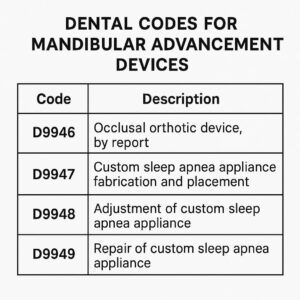
Dental Codes for Mandibular Advancement Devices
Table of Contents
ToggleWhat is a Mandibular Advancement Device (MAD)?
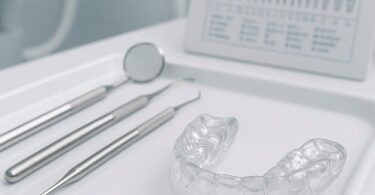
Before we dive into the numbers, let’s quickly establish what we are talking about. A Mandibular Advancement Device is a custom-fitted oral appliance, similar to a sports mouthguard or an orthodontic retainer.
It is designed to treat obstructive sleep apnea and snoring by holding your lower jaw (the mandible) in a forward position while you sleep. This simple movement tightens the soft tissues and muscles in your throat, preventing the airway from collapsing.
Unlike a CPAP machine, which pushes air into your airway, a MAD physically repositions the jaw to keep the airway open. Because these devices are custom-made by a dentist using digital scans or physical impressions, they require specific coding for insurance and record-keeping.
The Primary Dental Codes: D7880 and D7881
In the world of dentistry, the American Dental Association (ADA) publishes the Current Dental Terminology (CDT) code set. These are the codes dentists use to describe procedures to insurance companies. For Mandibular Advancement Devices, there are two primary codes you need to know.
D7880: Occlusal Orthotic Device, Including Fitting and Adjustment
This is the main code for the device itself. If you are getting a custom oral appliance for sleep apnea, this is likely the code you will see on your treatment plan.
What does D7880 cover?
-
Fabrication: The process of taking impressions (molds) or digital scans of your teeth to create a custom device.
-
Laboratory Costs: The production of the appliance by a dental lab.
-
Placement: Fitting the device in your mouth to ensure comfort and retention.
-
Initial Adjustments: The basic adjustments needed to help you get used to wearing the device.
It is important to note that D7880 is typically used for a durable, adjustable appliance. These are the gold standard for treating obstructive sleep apnea. They are usually made of hard acrylic with metal components that allow the dentist to incrementally advance your jaw over several weeks to find the optimal position.
Important Note: This code is not typically used for “boil-and-bite” devices you buy at a pharmacy. It strictly refers to professional, custom-fabricated devices.
D7881: Occlusal Orthotic Device Adjustment
This is the supporting code. While D7880 includes initial fitting and basic adjustments, ongoing care requires a separate code.
What does D7881 cover?
-
Follow-up visits: After you have had the device for a few weeks, you will return to the dentist for a titration appointment.
-
Progressive advancement: The dentist will adjust the device to move your jaw forward slightly to optimize airway opening.
-
Fine-tuning: If you experience jaw soreness, tooth pain, or if the device becomes loose, the dentist uses this code to cover the time and expertise required to fix the fit.
You might see this code used several times during your first year of treatment. It is normal to need 2 to 4 adjustment appointments to get the device working perfectly and feeling comfortable.
How Medical vs. Dental Insurance Works for MADs
Here is where things get a little tricky, but we will keep it straightforward.
Traditionally, dental insurance (the plan you use for cleanings and fillings) was designed for the health of your teeth and gums. Medical insurance (the plan you use for doctor visits and surgeries) was designed for treating diseases like diabetes, hypertension, and sleep apnea.
Since sleep apnea is a medical condition, many medical insurance plans—including Medicare—cover oral appliance therapy. However, the dentist is a dental provider. So, how do they get paid?
There are generally two ways dental offices handle this:
-
Medical Billing: The dental office has a specialized billing team that submits claims directly to your medical insurance (Blue Cross, Aetna, Cigna, etc.) using medical codes (CPT codes) and the dental codes (D7880) as supporting information. This often results in better coverage because medical plans typically have separate “durable medical equipment” (DME) benefits.
-
Dental Billing: The office bills your dental insurance. However, many dental plans do not cover oral appliances for sleep apnea because they consider it a “medical” issue. Some high-end PPO dental plans may offer a benefit, but it is often limited to a percentage of the cost.
When to Use Each Code
To make this clearer, let us look at a comparative table showing how these codes function depending on who is paying.
| Code | Procedure | Medical Insurance Role | Dental Insurance Role |
|---|---|---|---|
| D7880 | Fabrication of MAD | Used as proof of service; often paid under DME benefits if medically necessary. | May cover partially if “orthodontics” or “TMJ” benefits are available, though rare. |
| D7881 | Adjustments | Usually covered under the global period of the device (first 90 days) or as a follow-up visit. | Often subject to deductibles or may be denied if the device was not covered. |
Additional Associated Codes
While D7880 and D7881 are the stars of the show, you might see a few other codes on your treatment plan. These help paint a complete picture of the work involved.
D0470: Diagnostic Casts
This code is often used for the study models. When your dentist takes impressions of your upper and lower teeth, they send them to the lab. The lab pours these impressions into stone (plaster) models to design your appliance. This code covers that preliminary step.
D0150 / D0120: Comprehensive or Periodic Oral Evaluation
Before any dentist makes an appliance, they need to examine your mouth. If you are a new patient, you will likely see a comprehensive oral evaluation (D0150) . If you are an existing patient, you will see a periodic oral evaluation (D0120) . This ensures your teeth and gums are healthy enough to support an oral appliance.
Radiographs (X-rays)
Depending on the dentist’s protocol and your medical history, you may need X-rays. Common codes include:
-
D0330: Panoramic film (shows all teeth and jaw structure).
-
D0270: Bitewings (checks for cavities).
-
D0220 / D0230: Intraoral periapical images (focused on specific teeth).
Sleep Study (Polysomnogram) Codes
While the dentist does not usually perform the sleep study, it is a prerequisite for insurance coverage. To justify the medical necessity of code D7880, most insurers require a sleep study confirming Obstructive Sleep Apnea.
-
CPT 95810: Polysomnography (sleep study) attended by a technologist.
-
CPT 95811: Split-night study (diagnosis and CPAP titration in one night).
Navigating Insurance Coverage: A Step-by-Step Guide
Getting insurance to pay for a Mandibular Advancement Device can feel like a maze. However, if you approach it methodically, you can maximize your benefits. Here is a realistic, step-by-step guide.
Step 1: Confirm the Diagnosis
Insurance companies are not interested in paying for snoring alone. They want proof of a medical condition.
-
Requirement: A recent (usually within the last 12 months) sleep study report.
-
The Diagnosis: The report must show an Apnea-Hypopnea Index (AHI) or Respiratory Disturbance Index (RDI) indicating mild, moderate, or severe obstructive sleep apnea.
Step 2: Verify “Medical Necessity” for a MAD
Most insurers have a “step therapy” policy. This means you must try the “gold standard” (CPAP) first, or prove that you cannot tolerate it.
-
If you tried CPAP: You may need a letter from your sleep doctor stating you failed CPAP therapy due to claustrophobia, noise intolerance, skin irritation, or lack of efficacy.
-
If you haven’t tried CPAP: Some plans allow for an oral appliance as a first-line treatment for mild to moderate sleep apnea, but this varies. Always check with your plan.
Step 3: Ask the Right Questions
When you call your insurance company, do not ask, “Do you cover dental codes?” Instead, ask these specific questions:
-
“Does my medical plan cover Durable Medical Equipment (DME) for the treatment of Obstructive Sleep Apnea?”
-
“Is a Mandibular Advancement Device considered a covered benefit under my plan?”
-
“What is my DME coinsurance? (e.g., 80% covered after deductible)”
-
“Do I have a specific deductible for DME that is separate from my office visit deductible?”
Step 4: In-Network vs. Out-of-Network
Your dentist may be “in-network” with your dental insurance, but not with your medical insurance. This is extremely common.
-
If the office bills medical insurance, they may be considered an “out-of-network” provider.
-
Out-of-network benefits usually cover less (e.g., 60% instead of 80%) and have a higher deductible.
-
Some dentists offer “assignment of benefits,” meaning they will file the claim for you even if they are out-of-network, but you may be responsible for the difference.
Cost Realities: What to Expect Out-of-Pocket
Let us be honest about money. Understanding the codes is one thing; understanding the bill is another. The cost of a Mandibular Advancement Device can vary widely based on where you live, the type of device, and your insurance.
The Breakdown of Costs
If you were paying cash (without insurance), a custom MAD typically ranges from $1,800 to $4,500.
| Service | Typical Cost (No Insurance) | Notes |
|---|---|---|
| Consultation & Exam (D0150) | $100 – $250 | Includes X-rays if necessary. |
| Impressions & Lab Work (D0470) | $200 – $400 | Digital scanning may cost more but is often included. |
| Device Fabrication (D7880) | $1,500 – $3,500 | The bulk of the cost. High-end appliances (e.g., SomnoDent, Herbst) are pricier. |
| Follow-up Adjustments (D7881) | $100 – $300 per visit | Many offices bundle the first year of adjustments into the total fee. |
With Insurance
If your medical insurance approves the claim, you will likely be responsible for:
-
Your deductible: If you haven’t met your medical deductible for the year, you pay 100% until it is met. (e.g., If your deductible is $1,000, you pay the first $1,000).
-
Coinsurance: After the deductible, you pay a percentage. If your plan covers 80% of DME, you pay 20%.
Example Calculation:
Total Device Cost: $2,500
Remaining Deductible: $500
Coinsurance: 20%*You pay $500 (deductible) + $400 (20% of remaining $2,000) = $900 out-of-pocket.*
Insurance pays $1,600.
Frequently Asked Questions (FAQ)
Here are some of the most common questions people ask when researching dental codes and MAD therapy.
Q1: Is there a specific code for a “snoring device” versus a “sleep apnea device”?
No. The codes D7880 and D7881 do not differentiate between snoring and sleep apnea. However, insurance does. While the code is the same, the medical necessity is determined by the diagnosis code (ICD-10) attached to the claim. If the diagnosis is “snoring” (R06.83), medical insurance will deny the claim. If the diagnosis is “Obstructive Sleep Apnea” (G47.33), it has a chance of being approved.
Q2: Does Medicare cover D7880?
Yes, Medicare does cover Mandibular Advancement Devices under specific circumstances. Medicare Part B covers oral appliances as Durable Medical Equipment (DME) for beneficiaries with diagnosed Obstructive Sleep Apnea. However, there are strict rules:
-
The device must be furnished by a qualified dentist or physician.
-
The beneficiary must have a face-to-face evaluation.
-
The beneficiary must have tried and failed CPAP, or have a contraindication to CPAP.
-
The device must meet specific standards (usually a custom, adjustable device).
Q3: How often can I use D7881 (adjustments)?
There is no strict limit, but insurance companies look for “reasonable and customary” frequency. Initially, you might have adjustments every 2-4 weeks for the first 3 months. After that, you typically need a follow-up every 6 to 12 months to check the fit and jaw joint health. If you are getting adjusted every week for a year, the insurance company may question the medical necessity.
Q4: What happens if I lose my device?
If you lose your Mandibular Advancement Device, you cannot simply get it “refilled” like a prescription. The code D7880 is for the fabrication of the device. If you lose it, you will likely need a new D7880 claim. Most insurance companies will cover a replacement device once every 3 to 5 years, though this varies by plan. If it is lost within the first year, you may have to pay out-of-pocket for a replacement.
Q5: My dentist used a code I don’t recognize: D9944 or D9945. What are those?
These are codes for occlusal guards or night guards (used for teeth grinding, or bruxism).
-
D9944: Occlusal guard, hard, full arch.
-
D9945: Occlusal guard, soft, full arch.
If you see these codes, you are likely being billed for a night guard for teeth grinding, not a Mandibular Advancement Device for sleep apnea. While some bruxism appliances look similar, they do not advance the jaw and are not effective for treating sleep apnea. If your dentist is treating you for sleep apnea, the code should be D7880. If they are treating you for grinding, it will be D9944 or D9945.
A Realistic Timeline for Treatment
Understanding the timeline helps you understand why the billing is structured the way it is. You aren’t just paying for a piece of plastic; you are paying for a process that often takes 2 to 4 months.
-
Week 1: Consultation. The dentist reviews your sleep study, examines your teeth, and takes X-rays. (Codes: D0150, D0330)
-
Week 2: Records. Impressions or digital scans are taken and sent to the lab. (Code: D0470)
-
Week 4: Delivery. You return to the office to pick up the device. The dentist inserts it, checks the fit, and gives you instructions. (Code: D7880)
-
Week 6: First Adjustment. You have worn the device for 2 weeks. The dentist activates the device to advance the jaw slightly. (Code: D7881)
-
Week 8: Second Adjustment. Another advancement. (Code: D7881)
-
Week 10-12: Follow-up. You may see your sleep doctor for a follow-up sleep study with the device to ensure it is working effectively. (Medical code: 95810 or 95811)
-
Ongoing: Maintenance. You return to the dentist every 6-12 months to check the device fit and the health of your bite. (Code: D7881 or sometimes a periodic exam, D0120)
Tips to Avoid Billing Surprises
No one likes opening a bill that is much higher than expected. Here are three actionable tips to ensure your journey with a Mandibular Advancement Device is financially smooth.
1. Get a Pre-Determination (Pre-Auth)
Before you agree to the treatment, ask the dental office to submit a pre-determination (also called a pre-authorization) to your medical insurance. This is a request to the insurance company asking, “If we do this procedure (D7880), will you pay for it?”
-
Why this matters: It gives you a written estimate of what insurance will pay before you commit. It is not a guarantee of payment, but it is a very strong indicator.
-
Cost: Usually free for the patient.
2. Understand the “Global Period”
In medical billing, there is often a “global period” for surgical or DME procedures. This means that for a certain number of days (often 90 days) after the device is delivered, the cost of follow-up adjustments (D7881) is included in the initial fee.
-
Ask your dentist: “Are the adjustments for the first 90 days included in the D7880 fee, or will I be billed separately for D7881?” Some offices charge separately; some bundle. Knowing this upfront prevents surprise bills.
3. Verify Your Medical Deductible Status
This is the most overlooked step. If your medical plan has a $3,000 deductible and it is January, you will likely pay full price for the device until that deductible is met.
-
Strategy: If possible, schedule the treatment later in the year after you have met your deductible through other medical expenses (surgeries, specialist visits, etc.) to minimize your out-of-pocket cost.
The Importance of the Sleep Physician
A crucial element that is often missing from the “code conversation” is the role of the sleep physician. For a successful insurance claim, the dentist and the sleep doctor must communicate.
The sleep doctor provides the “medical necessity.” Without a prescription from a physician (or a physician’s order), a dental claim for D7880 will almost certainly be denied by medical insurance.
Your treatment journey should look like a triangle:
-
Sleep Physician: Diagnoses sleep apnea and prescribes the oral appliance.
-
Dentist: Fabricates and fits the device.
-
Patient: Uses the device consistently.
If one leg of this triangle is missing, the insurance claim becomes shaky. If your dentist is asking you to pay out-of-pocket because they “don’t work with medical insurance,” it might be worth asking your sleep doctor for a referral to a dentist who specializes in medical billing for oral appliances.
Conclusion
Navigating the dental codes for a Mandibular Advancement Device does not have to be a nightmare. By understanding that D7880 covers the fabrication of the custom device and D7881 covers the necessary adjustments, you can read your treatment plan with confidence.
Remember, the key to financial success lies in treating this as a medical necessity, not just a dental procedure. Work closely with your sleep physician, ask your dentist about medical billing options, and always verify your Durable Medical Equipment benefits with your insurance provider before starting treatment. A good night’s sleep is invaluable, and understanding the billing process is the first step toward getting there without financial stress.
Additional Resources
For more information on oral appliance therapy and insurance coverage, we recommend visiting the following trusted sources:
-
American Academy of Dental Sleep Medicine (AADSM): aadsm.org
-
This is the leading organization for dentists who treat sleep apnea. They offer patient resources and directories to find qualified dentists in your area.
-
-
American Sleep Apnea Association (ASAA): sleepapnea.org
-
A non-profit organization that provides excellent educational materials, support groups, and advocacy for sleep apnea patients.
-
Disclaimer: This article is for informational purposes only and does not constitute medical, dental, or legal advice. Dental and medical coding standards, insurance policies, and coverage criteria vary by provider, location, and individual plan. Always consult with your licensed dentist, physician, and insurance provider to verify coverage and obtain a pre-treatment estimate before proceeding with any medical or dental procedure.