If you have ever woken up with a sore jaw, a pounding headache, or the unsettling realization that you’ve been grinding your teeth into dust overnight, you have likely heard about the NTI-tss device. It is a small, discreet, and incredibly effective appliance for managing bruxism (teeth grinding) and temporomandibular joint (TMJ) disorders.
But when you sit down in the dentist’s chair and they hand you a treatment plan, you might find yourself staring at a confusing string of letters and numbers. You are looking for the dental code for NTI guard.
Understanding dental codes can feel like learning a foreign language. Unlike medical insurance, which often uses standardized codes that are relatively straightforward, dental codes (CDT codes) can be nuanced. The wrong code can mean the difference between your insurance covering a portion of your treatment and you paying the full price out of pocket.
In this guide, we are going to strip away the complexity. We will walk you through exactly what an NTI guard is, why it is different from a standard night guard, the specific codes used to bill for it, and—most importantly—how to navigate the insurance maze to maximize your benefits.
Let’s crack the code.
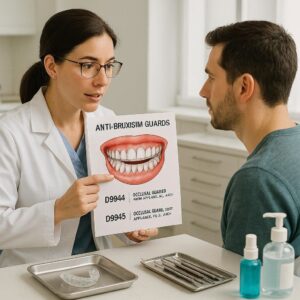
Dental Code for NTI Guard
What Exactly is an NTI Guard?
Before we dive into the digits and decimals of dental billing, it is essential to understand what you are actually paying for. The NTI-tss (Nociceptive Trigeminal Inhibition Tension Suppression System) is not your typical night guard.
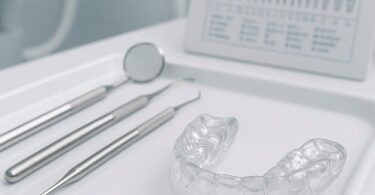
Most standard occlusal guards are thick, hard, or soft splints that cover all the teeth on one arch (usually the upper arch). They act as a barrier, preventing the upper and lower teeth from touching each other. The idea is that if the teeth can’t touch, they can’t grind against each other.
The NTI guard works on a completely different principle. It is a small appliance that fits only over the front teeth—specifically the incisors. It does not cover the molars at all. The theory behind it is fascinating. It relies on the body’s natural physiology.
When you clench your jaw, the temporalis muscles (the large muscles on the sides of your head) contract intensely. These muscles are responsible for closing the jaw with massive force. The NTI guard works by creating a mechanical stop that only engages the incisors. When the incisors touch the appliance, it triggers a reflex that reduces the intensity of the clenching in the temporalis muscles.
In simple terms: it tricks your brain into relaxing the powerful jaw muscles. For patients suffering from severe migraines, chronic jaw pain, or those who crack teeth despite wearing full-coverage guards, the NTI is often a game-changer.
The Core Difference: Full Coverage vs. Anterior Device
To understand the billing, you must understand the classification. Dentists categorize oral appliances based on what they cover and what they do.
| Feature | Standard Night Guard (Full Coverage) | NTI Guard (Anterior Device) |
|---|---|---|
| Coverage | Covers all teeth on the upper or lower arch (full arch). | Covers only the front teeth (incisors). |
| Mechanism | Physical barrier to prevent tooth wear. | Neuromuscular inhibition to reduce clenching force. |
| Primary Use | Bruxism (grinding), mild wear. | Severe bruxism, TMJ disorders, tension headaches, migraines. |
| Size | Bulky; often feels like a mouthguard. | Small, discreet; barely visible when worn. |
| Adjustability | Typically one static position. | Often adjustable to refine the bite position. |
Why does this distinction matter for the dental code? Because insurance companies do not just look at “what the device does”; they look at “what the device is.” If a dentist bills a full-coverage code for a tiny anterior device, the claim will likely be denied for a mismatch. Conversely, billing an anterior device as a full-coverage guard could be considered insurance fraud.
The Primary Dental Code for NTI Guard: D7880
When a dental office bills for an NTI guard, the primary code they use is D7880.
According to the Current Dental Terminology (CDT) code set published by the American Dental Association (ADA), D7880 is defined as: Occlusal orthotic device adjustment, evaluation, and/or delivery.
Wait—adjustment and delivery? That sounds confusing. Let’s break that down.
The CDT code system does not have a specific code that says “NTI-tss device.” Instead, the NTI falls under the umbrella of occlusal orthotic devices. An occlusal orthotic is a fancy term for a removable intraoral appliance that is designed to manage or treat issues related to the occlusion (bite) and the temporomandibular joint.
Here is how D7880 works in practice:
-
Fabrication: Usually, the fabrication of the device is bundled into this code. Unlike a crown or a bridge where there is a separate code for the lab work, the NTI guard is typically billed under the dentist’s time and expertise.
-
Delivery: This code covers the chair time required to fit the appliance, check the bite, and ensure the patient is comfortable.
-
Adjustments: It often includes a series of follow-up adjustments within a certain time frame (usually 90 days) to fine-tune the device.
When D7880 is Used
D7880 is the workhorse code for the NTI. If you are receiving an NTI-tss device that is fabricated by the dentist in-office or via a dental lab, this is the code you will see on your treatment plan.
However, there is a nuance. Some dentists will split the treatment into two phases:
-
D7879: Occlusal orthotic device, evaluation, and adjustment. This is sometimes used for the initial diagnostic phase.
-
D7880: Occlusal orthotic device, adjustment, evaluation, and/or delivery. This is used for the final appliance delivery.
For most patients, you will see a single line item for D7880 covering the entire treatment of the NTI guard.
The Secondary Code: D7899
Sometimes, you might see a different code on your bill, especially if the dentist uses a specific laboratory service to create the NTI. That code is D7899.
D7899 is defined as: Occlusal orthotic device, fabrication, and delivery (by laboratory).
The key difference here is the source. D7880 typically implies the dentist did the work in-house or that the fabrication cost is bundled into the clinical fee. D7899 explicitly indicates that a dental laboratory fabricated the device.
Why does this matter?
-
Cost: Lab-fabricated devices are often more expensive because the dentist pays a lab fee. Consequently, the total fee for D7899 is usually higher than D7880.
-
Insurance: Some insurance plans prefer one over the other. They might have a higher allowance for a lab-fabricated device because it suggests a higher level of precision and quality.
A Quick Reference Table for NTI Guard Coding
| CDT Code | Description | Typical Use for NTI Guard |
|---|---|---|
| D7880 | Occlusal orthotic device, adjustment, evaluation, and/or delivery | Used for in-office fabricated or bundled NTI devices. This is the most common code you will encounter. |
| D7899 | Occlusal orthotic device, fabrication, and delivery (by laboratory) | Used when the NTI is sent to a professional lab for fabrication. Usually a higher fee. |
| D7879 | Occlusal orthotic device, evaluation, and adjustment | Sometimes used for the diagnostic phase, or if the appliance is adjusted without a new fabrication. |
Important Note: The NTI-tss is a specific brand name device. While many dentists use the term “NTI” generically to describe any anterior bite stop, the official NTI-tss system requires specific training and lab protocols. If you are receiving a true branded NTI, the dentist will likely use D7880 or D7899 based on their practice setup.
Does Dental Insurance Cover the NTI Guard?
This is the million-dollar question. The answer is frustratingly vague: it depends.
Dental insurance is designed primarily for preventative care (cleanings) and restorative care (fillings, crowns). Many insurance plans view bruxism and TMJ disorders as medical issues, not dental ones. However, because the treatment is administered by a dentist, the coverage falls into a gray area.
Factors Influencing Coverage
-
Plan Type: PPO plans (Preferred Provider Organizations) are more likely to offer some coverage for occlusal orthotics. HMO plans (Health Maintenance Organizations) often have very limited or no coverage for these devices.
-
Medical Necessity: If the NTI guard is prescribed solely to prevent tooth wear (attrition), it is often considered a dental necessity. However, if it is prescribed for migraines or TMJ pain, it might fall under medical insurance—which is a separate battle entirely.
-
Frequency Limitations: Most dental plans have a frequency limitation on occlusal orthotics. They might cover one device every 3, 5, or even 10 years. If you had a night guard five years ago, you may still be in the “waiting period” for a new one, even if the NTI is a different type of device.
How Insurance Typically Classifies NTI Guards
Insurance companies rarely look at the specific brand “NTI.” They look at the CDT code. They classify D7880 and D7899 in a few ways:
-
Major Restorative: Many plans categorize occlusal orthotics under “Major Restorative” services. This means the plan typically pays a lower percentage (often 50%) after you meet your deductible.
-
TMJ Exclusion: This is the big one. A significant number of dental insurance policies have a specific clause that excludes coverage for “TMJ disorders” or “occlusal orthotics.” If your policy has this exclusion, the claim will be denied immediately, regardless of how severe your grinding is.
-
Medical Crossover: Some advanced dental offices will attempt to bill your medical insurance for the NTI guard if it is being used to treat migraines or TMJ. This requires a specific diagnosis code (like G44.011 for migraine) and a referral. It is possible, but it requires a skilled billing team.
A Note on Medical Insurance Billing
If you suffer from chronic migraines and your neurologist has recommended an NTI guard, you should ask your dentist if they are willing to file a medical claim. The CPT (Current Procedural Terminology) code used in medicine is different. There is no direct medical code for a dental appliance, but it often falls under durable medical equipment (DME).
This process is complicated. Medical insurance is often more strict about pre-authorizations. However, if approved, the coverage for DME is often better than dental coverage for major services. If your dentist does not handle medical billing, you may need to submit the claim yourself with a letter of medical necessity from your physician.
Breaking Down the Treatment Process: What to Expect
Understanding the steps involved in getting an NTI guard helps you understand why the costs (and codes) are structured the way they are. It is rarely a one-visit procedure.
Step 1: Consultation and Diagnosis (D0150 or D9430)
Before any appliance is made, the dentist needs to diagnose the problem. They will likely take X-rays (panoramic or CBCT) to look at the condyles of the jaw. They will also perform a clinical exam to assess the range of motion, muscle tenderness, and wear patterns on your teeth.
This visit is usually billed under an examination code (like D0150 for comprehensive exam) or a problem-focused exam. This is separate from the appliance code.
Step 2: Impressions and Records (D7875)
Sometimes, a separate code is used for the records needed to fabricate the orthotic. D7875 is the code for impression and cast preparation for orthotic device. This covers the time and materials for taking molds of your teeth.
In many dental offices, this is included in the total fee for the NTI, but it is worth asking. If you see D7875 on your ledger, it is likely part of the preparatory work for the D7880 or D7899 that follows.
Step 3: Fabrication and Delivery (D7880 or D7899)
This is the main event. The dentist sends the case to the lab (or fabricates it in-house). When it arrives, you return for a delivery appointment. The dentist will place the appliance, check the bite, and ensure it is comfortable. They will also teach you how to insert and remove it.
This is where the bulk of the fee is applied.
Step 4: Follow-Up Adjustments
The NTI guard is unique because it often requires titration. Because the device aims to reduce muscle tension, the dentist may need to adjust the appliance several times over the following weeks to find the “sweet spot” where your jaw relaxes completely.
Most comprehensive fees for D7880 include a 30- to 90-day adjustment period. If you keep coming back for adjustments a year later, there may be a separate adjustment code (D7881 for occlusal orthotic device adjustment).
How to Read Your Treatment Plan
When you receive a treatment plan, it can look like a cryptic spreadsheet. Here is a mock-up of what you might see for an NTI guard:
| Procedure Code | Description | Fee | Insurance Estimate | Patient Estimate |
|---|---|---|---|---|
| D0150 | Comprehensive Oral Evaluation | $150 | $100 | $50 |
| D7875 | Impression/Cast Prep | $200 | $0 | $200 |
| D7880 | Occlusal Orthotic Delivery | $1,200 | $600 | $600 |
| Total | $1,550 | $700 | $850 |
In this scenario, the insurance plan covered 50% of the orthotic (D7880) after the deductible, but did not cover the impressions (D7875) or the exam (D0150) fully.
Important Note for Readers: If you see a line item for D7899, the fee might be higher (e.g., $1,500) because of the lab fee. However, sometimes insurance reimburses better for lab-fabricated devices because they are considered “durable.” Always ask your office manager which code they are using and why.
Common Coding Mistakes and Denials
Even the best dental offices make mistakes. If your insurance denies coverage for your NTI guard, it might be due to one of these common coding errors:
-
Using a Restorative Code: Sometimes, an inexperienced biller might try to use a crown or bridge code (like D2999 for unspecified restorative). This is almost always denied because it does not match the narrative of an orthotic.
-
Missing Medical Diagnosis: If the dentist uses a diagnosis code like “sleep bruxism” but the plan excludes TMJ, the claim will deny. However, if the dentist uses a diagnosis code like “attrition” (tooth wear), some plans will cover it as a preventive measure to save the teeth. The diagnosis code attached to the procedure code is just as important as the procedure code itself.
-
Frequency Limitations: Even if the code is correct, the insurance may deny it because the patient had a “night guard” three years ago. In the insurance company’s database, D7880 is just another occlusal guard. They do not differentiate between the NTI and a standard full-coverage guard. You will need to appeal this with a letter explaining that the new device is medically necessary because the previous device failed or was not suitable.
Why the NTI Guard Costs What It Does
If you are looking at the price tag for an NTI and wondering why it costs as much as a crown, it is helpful to understand the value breakdown.
-
Dentist Expertise: Fitting an NTI requires knowledge of neuromuscular dentistry. A standard night guard is easier to fabricate and adjust. The NTI requires precise adjustment to ensure the incisal stop is accurate without interfering with the natural bite.
-
Lab Costs: If the device is lab-fabricated (D7899), the lab charges the dentist a fee for the materials and technician time. High-quality materials that are biocompatible and durable are expensive.
-
Time: The dentist spends time diagnosing the condition, taking precise records, adjusting the device, and following up. Unlike a filling, which is a one-and-done procedure, the NTI involves multiple visits.
-
Equipment: Some dentists use advanced technology like T-Scan (digital bite analysis) or EMG (electromyography) to calibrate the NTI. These tools add to the overhead cost of providing the service.
Alternatives to the NTI Guard
If you are exploring the dental code for NTI guard because you are trying to budget, it is worth knowing the alternatives. Depending on your diagnosis, a different appliance might be more appropriate—and potentially coded differently.
| Appliance Type | CDT Code | Best For | Cost Range |
|---|---|---|---|
| Soft Night Guard | D9944 (or D9945 for hard) | Mild grinding; protection of enamel. | Lower cost |
| Hard Night Guard | D9945 | Moderate grinding; durable protection. | Moderate cost |
| NTI-tss (Anterior) | D7880 / D7899 | Severe clenching, migraines, TMJ pain. | Higher cost |
| Splint / Orthotic | D7880 | Complex TMJ disorders; repositioning. | Highest cost |
Important Note: A standard D9944 or D9945 is classified under “Miscellaneous Services” in many insurance plans. These often have a separate frequency limitation (often once every 3 years) and may have a higher or lower coverage rate compared to D7880. Check your plan specifics.
Maximizing Your Insurance Benefits
Navigating insurance for an NTI guard requires a bit of strategy. Here are some practical tips to help you get the most out of your benefits.
1. Get a Pre-Determination
Before you agree to treatment, ask your dentist to send a pre-determination (pre-authorization) to your insurance company. This is not a guarantee of payment, but it gives you a written estimate of what the insurance says they will pay.
On the pre-determination, check the following:
-
Is the code D7880 or D7899 covered?
-
Is there a frequency limitation?
-
Does the plan have a TMJ exclusion clause?
2. Review Your Policy for TMJ Exclusions
This is the most critical step. Look at your dental insurance booklet or online portal. Search for the terms “TMJ,” “bruxism,” “occlusal orthotic,” or “temporomandibular.” If you see the word “exclusion,” the insurance company will not pay for the device regardless of the code used.
If there is an exclusion, you have two options:
-
Pay out of pocket: Ask the dental office if they offer a cash discount or in-house financing.
-
Try medical insurance: Ask your dentist if they will submit to medical insurance with a medical diagnosis code for migraines or TMJ pain.
3. Use Your Flexible Spending Account (FSA) or Health Savings Account (HSA)
If insurance denies coverage, or if you have a high deductible, remember that the NTI guard is a qualified medical expense. You can use pre-tax dollars from an FSA or HSA to pay for it. This effectively gives you a discount equal to your tax bracket.
4. Ask About Bundled Fees
When discussing the cost, ask the front desk if the fee is “bundled.” A bundled fee includes the consultation, impressions, appliance, and all adjustments within a specific timeframe. This protects you from surprise bills if you need to come back for several adjustments to get the fit perfect.
The Future of Dental Coding for Orthotics
Dental coding is updated every year by the ADA. While D7880 and D7899 have been stable for years, there is a constant push for more specific codes to differentiate between appliances.
Currently, there is no specific code for “anterior bite stop” or “neuromuscular orthotic.” Everything is lumped into “occlusal orthotic.” This lack of specificity is one of the main reasons insurance claims are so unpredictable.
In the future, we may see codes that separate:
-
D7880.1: Full arch stabilization splint
-
D7880.2: Anterior disclusion appliance (which is exactly what the NTI is)
Until then, clear communication with your dental office about why you are getting the appliance is essential. If they document that the device is an “anterior disclusion appliance for the management of intractable migraines,” they have a better chance of appealing a denial than if they simply write “night guard.”
Living with Your NTI Guard: Tips for Success
Once you have navigated the coding and coverage, and you have your new appliance, you want it to work. Here is how to ensure your investment pays off.
-
Wear it as directed: The NTI is typically worn only at night. However, some patients with severe daytime clenching wear it for short periods during the day. Follow your dentist’s instructions.
-
Keep it clean: Clean the appliance daily with a soft toothbrush and non-abrasive toothpaste. Do not use boiling water, as it can warp the acrylic.
-
Watch for soreness: It is normal for your front teeth to feel slightly sensitive or loose in the morning during the first week. This is the teeth settling into their new position. However, if your back teeth start to feel like they are not touching when the appliance is out, contact your dentist immediately. This is called “posterior open bite,” and while it is usually reversible with adjustment or discontinued use, it needs to be monitored.
-
Replace when needed: NTI guards are not lifetime devices. Depending on how hard you clench, they may wear out or crack after 2 to 5 years. Plan for a replacement. If you need a replacement, the same dental codes (D7880 or D7899) will apply, but insurance frequency limitations may restrict coverage.
Conclusion
Navigating the world of dental billing for an NTI guard can feel overwhelming, but it boils down to understanding a few key concepts. The primary dental code you will encounter is D7880 (occlusal orthotic delivery), which covers the fabrication, fitting, and adjustment of this specialized anterior appliance. While insurance coverage varies wildly—often depending on whether your plan excludes TMJ disorders—understanding this code empowers you to ask the right questions, verify your benefits, and make informed financial decisions about your care.
By arming yourself with knowledge about the difference between D7880 and D7899, the importance of pre-determinations, and the potential for medical insurance billing, you can move forward with your treatment confidently. Your comfort—free from jaw pain and headaches—is worth the effort.
Frequently Asked Questions (FAQ)
1. Is D7880 the only code used for an NTI guard?
No. While D7880 is the most common, some dentists use D7899 if the device is fabricated by an external laboratory. Both codes represent the same type of appliance (occlusal orthotic) but differentiate how it was made.
2. Will my dental insurance pay for the NTI guard?
It depends entirely on your plan. Many plans cover D7880 under “major services” at 50% after the deductible. However, if your plan has a specific “TMJ exclusion” clause, they will not pay anything. You should always check your policy or get a pre-determination before starting treatment.
3. What is the difference between D9945 and D7880?
D9945 is the code for a standard “hard night guard” that covers the entire arch. D7880 is for an “occlusal orthotic,” which includes devices like the NTI that are used for TMJ and bruxism management. The NTI is an orthotic, not just a guard, so D7880 is the correct code.
4. Can my dentist bill my medical insurance for an NTI guard?
Yes, in some cases. If the NTI is being prescribed to treat chronic migraines (ICD-10 code G43.xxx) or TMJ disorders, it may be covered under medical insurance as Durable Medical Equipment (DME). However, not all dental offices are equipped to handle medical billing, so you may need to inquire specifically about this option.
5. What if my insurance denies the claim for D7880?
First, review the denial reason. If it is due to a frequency limitation (you had another guard within the allowed timeframe), you can appeal with documentation explaining why the NTI is medically necessary and distinct from your previous device. If it is due to a TMJ exclusion, the denial is likely final for dental insurance, and you should discuss cash pay rates or medical billing options with your provider.
Additional Resources
For further reading and official information regarding dental coding and the NTI-tss system, consider the following resource:
-
American Dental Association (ADA) CDT Code Website: The official source for Current Dental Terminology codes. You can find the latest definitions for D7880 and D7899 here.
-
NTI-tss Official Website: For patient information regarding the science behind the device and to find certified providers in your area.
Link: Learn more about the NTI-tss System and find a dentist
Disclaimer:
This article is for informational and educational purposes only. Dental coding and insurance policies vary significantly by provider, region, and individual plan. The information presented here is based on standard coding practices (CDT codes) but should not be taken as guaranteed reimbursement advice. Always consult with your dental insurance carrier or billing specialist before treatment.
Author: Web Writer Team
Date: March 22, 2026