If you have ever sat in a dentist’s chair, listening to the hum of the drill, and heard the words “protective restoration,” you might have wondered what that actually means. It sounds serious, and in the world of dental care, it is a specific and incredibly valuable procedure.
But when the billing statement arrives, or when you are reviewing a treatment plan, you will likely see it listed not by its name, but by a code: D1354.
Navigating dental insurance and terminology can feel like learning a new language. You want to know what is being done to your teeth, why it is necessary, and most importantly, how much it is going to cost you. You also want to be sure that the dentist is using the right code, because in dentistry, the code dictates the coverage.
This guide is here to demystify everything about the dental code for protective restoration. Whether you are a patient trying to understand your bill, a dental student studying CDT codes, or a front-office coordinator looking for clarity, we will walk through every detail.
We will cover what this code actually is, how it differs from a standard filling, when it is appropriate to use it, and how insurance companies typically view it. By the end, you will be equipped with the knowledge to have a confident conversation with your dental provider.
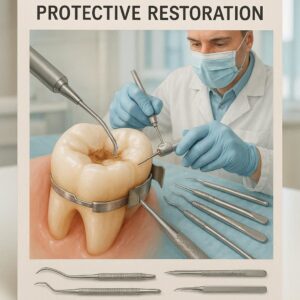
Dental Code for Protective Restoration
Table of Contents
ToggleWhat Exactly is a Protective Restoration?
Before we dive into the code itself, let’s break down the term “protective restoration.”
A restoration, in dental terms, is anything that restores the function or shape of a tooth. Usually, we think of fillings. However, a protective restoration is slightly different.
The Definition of D1354
According to the Current Dental Terminology (CDT) code set, which is maintained by the American Dental Association (ADA), code D1354 is defined as:
Interim caries arresting medicament application — per tooth.
Wait a minute—that doesn’t say “protective restoration” in the title, does it? In the field, D1354 is widely referred to as the code for a protective restoration. The term “interim caries arresting medicament” is the clinical description.
Essentially, this code is used when a dentist applies a specific medicament (a substance) to a tooth to stop the progression of a cavity (caries) without the need for traditional drilling and filling.
Why “Protective” Matters
The word “protective” is key here. This procedure is designed to protect the tooth from further decay. It is not necessarily the final fix, but rather a strategic intervention. It buys time. It allows the tooth to heal or remineralize, or it simply stabilizes the decay until a more permanent restoration can be placed.
Think of it like applying a sealant to a wooden fence to stop rot before it eats through the entire board. You aren’t replacing the wood yet; you are protecting what is there and stopping the damage from spreading.
When is the D1354 Code Used?
Dentists do not use this code lightly. It has very specific clinical applications. Understanding when it is used helps you understand why your dentist might recommend it over a traditional filling.
Managing Early Childhood Caries
One of the most common uses for D1354 is in pediatric dentistry. Young children often struggle with “baby bottle tooth decay” or early childhood caries. For a toddler who is uncooperative with extensive treatment, drilling a tooth might be traumatic or even impossible without general anesthesia.
In these cases, a dentist might apply a caries-arresting medicament like silver diamine fluoride (SDF) using the D1354 code. This liquid is painted onto the cavity. It stops the decay in its tracks, hardens the softened dentin, and buys time until the child is older, more cooperative, or until the baby tooth falls out naturally.
Managing Patients with Special Needs
Similarly, for patients with special healthcare needs—those who may have difficulty sitting for long appointments or who have strong gag reflexes—a protective restoration is a gentle, non-invasive option.
It requires no local anesthetic (numbing), no drilling, and no loud noises. It is a compassionate approach to care that focuses on stabilization rather than aggressive intervention.
Arresting Root Caries in Geriatric Patients
As we age, our gums recede, exposing the softer root surfaces of the teeth. Root caries are incredibly common in the geriatric population. Because root surfaces are not as hard as enamel, decay can progress rapidly.
Placing a traditional filling on a root surface can sometimes be challenging due to moisture control and the proximity to the gum line. A protective restoration using D1354 offers a simple, effective way to arrest that root decay, preserving the tooth structure and preventing the need for more complex procedures like root canals or extractions.
A “Time-Out” for Deep Decay
Sometimes, a dentist opens a tooth to remove decay and finds that it is much deeper than expected, heading dangerously close to the nerve (pulp). If the decay is extremely deep, drilling it all out might expose the nerve, requiring a root canal immediately.
In these scenarios, a dentist might place a protective restoration (often a medicament like a calcium hydroxide liner or a bioactive material) to calm the nerve and allow the tooth to heal. They will then use D1354 to code this interim step, scheduling a follow-up visit to place the permanent filling (usually coded under D2391-D2394 for resins or D2140-D2160 for amalgam).
“Silver Diamine Fluoride” Applications
Perhaps the most common product associated with D1354 today is Silver Diamine Fluoride (SDF) . SDF is a liquid that contains silver (an antimicrobial agent) and fluoride (which remineralizes tooth structure). When applied to a cavity, it kills the bacteria and hardens the tooth.
Because SDF is a “caries arresting medicament,” the application of SDF to a cavity is billed under D1354. It is important to note that if SDF is applied to a sound tooth purely for preventive reasons (like a sealant), a different code (D1355) might be used. But when it is applied to an active cavity to stop it, D1354 is the correct code.
D1354 vs. Traditional Fillings: A Comparative Table
One of the biggest confusions for patients is understanding why a protective restoration is different from a filling. They both address decay, so why aren’t they the same? The table below highlights the key differences.
| Feature | Protective Restoration (D1354) | Traditional Filling (e.g., D2391) |
|---|---|---|
| Invasiveness | Non-invasive. No drilling or cutting of tooth structure. | Invasive. Requires removal of decayed tooth structure with a drill or laser. |
| Anesthesia | Usually none required. | Usually requires local anesthetic (numbing). |
| Purpose | Arrest decay; stabilize the tooth; interim measure. | Restore form and function; permanent solution. |
| Materials | Liquid medicaments (Silver Diamine Fluoride, Chlorhexidine, Calcium Hydroxide). | Solid materials (Composite resin, Amalgam, Glass Ionomer, Gold). |
| Durability | Interim. May last months to a few years, depending on the case. | Long-term. Designed to last 5-15+ years with proper care. |
| Aesthetics | SDF stains decayed areas black. Other medicaments are opaque. | Color-matched to natural tooth (composite). |
| Time | Usually takes 1-5 minutes per tooth. | Usually takes 15-45 minutes per tooth. |
Insurance Nuances: Does Your Plan Cover D1354?
This is where things get tricky. The dental code for protective restoration is a relatively newer code in the CDT manual, and insurance companies are still catching up with its clinical value.
Medical vs. Dental Necessity
Insurance carriers generally cover procedures they deem “medically necessary.” While arresting decay is certainly medically necessary, some insurance companies view D1354 as a “preventive” measure rather than a “restorative” one. Others may view it as a temporary procedure that should not be covered because the “permanent” restoration hasn’t been done yet.
Coverage Varies Widely
Unlike a standard filling, which almost every insurance plan covers (with a patient copay), coverage for D1354 is inconsistent.
-
Some PPO Plans: These may cover 50% to 80% of the cost, categorizing it under “Basic Restorative” services.
-
Medicaid: Many state Medicaid programs cover D1354, especially for children and adults with special needs, because it is a cost-effective way to manage decay and reduce the need for expensive operating room visits.
-
HMO/DMO Plans: These often require a copay that is either very low (e.g., $10) or the plan may not recognize the code at all, meaning the patient pays the full office fee.
The Frequency Limitation
A common insurance limitation is frequency. Most insurance companies will only pay for D1354 once every 12 to 24 months per tooth. However, clinically, SDF may need to be reapplied 2 to 4 times a year to be most effective.
This creates a scenario where the dentist may bill the insurance for the first application (which gets paid), but subsequent reapplications may be denied by insurance, leaving the patient responsible for the cost if they choose to continue the treatment.
A Note on Documentation
For dentists, proper documentation is crucial when billing D1354. Because this code is often scrutinized by insurance auditors, the dentist must clearly document:
-
The presence of active caries (decay).
-
The specific medicament used (e.g., 38% Silver Diamine Fluoride).
-
The reason for choosing this non-invasive approach (e.g., patient age, behavior, medical complexity).
-
Photos or radiographs (X-rays) are often helpful to prove the existence of the decay before treatment.
The Clinical Process: What to Expect
If your dentist recommends a protective restoration using code D1354, you might wonder what the appointment will look like. It is often much simpler than you expect.
Step 1: Assessment and Consent
The dentist will examine the tooth, likely take an X-ray to see how deep the decay is. They will explain that the medicament will arrest the decay but may cause staining (especially if using SDF). They will then ask for your consent.
Step 2: Isolation and Drying
To ensure the medicament works effectively, the tooth must be dry. The dentist will use cotton rolls or a suction device to keep the area dry. For children, they might use a “Mr. Thirsty” or a small suction to keep the cheek and tongue away.
Step 3: Application
Using a small brush (like a tiny paintbrush), the dentist applies the medicament directly onto the cavity. This is painless. You might taste a metallic flavor (if SDF is used), but it fades quickly.
Step 4: Setting
The medicament needs a minute or two to set. For SDF, it works almost immediately upon contact with the tooth structure. The dentist may apply a varnish over the top to help it stay in place.
Step 5: Post-Operative Instructions
This is a critical step. If SDF was used, the dentist will warn you that the decayed part of the tooth will turn black. This is a sign that the medicament is working—it has oxidized and killed the bacteria. You will also be advised not to eat or drink for at least 30 to 60 minutes to allow the medicament to fully set.
Frequently Asked Questions About the Dental Code for Protective Restoration
To further clarify the nuances of D1354, let’s address some of the most common questions that arise in dental offices.
Is a protective restoration the same as a sealant?
No. This is a very common misconception. A dental sealant (code D1351) is applied to a sound tooth—a tooth with no decay—to prevent cavities. A protective restoration (D1354) is applied to a tooth that already has active decay to stop the progression. Sealants are preventive; protective restorations are therapeutic.
Why did my insurance deny the claim for D1354?
There are several reasons for denial. The most common are:
-
Frequency: You may have had the procedure on the same tooth within the last 12-24 months.
-
Missing Tooth Number: The dentist may have forgotten to list which tooth was treated.
-
Plan Exclusion: Some plans explicitly exclude “interim” or “caries arresting” procedures, stating they will only pay for definitive restorations (fillings).
-
Age Limits: Some plans only cover D1354 for patients under a certain age (e.g., under 18) or over a certain age (e.g., over 65).
If your claim is denied, ask your dentist’s billing coordinator to review it. Sometimes an appeal with clinical notes and X-rays can overturn the denial.
Will my tooth turn black permanently?
This depends entirely on the medicament used. Silver Diamine Fluoride (SDF) is the most common medicament. It will permanently stain the decayed part of the tooth black. The healthy enamel around the cavity will not stain, but the cavity itself will turn a dark, charcoal black.
This is often the biggest barrier to patient acceptance. If the tooth is a back molar, many patients accept the stain in exchange for avoiding the drill. If it is a front tooth, the dentist may use a different medicament (like potassium iodide after SDF) or opt for a traditional filling to preserve aesthetics.
Is D1354 safe for pregnant women?
Silver Diamine Fluoride is considered safe for use during pregnancy by most dental professionals. The amount of silver and fluoride used is minuscule and is applied topically, not ingested in significant quantities. However, it is always best to inform your dentist if you are pregnant, and they will take appropriate precautions. Many dentists prefer to use SDF during pregnancy because it eliminates the risk of stress from drilling and the potential risks associated with local anesthesia.
Can I eat right after a protective restoration?
You should wait. Most dentists advise waiting at least 30 to 60 minutes before eating or drinking. Because the tooth was not drilled and you were not numbed, you can eat normally after that time. However, if SDF was applied, you might be advised to avoid crunchy or sticky foods for the first 24 hours to prevent the medicament from being rubbed off prematurely.
What happens if the protective restoration fails?
If the decay continues to progress despite the application of the medicament, the dentist will need to reassess. This might mean switching to a traditional filling or, if the decay is too extensive, potentially a crown or extraction. The protective restoration is a great first line of defense, but it is not a guarantee. Patient compliance with oral hygiene and diet is still essential for long-term success.
The Role of Silver Diamine Fluoride in Modern Dentistry
We cannot talk about D1354 without diving deeper into Silver Diamine Fluoride. It has been a game-changer in the field.
A Historical Perspective
SDF has been used in Japan and other countries for decades, but it only gained FDA clearance in the United States in 2014. Since then, its popularity has skyrocketed. It offers a solution for a population that has long been underserved: those who are anxious, very young, or medically compromised.
How SDF Works
SDF works through a dual-action mechanism:
-
Silver: Acts as an antimicrobial agent. It kills the bacteria (Streptococcus mutans) responsible for causing cavities.
-
Fluoride: Helps remineralize the tooth structure, making it harder and more resistant to future decay.
When these two elements combine, they effectively “freeze” the cavity. The tooth structure becomes harder, and the bacteria are neutralized.
The Aesthetic Conundrum
The major drawback of SDF is the staining. It permanently stains carious (decayed) dentin black. While this is a sign of success, it can be aesthetically displeasing, especially for visible teeth.
To combat this, dentists sometimes use a two-step process. They apply SDF first to arrest the decay. Then, at a subsequent appointment, they remove the black-stained area and place a tooth-colored filling over it. This gives the patient the benefit of arrested decay with the aesthetics of a composite filling. In this scenario, the dentist might bill D1354 for the first visit and a filling code for the second visit.
Important Considerations for Parents
If your child’s dentist recommends a protective restoration, it is natural to have questions. As a parent, you want the best for your child, but you also want to avoid unnecessary trauma.
The “No Drill” Option
For a young child who is fearful, the “no drill” approach is a blessing. It builds trust. The child learns that the dentist is not someone who hurts them. This positive association can last a lifetime.
Managing the Stain
If your child has a cavity on a baby molar, you might be worried about the black stain. While it is visible, baby teeth are temporary. The stain does not affect the permanent tooth underneath. In fact, by arresting the decay, the protective restoration is actually protecting the developing permanent tooth from infection that could spread through the root of the baby tooth.
Follow-Up Care
It is crucial to understand that D1354 is not a “set it and forget it” solution. Your child will need regular checkups to ensure the decay has not progressed. The dentist will likely recommend reapplication every 6 to 12 months.
Important Note for Parents: If your child has a protective restoration, continue to brush the tooth twice a day. The stain may not come off, but gentle brushing with a soft toothbrush will keep the healthy parts of the tooth clean.
The Financial Aspect: What Does D1354 Cost?
Since insurance coverage is unpredictable, it helps to have a realistic idea of what the out-of-pocket cost might be.
The cost of a protective restoration varies by geographic location and the specific dental practice. However, in the United States, the fee for D1354 generally ranges between $50 and $150 per tooth.
Here is a typical breakdown:
-
Without Insurance (Office Fee): $75 – $125 per application.
-
With Insurance (PPO): You might pay a copay of $20 – $50 after insurance pays its portion.
-
With Medicaid: Often covered in full for eligible patients.
-
With HMO: A small copay (often $10 – $20) if the plan includes the code.
Compared to the cost of a traditional filling, which can range from $150 to $400 or more depending on the size and material, the protective restoration is often a very cost-effective option.
Common Misconceptions About D1354
Let’s clear up a few persistent myths about the dental code for protective restoration.
Myth 1: “It’s just a temporary filling.”
While it is often interim, it is not a “temporary filling” in the sense of a material that will fall out in a week. Temporary fillings (like IRM) are coded under D2940 or D2941. D1354 is a medicament that chemically changes the tooth. It is a therapeutic intervention, not just a plug.
Myth 2: “If you use this, you don’t need to brush.”
False. D1354 arrests existing decay, but it does not prevent new decay. Excellent oral hygiene is still required to maintain the health of the rest of the tooth and the surrounding teeth. The medicament is a powerful tool, but it works best in conjunction with good home care.
Myth 3: “Dentists use this to avoid doing a real filling.”
This is a cynical view, but occasionally patients worry about this. In reality, most dentists prefer to place a filling because it is a definitive, higher-revenue procedure. Dentists choose D1354 because it is the clinically appropriate choice for that specific patient at that specific time. It represents a shift toward minimally invasive dentistry, which is often better for the patient’s long-term oral health.
Conclusion
Navigating dental codes can be overwhelming, but understanding the dental code for protective restoration—D1354—empowers you to make informed decisions about your oral health. This code represents a modern, minimally invasive approach to dentistry, focusing on arresting decay without the drill. Whether used for a toddler with early childhood caries, an adult with special needs, or an elderly patient with root decay, D1354 provides a compassionate and effective solution. While insurance coverage can be variable, the clinical value of stopping decay in its tracks is undeniable, making this code a vital tool in maintaining a healthy, lasting smile.
FAQ
1. What is the difference between D1354 and a regular filling?
D1354 is a non-invasive procedure where a liquid medicament is applied to stop active decay without drilling. A regular filling (e.g., D2391) involves removing the decayed tooth structure with a drill and placing a solid material to restore the tooth permanently.
2. Will my insurance cover a protective restoration?
Coverage varies significantly. Some plans cover it under “basic restorative” benefits, while others deny it as an interim procedure. It is best to contact your insurance provider or ask your dental office to verify your specific plan’s coverage for D1354.
3. Does the tooth turn black after D1354?
If the dentist uses Silver Diamine Fluoride (SDF), the decayed area of the tooth will turn black permanently. This is a sign that the bacteria have been killed. If the dentist uses other medicaments, staining may not occur.
4. Is the procedure painful?
No. One of the main advantages of D1354 is that it is non-invasive and requires no drilling. Therefore, local anesthetic (numbing) is rarely needed, and the application is painless.
5. How long does a protective restoration last?
It is considered an interim measure. The arrest of decay can last for months or even years, but it is not as durable as a traditional filling. Regular reapplication every 6-12 months is often recommended to maintain its effectiveness.
Additional Resources
For more information on dental codes and minimally invasive dentistry, visit the American Dental Association (ADA) Center for Professional Success. They provide the official CDT code manual and resources for patients and professionals.