If your child has lost a baby tooth too early—whether due to decay, injury, or natural loss—your dentist may have mentioned the term “space maintainer.” As a parent, you are likely juggling a million questions. What is it? Is it necessary? And, perhaps most importantly, what is the dental code for a space maintainer and will your insurance cover it?
Navigating dental insurance can sometimes feel like trying to read a foreign language. Dental codes, known as Current Dental Terminology (CDT) codes, are the secret language dentists use to talk to insurance companies. Understanding these codes empowers you to verify your benefits, avoid surprise bills, and ensure your child receives the necessary care.
In this guide, we will break down everything you need to know about space maintainer dental codes, the difference between fixed and removable appliances, what the procedure actually looks like, and how to handle the financial side of treatment. Let’s dive in and make this process as clear and stress-free as possible.
Dental Code for Space Maintainer
What Exactly is a Space Maintainer?
Before we discuss the specific billing codes, it helps to understand what a space maintainer is and why dentists consider them so important.
Think of baby teeth, or primary teeth, as natural placeholders. They hold the space in the jaw for the permanent teeth that are developing underneath. When a primary tooth is lost prematurely—meaning before the permanent tooth is ready to erupt—the teeth adjacent to the gap can drift or tilt into the empty space.
When that happens, there may not be enough room for the permanent tooth to come in properly. This can lead to:
-
Crowding: The permanent tooth gets stuck or comes in crooked.
-
Impaction: The tooth is unable to erupt at all.
-
Complex orthodontic issues: What could have been a simple fix early on turns into years of braces or aligners later.
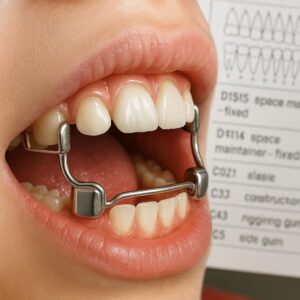
A space maintainer is a small, custom-made appliance that holds the gap open. It acts as a passive guardian, simply keeping the space available until the permanent tooth is ready to emerge naturally. It does not actively move teeth; it simply prevents other teeth from moving into the wrong spot.
There are two main types of space maintainers: fixed and removable. The type your child needs will directly determine the dental code used for billing.
Fixed vs. Removable Space Maintainers
To understand the billing, you must first understand the hardware. Dentists typically choose between two categories of appliances.
| Feature | Fixed Space Maintainer | Removable Space Maintainer |
|---|---|---|
| Attachment | Cemented onto the teeth adjacent to the gap. | Can be taken out by the parent/child. |
| Visibility | Usually a discreet metal loop or band. | Often looks like a retainer with a plastic plate and wire. |
| Best For | Single gaps; younger children; cases where compliance is a concern. | Multiple gaps; older children who can manage the appliance responsibly. |
| Risk | Cannot be lost easily, but oral hygiene around the bands is crucial. | Higher risk of loss or breakage; requires parental supervision. |
Most commonly, pediatric dentists lean toward fixed space maintainers for young children because they are non-removable. A child cannot forget to wear it, and it cannot get lost at school.
The Main Dental Code for Space Maintainer: D1510
In the world of dental billing, there is a standardized code book published by the American Dental Association (ADA). For a fixed space maintainer, the primary code you will see on your dental claim form is D1510.
What Does D1510 Cover?
The code D1510 is defined as: Space maintainer – fixed – unilateral. Let’s break that down.
-
Fixed: As we discussed, this means the appliance is cemented or bonded into the mouth. It is not removable.
-
Unilateral: This refers to one side of the mouth. If the missing tooth is on the left side of the lower jaw, it is unilateral.
When a dentist bills D1510, it typically includes the entire process:
-
Impressions: Taking molds of the child’s teeth to create a precise model.
-
Laboratory fabrication: The cost of the dental lab creating the custom metal appliance.
-
Seating/Placement: The appointment where the dentist tries in the appliance and cements it permanently.
Important Note: D1510 is usually a one-time fee. It covers the creation and placement of the device. However, it does not cover the removal of the device later, nor does it cover the initial exam or X-rays that determined the need for the device.
The Bilateral Option: D1516
Sometimes, a child may lose teeth on both sides of the mouth. For example, they might lose a molar on the upper left and the upper right simultaneously. In this case, a dentist may place a fixed space maintainer that crosses the palate (roof of the mouth) to hold spaces on both sides.
For this scenario, the code changes. You will see D1516 on your claim: Space maintainer – fixed – bilateral.
-
D1516 indicates a more complex appliance that stabilizes both sides of the arch. It is generally more expensive than the unilateral version because it uses more material, involves more lab time, and provides a more complex engineering structure to hold spaces across the midline.
A Note on Removable Codes: D1517
If your child is a bit older and the dentist recommends a removable appliance (similar to a retainer), the code changes again. You would be looking at D1517: Space maintainer – removable – unilateral or D1525: Space maintainer – removable – bilateral.
However, in pediatric dentistry, fixed appliances (D1510 and D1516) are far more common because they ensure the child cannot lose the appliance. Removable versions are often used in cases involving older children or when the missing teeth are located in the anterior (front) region.
What Does the Procedure Look Like?
Knowing the codes is one thing, but understanding what your child will actually experience can ease a lot of anxiety. The process is surprisingly straightforward.
Step 1: Diagnosis and Evaluation
Before any code is billed, the dentist will take X-rays (typically a panoramic or periapical) to confirm that the permanent tooth is developing healthily below the gum line. If the permanent tooth is missing or malformed, a space maintainer might not be the right solution.
Step 2: The Impression Appointment
This is usually when the D1510 code is initiated. The dentist will take a very precise impression of the child’s teeth using a soft, goopy material (alginate) or a digital intraoral scanner.
-
Traditional: The “goop” in a tray goes into the mouth for about 60 seconds. It can be messy but is painless.
-
Digital: A small wand is waved over the teeth to create a 3D model. This is often preferred for anxious children.
Step 3: Laboratory Fabrication
The impression is sent to a dental lab. Skilled technicians pour stone into the mold to create a replica of your child’s teeth. They then bend stainless steel wire or create a band-loop appliance to fit perfectly. This usually takes one to two weeks.
Step 4: Placement (Seating)
During this appointment, the dentist will clean the teeth that will hold the maintainer. They will try the appliance in the mouth to ensure it fits perfectly. If it is a band and loop, a metal band will be cemented around the tooth next to the gap, with a loop extending over the empty space to hold it open.
A reassuring quote from Dr. Sarah Jenkins, a board-certified pediatric dentist:
“I often tell parents that the placement appointment is usually faster than a filling. There’s no drilling. For the child, it feels like a simple cleaning appointment followed by a ‘metal ring’ being glued on. The hardest part is usually the taste of the cement, not the procedure itself.”
The Cost Factor: How Much Will You Pay?
Understanding the dental code is the first step to understanding the cost. While D1510 is the code, the price associated with it varies dramatically based on geography, the dentist’s specialty (pediatric dentists often charge more than general dentists), and your insurance plan.
Average Price Ranges (Without Insurance)
If you are paying out-of-pocket (cash), you can expect the following ranges for the placement of the appliance (the D1510 code):
-
Fixed Unilateral (D1510): $300 – $700
-
Fixed Bilateral (D1516): $500 – $1,200
-
Removal (D1520): $50 – $150 (billed separately later)
Insurance Coverage Nuances
Most dental insurance plans cover space maintainers, but there are specific rules you need to know.
-
The “Missing Tooth” Clause: Some plans will not pay for a space maintainer for a tooth that was extracted by a dentist due to decay, but they will pay if the tooth was knocked out in an accident. Always check your policy’s “missing tooth” clause. It is one of the most common reasons for denied claims.
-
Age Limits: Many insurance companies have age limitations. For example, they may only cover space maintainers for children under the age of 14. This rarely affects the typical patient, but it is worth noting if your older teenager needs one.
-
Deductibles and Maximums: You will likely pay your annual deductible first. Then, the insurance will cover a percentage—usually 50% to 80%—until you hit your annual maximum (often $1,000 to $2,000 per year).
Sample Insurance Breakdown Table
Let’s look at a realistic scenario. Suppose your dentist charges $600 for a D1510 (fixed unilateral space maintainer). Your insurance plan covers 70% for “major services” (space maintainers are often classified as major, though sometimes basic).
| Item | Amount |
|---|---|
| Total Fee (D1510) | $600.00 |
| Annual Deductible (if not met) | – $50.00 |
| Remaining Balance | $550.00 |
| Insurance Coverage (70%) | – $385.00 |
| Your Estimated Copay | $215.00 |
Note: This is a simplified example. Actual benefits vary based on plan specifics.
Important Billing Details: Separating Codes
One of the most common confusions for parents is seeing multiple charges on a bill. The dental code for space maintainer (D1510) is not the only code on the ledger. It is crucial to know what is included and what is separate.
What is NOT Included in D1510
When you receive a statement, you may see these codes billed alongside the D1510. They are legitimate charges if performed on different days or as separate necessary services.
-
D0120 / D0150 (Exam): The initial consultation where the dentist diagnosed the need for the space maintainer.
-
D0210 / D0270 (X-rays): The radiographs used to see the developing permanent tooth.
-
D4346 (Scaling): Sometimes, if the teeth adjacent to the gap have heavy plaque or gingivitis, a cleaning may be required before placement to ensure the cement bonds well.
-
D1520 (Removal): This is a separate code. When the permanent tooth begins to erupt (usually 6 to 12 months later), you will need to return to have the space maintainer removed. This is a distinct procedure and is billed separately.
Why is Removal Separate?
Think of it like a car. The purchase price (D1510) includes manufacturing and delivery. The eventual disposal or part-out (removal) is a service performed at a different time, requiring a new appointment, new chair time, and new instruments. This is standard ethical billing practice.
Maintaining the Space Maintainer
Once the appliance is placed, the billing is done, but the work isn’t over. To ensure you don’t have to pay for a replacement (which insurance rarely covers twice for the same gap), you need to maintain the appliance.
Hygiene Is Crucial
Fixed space maintainers create small crevices where food and plaque can hide. If the teeth that hold the appliance (the abutment teeth) decay, the appliance will loosen and fail.
-
Avoid Sticky Foods: Caramels, taffy, and gum can pull the appliance loose.
-
Avoid Hard Foods: Ice, hard candy, and popcorn kernels can break the solder joints of the appliance.
-
Flossing: This is the hardest part. Parents usually need to help floss using a floss threader to get under the wire or around the bands.
What to Do If It Breaks
If the space maintainer breaks or comes loose, do not wait. Contact your dentist immediately.
-
If it’s loose but still in the mouth: Avoid eating on that side.
-
If it has fallen out: Save the appliance. Do not try to glue it back in.
-
Billing for repairs: If the breakage occurs within the first month, many dentists will re-cement it for free as a courtesy. If it breaks six months later due to chewing on hard candy, there is often a repair fee (code D1510-RP or a simple D2999 unlisted procedure) that will be your responsibility.
Coding for Complex Cases
Sometimes, a space maintainer is not just about holding space. It may be part of a larger treatment plan.
The Distal Shoe
There is a specialized type of fixed space maintainer called a “distal shoe.” This is used when a primary second molar is lost very early, and the first permanent molar (the six-year molar) has not yet erupted. The distal shoe has an extension that goes into the gum tissue to guide the permanent molar into the correct position.
-
Code: This is often billed under D1510 as well, but sometimes it requires a narrative (a written explanation) to the insurance company because it is a less common variation. Some offices may bill it under a different code if the lab work is significantly more complex.
Band Placement
If a child is already in orthodontic treatment (braces), sometimes a space maintainer is just a “band and loop” soldered to an orthodontic band.
-
Code: This might be billed under D1510 or as part of the orthodontic package if the patient is in active orthodontic treatment (code D8080 for comprehensive orthodontics). If the child is not yet in braces, it is a standard D1510.
Frequently Asked Questions (FAQ)
Q1: Is a space maintainer considered orthodontic or general dentistry?
It is a bit of a gray area. In terms of coding, D1510 falls under “Other Services” in the CDT codebook. For insurance purposes, it is often categorized as “Major Restorative” or “Orthodontic” depending on the plan. If your child has orthodontic insurance (separate from basic dental), it might cover it better there. Always ask your dentist’s front desk to run a “pre-authorization” before starting treatment.
Q2: My insurance denied the claim. What do I do?
Don’t panic. Denials happen frequently with space maintainers. Common reasons include:
-
Timing: The claim was filed before the permanent tooth was evaluated.
-
Missing tooth clause: The insurance argued the space wasn’t “necessary” because the tooth was extracted due to neglect.
-
Frequency: Some plans only allow one space maintainer per lifetime.
Action: Ask your dentist to submit an appeal with X-rays and a narrative explaining why the space maintainer is medically necessary to prevent future orthodontic issues.
Q3: How long does the space maintainer stay in?
It stays in until the permanent tooth is visible breaking through the gum (erupting). This is typically anywhere from 6 months to 2 years. The dentist will monitor it with periodic X-rays. When the permanent tooth is about halfway erupted, they will schedule the removal appointment (D1520).
Q4: Will a space maintainer hurt my child?
There is usually some tenderness for 24 to 48 hours after placement. The gums and teeth adjust to the foreign object. Over-the-counter children’s ibuprofen or acetaminophen usually resolves this. If the appliance is poking the cheek, the dentist can adjust it easily.
Q5: Can an adult get a space maintainer?
While the code exists primarily for pediatric use, adults can theoretically get them. However, in adults, if a tooth is lost, the standard of care is usually an implant, bridge, or partial denture, rather than a space maintainer. If an adult is waiting for an implant, a temporary “space maintainer” might be billed as a flipper (removable partial denture) under a different code set.
Additional Resources
Navigating your child’s dental health doesn’t have to be a solo journey. For further reading and to verify the official definitions of the codes mentioned, the American Dental Association (ADA) maintains the official CDT code set.
-
American Dental Association (ADA) CDT Code Search: https://www.ada.org/en/publications/cdt (Link to official ADA resources)
-
American Academy of Pediatric Dentistry (AAPD): https://www.aapd.org/ – Offers parent-friendly brochures on space management and early dental care.
Conclusion
Understanding the dental code for a space maintainer—primarily D1510 for fixed unilateral and D1516 for fixed bilateral—gives you the tools to advocate for your child’s dental health and manage your family budget effectively. While the upfront cost and the insurance verification process can seem daunting, this simple appliance often saves thousands of dollars in future orthodontic treatment and prevents complex dental alignment issues. By knowing what to expect during placement, how to maintain the device, and how to navigate the billing codes, you are ensuring your child has the best chance for a healthy, straight smile as they grow.
Disclaimer: The information provided in this article is for general informational purposes only and does not constitute legal, financial, or medical advice. Dental codes, insurance policies, and treatment protocols are subject to change and may vary by provider, region, and individual health plans. You should consult with a qualified dental professional and your insurance provider to verify coverage and appropriate treatment for your specific situation.
Disclaimer: This article is for informational purposes only and does not constitute medical advice, financial advice, or a guarantee of insurance coverage. Dental coding can vary by region and payer. Always consult with your dental insurance provider and licensed dentist to verify specific codes and coverage.
Author: Dental Billing Specialist & Health Writer
Date: March 28, 2026