Let’s be honest for a second. Dental coding can feel like trying to read a map in the dark. You know what you want to say, but the insurance company speaks a completely different language.
One of the most common headaches? The dental code for unerupted tooth.
You see a patient. They have a tooth that just refuses to come out. Maybe it’s a canine stuck up in the palate. Maybe it’s a wisdom tooth buried deep in the bone. You know it needs to be addressed. But which code do you punch into that billing software?
Don’t worry. You are not alone.
Today, we are going to clear up every single piece of confusion around this topic. By the time you finish reading, you will know exactly which code to use, when to use it, and—just as importantly—which codes not to use.
We will keep this simple, friendly, and 100% practical. No complex medical jargon. No fake codes. Just real-world guidance that works.
Let’s dive in.
Why the Right Code for an Unerupted Tooth Actually Matters
Before we talk numbers, let’s talk about “why.” Why should you spend fifteen minutes reading an article about a single billing code?
Because money matters.
But it’s deeper than that.
When you choose the wrong dental code for an unerupted tooth, three bad things happen:
- The claim gets denied. Insurance sends back a confusing letter, and you get zero dollars.
- The patient gets angry. Nobody likes receiving a surprise bill for $800 because their plan “doesn’t cover that.”
- You waste time. Appeals, phone calls, resubmissions. That is time you could spend treating patients.
Using the correct code protects everyone. It protects your revenue. It protects your patient’s wallet. And it protects your sanity.
So let’s get it right.
The Main Codes You Need to Know (A Quick Overview)
Here is the honest truth. There is not one single dental code for unerupted tooth. There are several. Which one you choose depends entirely on what you are actually doing for the patient.
Are you just taking an X-ray? Are you surgically removing the tooth? Or are you exposing it so an orthodontist can pull it down?
Let me give you a bird’s-eye view before we zoom in.
| CDT Code | Procedure Name | When to Use It |
|---|---|---|
| D7280 | Surgical exposure of an unerupted tooth | When you uncover a tooth (usually for ortho) |
| D7285 | Incisional biopsy of hard tissue | When you take a sample of bone/tissue around the tooth |
| D7240 | Removal of impacted tooth – completely bony | When you extract a fully buried wisdom tooth |
| D7230 | Removal of impacted tooth – partial bony | When part of the tooth is under bone, part is visible |
| D7220 | Removal of impacted tooth – soft tissue | When the tooth is covered only by gum, not bone |
Keep this table handy. You might want to bookmark it.
Now, let’s break down each of these codes like we are having coffee together.
D7280: The Star of the Show – Surgical Exposure of an Unerupted Tooth
If you search for “dental code for unerupted tooth” online, D7280 is usually what people are looking for. But let’s be clear: this code is not for removal. It is for exposure.
What Exactly Is D7280?
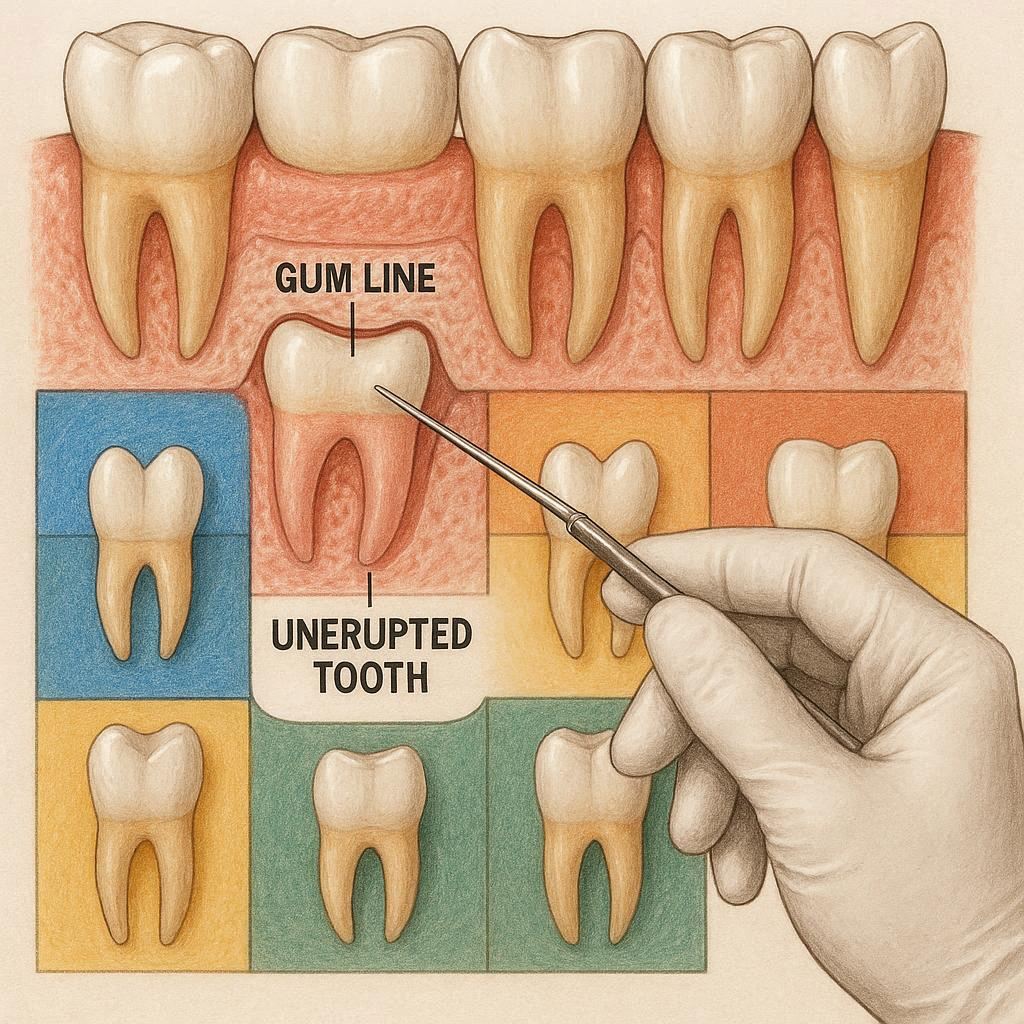
Imagine a 14-year-old patient. Their permanent canine tooth is stuck up in the roof of their mouth (the palate). The orthodontist says, “We need to get that tooth to come down.”
Your job? You surgically uncover that tooth.
You lift the gum tissue. You maybe remove a tiny bit of bone. You expose the crown of the tooth. Then you place an orthodontic bracket or a gold chain so the orthodontist can start pulling on it.
That procedure? That is D7280.
The Official Description
According to the CDT (Current Dental Terminology) manual, D7280 is officially defined as:
Surgical exposure of an unerupted tooth to aid eruption
Important Notes About D7280
Here is where things get tricky. Many insurance plans consider D7280 a “bundled service.” That means they might not pay you separately for the anesthesia or the flap design.
Also, D7280 is almost always performed for orthodontic reasons. And here is the hard truth: many medical plans cover this, but dental plans often exclude it.
Wait. Medical insurance?
Yes. If an unerupted tooth is causing a pathological problem (like a cyst or resorption of a neighboring root), you might bill the patient’s medical insurance. But that is a more advanced conversation.
For now, just remember: D7280 = expose, not remove.
Surgical Removal Codes (D7220, D7230, D7240)
Let’s say you are not exposing the tooth. You are taking it out completely. The patient has an impacted wisdom tooth, and it needs to go.
Now you need a different dental code for unerupted tooth removal. The code changes based on how deep the tooth is buried.
D7220 – Removal of Impacted Tooth (Soft Tissue)
This is the simplest type of impaction.
The tooth has partially broken through the bone. It is sitting right under the gum tissue. You can see a bump. You can feel it. But the gum is covering it like a blanket.
To remove it, you just cut the gum, pop the tooth out, and suture it closed.
Real-life example: A third molar (wisdom tooth) that is partially erupted but has decay because the patient couldn’t clean it.
D7230 – Removal of Impacted Tooth (Partial Bony)
Now things get more involved.
The tooth is partially covered by bone. Part of the crown might be visible in the mouth, but the rest is buried. You have to remove some bone to get the tooth out.
Real-life example: A lower wisdom tooth that is tilted and pushing against the second molar. You can see a corner of it, but the rest is under bone.
D7240 – Removal of Impacted Tooth (Complete Bony)
This is the big one.
The tooth is fully encased in bone. You cannot see it in the mouth at all. You only know it is there because of an X-ray. You have to cut through gum, remove a significant amount of bone, and often section the tooth into pieces to extract it.
Real-life example: A horizontally impacted wisdom tooth that is lying on its side, deep in the jawbone, nowhere near the surface.
Comparison Table: Which Removal Code Do You Choose?
| Code | Impaction Type | Bone Removal? | Typical Difficulty |
|---|---|---|---|
| D7220 | Soft tissue | No | Low |
| D7230 | Partial bony | Yes (minimal to moderate) | Medium |
| D7240 | Complete bony | Yes (significant) | High |
Note from an experienced biller: If you are unsure between D7230 and D7240, look at your X-ray. If the deepest part of the tooth is below the level of the adjacent tooth’s root, you are probably in D7240 territory.
What About D7285 and D7286? (Biopsy Codes)
Sometimes an unerupted tooth is not the main problem. The problem is something around the tooth.
For example, a patient has a radiolucency (a dark spot on the X-ray) next to an unerupted tooth. You suspect a cyst or a tumor. You need to take a piece of tissue to send to the lab.
In that case, you are not billing for the tooth itself. You are billing for a biopsy.
- D7285 – Incisional biopsy of hard tissue (bone). You cut into the bone to get a sample.
- D7286 – Incisional biopsy of soft tissue (gum). You just take a piece of gum tissue.
These are rare for most general dentists, but if you do surgical extractions, you should know they exist.
Common Mistakes (And How to Avoid Them)
Let me share some mistakes I see every single week in dental offices. Learn from them. It will save you hours on the phone with insurance reps.
Mistake #1: Using D7280 for Extraction
This is the number one error.
A doctor exposes an unerupted tooth, realizes it won’t move, and then extracts it. They try to bill D7280 and a separate extraction code.
Why it’s wrong: D7280 specifically says “to aid eruption.” If you remove the tooth, you are not aiding eruption. You are ending it.
How to fix it: Bill only the extraction code (D7220-D7240). Do not bill D7280.
Mistake #2: Bypassing the Pre-Authorization
Insurance companies love to deny D7280. They will say it is “not a covered benefit” or “orthodontic in nature.”
The fix: Always, always, always send a pre-authorization with X-rays and a narrative letter. Explain why the tooth needs exposure. If it is causing pain, root resorption, or cyst formation, say that in writing.
Mistake #3: Forgetting the Sedation Codes
Surgical exposure of an unerupted tooth is painful. Most patients need local anesthesia at minimum. Many need nitrous oxide (D9230) or IV sedation (D9241, D9242).
But here is the catch: some medical plans bundle sedation into the surgical code. Others pay separately. Check first.
Real-World Scenarios (Which Code Would You Pick?)
Let’s practice. Read each scenario. Pick your dental code for unerupted tooth. Then check your answer.
Scenario 1
A 16-year-old patient. The maxillary canine is palatally impacted. You see it on the CBCT. The orthodontist asks you to expose it and bond a bracket. The tooth stays in place.
Your code: D7280
Why: You are exposing to aid eruption, not removing.
Scenario 2
A 45-year-old patient. A lower wisdom tooth is fully encased in bone. No pain. No infection. But the patient wants it out preventatively. You remove bone, section the tooth, and extract it.
Your code: D7240
Why: Complete bony impaction. No question.
Scenario 3
A 30-year-old patient. An upper wisdom tooth has a small piece of gum covering it. You lift the gum with a probe, elevate the tooth, and remove it. No bone removal.
Your code: D7220
Why: Soft tissue only.
Scenario 4
An 11-year-old patient. An X-ray shows a permanent premolar that is not erupting. You uncover it, place a gold chain, and the orthodontist will pull it down later.
Your code: D7280
Why: Same logic as scenario 1. Exposure for ortho.
How to Write a Narrative That Gets Paid
Here is a secret that most articles won’t tell you.
The code itself is only half the battle. The other half is your narrative (the letter you send with your claim).
A weak narrative sounds like this:
“Patient has unerupted tooth #11. Did surgical exposure.”
That gets denied immediately.
A strong narrative sounds like this:
“Patient presents with impacted maxillary right canine (#11). Radiographic evidence shows the tooth is positioned palatally with no clinical eruption by age 14. The adjacent lateral incisor (#10) shows early external root resorption. Surgical exposure via flap reflection and bone removal was performed to place an orthodontic attachment. This procedure is medically necessary to prevent further root resorption and to guide the tooth into functional occlusion.”
See the difference?
The strong narrative gives medical necessity. It explains the why. Insurance companies need to see the “why” to write the check.
A Quick Checklist for Your Narrative
- Tooth number (use the universal numbering system or FDI)
- Patient’s age
- Why the tooth is not erupting normally
- Any damage to nearby teeth (root resorption, crowding, cyst)
- Specific procedure performed (flap, bone removal, chain placement)
- Why this is not just an orthodontic problem (if applicable)
Dental vs. Medical Insurance for Unerupted Teeth
This is where things get advanced. But stay with me. It could double your reimbursement.
Most dentists automatically bill dental insurance for D7280, D7220, D7230, and D7240.
But sometimes, medical insurance will pay.
When Does Medical Insurance Pay?
Medical insurance pays when the unerupted tooth is causing a medical condition, not just a dental one.
Examples of medical conditions:
- A cyst or tumor around the tooth (pathology)
- Chronic pain that affects eating or speaking
- Sinusitis caused by an upper impacted tooth
- Root resorption of an adjacent healthy tooth
How to Bill Medical Insurance
Billing medical is different. You don’t use CDT codes (D-codes). You use CPT codes (Current Procedural Terminology).
For surgical exposure of an unerupted tooth, the CPT code is often 41899 (unlisted procedure) or 40810 (depending on the site). But you must check with the specific medical plan.
Warning: Billing medical is not for beginners. You need:
- A strong diagnosis code (ICD-10) like K09.0 (developmental odontogenic cyst)
- Operative report
- Pre-authorization
- Patience. Medical plans take longer.
The Cost Factor (What Should You Charge?)
Let’s talk money. Because at the end of the day, you are running a business.
The fee for a dental code for unerupted tooth varies wildly by geography, insurance, and complexity.
But here are rough national averages in the US (for fees, not insurance allowed amounts):
| Code | Average Dentist Fee | Average Specialist Fee (Oral Surgeon) |
|---|---|---|
| D7280 | $500 – $800 | $900 – $1,500 |
| D7220 | $250 – $400 | $400 – $600 |
| D7230 | $300 – $500 | $500 – $800 |
| D7240 | $400 – $700 | $700 – $1,200 |
Important: These are estimates. Your fees should reflect your overhead, skill level, and local market. Do not just copy someone else’s fee schedule.
Frequently Asked Questions (FAQ)
Let me answer the questions I hear most often.
Q1: Is D7280 the same as an “eruption aid” code?
Yes. D7280 is the standard CDT code for surgical exposure to help an unerupted tooth come into the mouth.
Q2: Can I bill D7280 and D7240 on the same tooth on the same day?
No. You either expose it or remove it. You cannot do both. Pick one.
Q3: What if the tooth is unerupted but not impacted? (Example: a primary tooth that never fell out.)
Then you are not dealing with an impaction. You are dealing with an over-retained primary tooth. Use the appropriate extraction code for primary teeth (D7140 for extraction, or D7111 for a root fragment).
Q4: Does insurance cover D7280 for adults?
Sometimes. But many plans have age limits. Some will only cover D7280 for patients under 18. Check your specific policy.
Q5: What is the difference between “unerupted” and “impacted”?
Great question. “Unerupted” means the tooth has not broken through the gum yet. “Impacted” means it cannot erupt because something is blocking it (bone, another tooth, dense tissue). In daily conversation, dentists use them interchangeably. But for coding, “impacted” is more precise when you remove the tooth.
Q6: Do I need a separate code for the gold chain or bracket?
No. The placement of the chain or bracket is included in D7280. Do not bill separately for the hardware.
Q7: What if I take a CBCT scan to plan the exposure?
That is separate. Bill D0367 (CBCT – image capture) or D0368 (CBCT with interpretation). Do not bundle it into the surgical code.
Additional Resources (Link)
For the most up-to-date information on CDT codes and official coding guidelines, always refer to the American Dental Association’s CDT manual.
👉 Recommended resource: ADA CDT Code on Surgical Exposure (D7280) (This is the official source for all dental procedure codes. Bookmark it.)
A Friendly Note About Documentation
I cannot say this enough. Document everything.
If you perform a surgical exposure (D7280), your op note must include:
- Tooth number
- Type of impaction (palatal, buccal, etc.)
- Presence or absence of a cyst or pathology
- Method of flap design
- Type of attachment placed (chain, bracket, button)
- Any complications
If you get audited (and eventually, you will), your documentation is your best friend. A poorly written note looks suspicious. A detailed, clear note looks professional and truthful.
Putting It All Together (Your Cheat Sheet)
Let’s simplify everything into one easy-to-scan list.
Use D7280 when:
- You expose an unerupted tooth.
- You leave the tooth in place.
- You place an orthodontic attachment.
Use D7220 when:
- You remove an impacted tooth.
- Only gum tissue covers it (no bone removal).
Use D7230 when:
- You remove an impacted tooth.
- Bone covers part of the crown.
Use D7240 when:
- You remove an impacted tooth.
- Bone completely covers the entire tooth.
Use D7285 or D7286 when:
- You take a biopsy of tissue around an unerupted tooth.
Conclusion (Three Lines)
Choosing the right dental code for an unerupted tooth depends entirely on your goal: exposure (D7280) or removal (D7220–D7240). Always pair your code with a strong narrative explaining medical necessity to avoid denials. When in doubt, send a pre-authorization and document every detail of your procedure.
Final Thoughts from a Fellow Writer and Billing Nerd
I wrote this guide because I know how frustrating dental billing can be. You went to dental school to help people, not to fight with insurance adjusters. But learning the codes—really learning them—gives you back your power.
You stop guessing. You stop resubmitting claims three times. You start getting paid fairly for the excellent work you do.
So take this article. Bookmark it. Share it with your front desk team. And the next time you need a dental code for an unerupted tooth, you will know exactly where to look.
You have got this.
Disclaimer: This article is for informational and educational purposes only. Dental coding is complex and varies by payer. Always verify codes with your specific insurance plan or a certified professional coder.
Author: Dental Billing Team
Date: APRIL 15, 2026