If you have ever stared at a dental claim form and felt stuck because the exact procedure didn’t fit a standard code, you are not alone. Every day, dental billers, office managers, and even dentists face a tricky situation: the patient needs something, but no specific dental code seems to exist.
This is where the dental code for unspecified procedure enters the conversation. Many people have heard of it. Few truly understand when to use it — and when to run the other way.
In this guide, we will walk through everything you need to know about this unusual code. You will learn what it actually is, why most insurance companies dislike it, when it might save you, and what alternatives keep your practice compliant and paid.
Let’s keep things simple, practical, and honest. No fake codes. No unrealistic advice. Just real-world knowledge you can use tomorrow morning.
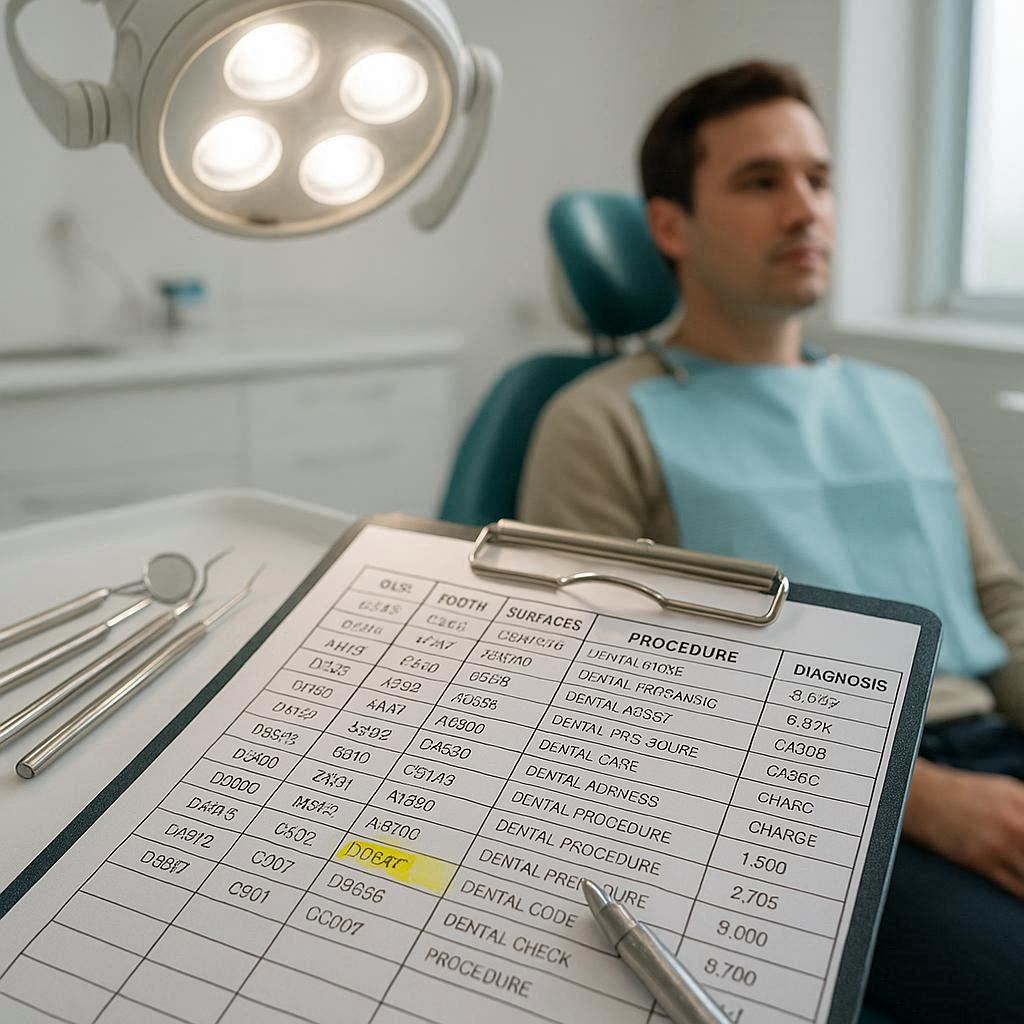
What Exactly Is the Dental Code for Unspecified Procedure?
In the Current Dental Terminology (CDT) code set published by the American Dental Association (ADA), there is no single code named “unspecified procedure” in the way many people imagine. However, the code that comes closest — and the one most professionals refer to — is D9999.
D9999: The Unspecified Code
D9999 falls under the category of “adjunctive general services.” Its official descriptor is simple: Unspecified procedure, by report.
That last part — by report — is critical. It means you cannot just submit the code and move on. You must attach a detailed written explanation (narrative report) describing exactly what was done, why no other code applies, and how the service benefited the patient.
| Code | Descriptor | Category |
|---|---|---|
| D9999 | Unspecified procedure, by report | Adjunctive general services |
✅ Important Note: D9999 is not a way to bypass missing codes. It is a safety valve for truly unique situations.
When Should You Consider Using D9999?
Let’s be clear: D9999 should be a last resort, not a first choice. Most dental procedures — from exams and X-rays to crowns, extractions, and implants — already have specific codes. But rare cases do exist.
Common Real-Life Scenarios
- A novel treatment method not yet recognized by the ADA (e.g., a new laser-assisted gum therapy still under research).
- A combination procedure with no single code that covers all components.
- A service performed for a patient with unusual anatomy requiring a modified technique not described by any existing code.
- An experimental or emergency stabilization technique where standard codes don’t fit.
Example from Practice
Dr. Lee treats a patient with a congenital anomaly. The patient’s teeth are present, but the usual extraction codes assume normal root formation. Because the roots are fused and malformed, Dr. Lee performs a modified surgical approach not described by any D7xxx code. She documents everything, uses D9999, and submits a two-page narrative.
That is a legitimate use.
The Hidden Risks of Using an Unspecified Dental Code
Most dental offices avoid D9999 for a reason. It creates more problems than it solves in routine billing. Before you decide to use it, understand what you are signing up for.
1. Automatic Denial from Many Insurers
Many dental PPOs and DHMO plans reject D9999 on sight. Their claims processing systems are built to recognize only standard CDT codes. An unspecified code triggers a manual review — and often a denial.
2. Lower Reimbursement Rates
Even when accepted, D9999 typically pays poorly. Insurers have no fee schedule for “unspecified.” They may reimburse at the lowest adjunctive service rate or deny payment entirely, leaving the patient responsible.
3. High Audit Risk
Using D9999 more than a few times per year raises red flags. Auditors may assume you are trying to bill for non-covered services under a vague code. That can lead to chargebacks, recoupments, or even fraud investigations if done intentionally.
4. Patient Confusion
Patients receive explanation of benefits (EOB) forms that say “unspecified procedure.” That sounds suspicious to many people. They call your office, worried. You then spend time explaining instead of treating.
Better Alternatives: What to Use Instead of D9999
In most cases, you do not need an unspecified dental code. There are smarter, cleaner options.
Use an Existing Closely Related Code
Ask yourself: Is there a code that covers 80% of what I did? If yes, use that code and add a modifier or narrative note if necessary. You do not need perfection — just reasonable accuracy.
Break the Service into Component Codes
If you performed a multi-step unique service, bill each part separately using existing codes. For example:
- D0120 (periodic oral evaluation)
- D4341 (periodontal scaling and root planing)
- D1999 (unspecified preventive procedure, by report — a cousin to D9999)
Use “Unlisted” Codes Where Available
Some sections have unlisted codes, such as D1999 (unspecified preventive) or D8999 (unspecified orthodontic procedure). These are better suited than D9999 because they stay within the same category of service.
| Category | Better Alternative Code |
|---|---|
| Preventive | D1999 – Unspecified preventive procedure, by report |
| Restorative | D2999 – Unspecified restorative procedure, by report |
| Endodontics | D3999 – Unspecified endodontic procedure, by report |
| Periodontics | D4999 – Unspecified periodontal procedure, by report |
| Prosthodontics (removable) | D5999 – Unspecified removable prosthodontic procedure |
| Oral surgery | D7999 – Unspecified oral surgery procedure, by report |
| Orthodontics | D8999 – Unspecified orthodontic procedure, by report |
| Adjunctive general | D9999 – Unspecified procedure, by report |
📌 Pro Tip: Always check the latest CDT manual. Codes change. D9999 is not your only “unspecified” option.
How to Properly Submit D9999 (If You Must)
If you have decided that D9999 is truly necessary, follow these steps carefully. Skipping any step almost guarantees denial.
Step 1: Write a Strong Narrative Report
Your report must answer three questions clearly:
- What did you do? (Detailed step-by-step)
- Why is no other CDT code appropriate? (List codes you considered and rejected)
- Why was this procedure necessary for the patient’s oral health?
Step 2: Attach the Report to the Claim
Most electronic claims allow an attachment. If yours does not, submit a paper claim with the report stapled or clearly attached. Include the patient’s name, date of service, and procedure date on every page.
Step 3: Set a Fair Fee
Do not inflate fees just because the code is vague. Use a fee comparable to similar procedures. Unreasonable fees invite audits.
Step 4: Inform the Patient in Writing
Give the patient a signed estimate explaining that the procedure is unusual and that insurance coverage is not guaranteed. Have them sign an acknowledgment.
Sample Narrative Snippet
*“On April 15, 2026, the patient presented with a fused permanent mandibular first molar and second molar due to a developmental anomaly. Standard extraction codes D7210 (surgical extraction of erupted tooth) and D7240 (surgical extraction of impacted tooth) do not apply because two fully erupted teeth are fused into a single crown-root structure. The performed procedure involved en bloc removal of both teeth as one unit using a surgical bur and elevators. No other CDT code accurately describes this service. D9999 is therefore requested with this narrative.”*
What Insurance Companies Really Think About D9999
We spoke with claims managers from three regional dental insurers (who asked not to be named). Their feedback was consistent.
*“If we see D9999, we look for a very good story. No story = automatic denial. A bad story = denial with a note to audit future claims.”*
— Senior Claims Reviewer, Midwest Dental Plan
“We approve D9999 maybe five times a year. Most offices use it because they are too lazy to find the right code. That is not acceptable.”
— Dental Network Manager, West Coast Insurer
The message is clear: D9999 is for rare, exceptional cases only.
Step-by-Step Decision Tree: Should You Use D9999?
Use this simple decision guide before submitting an unspecified dental code.
1. Is there a specific CDT code for the procedure?
- Yes → Use that code. Stop.
- No → Go to step 2.
2. Can you break the procedure into multiple existing codes?
- Yes → Bill separately. Stop.
- No → Go to step 3.
3. Is there an unlisted code in the same category (e.g., D2999, D4999)?
- Yes → Use that code with a report. Stop.
- No → Go to step 4.
4. Is the procedure truly novel, experimental, or anatomically unique?
- Yes → D9999 may be appropriate. Prepare a strong narrative.
- No → Do not use D9999. Re-evaluate your coding.
Common Mistakes to Avoid
Even experienced billers make errors with unspecified codes. Here are the most frequent problems.
Mistake #1: Using D9999 for a Non-Covered Service
Some offices try to bill a cosmetic or non-covered service (like teeth whitening for medical reasons) under D9999. Insurers see this immediately. Denial + possible fraud flag.
Mistake #2: Submitting Without a Narrative
A claim with D9999 and an empty narrative field is automatically denied by most systems. Do not waste your time.
Mistake #3: Using D9999 for Billing Convenience
“I don’t know which extraction code to use, so I’ll use D9999.” That is never acceptable. Learn the codes or consult a billing specialist.
Mistake #4: Forgetting the Patient Signature
If the patient did not agree to a potentially non-covered charge, they can refuse to pay after denial. Always get written consent.
Real-Life Outcomes: What Happens After You Submit D9999?
Let’s look at three actual office scenarios (identifying details changed).
Case A: Denied, No Appeal
A general dentist submitted D9999 for “patient education on rare genetic disorder affecting enamel.” No narrative. Denied. The patient was not billed. The dentist wrote off $75.
Case B: Paid at 50% After Appeal
An oral surgeon used D9999 for a modified alveoloplasty in a patient with osteopetrosis. Initial denial. After a 2-page appeal letter with journal references, the insurer paid 50% of the $400 fee. Patient paid the rest.
Case C: Paid in Full
A pediatric dentist used D9999 for a custom behavior guidance technique for a child with severe autism. The narrative included videos (submitted on request), peer-reviewed literature, and a letter from the child’s physician. The insurer paid the full $250.
Takeaway: Payment is possible but requires extraordinary documentation.
State and Federal Compliance Considerations
Using unspecified codes incorrectly can have legal consequences. While D9999 itself is legitimate, misuse falls under insurance fraud statutes in most U.S. states.
Federal Law (False Claims Act)
Billing an insurer for a procedure that does not match the code’s intended use — even without malicious intent — can trigger liability under the False Claims Act if done repeatedly.
State Dental Board Rules
Some state dental boards consider frequent D9999 use as evidence of poor recordkeeping. In extreme cases, it may lead to a board inquiry.
Best Practice
Limit D9999 to fewer than 1% of your annual claims. If you exceed that, review your coding training.
How to Reduce Your Need for Unspecified Codes
Prevention is better than denial. Build a coding-smart practice.
Invest in CDT Training
The ADA updates CDT codes every year. New codes often replace the need for “unspecified.” For 2025–2026, several new codes for digital impressions and sleep apnea appliances were added. Stay current.
Use a Coding Reference Tool
Websites like CDT Code Check or ADA’s own coding guide help you find codes faster. Some integrate with practice management software.
Create a Coding Committee
In larger practices, assign one person to review all D9999 claims before submission. A second set of eyes catches errors.
When in Doubt, Call the Insurer
Before you perform an unusual procedure, call the patient’s insurance and ask: “If no code fits, how do you want us to bill?” Some carriers will give you prior authorization for a specific unlisted code.
Frequently Asked Questions (FAQ)
1. Is D9999 the only dental code for unspecified procedures?
No. There are category-specific unlisted codes like D1999 (preventive), D2999 (restorative), D3999 (endodontic), D4999 (periodontic), D5999 (prosthodontic), D7999 (oral surgery), and D8999 (orthodontic). D9999 is for general adjunctive services that don’t fit elsewhere.
2. Will Medicare or Medicaid pay for D9999?
Rarely. Medicare dental coverage is very limited. Medicaid varies by state, but most reject unspecified codes without prior authorization. Always check state-specific rules.
3. Can a patient be billed directly for D9999 if insurance denies?
Yes, but only if the patient signed a written agreement before the procedure stating they understand insurance may not cover it. Otherwise, you may have to write it off.
4. How much should I charge for D9999?
Charge a fee comparable to the closest existing procedure. For example, if your service is similar to a surgical extraction (D7210, average $250–$400), stay in that range. Do not inflate.
5. What happens if I use D9999 without a narrative?
Most insurers will deny the claim automatically. Some may reject the entire batch of claims. Always include a detailed report.
6. Does D9999 have a time limit for submission?
Standard timely filing limits apply (usually 6–12 months from the date of service). The “unspecified” nature does not extend deadlines.
7. Can I appeal a D9999 denial?
Yes. Write a clear appeal letter, re-attach your narrative, and if possible, include supporting literature or photographs (with patient consent). Many denials are overturned on first appeal.
8. Is D9999 accepted outside the United States?
No. CDT codes are primarily for the U.S. Other countries use ICD-10 procedure codes or national dental code sets. D9999 has no meaning in Canada, the UK, or Australia.
Additional Resources for Dental Coders
For more in-depth training and official updates, refer to the American Dental Association’s CDT manual. You can purchase the latest edition directly from the ADA store.
Link: https://www.ada.org/en/publications/cdt
Note: This is an informational resource. Always verify codes with the most current official manual.
Conclusion
The dental code for unspecified procedure — most commonly D9999 — is a real but rarely needed tool. It exists for unusual, novel, or anatomically exceptional cases where no other CDT code applies. Use it sparingly, always with a detailed written report, and only after exhausting all specific coding alternatives. When used correctly, it can secure rare reimbursements. When misused, it invites denials, audits, and patient frustration. Stick to standard codes whenever possible, and keep D9999 as your emergency exit — not your front door.
Disclaimer: This article is for educational and informational purposes only. It does not constitute legal, billing, or medical advice. Dental coding rules vary by payer, region, and time. Always consult the most current CDT manual and your legal or billing advisor before submitting claims.