Canada is known for its publicly funded healthcare system, often referred to as Medicare. This system covers visits to doctors and hospitals, ensuring that essential medical care is free at the point of service for all Canadian citizens and permanent residents. This leads to a common question: “Does this cover dental care too?”
The answer, for the vast majority of Canadians, is no. Dental care in Canada operates very differently from general healthcare. It is a predominantly private, fee-for-service system. This means that most Canadians must pay for their dental visits out-of-pocket or rely on private dental insurance provided by their employer.
If you are a newcomer to Canada, or if you are a Canadian looking to understand the costs you will face, this guide will provide a clear and realistic breakdown. We will explore the fee guides that dictate prices, the average cost of common procedures, and the financial assistance options available.
How Much Does It Cost To See A Dentist In Canada?
The Canadian Dental Care Landscape
The first thing to understand is that Canada does not have a single national dental care plan for the general population. The responsibility for healthcare falls to the provinces, and traditionally, dental care has been excluded from the public system.
Instead, the system is built on:
-
Private Payment: You pay the dentist directly.
-
Private Insurance: Most working Canadians and their families have dental coverage through their employer’s benefits package. This insurance usually covers a significant portion of the cost.
-
Public Programs: Some provincial governments offer limited dental programs for specific groups, such as children from low-income families, seniors, or individuals on social assistance. The recent launch of the Canadian Dental Care Plan (CDCP) is expanding this access for low- and middle-income families.
How Dentists Set Their Prices: The Fee Guide
In Canada, there is no single “official” government-mandated price list for dental procedures. Instead, each provincial dental association publishes an annual “Fee Guide.” This guide provides a list of dental procedures and a suggested fee for each one.
Dentists are not legally required to follow this guide. They are free to set their own prices. However, the fee guide serves as a benchmark. Most dentists charge fees that are in line with the guide, while some may charge slightly more, and others slightly less.
Important Note: When you visit a dentist in Canada, you can ask them if their fees follow the current provincial fee guide. This is a perfectly reasonable question. If a dentist charges significantly above the guide, it might be worth getting a second opinion.
Average Costs for Common Dental Procedures in Canada
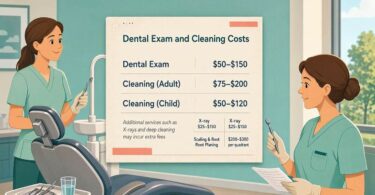
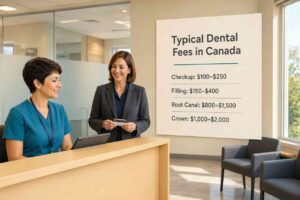
The following table provides a realistic range for common procedures based on the general fee guides across provinces. Remember, prices are in Canadian dollars (CAD) and can vary from province to province. Ontario and British Columbia tend to be slightly more expensive than Atlantic Canada or Quebec.
| Procedure | Description | Average Cost Range (CAD) |
|---|---|---|
| Routine Checkup (Exam) | A visual examination by the dentist. | $50 – $100 |
| Standard Cleaning (Scaling) | Removal of plaque and tartar, typically by a hygienist. (Often priced per unit of time, e.g., 15 minutes). | $100 – $250 |
| Full Mouth X-Rays | A series of X-rays to see the entire mouth. | $60 – $150 |
| Tooth-Colored Filling (Composite) | For a small to medium cavity on one surface. | $150 – $350 |
| Tooth-Colored Filling (Complex/Multiple Surfaces) | For a larger cavity on multiple surfaces of the tooth. | $250 – $500 |
| Root Canal (Molar) | Treatment to remove the infected nerve of a back tooth. | $800 – $1,500 |
| Porcelain Crown | A cap to cover a damaged or root-canaled tooth. | $1,000 – $1,800 |
| Simple Extraction | Removal of a visible tooth. | $150 – $300 |
| Surgical Extraction (Impacted Wisdom Tooth) | Removal of a tooth that is below the gum line. | $300 – $600 |
| Dental Implant (Full Treatment) | Includes the surgical placement, abutment, and crown. | $3,000 – $6,000 |
These numbers give you a solid foundation for understanding what to expect when you sit in the chair.
The Cost of a “Routine” Visit
When a Canadian thinks of a “dental visit,” they usually mean a checkup and a cleaning. This is the most common appointment.
The total cost for a routine visit (exam, X-rays, and cleaning) for a patient with no issues can range from $200 to $400. This is why having insurance is so valuable. Without it, this is a significant expense to pay two times a year.
The Role of Private Insurance in Canada
Because the public system does not cover general dentistry, private insurance is a massive part of the Canadian dental economy. Most full-time employees receive dental benefits through their employer.
A typical Canadian dental insurance plan follows a similar structure to US plans:
-
100% coverage for preventive services (cleanings, exams).
-
80% coverage for basic services (fillings, extractions).
-
50% coverage for major services (crowns, bridges, dentures).
-
An annual maximum (usually $1,500 to $2,500 CAD per person per year).
Your out-of-pocket cost is the difference between the dentist’s fee and what the insurance company pays. If your dentist’s fees are higher than the insurance company’s “usual and customary” rates, you will also be responsible for paying the difference, a practice known as “balance billing.”
Public Assistance: The Canadian Dental Care Plan (CDCP) and Other Programs
The landscape of dental care in Canada is changing. For a long time, low-income Canadians struggled to access care. This is being addressed by new programs.
1. The Canadian Dental Care Plan (CDCP)
This is a relatively new, federal government initiative. It is not free dental care for everyone. It is a means-tested insurance program. It provides coverage for Canadian residents who:
-
Have an adjusted family net income of less than $90,000.
-
Do not have access to private dental insurance.
-
Have filed their tax return in the previous year.
The CDCP covers a wide range of services, including cleanings, fillings, root canals, and dentures. The level of coverage (the percentage the government pays) depends on your income tier. Families with lower incomes receive more coverage. There may be a co-payment required for families with higher incomes within the eligible range.
2. Provincial and Territorial Programs
Many provinces have their own targeted programs. For example:
-
Healthy Smiles Ontario: Provides free dental care for children from low-income families.
-
Alberta Child Health Benefit: Similar program for children in Alberta.
-
Many provinces also offer emergency dental coverage for adults on social assistance.
If you think you may qualify for public assistance, it is worth researching the specific programs available in your province or territory.
The Cost of Dental Care for Newcomers and Visitors
If you are new to Canada (a recent immigrant, a temporary worker, or an international student), you are in the same position as an uninsured Canadian. You will pay the full fee out-of-pocket.
It is highly recommended that newcomers purchase private dental insurance. Many insurance companies offer “newcomer” plans specifically designed for people who have recently arrived. These plans can be very affordable and provide essential coverage.
For visitors to Canada, travel health insurance often does not include dental coverage, or it may only cover emergency dental pain relief. Routine checkups and cleanings are not covered. If you are visiting for a long period, a visitor insurance plan with a dental rider is a wise investment.
How to Save Money on Dental Care in Canada
Dental care in Canada is expensive, but there are proven ways to manage the cost.
1. Use Your Insurance Strategically
If you have insurance, understand your plan. Know your annual maximum. If you have major work to do, you can split it across two calendar years to use two years’ worth of benefits. For example, get one crown in November and a second in January.
2. Ask About Payment Plans
Most Canadian dental offices are willing to work with you on a payment plan for larger bills. They may allow you to break a $1,500 crown into three monthly payments of $500.
3. Seek Treatment at a Dental School
Canada has several excellent dental schools (such as the University of Toronto, McGill University, and the University of British Columbia). These schools offer treatment at reduced costs. The work is done by students under close supervision. The savings can be substantial (30-50%).
4. Look for a New Patient Special
Many dental offices, especially in larger cities, offer special promotions for new patients. This might include a discounted or free first exam and X-rays, or a reduced price on a cleaning. This can be a great way to save on your initial visit to a new clinic.
5. Practice Diligent Prevention
The cheapest dental visit is the one you do not need. Brushing twice a day, flossing daily, and seeing your dentist for regular cleanings every six months is the most cost-effective strategy in the long run. A $200 cleaning is far cheaper than a $1,500 root canal and crown.
Conclusion
Seeing a dentist in Canada is a private, out-of-pocket expense for most people, as it is not covered by the public healthcare system. Costs are guided by provincial fee guides, and a routine visit can cost hundreds of dollars. However, with private insurance, new federal programs like the CDCP, and smart money-saving strategies, Canadians can access the dental care they need.
Frequently Asked Questions (FAQ)
Q: Is dental care free in Canada for anyone?
A: For the general population, no. Dental care is not covered by the public Medicare system. It is free for some specific groups, such as low-income children under certain provincial programs, or for some eligible individuals under the new Canadian Dental Care Plan (CDCP). Most people rely on private insurance or pay out-of-pocket.
Q: What is the average cost of a dental cleaning in Canada?
A: A standard cleaning (scaling and polishing) by a dental hygienist typically costs between $100 and $250 CAD, depending on how long it takes and the specific clinic’s fee schedule.
Q: Are dental fees higher in Canada than in the US?
A: In general, dental fees in Canada are quite comparable to those in the US. However, the exchange rate often makes treatment in Canada seem cheaper for Americans paying with US dollars. The cost structure and the technology used are very similar in both countries.
Q: Can I use my US dental insurance in Canada?
A: It depends on your specific US plan. Some PPO plans have an international network or will reimburse you for treatment received abroad. You would typically pay the Canadian dentist in full and then submit a claim to your US insurance company for reimbursement. Always check with your provider before receiving treatment.
Q: What is the cheapest province in Canada for dental work?
A: While there is no official ranking, the general trend is that dental fees are slightly lower in the Atlantic provinces (Newfoundland, New Brunswick, Nova Scotia, PEI) and Quebec compared to Ontario, Alberta, and British Columbia. This is often related to the lower cost of living and practice overhead in those areas.
Additional Resource:
To learn more about the new Canadian Dental Care Plan and to check your eligibility, visit the official Government of Canada website: https://www.canada.ca/