If you have ever stared at a patient’s chart noting two swollen legs and felt unsure which ICD-10 code truly fits the visit, you are not alone. Lower extremity edema is one of those clinical findings that seems simple on the surface but gets complicated quickly when you open your coding manual.
Is it simply swelling? Is it fluid retention? Or is it a sign of something deeper like heart failure or venous insufficiency?
This guide walks you through everything you need to know about coding bilateral lower extremity edema accurately, honestly, and without the headache. We will look at the correct codes, documentation tips, common pitfalls, and how to tell the difference between a symptom code and a definitive diagnosis.
Let us get those legs—and your coding sheet—sorted out.
ICD-10 Code Bilateral Lower Extremity Edema
Table of Contents
ToggleWhat Is Bilateral Lower Extremity Edema? A Quick Refresher
Before we jump into alphanumeric codes, let us quickly talk about what bilateral lower extremity edema actually means. In simple terms, it is the abnormal buildup of fluid in both legs. The swelling can affect the feet, ankles, calves, and even the thighs.
Patients often describe it as:
-
Legs feeling heavy or tight.
-
Shoes that do not fit by the end of the day.
-
Skin that looks shiny or stretched.
-
A “pit” or dent remaining after pressing on the skin (pitting edema).
When the edema is bilateral, it means both legs are involved. This is an important distinction from unilateral edema, which often points to a local cause like a blood clot or injury.
Note for coders: Bilateral involvement changes your coding logic. A code that works for one leg does not always work for both.
The Primary ICD-10 Code for Bilateral Lower Extremity Edema
Let us answer the main question right away.
The most direct ICD-10 code for bilateral lower extremity edema is R60.9 – Edema, unspecified.
Yes, you read that correctly. R60.9 is the go-to code when a clinician documents “bilateral lower extremity edema” without specifying the exact cause or type.
Why R60.9?
R60.9 falls under the category “Symptoms and signs involving the genitourinary system” (R60). But wait—legs are not genitourinary. That is a known quirk in the ICD-10 structure. Historically, edema codes live here because fluid balance relates closely to renal and urinary function.
-
R60.0 – Localized edema
-
R60.1 – Generalized edema
-
R60.9 – Edema, unspecified
For bilateral lower extremity edema that is not clearly generalized (whole body) and not otherwise specified, R60.9 is your correct choice.
When to Use R60.0 Instead
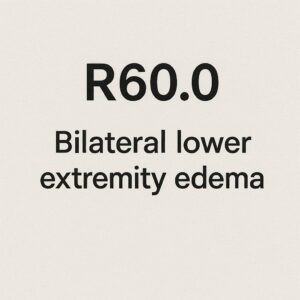
Some coders wonder if bilateral leg edema qualifies as “localized edema.” The answer is yes, but with caution. R60.0 is for edema limited to a specific body region. If the physician clearly states “bilateral lower extremity edema” and rules out generalized edema, R60.0 is acceptable and actually more specific.
Here is a helpful comparison:
| Code | Description | Best use case |
|---|---|---|
| R60.0 | Localized edema | Swelling confined to both legs only. No swelling in hands, face, or abdomen. |
| R60.9 | Edema, unspecified | Documentation simply says “bilateral LE edema” without further detail. |
| R60.1 | Generalized edema | Swelling present in legs, arms, face, or sacrum (often from heart, liver, or kidney failure). |
Important: Always code to the highest specificity available in the medical record. Do not guess. If the note says “bilateral edema,” R60.9 is safe. If it says “bilateral pedal edema localized to feet and ankles,” R60.0 is better.
Other ICD-10 Codes That May Apply to Bilateral Leg Swelling
Here is where honesty in coding matters. Bilateral lower extremity edema is often a symptom, not the final diagnosis. If the physician has identified an underlying cause, you should code that cause first. The edema becomes a secondary finding.
Let us look at common underlying conditions that present with bilateral leg swelling.
I50.9 – Heart Failure, Unspecified
Heart failure is a classic cause of bilateral edema. When the heart pumps inefficiently, fluid backs up in the venous system and gravity pulls it down to the legs.
-
I50.20 – Systolic (congestive) heart failure
-
I50.30 – Diastolic (congestive) heart failure
-
I50.9 – Heart failure, unspecified
If the physician documents “chronic heart failure exacerbation with bilateral lower extremity edema,” you sequence I50.9 (or more specific type) as primary. Then you may add R60.9 as secondary for the symptom, though many payers accept the heart failure code alone.
I87.2 – Venous Insufficiency (Chronic)(Peripheral)
Chronic venous insufficiency (CVI) is another leading cause. The veins in the legs cannot push blood back up to the heart efficiently, leading to pooling and swelling.
-
I87.2 – Venous insufficiency (chronic)(peripheral)
When a patient has known CVI and presents with bilateral leg edema, I87.2 is the correct primary code. You do not always need an additional edema code unless the swelling is particularly severe or being tracked separately.
N04.9 – Nephrotic Syndrome with Unspecified Morphology
Kidney disease causes protein loss, which lowers osmotic pressure and leads to fluid shifting into tissues. This often presents as bilateral edema that can become generalized.
-
N04.9 – Nephrotic syndrome with unspecified morphologic changes
K76.89 – Other specified diseases of liver
Liver disease, especially cirrhosis, leads to low albumin and fluid retention. Bilateral edema may be an early sign before ascites develops.
E87.70 – Fluid overload, unspecified
This code is sometimes used for hospitalized patients receiving IV fluids who develop bilateral swelling. Use it cautiously in outpatient settings.
Coding for Bilateral vs. Unilateral Edema: Why It Matters
The word “bilateral” changes everything. Many coders accidentally use codes designed for one leg and apply them to both. That can lead to denials.
Consider this example:
| Condition | Correct code | Wrong code |
|---|---|---|
| Swelling in right leg only | R22.42 (Localized swelling, right lower limb) | R60.9 |
| Swelling in left leg only | R22.43 (Localized swelling, left lower limb) | R60.9 |
| Swelling in both legs | R60.9 or R60.0 | R22.42 (that is only one side) |
The R22 codes (localized swelling, mass, or lump) are specific to laterality but are not true “edema” codes. Some coders use them for traumatic swelling. For medical edema (fluid retention), stick with R60.
Documentation Requirements for Accurate Coding
You cannot code what the physician did not write. That is the golden rule. For bilateral lower extremity edema, the medical record must include specific elements.
What a Strong Note Looks Like
A well-documented note for billing purposes should include:
-
Location: “Bilateral” must appear. Not “both legs” written in two separate places. The word bilateral is your magic term.
-
Character: Is it pitting or non-pitting? Soft or brawny? Acute or chronic?
-
Associated signs: Pain, redness, warmth, or skin changes.
-
Timing: Constant? Worse at end of day? Better with elevation?
-
Likely cause (if known): Heart failure, venous disease, medication side effect, etc.
Example Documentation
“Patient presents with bilateral lower extremity edema involving both feet and ankles. Edema is pitting (2+), worse in the evenings, and improves with leg elevation. No unilateral redness or calf pain to suggest DVT. Given history of heart failure, this likely represents mild fluid overload.”
From this note, a coder could justify:
-
Primary: I50.9 (Heart failure)
-
Secondary: R60.0 (Localized edema, bilateral)
Common Coding Mistakes to Avoid
Even experienced coders make errors with edema coding. Here are the most frequent ones to watch for.
Mistake #1: Using Lymphedema Codes Incorrectly
Lymphedema has its own code range (I89.0, Q82.0). These are for swelling caused by lymphatic system damage or malformation. Do not use them for routine venous or cardiac edema unless the physician specifically documents “lymphedema.”
Mistake #2: Forgetting Laterality Exclusions
Some codes are inherently unilateral or unspecified. Double-check that your chosen code does not exclude the opposite side.
Mistake #3: Coding Edema as Primary When a Specific Diagnosis Exists
If the physician documents “bilateral lower extremity edema due to chronic venous insufficiency,” your primary code is I87.2 (venous insufficiency). The edema is a symptom. You may add R60.0 as a secondary code, but the definitive diagnosis takes priority.
Example of correct sequencing:
-
Primary: I87.2 – Venous insufficiency
-
Secondary: R60.0 – Localized edema (bilateral lower extremities)
Mistake #4: Missing Medication-Induced Edema
Certain medications cause bilateral leg swelling. Common culprits include:
-
Calcium channel blockers (amlodipine, nifedipine)
-
NSAIDs (ibuprofen, naproxen)
-
Corticosteroids
-
Thiazolidinediones (pioglitazone, rosiglitazone)
When a physician documents “bilateral edema likely secondary to amlodipine,” you code the adverse effect. Use:
-
T46.1X5A – Adverse effect of calcium-channel blockers, initial encounter
-
Then R60.0 for the edema
Step-by-Step Coding Decision Tree
Use this simple flowchart logic to choose your code every time.
Step 1: Does the physician identify a specific cause (heart failure, venous insufficiency, kidney disease, liver disease)?
-
Yes → Code the cause first. Add edema code as secondary if needed for specificity.
-
No → Go to Step 2.
Step 2: Is the edema present only in both legs (not arms, face, or abdomen)?
-
Yes → Use R60.0 (localized edema).
-
No (swelling also in hands, face, or trunk) → Use R60.1 (generalized edema).
Step 3: Is the documentation vague (simply says “edema” or “bilateral leg swelling” without detail)?
-
Yes → Use R60.9 (edema, unspecified).
When to Use Z Codes Alongside Edema
Z codes describe factors influencing health status. They are not diagnoses, but they add context. For bilateral lower extremity edema, Z codes may appear in these situations:
-
Z13.89 – Encounter for screening for other disorders (if checking for DVT due to swelling)
-
Z91.89 – Other specified risk factors (if patient has prior history of edema)
-
Z79.4 – Long-term (current) use of diuretics (very common with edema patients)
Do not use Z codes as primary diagnoses for edema unless the visit is specifically for screening or medication management without active swelling.
Specialty-Specific Coding Considerations
Different medical specialties document and treat bilateral lower extremity edema differently. Here is how to adjust your coding approach by specialty.
Primary Care / Family Medicine
You will see undifferentiated edema most often here. The physician may not know the cause yet. In this setting, R60.9 or R60.0 is perfectly acceptable as a primary code while diagnostic testing is pending.
Cardiology
Cardiologists almost always link edema to heart failure or venous disease. You should rarely use R60 codes here. Look for I50.x or I87.2 instead. If the cardiologist writes “no evidence of heart failure, likely idiopathic edema,” then R60.9 is appropriate.
Nephrology
Kidney specialists see edema from fluid overload. Expect codes like N04.9 (nephrotic syndrome) or N18.9 (chronic kidney disease). The edema is a secondary manifestation.
Vascular Medicine
These physicians treat venous and lymphatic causes. I87.2 (venous insufficiency) and I89.0 (lymphedema) dominate their coding sheets. You may see specific laterality codes for venous insufficiency, so verify bilateral documentation.
How Payers View Bilateral Edema Codes
Medicare and commercial insurers have different sensitivities to edema codes. Here is what you need to know.
Medicare
Medicare generally accepts R60.9 for outpatient visits when documented appropriately. However, they expect progress toward a definitive diagnosis. If you use R60.9 repeatedly for the same patient over many visits without identifying a cause, you may face medical review.
Commercial Insurers
Many commercial payers follow similar rules. Some specifically exclude R60.9 from certain quality measures because it is a symptom code. If your contract has pay-for-performance metrics, try to move toward a definitive diagnosis code quickly.
Medicaid
Medicaid varies by state. In general, symptom codes like R60.9 are acceptable for initial visits but should not be the final code on a claim after diagnostic testing is complete.
Documentation Tips for Clinicians (To Help Coders)
If you are a clinician reading this, thank you. Your documentation directly impacts coding accuracy. Here is what your coding team wishes you would write.
Instead of writing: “Legs swollen.”
Write: “Bilateral lower extremity edema from feet to knees, 2+ pitting, worse at day’s end.”
Instead of writing: “Edema likely cardiac.”
Write: “Bilateral LE edema consistent with early diastolic heart failure. Echocardiogram ordered.”
Instead of writing: “Stop amlodipine for swelling.”
Write: “Bilateral ankle edema secondary to amlodipine. Will switch to alternative agent.”
One extra sentence from you saves your coder ten minutes of chart review.
Real-World Coding Scenarios and Examples
Let us walk through five patient scenarios. Each one shows the correct coding path.
Scenario 1: New Onset Swelling, Cause Unknown
Chart note: “65-year-old female with new bilateral foot and ankle swelling. No shortness of breath. No known heart or kidney disease. Will check basic metabolic panel and echocardiogram.”
Correct coding:
-
R60.0 (Localized edema, bilateral)
Reasoning: No definitive cause identified yet. Edema is localized to both lower extremities.
Scenario 2: Known Heart Failure with Exacerbation
Chart note: “78-year-old male with chronic systolic heart failure. Presents with 3-pound weight gain and bilateral lower extremity edema to knees. No orthopnea.”
Correct coding:
-
I50.20 (Systolic heart failure)
-
R60.0 (Localized edema, bilateral – optional)
Reasoning: Heart failure is the definitive diagnosis. The edema is a manifestation. Many coders would stop at I50.20 alone.
Scenario 3: Chronic Venous Insufficiency Follow-Up
Chart note: “52-year-old female with longstanding chronic venous insufficiency. Reports bilateral leg swelling and heaviness by evening. Wears compression stockings daily.”
Correct coding:
-
I87.2 (Venous insufficiency, chronic)
Reasoning: The edema is expected given the venous diagnosis. No separate edema code needed.
Scenario 4: Medication Side Effect
Chart note: “45-year-old male on amlodipine 10mg for hypertension. Developed bilateral ankle edema over past month. No other symptoms. Will reduce dose.”
Correct coding:
-
T46.1X5A (Adverse effect of calcium-channel blockers)
-
I10 (Hypertension)
-
R60.0 (Localized edema)
Reasoning: The adverse effect is the primary reason for the visit. Hypertension is still present. Edema is the manifestation.
Scenario 5: Post-Operative Edema
Chart note: “72-year-old female, 2 weeks post total knee replacement (right knee). Presents with bilateral lower extremity edema, worse on the right. No calf pain or redness. Ultrasound negative for DVT.”
Correct coding:
-
R60.0 (Localized edema, bilateral)
-
Z96.65 (Presence of right artificial knee joint)
Reasoning: The surgery was on the right side, but the edema is bilateral. No DVT identified. R60.0 captures the finding.
The Relationship Between Edema and Body Mass Index (BMI)
Obesity is a frequent contributor to bilateral lower extremity edema, but it is rarely the sole cause. Here is how to handle coding when BMI is involved.
| BMI range | Coding consideration |
|---|---|
| 30.0 – 39.9 (Obese) | May be a contributing factor. Code Z68.3x as secondary to R60.9 if physician documents “obesity-related edema.” |
| 40+ (Severe obesity) | More likely to cause lymphedema-like changes. Consider Z68.4x. |
| Normal or overweight | BMI is unlikely to be the primary driver. Look for other causes. |
Do not automatically link edema to obesity unless the physician explicitly states a relationship.
How to Avoid Audit Traps with Edema Coding
Auditors look for patterns. Here are three red flags that could trigger a review of your edema coding.
Red Flag #1: Prolonged Use of R60.9 Without Diagnostic Workup
If you see the same patient with R60.9 for six consecutive visits and no testing has been ordered, an auditor may ask why. The expectation is that you work toward a specific diagnosis.
Red Flag #2: Coding Edema as Primary When a Higher-Priority Diagnosis Exists
Heart failure, kidney failure, and liver disease all take precedence over edema. If you consistently code R60.9 as primary in patients with known CHF, expect a records request.
Red Flag #3: Using Lymphedema Codes Without Confirmation
Lymphedema requires specific diagnostic criteria or a known cause (surgery, radiation, congenital). Do not use I89.0 or Q82.0 just because swelling is chronic.
A Note on Pitting vs. Non-Pitting Edema
You may see documentation describing the “pit” quality of edema. This matters more for clinical management than for coding. However, coders should know that:
-
Pitting edema (leaves a dent) → Most common. Seen in heart failure, venous insufficiency, kidney disease.
-
Non-pitting edema (no dent) → Suggests lymphedema or myxedema (thyroid disease).
If the physician documents “non-pitting bilateral lower extremity edema,” you might consider lymphedema coding if other features align. But again, wait for the physician to make that call.
Frequently Asked Questions (FAQ)
Q1: Can I use R60.9 for bilateral lower extremity edema if the patient also has swelling in their hands?
No. If swelling is present in hands, face, or trunk, that is generalized edema. Use R60.1 instead.
Q2: What is the difference between R60.0 and R60.9 for bilateral leg swelling?
R60.0 (localized) means the swelling is confined to a specific region (both legs). R60.9 (unspecified) means you have less information. Use R60.0 when the note clearly limits edema to the legs only.
Q3: Does Medicare cover a visit coded only with R60.9?
Yes, for new or undiagnosed swelling. Medicare covers symptom codes when they are medically necessary. However, repeated use without diagnostic progress may lead to denial.
Q4: How do I code bilateral lower extremity edema in a pregnant patient?
Pregnancy-related edema is common. If it is a normal finding of pregnancy, use O99.89 (Other specified diseases and conditions complicating pregnancy) followed by R60.0. If preeclampsia is suspected, code O14.x first.
Q5: What code should I use for bilateral leg swelling after a long flight?
This is often transient edema from immobility. Unless there is a DVT (deep vein thrombosis), code R60.0. If a DVT is confirmed, use I26.01 (pulmonary embolism with DVT) or I80.2x (DVT of lower extremity) depending on laterality.
Q6: Can I code bilateral edema and unilateral edema together on the same claim?
No. Choose the code that best describes the overall presentation. Bilateral includes both sides. You do not need separate unilateral codes.
Q7: Is there a specific ICD-10 code for chronic bilateral lower extremity edema?
No single code says “chronic bilateral edema.” Use R60.0 or R60.9 with a chronicity note in the documentation. Some coders add Z91.89 (other specified risk factors) to indicate long-standing status.
Q8: What if the doctor writes “bilateral LE edema” but also writes “rule out DVT”?
Code the edema as R60.9 or R60.0. Do not code possible DVT. Only code confirmed diagnoses. If DVT is ruled out, you stay with the edema code.
Q9: How do I code bilateral edema when the patient is on dialysis?
For end-stage renal disease (ESRD) on dialysis, fluid overload is common. Code the kidney disease first: N18.6 (ESRD). Then add E87.70 (fluid overload) or R60.0 for the edema.
Q10: Does the severity of pitting (1+ to 4+) affect coding?
No. The ICD-10 codes do not differentiate by severity. However, severity can support medical necessity for certain procedures or higher evaluation and management levels.
Additional Resource for Coders and Clinicians
For the most up-to-date official ICD-10-CM guidelines, always consult the Centers for Medicare & Medicaid Services (CMS) ICD-10 webpage. You can download the full 2025 code set and official guidelines for free.
🔗 CMS Official ICD-10 Website: www.cms.gov/medicare/coding-billing/icd-10-codes
Bookmark this page. The guidelines are updated annually, and you do not want to code from outdated information.
Final Thoughts on Coding Bilateral Lower Extremity Edema
Coding bilateral lower extremity edema does not have to be a struggle. Remember these three core takeaways.
First, when no specific cause is known or documented, R60.9 (edema, unspecified) or R60.0 (localized edema) serves your needs. Both are acceptable, with R60.0 being slightly more specific when the swelling is confined to the legs.
Second, always look for an underlying diagnosis before settling on a symptom code. Heart failure, venous insufficiency, kidney disease, liver disease, and medication side effects all take priority over edema in the sequencing hierarchy.
Third, document clearly and completely. The word “bilateral” must be present. Describe the swelling, its timing, and any relieving factors. Your documentation is the foundation of accurate coding.
You now have a practical, honest roadmap for coding bilateral lower extremity edema. Use it with confidence, stay curious, and when in doubt, go back to the medical record. The answer is almost always there.
*Disclaimer: This article is for educational purposes only and does not constitute legal or medical coding advice. Coding guidelines change frequently. Always refer to the current official ICD-10-CM manual and consult with a certified medical coder or compliance officer for specific patient cases.*