Let’s be honest for a second. No physical therapist or PT assistant went to school because they loved billing and coding. You got into this field because you wanted to help people move better, feel stronger, and live without pain.
But here we are.
Between you and a paid claim stands a small but mighty string of characters: the ICD-10 code.
When used correctly, ICD-10 codes for physical therapy treatment do more than just satisfy insurance requirements. They tell a story. They explain why a patient needs your hands-on skills, your exercise prescription, and your clinical reasoning.
When used incorrectly? They lead to denials, audits, and lost revenue.
This guide is not a boring list of random numbers. Think of it as your friendly, practical companion for everyday PT documentation. We will walk through the most common codes, the biggest mistakes, and how to choose the right code without losing your mind.
Why ICD-10 Codes Matter More Than You Think
Before we jump into lists and tables, let’s talk about the “why.” Insurance companies do not pay for physical therapy because you are a nice person. They pay for medical necessity. That is the magic phrase.
Medical necessity means: there is a clear, documented reason your patient needs skilled PT. An ICD-10 code is the shorthand for that reason.
Think of it like this:
- The ICD-10 code answers “What is wrong?”
- The therapy plan answers “What are we doing about it?”
If those two things do not match, the claim gets rejected. For example, you cannot treat a shoulder impingement (M75.41) and bill under a low back pain code (M54.5). That raises red flags immediately.
The Real Cost of Bad Coding
A small mistake might seem harmless. But consider:
- Delayed payments – Your office staff spends hours chasing corrections.
- Audit triggers – Payers love patterns. Frequent mismatches or “unspecified” codes invite scrutiny.
- Patient frustration – They get a surprise bill because insurance denied the claim.
On the flip side, accurate coding builds trust with payers and protects your practice. It also makes your documentation stronger, clearer, and more defensible.
How This Article Is Organized
We will move through ICD-10 codes the way you actually see patients. That means starting with pain, then moving to specific joints, then post-surgical cases, and finally neurological and other common conditions.
Along the way, you will find:
- Practical tables for quick reference
- Real-world examples
- Warnings about frequently misused codes
- A helpful FAQ at the end
You do not need to memorize everything. Bookmark this page. Use it as a reference when you are stuck.
The Foundation: Pain Codes Every PT Should Know
Pain is the number one reason people seek physical therapy. But pain codes are also the most misused category. Let’s clear things up.
Acute vs. Chronic Pain
ICD-10 makes a very important distinction:
| Code | Description | Typical Use |
|---|---|---|
| M25.51 | Pain in shoulder | Acute or chronic, specific joint |
| M25.52 | Pain in elbow | |
| M25.53 | Pain in wrist | |
| M25.54 | Pain in hip | |
| M25.55 | Pain in knee | |
| M25.56 | Pain in ankle | |
| M25.57 | Pain in foot and toes | |
| M25.58 | Pain in other specified joint |
For chronic, generalized pain without a specific joint diagnosis, you might use:
- G89.29 – Other chronic pain
- M79.1 – Myalgia (muscle pain)
Important note: Avoid using M79.10 (unspecified myalgia) unless you truly have no better option. Payers see this as a lazy code. Always look for a more specific diagnosis first.
When to Use “Unspecified” Codes
Here is a rule you can trust: if you can be more specific, be more specific.
Unspecified codes exist. Sometimes you genuinely do not have a precise diagnosis yet (e.g., first visit, no imaging, unclear presentation). But using them repeatedly will hurt your practice.
Use unspecified codes only when:
- The diagnosis is truly unknown after a reasonable exam
- You are waiting on imaging or physician referral
- The payer accepts them (some do not)
Never use them just to save time.
Lower Quarter: ICD-10 Codes for Hip, Knee, and Ankle
Lower extremity problems make up a huge percentage of outpatient PT. Let’s break these down by body part.
Hip and Pelvis
| Code | Diagnosis | PT Relevance |
|---|---|---|
| M25.551 | Pain in right hip | General hip pain |
| M25.552 | Pain in left hip | |
| M25.559 | Pain in unspecified hip | Use sparingly |
| M16.0 | Bilateral primary osteoarthritis of hip | Common in older adults |
| M16.10 | Unilateral primary OA, unspecified hip | |
| M76.30 | Iliotibial band syndrome, unspecified leg | IT band friction syndrome |
| M70.7 | Other bursitis of hip | Trochanteric bursitis |
Real-world example: A 68-year-old female with right hip stiffness and groin pain. X-ray shows moderate osteoarthritis. You should code M16.11 (unilateral primary OA, right hip), not a pain-only code.
Knee
Knee codes require attention to laterality (right vs. left) and the specific structure involved.
| Code | Diagnosis | Notes |
|---|---|---|
| M17.11 | Unilateral primary OA, right knee | Very common |
| M17.12 | Unilateral primary OA, left knee | |
| M17.0 | Bilateral primary OA | Both knees |
| M22.2 | Patellofemoral disorders | Patellar tracking issues |
| M23.201 | Derangement of medial meniscus, right knee | Torn meniscus |
| S83.511A | Sprain of ACL, right knee, initial encounter | Acute injury |
Important: For post-surgical knee patients, you will generally use a Z-code (more on this later) plus the reason for surgery.
Ankle and Foot
Ankle sprains are extremely common. Use these codes carefully.
| Code | Diagnosis | When to Use |
|---|---|---|
| S93.401A | Sprain of unspecified ligament of right ankle, initial encounter | Acute ankle sprain |
| S93.402A | Left ankle | |
| M25.571 | Pain in right ankle | Non-specific pain |
| M77.31 | Calcaneal spur, right foot | Plantar fasciitis with spur |
| M72.2 | Plantar fascial fibromatosis | Plantar fasciitis without spur |
Pro tip from a billing specialist: “I see so many claims with M25.571 for ankle pain when the real diagnosis is status post ankle sprain. Always go back to the original injury code if the patient is still within treatment for that injury.”
Upper Quarter: Shoulder, Elbow, Wrist, and Hand
Upper quarter problems are the bread and butter of outpatient orthopedics. Here is your cheat sheet.
Shoulder: The Common Codes
Shoulder diagnoses can be tricky because multiple structures often overlap. But your primary code should reflect the primary impairment.
| Code | Diagnosis | Best For |
|---|---|---|
| M75.101 | Unspecified rotator cuff tear, right shoulder | Confirmed tear |
| M75.41 | Impingement syndrome, right shoulder | Subacromial impingement |
| M75.51 | Bursitis of right shoulder | Bursitis only |
| M75.01 | Adhesive capsulitis, right shoulder | Frozen shoulder |
| S43.401A | Sprain of right shoulder, initial encounter | Mild trauma without dislocation |
Watch out for: M75.101 (unspecified tear). If you know it is a full-thickness tear, use the specific code. Unspecified tear codes should be temporary.
Elbow
Tennis elbow. Golfer’s elbow. These are some of the easiest codes to get right.
| Code | Diagnosis | Typical Patient Profile |
|---|---|---|
| M77.11 | Lateral epicondylitis, right elbow | Tennis elbow, gripping pain |
| M77.12 | Lateral epicondylitis, left elbow | |
| M77.01 | Medial epicondylitis, right elbow | Golfer’s elbow |
| M77.02 | Medial epicondylitis, left elbow |
Important lateralality note: Always include right (1) or left (2). The unspecified code (M77.10) is almost never appropriate in outpatient PT unless both arms are affected equally, which is rare.
Wrist and Hand
| Code | Diagnosis | Common in PT |
|---|---|---|
| G56.01 | Carpal tunnel syndrome, right upper limb | Post-operative or conservative |
| G56.02 | Left upper limb | |
| M25.531 | Pain in right wrist | Non-specific pain |
| M65.841 | Other synovitis, right hand | De Quervain’s tenosynovitis |
Pro tip: Carpal tunnel syndrome (G56.0x) is a neurological code, not a musculoskeletal one. That is fine. ICD-10 allows it. Just make sure your plan of care addresses nerve gliding, not just wrist strengthening.
Spinal Codes: Cervical, Thoracic, and Lumbar
The spine is where many therapists feel the most uncertainty. Let’s simplify.
General Neck and Back Pain
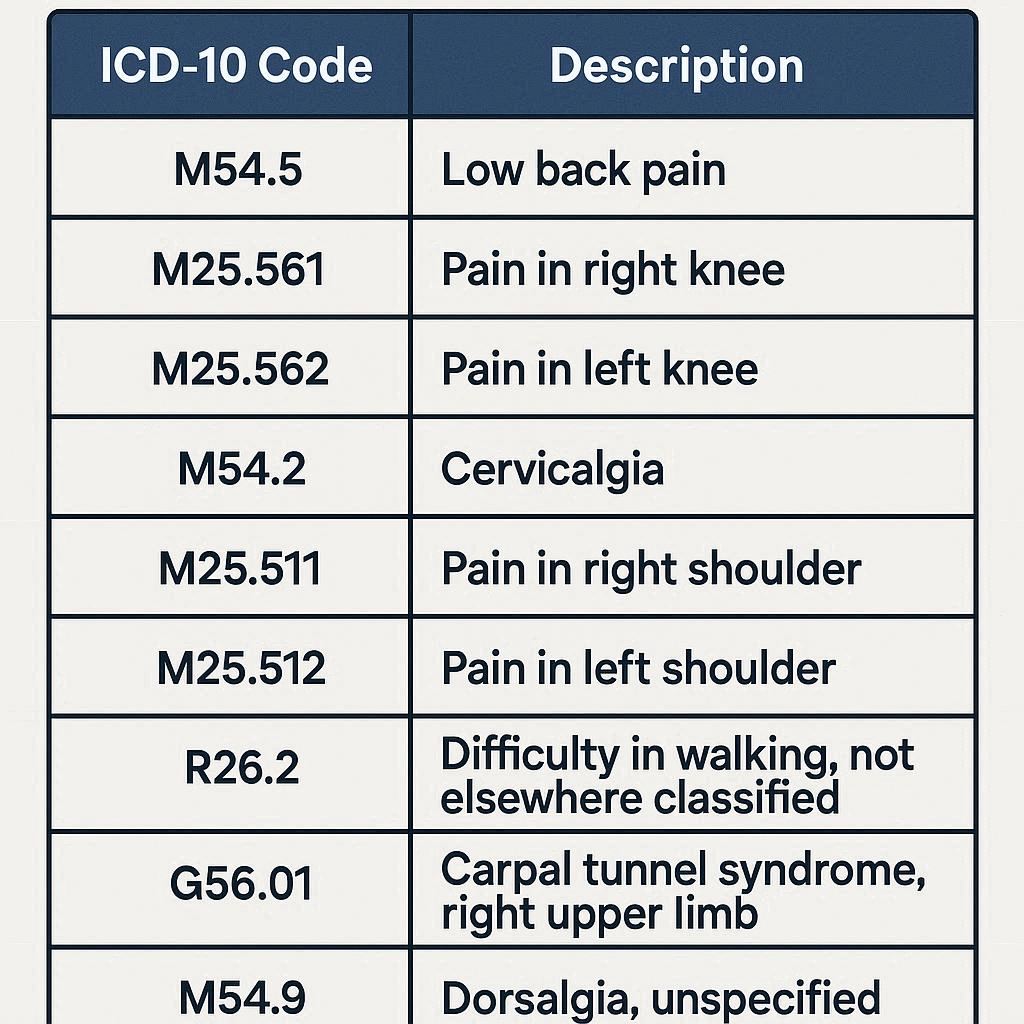
Avoid these codes if at all possible: M54.2 (cervicalgia), M54.5 (low back pain), M54.6 (pain in thoracic spine). Why? Because payers see them as “rule-out” codes. They suggest you have not identified a specific source.
Instead, push for:
| Better Code | Diagnosis | Why It Is Better |
|---|---|---|
| M99.01 | Segmental and somatic dysfunction, cervical | Indicates a mechanical problem |
| M54.16 | Radiculopathy, lumbar region | Specific nerve involvement |
| M51.16 | Lumbar disc disorder with radiculopathy | Very specific |
When to use M54.5 anyway: On an evaluation before you have imaging or a specific diagnosis, and the payer accepts it. But document your reasoning clearly.
Radiculopathy vs. Neuropathy
This confuses many therapists. Here is the simple difference:
- Radiculopathy (M54.1x) – Nerve root problem. Pain, numbness, or weakness that follows a specific dermatome or myotome. Example: L5 radiculopathy with foot drop.
- Neuropathy (G62.9, G60.9) – More diffuse nerve damage. Often from diabetes or other systemic disease.
“If the patient says their pain goes down the leg but you cannot map it to a specific root, do not call it radiculopathy. Use a pain code until you have more information.” – Anonymous PT Auditor
Post-Surgical Physical Therapy: Z-Codes Are Your Friend
After surgery, the reason for surgery matters less than the fact of the surgery. That is where Z-codes (factors influencing health status) enter the picture.
The Standard Formula
For post-op PT, use two codes:
- A Z-code for aftercare
- The original diagnosis code (optional but recommended by many payers)
| Z-Code | Meaning | Example |
|---|---|---|
| Z47.1 | Aftercare following joint replacement surgery | Total knee, total hip |
| Z47.89 | Aftercare following other specified surgery | Rotator cuff repair, ACL reconstruction |
| Z48.81 | Aftercare following tendon surgery | Tendon repair |
| Z48.89 | Aftercare following other specified procedures | Other orthopedic surgeries |
Real-World Examples
Total knee replacement (TKA)
- Primary: Z47.1 (aftercare following joint replacement)
- Secondary (optional): M17.11 (primary OA, right knee)
Rotator cuff repair
- Primary: Z47.89
- Secondary: M75.101 or specific tear code
Lumbar fusion
- Primary: Z47.89
- Secondary: M51.16 (disc disorder with radiculopathy)
Important note: Some payers, including Medicare, want the Z-code as primary for post-op PT. Always check your local coverage determinations (LCDs).
Neurological Conditions in PT
Neurological physical therapy has its own set of common codes.
| Code | Diagnosis | PT Focus |
|---|---|---|
| G81.90 | Hemiplegia, unspecified side | Post-stroke |
| G81.91 | Hemiplegia, right dominant side | |
| G81.92 | Hemiplegia, left side | |
| G20 | Parkinson’s disease | LSVT BIG, balance |
| G35 | Multiple sclerosis | Gait, strength, fatigue |
| I69.351 | Hemiplegia following cerebral infarction, right side | Late effect of stroke |
| R26.2 | Difficulty walking, not elsewhere classified | Gait abnormality |
Special note on stroke codes: Codes starting with I69 are for late effects of a stroke (after the acute phase). Use these in outpatient PT. G81 codes are appropriate when the stroke event is not specified as recent.
Musculoskeletal Rules and Coding for Medicare Patients
Medicare has its own expectations for ICD-10 codes related to the “Musculoskeletal Rules.” If you treat Medicare patients, pay attention here.
The Musculoskeletal (MSK) Rules (part of the Medicare Fee-for-Service Medical Review) require specificity. You cannot just use a pain code for Medicare. They want:
- Specific joint (including laterality)
- Specific condition (OA, tear, dysfunction)
Medicare-Friendly Code Examples
| Instead of this … | Use this … |
|---|---|
| M54.5 (low back pain) | M99.03 (somatic dysfunction, lumbar) OR M51.16 (disc disorder) |
| M25.551 (hip pain) | M16.11 (OA right hip) OR M25.551 with supporting documentation |
| M79.1 (myalgia) | M60.9 (myositis unspecified) OR specific muscle strain code |
This is not just a suggestion. Medicare auditors look for these patterns.
The Most Common ICD-10 Coding Mistakes in PT (And How to Avoid Them)
After reviewing thousands of PT claims, auditors see the same errors again and again.
Mistake #1: Using Unspecified Codes Excessively
Example: M54.5 for every low back patient.
Fix: Spend 30 extra seconds finding a more specific code. If you truly do not know, document why. Then update the code at the next visit once you have more information.
Mistake #2: Forgetting Laterality
ICD-10 requires you to specify right, left, or bilateral for almost all musculoskeletal codes. A code like M25.551 means right shoulder. M25.552 means left. M25.559 means unspecified.
Fix: Build a habit. Always ask yourself: Right? Left? Both?
Mistake #3: Using Post-Op Codes Incorrectly
Example: Billing Z47.1 for a patient who had a knee scope six months ago and now has new-onset low back pain.
Fix: The Z-code must match the body part you are treating. For a new problem, use a new primary diagnosis.
Mistake #4: Not Updating Codes
Patients get better. Their primary diagnosis might change from “acute sprain” (S93.401A) to “residual instability” (M25.39).
Fix: Re-evaluate your primary code every 30 days or at every progress note.
Quick Reference Table: ICD-10 Codes for Physical Therapy by Body Part
| Body Region | Most Common Codes | Avoid When Possible |
|---|---|---|
| Cervical spine | M99.01, M54.16, M50.20 | M54.2 (cervicalgia) |
| Thoracic spine | M99.02, M54.6 | M54.6 alone |
| Lumbar spine | M99.03, M51.16, M54.16 | M54.5 alone |
| Shoulder | M75.41, M75.01, M75.101 | M25.511 alone |
| Elbow | M77.11, M77.01 | M25.521 alone |
| Wrist/hand | G56.01, M65.841 | M25.531 alone |
| Hip | M16.11, M76.30 | M25.551 alone |
| Knee | M17.11, M22.2, M23.201 | M25.561 alone |
| Ankle/foot | S93.401A, M77.31 | M25.571 alone |
Step-by-Step: How to Choose the Right Code in 60 Seconds
You do not have time for a 10-minute coding session between patients. Here is a rapid workflow.
Step 1: Identify the primary problem.
Ask: What is the single most limiting factor for this patient today? Pain? Weakness? Stiffness? Instability?
Step 2: Locate the anatomical site.
Which joint, muscle group, or spinal region?
Step 3: Determine the pathology if known.
Do you have a specific diagnosis (OA, tear, sprain, radiculopathy)? Or are you still in the evaluation phase?
Step 4: Match the code to your treatment.
Your interventions should clearly address the code. If you are doing gait training for a patient with a shoulder code, you have a problem.
Step 5: Document your reasoning.
One sentence in your note: “Primary diagnosis is M17.11 (right knee OA) as evidenced by joint line tenderness, crepitus, and morning stiffness lasting 15 minutes.”
That’s it. You are done.
Frequently Asked Questions (FAQ)
Q1: Can I use two ICD-10 codes on one claim?
Yes. Most physical therapy claims benefit from a primary code (the main reason for care) and a secondary code (a related but separate condition). For example: Primary Z47.1 (TKA aftercare) and secondary M17.11 (OA).
Q2: What happens if I choose the wrong code?
It depends. Sometimes the claim is denied and you resubmit with a corrected code. Repeated errors can trigger an audit. Honest mistakes are usually fixable. Pattern errors are dangerous.
Q3: Do I need a different code for each visit?
Not necessarily. The same diagnosis code can be used for multiple visits as long as the patient is still receiving treatment for that condition. Update the code when the clinical picture changes significantly.
Q4: How do I code for wellness or prevention visits?
Unfortunately, most insurance does not cover “wellness PT” unless it is related to a specific diagnosis. For example, fall prevention after a stroke (I69.351) is covered. General “I want to stay active” is usually not.
Q5: Are ICD-10 codes the same for all insurance companies?
Mostly yes. The codes themselves are universal. However, different payers (Medicare, Blue Cross, UnitedHealthcare) may have different coverage policies about which codes they accept. Always check your contracts.
Q6: Where can I find the most up-to-date codes?
The official source is the CDC’s ICD-10-CM website. Your billing software should also update annually (October 1 is the federal update date).
Additional Resource: Official ICD-10-CM Coding Guidelines
For the most authoritative and detailed guidance, refer directly to the Centers for Medicare & Medicaid Services (CMS) 2026 ICD-10-CM Official Guidelines for Coding and Reporting.
👉 Access the official CMS ICD-10-CM guidelines here (opens new window)
Bookmark this page. The guidelines are updated annually, and small changes can affect your claims.
Final Thoughts: Coding Is Communication
Remember why you became a physical therapist. It was not to master ICD-10. But coding well serves a bigger purpose. It communicates the value of what you do. It tells the story of a patient who could not walk without pain, and then learned to walk again. It justifies the skilled, hands-on, life-changing work that happens in your clinic every day.
When you choose the right ICD-10 code, you are not checking a box. You are advocating for your patient. You are protecting your practice. And you are keeping the door open for the next patient who needs you.
Keep this guide handy. Bookmark the CMS link. And when you are stuck, ask yourself one simple question: Does this code honestly and accurately reflect what I am treating today?
If the answer is yes, you are on the right track.
Conclusion
Choosing accurate ICD-10 codes for physical therapy treatment protects your reimbursements and tells a clear story of medical necessity. Focus on specificity, laterality, and matching the code to your actual interventions. When in doubt, remember: a specific code with good documentation always wins over an easy but vague default.
Disclaimer: This article is for informational and educational purposes only. It does not constitute medical or legal advice. Coders and clinicians should always verify codes with a certified medical coder and current ICD-10 CM guidelines.