In the intricate tapestry of modern healthcare, where complex human conditions intersect with vast digital systems, a simple alphanumeric sequence holds immense power. For the patient living with Parkinson’s disease, their reality is one of subtle tremors, progressive rigidity, and a silent internal struggle. For the clinician, it is a diagnostic puzzle and a long-term management challenge. For the healthcare administrator, it is a matter of resource allocation and operational efficiency. The thread that weaves these disparate perspectives into a coherent, actionable narrative is the International Classification of Diseases, Tenth Revision, Clinical Modification (ICD-10-CM) code.
This article is not merely a technical manual for assigning code G20, the code for Parkinson’s disease. It is an exploration of how this code, and its intricate family of related codes, serves as a critical linchpin in the ecosystem of patient care. A correctly assigned code is more than a billing tool; it is a data point that contributes to our global understanding of the disease, a key that unlocks access to specialized therapies, and a precise label that ensures the patient’s electronic health record accurately reflects their unique medical journey. We will embark on a detailed expedition through the neurology of Parkinson’s, the logic of the ICD-10 system, and the practical art of clinical documentation, revealing why mastering this domain is essential for clinicians, coders, and healthcare organizations alike.
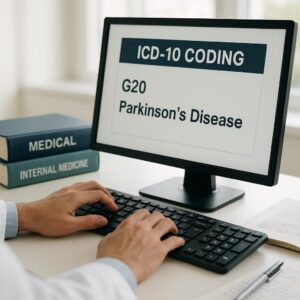
ICD-10 coding for Parkinson’s disease
Chapter 1: Understanding the Foundation – What is Parkinson’s Disease?
Before a single code can be assigned, one must first understand the disease itself. Parkinson’s disease (PD) is a progressive neurodegenerative disorder, primarily characterized by the gradual loss of dopamine-producing neurons in a specific region of the midbrain called the substantia nigra pars compacta. This neuronal loss sets in motion a cascade of motor and non-motor symptoms that define the patient’s experience.
1.1 The Pathophysiology: The Demise of Dopamine
Dopamine is a crucial neurotransmitter that acts as a chemical messenger, facilitating smooth, coordinated muscle movement. As the neurons in the substantia nigra degenerate, dopamine levels in the brain’s basal ganglia—the center for motor control—plummet. This dopamine deficit disrupts the normal balance between dopamine and other neurotransmitters like acetylcholine, leading to the classic motor symptoms of PD.
Adding to the pathological picture is the presence of Lewy bodies. These are abnormal, spherical aggregates of a protein called alpha-synuclein that accumulate inside neurons. The presence of Lewy bodies is a hallmark pathological feature of Parkinson’s disease, and their spread throughout the brain is thought to be linked to the progression of both motor and non-motor symptoms.
1.2 Clinical Hallmarks: The Cardinal Motor Symptoms
The diagnosis of Parkinson’s disease is primarily clinical, based on the presence of these four cardinal motor signs:
-
Tremor: Often the first and most recognizable symptom, the Parkinsonian tremor is a “pill-rolling” tremor—a rhythmic back-and-forth motion of the thumb and forefinger—that occurs at rest (typically 4-6 Hz) and improves with voluntary movement.
-
Bradykinesia: This is the slowness of movement and is a core feature required for diagnosis. It manifests as difficulty initiating movement, a general reduction in spontaneous movement, and fatigue and hesitation during repetitive tasks.
-
Rigidity: An increased stiffness and resistance to movement in the limbs, neck, or trunk. It can be “lead-pipe” (uniform resistance) or “cogwheel” (a jerky resistance superimposed on the rigidity, often when combined with tremor).
-
Postural Instability: Impaired balance and coordination, leading to a high risk of falls. This symptom typically appears in the later stages of the disease.
A diagnosis of PD typically requires the presence of bradykinesia plus either tremor, rigidity, or both.
1.3 The Unseen Burden: Non-Motor Symptoms
While motor symptoms are the most visible, the non-motor symptoms of PD can be equally, if not more, debilitating. These include:
-
Neuropsychiatric: Depression, anxiety, apathy, and visual hallucinations.
-
Cognitive: Mild cognitive impairment, and in later stages, Parkinson’s disease dementia.
-
Autonomic: Orthostatic hypotension (dizziness upon standing), constipation, urinary dysfunction, and excessive sweating.
-
Sleep Disorders: REM sleep behavior disorder (acting out dreams), insomnia, and excessive daytime sleepiness.
-
Sensory: Loss of smell (anosmia), pain, and paresthesia.
Understanding this full spectrum is vital for coding, as many of these conditions require their own diagnostic codes to paint a complete picture of the patient’s health status.
Chapter 2: The Language of Modern Medicine – Demystifying the ICD-10-CM System
The ICD-10-CM is the standardized system used in the United States to classify and code all diagnoses, symptoms, and procedures recorded in conjunction with hospital care. Its primary purposes are:
-
Reimbursement: To justify medical necessity for services rendered to insurance payers.
-
Epidemiology: To track the incidence and prevalence of diseases.
-
Research: To identify patient populations for clinical trials and study disease outcomes.
-
Quality Metrics: To measure the performance and effectiveness of healthcare providers.
2.1 Structure and Syntax: How an ICD-10 Code is Built
ICD-10-CM codes are alphanumeric and can range from three to seven characters in length. The structure is hierarchical:
-
Chapter: The first character is a letter, representing the chapter. Diseases of the nervous system are found in Chapter VI, codes G00-G99.
-
Category: The first three characters (e.g., G20) represent the category of the disease—in this case, Parkinson’s disease.
-
Subcategory and Extension: Characters four through seven provide increasing levels of detail regarding etiology, anatomic site, severity, and other clinical specifics. For Parkinson’s disease, the code G20 requires no further characters; it is a “code also” and “code first” instruction hub.
Chapter 3: The Core Code – A Deep Dive into G20 (Parkinson’s Disease)
The code G20 is the fundamental code for idiopathic (meaning of unknown cause) Parkinson’s disease. It is used for classic, primary Parkinson’s disease, also referred to as paralysis agitans.
3.1 Code G20: Definition and Scope
Code G20 should be assigned when the physician’s documentation unequivocally states a diagnosis of “Parkinson’s disease,” “idiopathic Parkinson’s,” or “primary Parkinsonism.” It is a standalone code that captures the underlying neurodegenerative process.
3.2 What G20 Does Not Include: Understanding the Excludes1 and Excludes2 Notes
One of the most critical aspects of accurate coding is understanding the “Excludes” notes in the ICD-10 manual.
-
Excludes1: A type of “pure” exclusion. The two conditions cannot be coded together because they are mutually exclusive. For G20, the Excludes1 note is:
-
Hemiparkinsonism (G21.4): This is a rare form of Parkinsonism that affects only one side of the body. It is considered a distinct entity from idiopathic PD.
-
-
Excludes2: The condition is not part of the condition represented by the code, but the patient may have both conditions at the same time. You may code both if the documentation supports it. Key Excludes2 notes for G20 include:
-
Dementia with Parkinsonism (G31.83): This refers to Lewy body dementia, where dementia precedes or appears concurrently with parkinsonism. This is a crucial differential diagnosis.
-
Shy-Drager syndrome (G90.3): Now more commonly known as Multiple System Atrophy (MSA), a distinct neurodegenerative disorder.
-
Secondary Parkinsonism (G21.-): This is a major category we will explore next.
-
Chapter 4: The Art of Specificity – Documenting and Coding Parkinsonian Syndromes
Not all that trembles is Parkinson’s disease. Many conditions can cause Parkinsonian symptoms (parkinsonism), and the ICD-10-CM system demands specificity.
4.1 Secondary Parkinsonism (G21): A World of Etiologies
Code category G21 is used when the parkinsonism is a symptom of another, identifiable cause. The fourth character provides the necessary specificity.
-
G21.0 – Malignant Neuroleptic Syndrome: A life-threatening reaction to antipsychotic drugs.
-
G21.1 – Other Drug-Induced Parkinsonism: A very common scenario. Caused by medications like typical antipsychotics (e.g., haloperidol), some antiemetics (e.g., metoclopramide), and rarely, some calcium channel blockers.
-
G21.2 – Parkinsonism due to other external agents: For instance, poisoning by manganese or carbon monoxide.
-
G21.3 – Postencephalitic Parkinsonism: A historical but important category.
-
G21.4 – Hemiparkinsonism: As noted in the Excludes1 for G20.
-
G21.8 – Other Secondary Parkinsonism
-
G21.9 – Secondary Parkinsonism, unspecified
Coding Tip: If a patient has drug-induced parkinsonism, the correct code is G21.1, not G20. The underlying cause is the drug, not idiopathic neurodegeneration.
4.2 Other Degenerative Parkinsonian Diseases (G23.1, G31.83, G31.85, G90.3)
This is where diagnostic acumen is paramount. These “Parkinson’s-plus” syndromes have features of PD but also have distinguishing characteristics and worse prognoses.
-
G23.1 – Progressive Supranuclear Palsy (PSP): Characterized by early falls, vertical gaze palsy, and poor response to levodopa.
-
G31.83 – Dementia with Lewy Bodies (DLB): Dementia appears before or within one year of the motor symptoms. Visual hallucinations and cognitive fluctuations are common.
-
G31.85 – Corticobasal Degeneration (CBD): Marked by asymmetric, progressive apraxia and “alien limb” phenomenon.
-
G90.3 – Multiple System Atrophy (MSA): Combines parkinsonism with severe autonomic failure (MSA-P) or cerebellar ataxia (MSA-C).
4.3 The Critical Distinction: Essential Tremor (G25.0) vs. Parkinsonian Tremor
This is a common diagnostic challenge. Essential tremor is an action tremor (worsens with movement), often familial, and improves with alcohol. It is coded as G25.0. Confusing it with PD’s resting tremor is a common documentation and coding error.
Chapter 5: Beyond the Primary Diagnosis – Coding Co-morbidities and Manifestations
A patient with Parkinson’s disease is rarely defined by G20 alone. The ICD-10 system uses conventions to link related conditions.
5.1 The “Use Additional Code” Mandate: Capturing the Full Picture
The official coding guidelines for G20 instruct to “use additional code to identify:”
-
Dementia: If present.
-
Psychosis: If present.
-
Dyskinesia: If present, often as a side effect of long-term levodopa therapy.
This means you will list multiple codes to fully describe the patient’s condition. The primary diagnosis (the reason for the encounter) is listed first, but all coexisting conditions that are treated or managed should be coded.
5.2 Cognitive and Psychiatric Manifestations
Coding cognitive and psychiatric issues in PD requires careful attention to the physician’s documentation.
-
Parkinson’s Disease Dementia: If the dementia is explicitly documented as being due to the Parkinson’s disease process, the correct code is F02.80 – Dementia in other diseases classified elsewhere without behavioral disturbance. If behavioral disturbances like hallucinations or aggression are present, you would use F02.81 – …with behavioral disturbance. Crucially, you must also code G20.
-
Hallucinations in PD: If the patient has psychosis/hallucinations without a formal diagnosis of dementia, you would code F06.8 – Other specified mental disorders due to known physiological condition, along with G20.
-
Mild Cognitive Impairment: If documented, code G31.84 – Mild cognitive impairment, so stated.
5.3 Autonomic and Other System Manifestations
-
Orthostatic Hypotension: Code I95.1 – Orthostatic hypotension in addition to G20.
-
Constipation: Code K59.00 – Constipation, unspecified.
-
Neurogenic Bladder: Code N31.9 – Neuromuscular dysfunction of bladder, unspecified.
Common Parkinson’s Disease Manifestations and Their Corresponding ICD-10 Codes
| Manifestation | Specific Description | ICD-10 Code(s) | Coding Notes |
|---|---|---|---|
| Primary Disease | Idiopathic Parkinson’s Disease | G20 | Foundational code. |
| Dementia | Dementia due to PD | F02.80 (without behav. disturb.) / F02.81 (with behav. disturb.) | Code first G20. |
| Psychosis | Hallucinations without dementia | F06.8 | Use with G20. Documentation is key. |
| Cognitive | Mild Cognitive Impairment | G31.84 | Use with G20. |
| Autonomic | Orthostatic Hypotension | I95.1 | A common comorbidity. |
| Autonomic | Constipation | K59.00 | Code the symptom. |
| Sleep | REM Sleep Behavior Disorder | G47.52 | Highly specific to synucleinopathies like PD. |
| Medication Effect | Levodopa-induced Dyskinesia | G25.66 | Use with G20. Indicates advanced disease. |
| Secondary Cause | Drug-Induced Parkinsonism | G21.1 | NOT G20. Code the drug if applicable (T36-T50). |
Chapter 6: The Clinician-Coder Partnership – The Imperative of Precise Documentation
The coder’s world is bound by a golden rule: “If it isn’t documented, it didn’t happen.” The physician’s note is the legal and clinical source of truth.
6.1 Common Documentation Pitfalls and How to Avoid Them
-
Vague Terminology: Using “parkinsonism” without specifying the type (idiopathic, drug-induced, vascular). A coder cannot assume it is G20.
-
Inconsistent Problem Lists: The problem list in the Electronic Health Record (EHR) stating “Parkinson’s disease” while a progress note only mentions “tremor.”
-
Unlisted Manifestations: Failing to document the presence or absence of dementia, hallucinations, or orthostasis, leading to incomplete coding.
-
Failure to Distinguish: Not clearly differentiating between PD, DLB, and Essential Tremor in the assessment.
6.2 Querying for Clarity: A Collaborative Process
When documentation is unclear, contradictory, or incomplete, the coder must initiate a physician query. This is a formal, non-leading process to clarify the record. For example: “The patient is noted to have parkinsonism and is on metoclopramide. Can you please clarify if this is idiopathic Parkinson’s disease (G20) or drug-induced parkinsonism (G21.1)?”
Chapter 7: The Real-World Impact – How Accurate Coding Influences Patient Care and Healthcare Systems
Accurate coding is not a bureaucratic exercise; it has tangible, far-reaching consequences.
7.1 Driving Reimbursement and Resource Allocation
Medicare and other insurers use diagnosis codes within systems like the MS-DRG (Medicare Severity-Diagnosis Related Group) to determine payment for hospital stays. A patient with PD coded as G20 alone will be reimbursed at a lower rate than a patient coded as G20 + F02.81 (PD with dementia with behavioral disturbance), as the latter is more complex and resource-intensive. Accurate coding ensures hospitals are fairly compensated for the care they provide.
7.2 Fueling Research, Epidemiology, and Public Health
Every coded claim is a data point. Aggregated data from accurate G20 coding allows researchers to:
-
Identify geographic clusters of PD.
-
Track the prevalence of the disease over time.
-
Identify potential environmental or genetic risk factors.
-
Recruit appropriate patients for clinical trials of new medications or deep brain stimulation (DBS).
7.3 Enhancing the Quality of Patient Data and Treatment Pathways
Precise coding populates the EHR with structured data. This enables:
-
Clinical Decision Support: Alerting a physician that a patient with G20 should not be prescribed certain antiemetics.
-
Population Health Management: Easily generating a registry of all PD patients in a health system to ensure they receive annual neurology follow-ups or fall-risk assessments.
-
Outcome Tracking: Comparing outcomes for patients with different manifestations of PD.
Chapter 8: A Practical Coding Workflow – From Patient Chart to Final Claim
-
Review the Encounter: Identify the reason for the visit (e.g., routine PD management, hospitalization for a fall).
-
Analyze the Documentation: Scrutinize the History & Physical, Progress Notes, Consult Reports, and Discharge Summary.
-
Identify the Principal Diagnosis: The chief reason for the encounter. For a neurology follow-up, this is likely G20.
-
Identify Secondary Diagnoses: Code all other documented, relevant conditions (e.g., F02.80, I95.1, G25.66).
-
Verify Specificity and Excludes Notes: Ensure you are not using G20 for a drug-induced case. Confirm the correct dementia code.
-
Sequence the Codes Correctly: List the principal diagnosis first, followed by co-morbidities and manifestations.
-
Submit the Claim: The coded data is transmitted to the payer.
Conclusion: The Code as a Compass
The ICD-10 code for Parkinson’s disease, G20, is a deceptively simple label for a profoundly complex condition. Its accurate application, supported by precise documentation and a deep understanding of related syndromes and manifestations, is fundamental to modern healthcare. It ensures financial integrity, fuels scientific discovery, and, most importantly, helps create a data-driven roadmap for delivering compassionate, comprehensive, and personalized care to every individual navigating the challenging journey of Parkinson’s disease.
Frequently Asked Questions (FAQs)
Q1: What is the exact ICD-10 code for Parkinson’s disease?
A: The code is G20 – Parkinson’s disease. It is a three-character code and requires no additional digits.
Q2: How do I code Parkinson’s disease with dementia?
A: You will code both conditions. The sequence depends on the reason for the encounter. For most encounters focused on the dementia, you would code F02.81 (Dementia in other diseases classified elsewhere with behavioral disturbance) first, followed by G20. Always follow the ICD-10 instruction to “code first the underlying disease,” which is G20. Check the official guidelines for specific sequencing rules.
Q3: What is the difference between G20 and G21.1?
A: G20 is for idiopathic (primary/unknown cause) Parkinson’s disease. G21.1 is for drug-induced parkinsonism, which is a reversible or treatable condition caused by an external medication. They are distinct and should not be confused.
Q4: Can a patient have both Essential Tremor (G25.0) and Parkinson’s disease (G20)?
A: Yes, it is possible for a patient to have both conditions concurrently. If the physician documents both, then both codes, G25.0 and G20, should be assigned.
Q5: What resources are best for staying current with ICD-10 coding changes?
A: The definitive sources are the CMS (Centers for Medicare & Medicaid Services) and the CDC’s NCHS (National Center for Health Statistics), which publish the official ICD-10-CM guidelines and code updates annually. Professional organizations like the AAPC (American Academy of Professional Coders) and AHIMA (American Health Information Management Association) also provide excellent resources and updates.
Additional Resources
-
CDC ICD-10-CM Official Guidelines: https://www.cdc.gov/nchs/icd/icd-10-cm.htm
-
American Parkinson Disease Association (APDA): https://www.apdaparkinson.org/
-
Michael J. Fox Foundation for Parkinson’s Research: https://www.michaeljfox.org/
-
AHIMA Website (for HIM professionals): https://www.ahima.org/
-
National Institute of Neurological Disorders and Stroke (NINDS) – Parkinson’s Disease Information Page: https://www.ninds.nih.gov/Disorders/All-Disorders/Parkinsons-Disease-Information-Page
Date: October 22, 2025
Author: Dr. Evelyn Reed, Medical Informatics Specialist
Disclaimer: This article is intended for informational and educational purposes only. It is not a substitute for professional medical coding, billing, or legal advice. Medical coders must consult the most current, official ICD-10-CM coding guidelines, payer-specific policies, and physician documentation for accurate code assignment.