Dental crowns are a cornerstone of restorative dentistry, but when it comes to survey crowns, the process becomes more intricate. A survey crown is specifically designed for patients with removable partial dentures (RPDs) to ensure proper fit, function, and aesthetics. However, navigating the dental codes (CDT codes) for survey crowns can be complex, leading to billing errors and claim denials.
This comprehensive guide explores everything about survey crowns, from their clinical applications to the correct dental billing codes. Whether you’re a dentist, lab technician, or insurance specialist, this article will provide detailed insights, procedural breakdowns, and billing best practices to optimize patient care and reimbursement.

Dental Code Survey Crowns
2. Understanding Dental Codes: An Overview
Dental procedures are categorized using Current Dental Terminology (CDT) codes, maintained by the American Dental Association (ADA). These codes standardize billing and insurance claims.
Why Dental Codes Matter for Survey Crowns
-
Ensures accurate insurance reimbursement
-
Prevents claim denials due to incorrect coding
-
Helps track treatment plans and patient records
Common CDT Code Categories
| Category | Description | Example Codes |
|---|---|---|
| Diagnostic | Exams, X-rays | D0120, D0274 |
| Restorative | Fillings, Crowns | D2740, D2752 |
| Prosthodontics | Crowns, Dentures | D6057, D6065 |
| Surgical | Extractions, Implants | D7140, D6010 |
3. What Is a Survey Crown in Dentistry?
A survey crown is a custom-made dental crown designed to work harmoniously with a removable partial denture (RPD). Unlike standard crowns, survey crowns have:
-
Guiding planes for denture stability
-
Retentive undercuts to secure clasps
-
Optimal contours to prevent food traps
Key Features of a Survey Crown
✔ Precision fit for RPD compatibility
✔ Enhanced durability (often metal-ceramic or zirconia)
✔ Customized contours to avoid interference with denture movement
4. Indications for a Survey Crown
Survey crowns are recommended when:
-
A patient has missing teeth requiring an RPD.
-
Existing teeth need additional support for denture retention.
-
Abutment teeth require reinforcement to withstand denture forces.
When to Choose a Survey Crown vs. Standard Crown
| Scenario | Survey Crown | Standard Crown |
|---|---|---|
| Patient has an RPD | ✅ Required | ❌ Not ideal |
| Single tooth restoration | ❌ Overkill | ✅ Best choice |
| Need for denture retention | ✅ Optimal | ❌ Lacks retention features |
5. Types of Survey Crowns and Materials Used
Survey crowns can be made from different materials, each with pros and cons:
A. Metal-Ceramic (PFM) Survey Crowns
-
Pros: Strong, durable, good aesthetics
-
Cons: Requires more tooth reduction
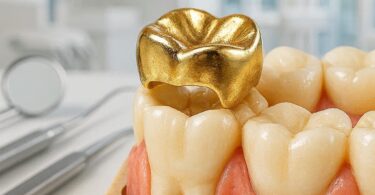
B. Full Metal (Gold or Cobalt-Chrome) Survey Crowns
-
Pros: Extremely durable, ideal for high-stress areas
-
Cons: Less aesthetic
C. Zirconia Survey Crowns
-
Pros: High strength, excellent aesthetics
-
Cons: Higher cost
6. Step-by-Step Procedure for Survey Crown Placement
Step 1: Diagnosis and Treatment Planning
-
Assess the patient’s denture needs.
-
Take impressions and perform a tooth survey.
Step 2: Tooth Preparation
-
Reduce the tooth structure to accommodate the crown.
Step 3: Impression and Temporary Crown
-
Send impressions to the lab.
-
Place a temporary crown.
Step 4: Crown Fabrication (Lab Process)
-
The dental lab designs the crown with retentive features.
Step 5: Crown Fitting and Denture Adjustment
-
Ensure proper fit with the RPD.
7. Common Dental Codes for Survey Crowns (CDT Codes)
-
D6057 – Prefabricated abutment for RPD
-
D6065 – Crown supported RPD retainer
8. Insurance and Billing Considerations
-
Verify coverage before treatment.
-
Use narrative notes to justify medical necessity.
9. Challenges and Complications
-
Poor denture fit due to incorrect crown contouring.
-
Insurance denials from incorrect coding.
10. Best Practices for Dentists and Labs
-
Communicate clearly with the dental lab.
-
Double-check CDT codes before submission.
11. Case Studies
-
Case 1: Patient with a lower RPD needing survey crowns for retention.
-
Case 2: Insurance denial due to incorrect coding (resolved with D6065).
12. Future Trends
-
Digital scanning for more precise survey crowns.
-
3D-printed crowns for faster production.
13. Conclusion
Survey crowns play a crucial role in RPD stability and patient comfort. Proper diagnosis, material selection, and CDT coding are essential for success. By following best practices, dentists can optimize both clinical outcomes and insurance reimbursements.
14. FAQs
Q1: What is the difference between a survey crown and a regular crown?
A: A survey crown has special contours for RPD retention, while a regular crown does not.
Q2: What is the best material for a survey crown?
A: Metal-ceramic or zirconia are popular choices for durability.
Q3: Which CDT code should I use for a survey crown?
A: D6065 is commonly used for crown-retained RPD abutments.