the linchpin connecting a physician’s skilled work to appropriate reimbursement, the key that unlocks data for research and public health, and a critical component of a patient’s permanent medical record. Among the thousands of codes in the CPT® (Current Procedural Terminology) lexicon, CPT code 11102 stands as a perfect example of this complex interplay. On its surface, it simply describes a “tangential biopsy of skin (eg, shave, scoop, saucerize, curette).” But beneath this succinct description lies a universe of clinical nuance, coding rules, and financial implications.
For medical coders, billers, practice managers, and even clinicians, a superficial understanding of 11102 is a liability. Misapplying this code can lead to claim denials, delayed payments, audits, and potential compliance issues. Conversely, mastering its intricacies ensures smooth revenue cycle operation, accurate data reporting, and, ultimately, the financial stability that allows a practice to continue providing essential patient care.
This definitive guide is designed to be your ultimate resource for CPT code 11102. We will move beyond a basic definition and embark on a comprehensive exploration. We will dissect the clinical procedure it represents, differentiate it from a myriad of similar codes, delve into the paramount importance of documentation, and chart a course through the turbulent waters of payer policies. Our goal is to transform your knowledge from simple recognition to deep, actionable mastery, empowering you to code with unwavering confidence and precision.
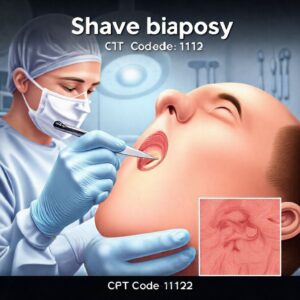
CPT Code 11102 for shave biopsy
2. Understanding the Shave Biopsy: A Clinical Primer
Before a coder can accurately assign a code, they must fundamentally understand the procedure it represents. A shave biopsy is not merely a “shave” in the conventional sense; it is a precise surgical technique with specific clinical intentions.
What is a Shave Biopsy?
A shave biopsy is a procedure where a physician uses a sharp instrument, typically a flexible biopsy blade or a scalpel, to remove a superficial sample of a skin lesion. The blade is moved in a tangential or horizontal plane relative to the skin’s surface, slicing across the base of the lesion. The depth of the excision is carefully controlled to remove the tissue of interest—typically the epidermis and the most superficial part of the dermis—while minimizing damage to deeper structures and avoiding a full-thickness incision. This results in a saucerized or shallow wound.
Clinical Indications and Objectives
A physician chooses a shave biopsy for specific types of lesions where the clinical question involves the upper layers of the skin. Common indications include:
-
Diagnosis of Superficial Lesions: Evaluating suspicious moles, seborrheic keratoses, skin tags, actinic keratoses, or superficial basal cell carcinomas.
-
Cosmetic Considerations: When a full-thickness excision would be unnecessary or would leave a more significant scar for a likely benign lesion.
-
Patient Factors: It is often quicker, requires no sutures, and results in less postoperative discomfort compared to an excision, making it suitable for patients who are anxious, on blood thinners, or have numerous lesions needing sampling.
The Procedure Step-by-Step:
-
Informed Consent: The physician discusses the procedure, risks, benefits, and alternatives with the patient.
-
Preparation: The site is identified, cleaned with an antiseptic solution like alcohol or chlorhexidine, and anesthetized using a local injectable anesthetic (e.g., lidocaine with epinephrine).
-
The Biopsy: The physician stabilizes the surrounding skin and, using a smooth, sweeping motion with a sterile blade, tangentially slices off the lesion at its base. The depth is controlled by the angle and pressure of the blade.
-
Hemostasis: Bleeding from the superficial wound is controlled using electrocautery (a hyfrecator), chemical agents (aluminum chloride or Monsel’s solution), or direct pressure.
-
Specimen Handling: The retrieved tissue sample is placed in a formalin-filled container and labeled for transport to a pathology laboratory.
-
Wound Care: The wound is typically left to heal by secondary intention. A topical antibiotic ointment and a bandage are applied. The patient is given instructions on keeping the area clean and dry.
(Image: A clinical photograph showing a physician performing a shave biopsy on a patient’s arm. The lesion is elevated by the anesthesia, and the blade is held at a shallow angle to the skin.)
Why the Clinical Understanding Matters for Coders:
A coder who understands that a shave biopsy is a superficial, tangential procedure is already better equipped to avoid common errors. They can intuitively grasp why it is coded separately from a full-thickness excision or a punch biopsy that removes a core of tissue. This clinical knowledge forms the bedrock upon which accurate coding is built.
3. The CPT® Coding System: A Foundation for Accuracy
The CPT code set, developed and maintained by the American Medical Association (AMA), is the standardized language used to report medical, surgical, and diagnostic services to insurers. Its primary purpose is to provide uniformity and streamline reporting and analysis.
The Integumentary System section of the CPT manual (codes 10030-19499) contains the codes for biopsies. Within this section, biopsies are categorized separately from excision procedures, a distinction of critical importance.
The Family of Biopsy Codes: 11102’s Immediate Relatives
CPT codes 11102 through 11107 are dedicated to biopsy procedures. They are categorized first by technique and then by number of lesions.
-
11102: Tangential biopsy of skin (eg, shave, scoop, saucerize, curette); single lesion.
-
11103: Each separate/additional lesion (List separately in addition to code for primary procedure). This is an add-on code.
-
11104: Punch biopsy of skin (including simple closure, when performed); single lesion.
-
11105: Each separate/additional lesion (List separately in addition to code for primary procedure). Add-on code.
-
11106: Incisional biopsy of skin (eg, wedge) (including simple closure, when performed); single lesion.
-
11107: Each separate/additional lesion (List separately in addition to code for primary procedure). Add-on code.
This structure highlights a key principle: Code 11102 is reported only once for the first lesion biopsied using the shave technique. For each subsequent shave biopsy performed at the same session, code 11103 is reported once for each additional lesion.
4. CPT Code 11102: A Deep Dive into the Details
Official CPT Descriptor:
“Tangential biopsy of skin (eg, shave, scoop, saucerize, curette); single lesion.”
Deconstructing the Language:
-
Tangential: This is the defining characteristic. It indicates the procedure was performed parallel to the skin’s surface, not perpendicular into it.
-
Shave, scoop, saucerize, curette: These are all acceptable techniques that achieve the same result—the removal of a superficial slice of tissue. The use of a curette (a scoop-shaped instrument) to scrape off a lesion falls under this code if it is performed for biopsy purposes. However, if curettage is used after electrodessication for destruction, it is not a biopsy.
What is Included in 11102?
CPT uses the concept of “bundling.” The work of code 11102 includes:
-
Local anesthesia (administered by the surgeon)
-
Preparation of the site
-
The biopsy procedure itself
-
Hemostasis (cautery or chemical)
-
Simple dressing application
What is Not Included?
-
Supply of materials (e.g., the blade, bandages) may be billed separately with a HCPCS Level II code (e.g., A4550 for surgical blades) if the payer allows, though many bundle these into the procedure payment.
-
Pathology services. The sending of the specimen to the lab is billed separately by the pathologist using codes from the Pathology and Laboratory section (88300-88309 for tissue examination).
-
Repair (closure). Since a shave biopsy wound is left open to heal, no closure is involved. If a simple closure is performed, it is included in excision codes but not in biopsy codes.
5. The Art of Differentiation: 11102 vs. Its Neighbors
The most common coding errors occur when 11102 is confused with other procedures. A master coder must be an expert at differentiation.
11102 (Shave Biopsy) vs. 11300-11313 (Shave Removal/Excision of Lesion)
This is the single most important distinction and a major audit risk.
-
Intent: A biopsy (11102) is performed to obtain tissue for diagnosis. The clinical intent is “I need to find out what this is.” The entire lesion may or may not be removed; the primary goal is sampling.
-
Intent: A shave excision (11300-11313) is performed for treatment/removal of a known or presumed benign lesion (e.g., a skin tag, a benign nevus). The clinical intent is “I am removing this lesion.” The goal is complete removal for cosmetic or prophylactic reasons, not primarily for diagnosis.
Coding Consequence: If a lesion is removed via shave technique and sent to pathology “just to be sure,” but the intent was removal, the appropriate code is from the 11300 series (shave excision), not 11102 (biopsy). The diagnosis code must support the medical necessity of the removal. Using 11102 for a removal is incorrect and can be considered upcoding.
11102 (Shave Biopsy) vs. 11104/11105 (Punch Biopsy)
-
Technique: A shave biopsy is tangential. A punch biopsy uses a circular blade (“punch”) to remove a full-thickness cylindrical core of tissue, including subcutaneous fat.
-
Closure: A punch biopsy (11104/11105) includes simple closure if performed. A shave biopsy does not involve closure.
-
Use Case: A punch biopsy is chosen when a deeper tissue sample is needed, such as for diagnosing inflammatory conditions (e.g., lupus, vasculitis) or deeper tumors.
11102 (Shave Biopsy) vs. 11600-11646 (Excision, Malignant Lesion)
-
Depth: A shave biopsy is partial-thickness. An excision (11600-11646) is full-thickness, removing the entire lesion down to the subcutaneous fat.
-
Margin: Excisions are performed with defined surgical margins (e.g., 2mm, 5mm) around the lesion to ensure complete removal of cancerous tissue. A biopsy has no such defined margin; it is a sample.
-
Closure: Excision codes include simple closure. Intermediate or complex closure can be billed separately if documented.
Differentiating Common Skin Procedures
| CPT Code | Procedure | Technique | Depth | Intent | Includes Closure? |
|---|---|---|---|---|---|
| 11102 | Shave Biopsy | Tangential slice | Superficial (epidermis, superficial dermis) | Diagnostic Sampling | No |
| 1130X | Shave Excision | Tangential slice | Superficial (epidermis, superficial dermis) | Treatment/Removal | No |
| 11104 | Punch Biopsy | Circular core | Full-thickness (into subcutaneous fat) | Diagnostic Sampling | Yes, Simple |
| 1160X | Excision, Malignant | Full-thickness incision | Full-thickness (into subcutaneous fat) | Treatment/Removal | Yes, Simple |
(Graphic: A side-view diagram of skin layers (epidermis, dermis, subcutaneous fat) with arrows pointing to each procedure type showing its depth and angle: Shave Biopsy – shallow horizontal arrow; Punch Biopsy – vertical cylindrical arrow through all layers; Excision – a deep, wide “V” shape into the fat.)
6. The Crucial Role of Medical Necessity and Documentation
The code is only as good as the documentation that supports it. The medical record must tell a clear, consistent story that justifies the medical necessity of the procedure.
Key Elements of Supporting Documentation:
-
History and Physical: The note should describe the lesion (size, location, color, shape, duration, changes) and the reason for concern. A note that simply says “lesion on back” is insufficient.
-
Medical Decision Making: The physician should document their differential diagnosis (e.g., “rule out basal cell carcinoma vs. sebaceous hyperplasia”).
-
Procedure Note: This is the most critical part. It must state:
-
Technique Used: The specific word “shave biopsy” or “tangential biopsy” is ideal.
-
Intent: Phrases like “biopsied for diagnosis” or “sample sent to pathology” support 11102.
-
Lesion(s) Number and Location: Clearly identify each lesion biopsied (e.g., “1.5 cm pigmented lesion on left cheek”).
-
Anesthesia: Type and amount used.
-
Hemostasis: Method used (e.g., “hemostasis achieved with electrocautery”).
-
Specimen Handling: A note that the specimen was sent to pathology.
-
Patient Instructions: Given post-procedure care instructions.
-
The “Aha!” Moment for Coders:
If the procedure note reads, “Shave excision of benign-appearing nevus from arm. Specimen sent to path,” a savvy coder will recognize a problem. The term “excision” implies removal, and “benign-appearing” undermines medical necessity for a biopsy. The coder should query the physician for clarification before automatically assigning 11102. The correct code might be from the 11300 series if the intent was truly removal.
7. A Step-by-Step Guide to Billing and Reimbursement
1. Code Assignment:
-
Identify the primary procedure: First shave biopsy = 11102.
-
Count additional lesions: Each subsequent shave biopsy performed at the same session = +11103.
-
Do not append modifier -50 (Bilateral Procedure) for biopsies on both sides of the body. Each lesion is coded individually by body area using 11102 and 11103.
2. Modifier Application:
-
Modifier -59 (Distinct Procedural Service): Used to indicate that a procedure was distinct or independent from other services performed on the same day. This might be necessary if, for example, a shave biopsy (11102) is performed on the arm and an unrelated punch biopsy (11104) is performed on the leg during the same encounter. It signals to the payer that the procedures should not be bundled.
-
Modifier -LT / -RT (Left Side, Right Side): While not always required, these can provide additional clarity regarding the location of the biopsy.
3. Diagnosis Code (ICD-10-CM) Linking:
The diagnosis code must support the medical necessity of a biopsy. It should reflect the physician’s medical reason for suspecting a condition that requires histologic confirmation.
-
Strong Supporting Diagnoses: R21 (Rash and other nonspecific skin eruption), L57.0 (Actinic keratosis), L82.1 (Other seborrheic keratosis), D48.5 (Neoplasm of uncertain behavior of skin), N84.1 (Polyp of cervix) – if biopsied.
-
Weak/Unsupported Diagnoses: L72.0 (Epidermal cyst) – typically not biopsied but excised; B07.9 (Viral wart) – typically destroyed or excised.
-
The Rule-Out Diagnosis: Most payers accept diagnosis codes that describe a sign or symptom (e.g., R21, R19.0 – Skin mass) or an uncertain diagnosis (e.g., D48.5) to justify a biopsy.
4. Claim Submission:
The claim (typically CMS-1500 form or electronic equivalent) will include:
-
CPT Codes: 11102, 11103 x [number of additional lesions]
-
ICD-10-CM Code: The supporting diagnosis
-
Place of Service (POS): e.g., 11 (Office)
-
Modifiers: If applicable
8. Navigating Common Pitfalls and Audit Triggers
Understanding what triggers denials and audits is key to prevention.
Top Pitfalls:
-
Coding a Removal as a Biopsy: Using 11102 when the intent was removal (using 1130X) is a major red flag.
-
Incorrect Lesion Count: Forgetting to code add-on code 11103 for subsequent lesions, or incorrectly using 11102 for each lesion.
-
Unsupported Medical Necessity: Using a diagnosis code that does not justify a diagnostic procedure.
-
Lack of Documentation: The procedure note fails to specify the technique or intent.
-
Unbundling: Improperly using modifier -59 to separate procedures that should be bundled.
Audit-Proofing Your Practice:
-
Regular Audits: Conduct internal audits of biopsy coding.
-
Coder-Physician Education: Foster communication. Coders should educate physicians on what needs to be documented, and physicians can educate coders on clinical nuances.
-
Stay Updated: Payer policies change. Subscribe to AMA CPT Network and payer newsletters.
-
Leverage Technology: Use EHR templates that prompt physicians for necessary documentation elements (e.g., technique, intent, location).
9. The Future of Dermatologic Coding: Trends and Considerations
The landscape of medical coding is not static. Several trends could impact how we report shave biopsies:
-
Increased Scrutiny: Medicare Administrative Contractors (MACs) and other payers are increasingly focused on dermatology services due to high utilization. Understanding and adhering to Local Coverage Determinations (LCDs) is becoming more critical.
-
Value-Based Care: The shift from fee-for-service to value-based reimbursement may change how these services are bundled into larger episode-of-care payments.
-
Telehealth Integration: As telehealth becomes more common for initial dermatological consultations, the process of documenting a lesion for later biopsy will evolve.
-
CPT Updates: The AMA regularly updates CPT. While 11102 has been stable, its guidelines and parenthetical notes can change. The 2025 CPT codebook must be consulted for the most current information.
10. Conclusion: The Path to Mastery
Mastering CPT code 11102 transcends mere memorization. It demands a synthesis of clinical understanding, coding expertise, and meticulous attention to documentation detail. It is about discerning the physician’s intent, accurately translating a tangible procedure into a digital code, and ensuring that this translation is fully supported by the patient’s story as recorded in the chart. By embracing this holistic approach—where clinical knowledge informs coding decisions, and robust documentation validates them—medical professionals can achieve not just compliance, but true mastery, ensuring the integrity of the revenue cycle and the quality of patient data.
11. Frequently Asked Questions (FAQs)
Q1: Can I report 11102 if the physician uses a curette to scrape off a lesion for biopsy?
A: Yes. The CPT descriptor for 11102 explicitly includes “curette” as an example of a tangential technique. If the curettage is performed to obtain a tissue sample for diagnosis, 11102 is appropriate.
Q2: A physician performs a shave biopsy on one lesion and a punch biopsy on another lesion during the same patient visit. How is this coded?
A: Code the primary procedure first. You would report 11102 for the shave biopsy and 11104 for the punch biopsy. Because these are different techniques performed on separate lesions, you must append modifier -59 to the second-listed code (e.g., 11104-59) to indicate it was a distinct procedural service and avoid bundling.
Q3: The pathology report comes back confirming a malignant melanoma. Do I change the biopsy code to an excision code?
A: Absolutely not. CPT codes reflect the procedure that was actually performed during the encounter. The biopsy was a diagnostic sampling procedure, so 11102 remains the correct code. The final diagnosis does not change the procedure code. The malignancy will be treated with a separate, more extensive procedure (e.g., a wide excision, 1160X) at a future date, which will be coded separately.
Q4: Does 11102 include the supply of the blade used for the procedure?
A: The work of performing the procedure includes the use of the blade. However, the supply cost of the blade itself can sometimes be billed separately using a HCPCS Level II code like A4550 (Surgical blades). This is highly payer-specific. Many insurers, including Medicare, consider the blade supply to be bundled into the payment for 11102 and will not reimburse for it separately. You must check your individual payer’s policy.
Q5: How do I code for a shave biopsy performed on a mucosal surface (e.g., inside the mouth or on the lip)?
A: The codes 11102-11107 are specific to skin. For a shave biopsy of a mucosal membrane, you would use a code from the appropriate anatomical section. For example, a shave biopsy of the lip mucosa might use code 40490 (Biopsy of lip) instead. Always choose the code that most accurately describes the anatomy and procedure.
12. Additional Resources
For the most accurate and authoritative information, always consult these primary sources:
-
AMA CPT® Professional Edition Codebook: The definitive source for CPT codes, guidelines, and descriptors. Updated annually.
-
CMS (Centers for Medicare & Medicaid Services) Manuals: Particularly the Medicare Claims Processing Manual (Pub. 100-04) for billing rules.
-
Local Coverage Determinations (LCDs): Search the CMS website for LCDs from your regional MAC that pertain to dermatology and biopsy procedures. These outline specific coverage requirements.
-
American Academy of Dermatology (AAD) – Coding Resources: The AAD provides excellent coding guides, webinars, and newsletters tailored to dermatology practices.
-
American Health Information Management Association (AHIMA) & American Academy of Professional Coders (AAPC): These professional organizations offer certifications, continuing education, journals, and forums where coding professionals can discuss complex scenarios.
Date: September 1, 2025
Author: The Medical Coding Specialist Team
Disclaimer: The information contained in this article is for educational and informational purposes only and is not intended as medical or legal advice. While every effort has been made to ensure accuracy, CPT® codes are proprietary to the American Medical Association (AMA), and the definitive resources should always be the most current CPT® codebook and payer-specific guidelines. Always consult with a qualified healthcare provider for any health concerns and with a certified professional coder for specific billing advice.