A wart. It’s a common, often benign skin growth that many consider a mere cosmetic nuisance. For healthcare providers, however, a wart represents a clinical decision tree with numerous branches: What is the best treatment method for this specific patient? Is it truly a wart, or could it be something more serious? For medical coders, billers, and practice managers, that same wart transforms into a critical question of accuracy and compliance: What is the correct CPT code? The seemingly simple act of removing a wart is underpinned by a complex framework of medical coding that, if navigated incorrectly, can lead to claim denials, reduced reimbursements, compliance issues, and even legal challenges. This article delves deep into the world of CPT codes for wart removal, moving beyond a simple code list to provide a comprehensive understanding of the “why” behind the “what.” We will explore the clinical rationale, the intricate details of the CPT manual, payer-specific policies, and practical scenarios to equip providers, coders, and interested patients with the knowledge needed to confidently navigate this essential aspect of dermatological and primary care practice.
CPT Codes for Wart Removal
2. Understanding the CPT® Universe: A Primer on Medical Coding
To understand the codes for wart removal, one must first grasp the system they belong to.
What is the CPT® Code Set?
Current Procedural Terminology (CPT®) is a uniform coding system developed and maintained by the American Medical Association (AMA). It is used to describe medical, surgical, and diagnostic services performed by healthcare providers. CPT codes are five-digit numeric codes that provide a standardized language for reporting services to insurers, ensuring uniformity and streamlining communication. The system is divided into three categories:
-
Category I: The largest section, containing codes for procedures and services widely performed and approved by the FDA (if applicable). This is where the vast majority of wart removal codes reside.
-
Category II: Optional alphanumeric codes used for performance measurement and tracking. These are not used for billing.
-
Category III: Temporary codes for emerging technologies, services, and procedures. These allow for data collection on new services that may eventually become Category I codes.
The Importance of Accurate Medical Coding
Accurate coding is the lifeblood of a medical practice. It is far more than a clerical task; it is a critical function that directly impacts:
-
Reimbursement: Correct codes ensure the provider is paid accurately and promptly for the services rendered.
-
Compliance: Using inappropriate codes can be construed as fraud or abuse, leading to audits, hefty fines, and legal repercussions.
-
Data Analytics: Coded data is used for public health tracking, research, and understanding disease prevalence and treatment outcomes.
-
Operational Efficiency: Clean, accurate claims reduce denials and the administrative burden of re-submissions and appeals.
3. Before the Code: Clinical Considerations in Wart Management
Coding cannot be divorced from clinical medicine. The chosen code is a direct reflection of the clinical service provided.
What Are Warts? Virology and Presentation
Warts are caused by the human papillomavirus (HPV), which infects the top layer of skin and causes it to grow rapidly, forming a raised lesion. They are classified by their appearance and location:
-
Common warts (Verruca vulgaris): Rough, raised bumps often on hands, fingers, and knees.
-
Plantar warts (Verruca plantaris): Grow inward on the weight-bearing areas of the foot due to pressure, often painful.
-
Flat warts (Verruca plana): Smaller, smoother warts that appear in large numbers on the face, neck, or hands.
-
Filiform warts: Long, narrow, frond-like growths typically appearing on the face.
-
Periungual warts: Grow around or under fingernails and toenails.
Diagnosis and Documentation: The Foundation of Accurate Coding
A provider must first diagnose the lesion. While often clinical, sometimes a biopsy (which has its own CPT codes, 11102-11107) is necessary to rule out malignancy like squamous cell carcinoma, which can sometimes mimic a wart. The medical record must be detailed and support the medical necessity of the procedure. Key documentation elements include:
-
Location: Precise anatomical site (e.g., “third digit, right hand,” “plantar surface of left heel”).
-
Size: The diameter of the lesion in centimeters. This is critical for excision codes.
-
Number: The exact count of lesions treated.
-
Description: Morphology (e.g., raised, flat, verrucous, keratotic).
-
Symptoms: Is it painful? bleeding? causing functional impairment?
-
Method of Removal: Specific technique used (e.g., “liquid nitrogen cryotherapy,” “electrodesiccation,” “scissor excision”).
-
Medical Necessity: Reason for removal (e.g., “patient reports pain with walking,” “lesion is repeatedly snagged and bleeding,” “failed previous over-the-counter treatments”).
The Treatment Decision: Factors Influencing the Choice of Procedure
The choice of treatment dictates the CPT code. Factors include:
-
Lesion type, size, and location
-
Patient age and pain tolerance
-
Provider preference and expertise
-
Cost and equipment availability
Common treatments include: -
Cryotherapy: Freezing with liquid nitrogen.
-
Electrosurgery: Burning with an electric current.
-
Laser therapy: Using a concentrated beam of light.
-
Excision: Cutting the wart out with a scalpel.
-
Chemical destruction: Applying acids like salicylic acid or trichloroacetic acid (often considered part of the E/M service or a supply cost if applied in-office, not typically a separately billable destruction procedure).
4. The CPT® Code Catalog for Wart Removal: A Detailed Breakdown
This is the core of the coding process. Wart removal is primarily captured under two code families: Destruction and Excision.
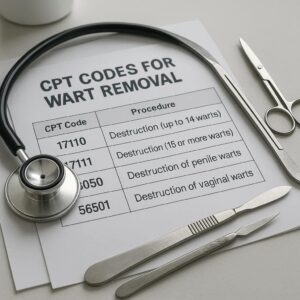
Category I: Destruction Methods (CPT Codes 17110 & 17111)
These are the most frequently used codes for wart removal. “Destruction” means the ablation of benign tissue by any method, not requiring suture closure.
-
CPT Code 17110: Destruction (e.g., laser surgery, electrosurgery, cryosurgery, chemosurgery), of benign lesion other than skin tags or cutaneous vascular proliferative lesions; single lesion.
-
Application: Use this code when one wart is destroyed.
-
“Single Lesion”: This is a per lesion code. If you destroy one wart, you report 17110 once.
-
-
CPT Code 17111: Destruction…; 2 to 14 lesions.
-
Application: Use this code when multiple warts are destroyed during the same session.
-
Crucial Note: This is a single code that represents the destruction of any number of lesions between 2 and 14. You report 17111 only once, regardless of whether you destroy 2, 5, or 14 warts. It is not reported per lesion.
-
-
Modifiers and Multiple Lesions:
-
What about 15 or more lesions? The CPT manual instructs you to use 17111 for 2-14 lesions and add add-on code +17112 for each additional lesion beyond 14. For example:
-
15 lesions destroyed: Report 17111 (for lesions 2-14) + +17112 x 1 (for the 15th lesion).
-
20 lesions destroyed: Report 17111 + +17112 x 6 (for lesions 15-20).
-
-
Modifier 59 (Distinct Procedural Service): Rarely, if lesions are in distinctly separate anatomical areas and require separate setups, this modifier might be applicable to indicate separate procedures. However, payer policies on this are very strict.
-
-
Methods of Destruction Covered: 17110 and 17111 are “method-independent.” They cover cryotherapy, electrosurgery, laser, and even chemical destruction if performed as a surgical procedure. The code represents the work of destruction itself.
Category II: Excision Methods (CPT Codes 11400-11446 & 11600-11646)
Excision codes are used when the lesion is cut out completely, requiring suture closure. These codes are chosen based on two factors: 1) Benign (11400-11446) vs. Malignant (11600-11646) and 2) The size of the lesion at its largest diameter plus the size of the margins required for removal.
-
Understanding Excision of Benign Lesions (CPT 11400-11446): Since warts are benign, this family is used if they are excised.
-
The code is chosen based on the excised diameter.
-
The excised diameter is calculated as the largest clinical diameter of the lesion itself PLUS the narrowest margins required to remove it completely.
-
Example: A provider excises a 0.5 cm wart on the arm. They take a 0.2 cm margin all the way around. The excised diameter is 0.5 cm + 0.2 cm + 0.2 cm = 0.9 cm. You would report code 11401 (Excision, benign lesion, trunk, arms or legs; excised diameter 0.6 to 1.0 cm).
-
These codes are anatomic site-specific (e.g., face, trunk, arms, legs), and each range has different size brackets and reimbursement values.
-
-
Shaving (CPT Codes 11300-11313): Shaving is a tangential removal without a full-thickness dermal excision. It does not require suture closure. It is less common for deep-seated warts like plantars but can be used for raised lesions. Like excision codes, they are chosen based on the lesion’s size and location.
Category III: Emerging Technologies
As new technologies emerge, such as specific laser wavelengths optimized for HPV, they may be tracked with Category III codes before being incorporated into the broader Category I codes like 17110.
5. Coding in Action: Real-World Clinical Scenarios and Examples
Let’s apply this knowledge to practical situations.
Scenario 1: Single Plantar Wart
-
Presentation: A 45-year-old patient presents with a painful 0.8 cm plantar wart on the right heel. The provider performs cryotherapy with liquid nitrogen.
-
Documentation: “Single, 0.8 cm verrucous, keratotic plaque on plantar right heel. Causing significant pain with ambulation. Treated with liquid nitrogen cryotherapy for approximately 10 seconds with a 1mm halo. Patient tolerated well.”
-
Correct Coding: 17110. A single lesion was destroyed.
Scenario 2: Multiple Common Warts on a Child’s Hands
-
Presentation: A 10-year-old has 8 small common warts across the dorsum of both hands. The provider uses electrodesiccation to treat all 8.
-
Documentation: “Eight (8) verrucous papules, each 2-4mm in size, scattered across dorsum of bilateral hands. Treated with electrodesiccation. Total of 8 lesions destroyed.”
-
Correct Coding: 17111. This single code covers the destruction of 2 to 14 lesions.
Scenario 3: A Large, Suspicious Lesion
-
Presentation: A 60-year-old patient has a 1.2 cm rough, irregular lesion on the cheek that has been growing. The provider is concerned it may not be a wart and performs an excision.
-
Documentation: “1.5 cm irregular hyperkeratotic plaque on left cheek. Concern for malignancy vs. verruca. Excised with 0.3 cm margins. Excised diameter 2.1 cm. Sent to pathology for analysis. Closed with layered sutures.”
-
Pathology Result: Returns as a benign verruca.
-
Correct Coding: Even though the final diagnosis is benign, the procedure was performed based on suspicion of malignancy. Therefore, you must use the malignant excision codes (1164x series). The excised diameter is 1.5 cm + 0.3 cm + 0.3 cm = 2.1 cm. The correct code would be 11642 (Excision, malignant lesion including margins, face, ears, eyelids, nose, lips; excised diameter 2.1 to 3.0 cm). The code reflects the work done, not the final diagnosis.
Quick-Reference Guide to Common Wart Removal CPT Codes
| CPT Code | Code Description | Typical Use Case | Key Considerations |
|---|---|---|---|
| 17110 | Destruction, benign lesion; single lesion | Freezing or burning one wart. | Report once for one lesion. |
| 17111 | Destruction, benign lesions; 2-14 lesions | Freezing or burning multiple warts in one session. | Single code for 2-14 lesions. Do not report per lesion. |
| +17112 | Destruction, benign lesions; each additional lesion beyond 14 | Destroying a very high number of warts (e.g., 15+). | Add-on code. Must be reported with 17111. |
| 11400-11446 | Excision, benign lesion | Cutting out a known wart, requiring stitches. | Code based on location and excised diameter (lesion + margins). |
| 11300-11313 | Shaving of epidermal or dermal lesion | Slicing off a raised wart, not requiring stitches. | Code based on location and largest lesion diameter. |
| 11102-11107 | Tangential biopsy (e.g., shave biopsy) | Sampling a lesion for diagnosis before treatment. | Used when diagnosis is uncertain. Different from therapeutic shaving. |
6. The Financial Anatomy: Reimbursement and Payer Policies
The code is submitted, but payment is not guaranteed. It is governed by payer rules.
Medicare and National Correct Coding Initiative (NCCI) Edits
Medicare and most commercial payers follow NCCI edits, which are rules that prevent improper payment when certain codes are reported together. A key edit for wart removal is that the destruction code (17110/17111) is bundled into an Evaluation and Management (E/M) service (e.g., 99202, 99213) performed on the same day by the same provider. This means you cannot typically bill both an office visit and the destruction unless the E/M service was significant, separately identifiable, and modifier 25 is appended to the E/M code. The documentation must clearly support the separate E/M service (e.g., “Patient seen for established visit for hypertension management. During the exam, patient also requests treatment for a new painful wart on finger. After completing the HTN visit, we proceeded with cryotherapy…”).
Commercial Payer Variations
Every insurance company has its own policy. Some may limit the number of warts treated per session. Others may have preferred treatments or require prior authorization for certain methods like laser. It is imperative to check the patient’s specific plan benefits and the payer’s policy for wart removal before treatment.
The Role of Medical Necessity
Insurers will not pay for procedures they deem “cosmetic.” If a wart is asymptomatic and not causing functional impairment, the removal may be considered cosmetic and denied. The provider’s documentation must robustly establish medical necessity: pain, bleeding, itching, interference with function, or risk of malignancy.
7. The Patient Perspective: Understanding Costs and Consent
Transparency in Patient Billing
Patients should be informed of potential costs upfront. If a procedure might be considered cosmetic or is subject to a deductible, they should be notified before treatment. Providing a good faith estimate prevents surprise bills and improves patient satisfaction.
The Importance of Informed Consent
Beyond financial consent, clinical informed consent is mandatory. The patient must understand the procedure, its risks (pain, scarring, infection, recurrence), alternatives, and the option of no treatment. This conversation should be documented in the chart.
8. Avoiding Common Pitfalls and Audit Triggers
-
Unbundling: Reporting 17110 multiple times for multiple warts instead of a single 17111. This is a serious error.
-
Insufficient Documentation: The chart must support the code selected. No size? Excision code is wrong. No lesion count? Destruction code is unsupported.
-
Upcoding: Using an excision code (which pays more) when a destruction was performed. Or using a malignant code for a known benign wart.
-
Downcoding: Using a destruction code when a complex excision was performed, unfairly reducing reimbursement for the work done.
9. The Future of Wart Removal and Its Coding
Advancements in Treatment
Research continues into immunotherapies (e.g., topical imiquimod, intralesional antigens) and more targeted lasers. These may eventually require new or revised CPT codes to accurately describe the service.
Evolution of the CPT® Code Set
The AMA’s CPT Editorial Panel constantly reviews and updates the code set. The trend in dermatology has been toward more specific codes. It is possible that in the future, the generic 17110/17111 could be replaced by more specific codes for different destruction methods or anatomic sites.
10. Conclusion: Mastering the Art and Science of Coding
Accurate coding for wart removal is a precise intersection of clinical detail and administrative rigor. The provider’s thorough documentation of the lesion’s size, number, location, and the method of removal provides the essential blueprint. The coder must then meticulously translate this clinical picture into the correct CPT code, adhering to code definitions, bundling rules, and payer-specific policies. Mastering this process ensures compliant reimbursement, minimizes audit risk, and ultimately supports the financial health of the practice while accurately reflecting the valuable care provided to the patient.
11. Frequently Asked Questions (FAQs)
Q1: Why was I billed for an office visit and the wart removal? I thought it was all one thing.
A: This is a common point of confusion. If you see the doctor for a specific problem (like a wart) and they treat it during that same visit, the treatment is usually included. However, if you had a separate, significant medical issue addressed during the same appointment (e.g., a medication refill for high blood pressure, discussion of lab results), and the wart was an additional problem treated, the provider may bill both an office visit (with modifier 25) and the procedure. The documentation must support that two distinct services were provided.
Q2: I had 5 warts frozen off. Why did my insurance only pay for one?
A: This almost certainly means your provider incorrectly billed the procedure using five units of code 17110 (for a single lesion). The correct way to bill 5 lesions is with one unit of code 17111. You should contact your provider’s billing office and ask them to check their coding and re-submit the claim with 17111.
Q3: My insurance denied the claim as “cosmetic.” What can I do?
A: Talk to your provider. They can submit an appeal to the insurance company with documentation from your medical record proving the medical necessity of the procedure. This documentation should include notes about pain, bleeding, functional impairment, or other symptoms you reported.
Q4: What is the difference between a “destruction” and an “excision”?
A: Destruction (e.g., freezing, burning) ablates the tissue; it is destroyed and sloughs off. Excision involves cutting the lesion out with a scalpel, which typically requires stitches to close the wound. Excision is often used for larger lesions or when a tissue sample is needed for biopsy.
Q5: Are there codes for applying acid to treat a wart?
A: Typically, no. The application of topical acids like salicylic acid in an office setting is usually considered part of an Evaluation and Management (E/M) service (the office visit) and is not separately billed as a procedure like destruction or excision. The cost of the material may be billed as a supply.
12. Additional Resources
-
The American Medical Association (AMA): The ultimate source for the CPT® code set. Purchasing the current year’s CPT Professional Edition is essential for any coding professional.
-
The Centers for Medicare & Medicaid Services (CMS): Provides access to NCCI edits, Medicare coverage policies, and fee schedules.
-
American Academy of Dermatology Association (AAD): Offers clinical guidelines on the treatment of warts, which can inform medical necessity.
-
American Academy of Professional Coders (AAPC): A premier organization for medical coders, offering certifications, training, and resources.
-
American Health Information Management Association (AHIMA): Another leading authority on health information and coding.
Date: September 7, 2025
Author: The Medical Billing Insights Team
Disclaimer: This article is intended for informational and educational purposes only. It does not constitute medical, legal, or financial advice. Medical coding is complex and constantly evolving. The information herein should not be used as a substitute for consulting the latest official CPT® manual from the American Medical Association (AMA), payer-specific guidelines, or a certified professional coder. CPT® is a registered trademark of the American Medical Association.