In the relentless pace of modern life, from the physical demands of manual labor to the repetitive motions of the digital workstation, our bodies are constantly pushed to their limits. This often manifests not as a single, traumatic event, but as a gradual, insidious accumulation of stress on our musculoskeletal system. It’s the sharp twinge in a construction worker’s back after a long day lifting heavy materials, the persistent ache in a cashier’s wrist from scanning countless items, or the debilitating shoulder pain experienced by a painter after hours of overhead work. This is the domain of overexertion and repetitive movements—a silent epidemic responsible for millions of injuries, countless lost workdays, and a significant burden on global healthcare systems.
Capturing the essence of these injuries within the structured language of medical classification falls to a specific and highly important code in the ICD-10-CM system: X50. Overexertion and strenuous or repetitive movements. This code, though simple in its alphanumeric designation, unlocks a deeper understanding of how, and often why, a patient presents with a specific condition. It moves the narrative beyond the “what” (e.g., a rotator cuff tear) to the “how” (e.g., from repetitive overhead lifting). This article serves as the definitive guide to ICD-10-CM Code X50, We will dissect its structure, illuminate its clinical applications through real-world case studies, delve into the critical importance of precise documentation, and explore its profound implications for public health, occupational safety, and medical reimbursement. For medical coders, healthcare providers, safety officers, and anyone involved in patient care and health data analysis, mastering the nuances of code X50 is not just a matter of administrative accuracy; it is a fundamental component of understanding and addressing one of the most common causes of human injury today.
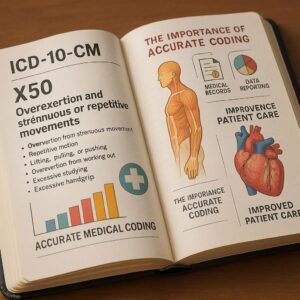
ICD-10-CM Code X50
Chapter 1: Understanding the ICD-10-CM Framework and the V/Y Chapter
To fully appreciate the role of code X50, one must first understand its place within the grand architecture of the International Classification of Diseases, Tenth Revision, Clinical Modification (ICD-10-CM). This system is far more than a simple list of diseases; it is a complex, hierarchical taxonomy used globally to encode diagnoses, symptoms, and reasons for encounters with healthcare services. Its primary purposes are multifaceted: it standardizes medical language for clear communication, enables the collection of reliable health statistics for public health surveillance, and forms the backbone of billing and reimbursement processes in healthcare systems like that of the United States.
A Deep Dive into Chapter XX: External Causes of Morbidity (V00-Y99)
ICD-10-CM is divided into 22 chapters, each covering a specific disease or condition category. Chapter XX, titled “External Causes of Morbidity,” is where code X50 resides. This chapter is unique. While most chapters describe the nature of a disease or injury (the “what”), Chapter XX describes the circumstance or cause of the injury (the “how,” “where,” and “when”). Codes from this chapter are never used as a primary diagnosis. Instead, they are intended to provide supplementary information that paints a complete clinical picture.
The codes within Chapter XX are organized by the type of external cause:
-
Transport Accidents (V00-V99): Categorizes events involving any vehicle.
-
Falls (W00-W19): Specifies the cause and location of falls.
-
Exposure to Inanimate Mechanical Forces (W20-W49): Includes being struck by objects, caught in equipment, etc.
-
Exposure to Animate Mechanical Forces (W50-W64): Includes bites, strikes, and other injuries caused by humans or animals.
-
Accidental Non-Mechanical Injury (W85-W99): Covers electric shocks, radiation, and noise exposure.
-
Intentional Self-Harm (X71-X83): For suicide and self-inflicted injury.
-
Assault (X85-Y09): For injuries inflicted by another person.
-
Event of Undetermined Intent (Y21-Y33): When the intent of the injury cannot be determined.
-
Legal Intervention and Operations of War (Y35-Y36): Specific to these circumstances.
-
Complications of Medical and Surgical Care (Y62-Y84): For misadventures during care.
-
Other External Causes of Accidental Injury (X50-X58): This is the category that contains our code of focus, X50.
The Role and Importance of External Cause Codes
The use of external cause codes, while often not mandatory for reimbursement in all outpatient settings in the U.S., is critically important for several reasons:
-
Public Health and Prevention: By analyzing data from external cause codes, health agencies can identify patterns and trends in injuries. A high incidence of X50 codes in a specific industry, for example, can trigger targeted workplace safety interventions and ergonomic assessments.
-
Research: Epidemiologists and occupational health researchers rely on this data to study the risk factors and long-term outcomes associated with different types of injuries.
-
Clinical Care: Understanding the cause of an injury can inform treatment plans and guide recommendations for activity modification to prevent re-injury.
-
Legal and Insurance Purposes: In workers’ compensation, personal injury, or liability cases, an external cause code like X50 provides unambiguous, standardized evidence of the claimed cause of injury, which is crucial for adjudicating claims.
Chapter 2: A Granular Look at ICD-10-CM Code X50
Official Code Description and Hierarchy
Code X50 is found in the ICD-10-CM index under “Overexertion” and “Strenuous movement.” Its official, full description is:
X50. Overexertion and strenuous or repetitive movements
It belongs to the broader category:
-
X50-X58: Other external causes of accidental injury
-
Chapter XX: External causes of morbidity (V00-Y99)
A crucial aspect of code X50 is that it requires a 7th character to denote the encounter type:
-
A: Initial encounter
-
D: Subsequent encounter
-
S: Sequela
Therefore, a complete code would be X50.0XXA for an initial encounter related to an overexertion injury.
Deciphering the Terminology: Overexertion, Strenuous, and Repetitive
The power and utility of code X50 lie in its ability to capture three distinct, yet often overlapping, mechanisms of injury. Understanding the clinical meaning of each term is paramount for accurate application.
-
Overexertion: This refers to exerting physical effort beyond one’s current capacity or state of training. It often implies an acute event where the load (weight, force) or duration of activity exceeds the structural tolerance of the muscles, tendons, ligaments, or bones. Example: A person who does not regularly exercise suddenly tries to lift a heavy piece of furniture and feels an immediate “pop” in their lower back.
-
Strenuous Movements: This describes activities that require a high level of physical exertion or force. While similar to overexertion, it can be a chronic state for individuals in certain occupations. The movement itself is inherently demanding. Example: A firefighter forcing open a door, a mover carrying a grand piano, or a landscaper digging with a shovel.
-
Repetitive Movements: This mechanism is characterized by the repeated performance of the same motion or task over a prolonged period. The injury is not caused by a single excessive force but by the cumulative micro-trauma from thousands of sub-maximal efforts. This leads to inflammation, tissue fatigue, and eventual breakdown. Example: A data entry clerk developing carpal tunnel syndrome from constant typing, or a baseball pitcher developing a torn ulnar collateral ligament from the repetitive throwing motion.
The Crucial “And/Or” Distinction in Clinical Scenarios
The official description “Overexertion and strenuous or repetitive movements” is deliberately inclusive. This Boolean logic allows the code to be used in several scenarios:
-
Overexertion AND Strenuous Movements: The classic acute injury from a single, heavy lift.
-
Overexertion AND Repetitive Movements: A scenario where the cumulative effect of repetition is compounded by a final, excessive effort.
-
Strenuous OR Repetitive Movements: It can be one or the other. A patient’s injury may be purely from repetition without a specific overexertion event, or purely from a single strenuous act without a history of repetition.
This flexibility ensures that code X50 can accurately reflect the complex and varied etiologies presented in clinical practice.
Chapter 3: Clinical Applications and Real-World Scenarios
Theoretical knowledge is solidified through practical application. Let’s explore how code X50 is used in various clinical settings.
Case Study 1: The Weekend Warrior (Acute Overexertion)
-
Patient: A 45-year-old male with a sedentary office job.
-
Presentation: Presents to the Emergency Department with acute, severe pain in his right Achilles tendon. He reports that while playing a vigorous game of basketball with friends over the weekend (an activity he engages in only occasionally), he felt a sudden, sharp pain as he pushed off to run.
-
Examination & Diagnosis: Physical exam reveals swelling, tenderness, and a positive Thompson test. An MRI confirms a complete Achilles tendon rupture.
-
Coding:
-
Primary Diagnosis: S86.011A – Strain of right Achilles tendon, initial encounter.
-
External Cause: X50.0XXA – Overexertion and strenuous or repetitive movements, initial encounter.
-
-
Rationale: The injury was a direct result of a single episode of strenuous physical activity that exceeded the tissue’s capacity—a classic case of acute overexertion.
Case Study 2: The Assembly Line Worker (Chronic Repetitive Movement)
-
Patient: A 38-year-old female who works on a manufacturing assembly line, performing the same twisting and screwing motion with her right arm hundreds of times per day.
-
Presentation: Presents to her primary care physician with a several-month history of gradually worsening pain and stiffness in her right shoulder. There was no specific injury event.
-
Examination & Diagnosis: Physical exam reveals pain with overhead activity and a positive Neer and Hawkins impingement sign. Diagnosis is right-sided rotator cuff tendinitis.
-
Coding:
-
Primary Diagnosis: M75.121 – Right rotator cuff tendinitis, initial encounter.
-
External Cause: X50.0XXA – Overexertion and strenuous or repetitive movements, initial encounter. (The “repetitive movements” component is key here).
-
-
Rationale: The condition developed insidiously due to the cumulative micro-trauma of thousands of repetitive arm motions. This is a work-related musculoskeletal disorder (WRMSD), and the X50 code, along with a place of occurrence code (if required), helps document the occupational link.
Case Study 3: The Healthcare Professional (A Combination of Factors)
-
Patient: A 52-year-old certified nursing assistant (CNA).
-
Presentation: Presents to an occupational health clinic with chronic lower back pain. Her job involves frequent patient transfers, which are inherently strenuous. Over the years, the repetitive nature of these lifts has taken a toll, and yesterday, while transferring a particularly heavy patient, she felt a new, acute “giving way” sensation in her lower back.
-
Examination & Diagnosis: Diagnosis of a lumbar sprain and exacerbation of pre-existing lumbar degenerative disc disease.
-
Coding:
-
Primary Diagnosis: S39.012A – Low back sprain, initial encounter. (M51.36 for the disc disease may also be used, but the acute injury is the focus of treatment).
-
External Cause: X50.0XXA – Overexertion and strenuous or repetitive movements, initial encounter.
-
-
Rationale: This case perfectly illustrates the “and/or” logic. The injury is the result of both long-term repetitive strenuous movements and a final acute overexertion event.
Chapter 4: The Critical Link: Pairing Code X50 with Injury and Condition Codes
As emphasized, X50 is a secondary code. Its meaning is derived from its association with a primary diagnosis code, which typically comes from Chapter XIII (Diseases of the Musculoskeletal System and Connective Tissue) or Chapter XIX (Injury, Poisoning and Certain Other Consequences of External Causes).
The Necessity of a Primary Diagnosis Code
The primary diagnosis code answers “What is the injury or condition?” while X50 answers “What caused it?”. Coding only X50 without a linked condition code is nonsensical and non-compliant.
Common Musculoskeletal Pairings: Sprains, Strains, and Tendinopathies
The vast majority of conditions linked to X50 are soft tissue musculoskeletal injuries.
-
Sprains (S03.-, S13.-, S23.-, S33.-, S83.-, S93.-): Injuries to ligaments.
-
Strains (S06.-, S16.-, S26.-, S36.-, S46.-, S56.-, S66.-, S76.-, S86.-, S96.-): Injuries to muscles or tendons.
-
Tendinitis/Tendinosis (M65.-, M75.-, M76.-, M77.-): Inflammation or degeneration of a tendon.
-
Bursitis (M71.-): Inflammation of the bursae.
-
Stress Fractures (M84.3-): Small cracks in a bone caused by repetitive force.
Beyond the Musculoskeletal System: Other Systems Affected
While less common, overexertion can lead to issues in other body systems. For example, a person might experience syncope (fainting) or a cardiac event like atrial fibrillation triggered by extreme physical exertion. In such cases, the primary code would be from the circulatory chapter (I00-I99), and X50 would still be applicable as the external cause.
Common Primary Diagnosis Codes Paired with X50
| Primary Diagnosis Code | Code Description | Typical Mechanism (X50 Link) |
|---|---|---|
| S43.421A | Sprain of right rotator cuff capsule, initial encounter | Acute overexertion (e.g., lifting a heavy object overhead) or a fall on an outstretched arm (would use a W-code instead). |
| M75.121 | Right rotator cuff tendinitis | Repetitive overhead activities (e.g., painting, swimming, assembly work). |
| S33.5XXA | Sprain of lumbar spine, initial encounter | Acute overexertion from a single, heavy, improper lift. |
| M54.50 | Low back pain, unspecified | Chronic overexertion and repetitive lifting (common in manual labor jobs). |
| S56.211A | Strain of extensor muscle, fascia and tendon of right thumb, initial encounter | Repetitive motion (e.g., from texting, gaming, using tools). |
| S83.311A | Sprain of medial collateral ligament of right knee, initial encounter | Strenuous twisting motion (e.g., pivoting in sports). |
| M70.60 | Trochanteric bursitis, unspecified hip | Repetitive friction from activities like running or climbing stairs. |
| S66.111A | Strain of flexor muscle, fascia and tendon of right index finger, initial encounter | Acute overexertion (e.g., jamming a finger catching a ball). |
| G56.01 | Carpal tunnel syndrome, right upper limb | Repetitive movements of the wrist and hand (classic occupational link). |
Chapter 5: Documentation Best Practices for Providers and Coders
Accurate coding is impossible without precise and detailed clinical documentation. The medical record is the source of truth.
What Physicians Must Document for Accurate Coding
To support the use of code X50, the provider’s note should explicitly link the condition to the cause. Vague statements are insufficient.
-
Poor Documentation: “Patient has low back pain.”
-
Excellent Documentation: “Patient presents with acute onset of low back pain which occurred yesterday when he was lifting a heavy air conditioning unit (approx. 80 lbs) at work and felt a sudden pop in his lower back.”
-
Poor Documentation: “Patient complains of right shoulder pain.”
-
Excellent Documentation: “Patient reports a 3-month history of gradually worsening right shoulder pain. She works as a cashier and performs repetitive scanning motions for 8 hours a day. No specific traumatic event.”
The excellent examples clearly describe the mechanism (overexertion vs. repetition), the activity, and often the context (work-related), making the application of X50 straightforward and defensible.
The Coder’s Responsibility: Querying for Specificity
When documentation is ambiguous, the coder has a professional responsibility to query the provider. A query is a formal request for clarification.
-
Scenario: Note states “Patient with wrist strain, likely from work.”
-
Effective Query: “Dear Dr. Smith, The note indicates the wrist strain is ‘likely from work.’ Could you please clarify the specific mechanism of injury, for example, repetitive typing, lifting, or use of vibrating tools, so that we may assign the most accurate external cause code?”
This collaborative process ensures the integrity of the coded data.
Chapter 6: The Public Health and Occupational Significance of Code X50
The data generated by the consistent use of codes like X50 is a powerful tool for public health and occupational safety.
Overexertion in the Workplace: A Leading Cause of Injury
According to the U.S. Bureau of Labor Statistics (BLS), overexertion and bodily reaction (which includes repetitive motion) are consistently among the leading causes of nonfatal workplace injuries and illnesses requiring days away from work. These injuries are most prevalent in sectors like:
-
Transportation and Warehousing
-
Healthcare and Social Assistance
-
Manufacturing
-
Retail Trade
-
Construction
Economic Impact: Workers’ Compensation and Lost Productivity
The economic burden of these injuries is staggering. It includes direct costs (medical expenses, workers’ compensation indemnity payments) and indirect costs (lost productivity, training replacement workers, administrative costs). Accurate coding with X50 helps insurance carriers and employers identify high-risk tasks and departments, allowing for a targeted return-on-investment analysis for safety interventions.
The Role of Ergonomics and Preventive Medicine
The ultimate goal of tracking these injuries is prevention. Data from X50 codes can:
-
Identify Ergonomic Hazards: Pinpoint specific jobs or tasks with high injury rates.
-
Drive Intervention: Justify the cost of ergonomic equipment (lift assists, adjustable workstations, anti-fatigue mats).
-
Inform Training Programs: Develop and implement training focused on proper lifting techniques and body mechanics.
-
Monitor Program Effectiveness: Track whether injury rates decrease after an ergonomic or training intervention is implemented.
![Image: An infographic showing statistics from the Bureau of Labor Statistics. “Overexertion: #1 Cause of Nonfatal Workplace Injuries,” “Leading Sectors: Healthcare, Transportation, Manufacturing,” “Annual Cost: Billions of Dollars.”]
Caption: Public health data, fueled by accurate coding, highlights the massive scale of the overexertion problem.
Chapter 7: Legal, Ethical, and Reimbursement Implications
The assignment of code X50 carries weight beyond clinical and public health spheres, entering the realms of law and finance.
Code X50 in Workers’ Compensation Claims
In workers’ compensation, establishing the work-relatedness of an injury is paramount. The combination of a primary injury code (e.g., a lumbar strain) with an external cause code of X50 provides strong, standardized evidence that the condition was caused by the physical demands of the job. This can be the difference between a claim being accepted or denied. Inconsistent or incorrect coding can lead to lengthy appeals and financial hardship for the injured worker.
The Importance of Accurate Coding for Fraud and Abuse Prevention
Intentional misuse of codes constitutes fraud. For instance, coding a pre-existing, degenerative condition as a new work-related injury caused by overexertion to get a workers’ compensation payout is illegal. Coders and providers have an ethical and legal obligation to ensure that the codes assigned are a direct reflection of the documented clinical facts.
Ethical Considerations in Documenting Causality
Providers must resist pressure from patients or employers to document a work-related cause if the clinical evidence does not support it. Conversely, they must be diligent in documenting a true work-related injury to ensure the patient receives the benefits and care they are entitled to. The ethical principle of justice demands fairness and accuracy in this process.
Chapter 8: The Future of Coding Overexertion: ICD-11 and Beyond
The world of medical classification is evolving with the introduction of the International Classification of Diseases, Eleventh Revision (IC-11).
A Preview of ICD-11’s Approach to External Causes
ICD-11, which is gradually being adopted globally, offers a more detailed and flexible structure. While the core concepts remain, the coding for external causes is integrated differently. In ICD-11, one can code the cause directly within the etiology of the disease code using “extension codes.” This allows for a more nuanced and directly linked representation of the cause and effect. For example, the code for a rotator cuff tear could be directly extended with a code for “overexertion” or “repetitive movement,” creating a more seamless data structure.
The Growing Role of Technology in Tracking and Preventing Injuries
Wearable sensors and AI-powered analytics are beginning to play a role in occupational health. These technologies can monitor a worker’s movements in real-time, identifying risky postures, excessive force, or repetitive patterns that could lead to an X50-classified injury. In the future, this data could even be integrated with electronic health records, providing an objective, data-driven basis for the clinical documentation that underpins code assignment, moving from retrospective coding to prospective prevention.
Conclusion: The Power of a Precise Code
The ICD-10-CM code X50, “Overexertion and strenuous or repetitive movements,” is a deceptively simple tool that holds significant power. It transforms a common clinical complaint into a structured data point that informs patient care, drives public health initiatives, supports occupational safety, and ensures the integrity of legal and financial systems. Mastering its application requires a collaborative effort between clinicians, who must document with clarity and specificity, and coders, who must translate that narrative into precise alphanumeric language. As we move toward a future with more integrated health data and advanced preventative technologies, the principles captured by code X50 will remain central to our understanding and mitigation of one of humanity’s most persistent health challenges: the physical cost of our labor.
Frequently Asked Questions (FAQs)
Q1: Is code X50 mandatory to use in all healthcare settings?
A1: In the United States, the use of external cause codes, including X50, is not universally mandated for reimbursement in outpatient settings by the Centers for Medicare & Medicaid Services (CMS). However, many state Medicaid programs, private insurers, and hospital systems require them. They are absolutely critical for workers’ compensation claims and are considered a best practice for complete and accurate clinical documentation.
Q2: Can code X50 be used for an injury that happened months or years ago?
A2: Yes, but the 7th character must reflect the encounter type. For a current encounter where the patient is being treated for the long-term effects (sequela) of an old overexertion injury (e.g., chronic pain, limited range of motion), you would use X50.0XXS. For routine follow-up care during the healing phase, you would use X50.0XXD (subsequent encounter).
Q3: How do I differentiate between code X50 and a code for a fall (W00-W19)?
A3: The mechanism is key. If a patient falls because their knee gave out from overexertion, the primary cause is the overexertion (X50), and the fall is a consequence. However, if the patient trips over a cable and falls, injuring their wrist, the primary external cause is the fall (a W-code), not overexertion. The provider’s documentation of the sequence of events is essential to make this distinction.
Q4: What if the overexertion was during a sports activity? Does that change the code?
A4: No, the code X50 itself does not change. The activity (sports) is part of the clinical narrative. ICD-10-CM provides optional “Place of Occurrence” codes (Y92.-) and “Activity” codes (Y93.-) that can provide additional context. For a sports injury, you could add Y93.5- (Activity, walking and playing). However, the fundamental cause of injury—overexertion—is still coded with X50.
Q5: A patient has carpal tunnel syndrome (G56.01) from typing. Should I use X50?
A5: Absolutely. Carpal tunnel syndrome is a classic condition caused by repetitive movements. The primary code is G56.01, and X50.0XXA (or X50.0XXD for follow-up) should be assigned as an external cause code to specify the etiology.
Additional Resources
-
The Official ICD-10-CM Guidelines: https://www.cms.gov/medicare/coding/icd10 (Annually updated; the definitive source for coding rules).
-
CDC’s ICD-10-CM Browser Tool: https://www.cdc.gov/nchs/icd/icd10cm.htm (A free, searchable online tool for looking up codes).
-
American Health Information Management Association (AHIMA): https://www.ahima.org (The premier association for health information management professionals, offering education, certifications, and resources on coding best practices).
-
American Academy of Professional Coders (AAPC): https://www.aapc.com (A leading organization for medical coder certification and education).
-
U.S. Bureau of Labor Statistics (BLS), Injuries, Illnesses, and Fatalities Program: https://www.bls.gov/iif/ (Provides the national data on workplace injuries, including those from overexertion).
-
National Institute for Occupational Safety and Health (NIOSH) – Musculoskeletal Health Program: https://www.cdc.gov/niosh/programs/msd/ (Offers research and resources on preventing work-related musculoskeletal disorders).
Disclaimer: This article is for informational purposes only and is intended for healthcare professionals, medical coders, and students in these fields. It is not a substitute for professional medical advice, diagnosis, or treatment. The coding information presented is based on the current understanding and application of ICD-10-CM guidelines; however, these codes and guidelines are subject to change. Always consult the most current, official ICD-10-CM manual, payer-specific policies, and a qualified healthcare provider for any health-related concerns or definitive coding decisions. The author and publisher are not responsible for any errors or omissions or for any outcomes resulting from the use of this information.
Date: November 05, 2025