If you are navigating the world of vascular surgery coding, you know that precision is everything. Getting the details right ensures proper reimbursement, reflects the complexity of the procedure, and maintains compliance. Few procedures illustrate this need for precision better than the creation of an Arteriovenous (AV) Fistula.
For patients requiring hemodialysis, a well-functioning AV fistula is a lifeline. It is the gold standard for vascular access because it offers fewer complications and longer longevity compared to grafts or catheters. But for the medical coders, billers, and surgeons involved, the journey from the operating room to the insurance claim is paved with specific codes and important rules.
This guide is designed to be your friendly, comprehensive roadmap. We will explore the specific CPT codes for AV fistula creation, what they mean, how to choose the correct one, and the common pitfalls to avoid. Whether you are a seasoned coder looking for a refresher or a professional new to vascular surgery billing, you are in the right place.
Let’s demystify the process together.
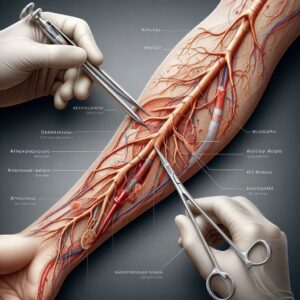
CPT Codes for AV Fistula Creation
What is an AV Fistula? A Quick Overview for Coders
Before we dive into the code sets, it is helpful to understand what the surgeon is actually doing. This clinical knowledge is the foundation of accurate coding.
An AV fistula is a surgical connection made between an artery and a vein, most commonly in the arm. The goal is to create a site with high blood flow that can withstand repeated needle insertions for dialysis.
Think of it this way: Veins are typically low-pressure vessels. By connecting a vein directly to a high-pressure artery, the vein is “arterialized.” It becomes larger, stronger, and develops a thicker wall. This makes it a perfect vessel for dialysis access.
The surgeon’s technique for creating this connection is the single most important factor in determining the correct code. Are they connecting the vein to the side of the artery? Are they moving the vein to a new location? These questions are central to our discussion.
The Core CPT Code Set for AV Fistula Creation (36818-36821)
The magic happens within the CPT code range 36818 to 36821. These are the specific codes used to report the creation of an autogenous AV fistula—meaning the fistula is created using the patient’s own veins and arteries.
It is crucial to distinguish these from codes for AV grafts (which use synthetic material) or revision surgeries. This section focuses strictly on the de novo creation of a native fistula.
Here is a breakdown of these four primary codes. We will present them in a table for easy comparison, then discuss each one in detail.
| CPT Code | Procedure Description | Key Differentiator |
|---|---|---|
| 36818 | Arteriovenous anastomosis, open; by upper arm cephalic vein transposition | The vein is moved (transposed) to a new, more superficial location. |
| 36819 | Arteriovenous anastomosis, open; by upper arm basilic vein transposition | Similar to 36818, but using the basilic vein, which is deeper and requires more extensive dissection. |
| 36820 | Arteriovenous anastomosis, open; by forearm vein transposition | A transposition procedure performed in the forearm. |
| 36821 | Arteriovenous anastomosis, open; by direct, any site (eg, Cimino type) (separate procedure) | A direct side-to-side or end-to-side connection without moving the vein. |
Understanding Code 36821: The Direct AV Fistula
Let’s start with the most straightforward code in the set: 36821. This code describes a direct AV anastomosis.
-
What it is: The surgeon connects an artery and a vein that are already lying close together in their natural positions. The classic example is the “Cimino fistula” at the wrist, where the cephalic vein is connected to the radial artery. The vein is not cut and moved; it is simply sutured to the artery, often in a side-to-side or end-to-side fashion.
-
When to use it: You will use this code when the vein is in a good, superficial location already and does not need to be tunneled or moved to make it accessible for dialysis. It is the most common code for forearm fistulas where the anatomy is favorable.
-
Key Phrase: “Separate procedure” is noted in the CPT manual. This means that if this anastomosis is performed as an integral part of a larger, more complex procedure, you should not bill it separately. However, for a standalone fistula creation, it is the correct code.
Understanding Transposition Fistulas (36818, 36819, 36820)
Sometimes, a good vein is available, but it is located too deep under the muscle or fascia to be easily accessed for dialysis. This is where transposition codes come into play. The key word here is transposition, which means the vein is surgically moved.
Think of it like this: The vein is in the wrong neighborhood. The surgeon needs to move it to a better location, just under the skin, so the dialysis needles can reach it.
-
Code 36820 (Forearm Vein Transposition): This is used when a vein in the forearm (often the cephalic or basilic) is moved to a more superficial position. The surgeon will dissect the vein free, ligate its side branches, create a new tunnel just under the skin, and then pull the vein through this new tunnel before connecting it to the artery.
-
Code 36818 (Upper Arm Cephalic Vein Transposition): This code is specific to moving the cephalic vein in the upper arm. The cephalic vein is often in a good location, but sometimes it needs to be relocated to a more anterior or accessible position.
-
Code 36819 (Upper Arm Basilic Vein Transposition): This is often considered the most complex of the basic fistula creation codes. The basilic vein is located deep in the upper arm, close to important nerves and arteries (the brachial artery and median nerve). To transpose this vein, the surgeon must perform a significant dissection to free it from its deep bed, move it superficially, and then create the anastomosis. Because of this extra surgical work, this code typically represents a higher relative value than the others.
Important Note: The work of “transposition” is included in these codes. You do not bill a separate code for “tunneling” or “incision and drainage” when performing a transposition fistula. The entire package of moving the vein and creating the connection is captured by the single CPT code.
Beyond Creation: Related Procedures and Their Codes
Creating the fistula is just one piece of the puzzle. Patients with AV fistulas often require additional procedures to ensure the fistula matures properly and functions correctly over time. Understanding these related codes is essential for a complete picture.
Declotting and Thrombectomy (36831, 36832, 36833)
Unfortunately, fistulas can clot (thrombose). When this happens, procedures are needed to restore blood flow.
-
36831: Open thrombectomy (removing the clot) of an AV fistula without any revision to the connection point. The surgeon just removes the clot.
-
36832: Revision of an AV fistula, which may include thrombectomy. This is used when the surgeon needs to fix a problem, like a narrowing (stenosis) at the anastomosis, and also remove a clot.
-
36833: Revision of an AV graft, with or without thrombectomy. Be careful not to confuse graft and fistula codes!
Imaging and Declotting: The Interventional Radiology Connection
Many fistula maintenance procedures are now performed percutaneously (through the skin) by interventional radiologists or vascular surgeons.
-
36147: Introduction of a needle into an AV fistula for diagnostic angiography.
-
36870: Percutaneous thrombectomy of an AV fistula. This is the non-open version of code 36831. The clot is broken up and removed using a special catheter.
Why Choosing the Right CPT Code Matters
You might be wondering, “Why all the fuss? It’s just a fistula in the arm.” The reason for the granularity in the CPT codes comes down to one word: work.
The amount of surgical effort, skill, and time required to perform a direct radial-cephalic fistula (36821) is significantly different from that required to perform a basilic vein transposition (36819). The latter involves more dissection, greater risk of nerve injury, and more complex wound closure.
-
Accurate Reimbursement: Using the correct code ensures the surgeon is fairly compensated for the complexity of the procedure they performed. Undercoding leaves money on the table. Overcoding can lead to audits and penalties.
-
Data and Outcomes: These specific codes help track the types of procedures being performed, which is valuable for research, quality improvement, and understanding surgical trends.
-
Medical Necessity: The code you choose must tell the story of why the procedure was done. A transposition is not performed on a whim; it is medically necessary because a direct anastomosis is not possible due to the vein’s depth. The code reflects that necessity.
Key Modifiers for AV Fistula Creation
Sometimes, the CPT code alone isn’t enough to tell the full story. This is where modifiers come in. They provide additional information about the procedure.
-
Modifier -50 (Bilateral Procedure): While less common for initial fistula creation (as only one access site is typically needed), it could theoretically be used if fistulas are created in both arms during the same operative session. Check payer preferences carefully, as some may not consider this a typical bilateral procedure.
-
Modifier -52 (Reduced Services): If a surgeon planned a full basilic vein transposition but, due to unexpected findings, could only perform a partial dissection and a direct anastomosis, modifier -52 might be appended to 36819 to indicate the service was reduced.
-
Modifier LT/RT (Left Side/Right Side): These are essential modifiers for all unilateral procedures. They specify on which side of the body the surgery was performed. Most payers require this information. For example, “36821-LT” for a direct fistula created on the left arm.
Common Coding Scenarios and How to Handle Them
Let’s look at a few realistic situations to see how these coding principles are applied.
Scenario 1: The Routine Wrist Fistula
-
The Case: A 65-year-old patient with end-stage renal disease (ESRD) needs a fistula. The surgeon performs an end-to-side anastomosis of the cephalic vein to the radial artery at the wrist. The vein is already superficial and in a good position.
-
The Code: 36821. This is the classic direct Cimino-type fistula. No transposition was performed.
Scenario 2: The Deep Vein Solution
-
The Case: A patient has no suitable superficial veins in the forearm or upper arm cephalic. The surgeon identifies a healthy basilic vein in the upper arm, but it is located deep beneath the fascia. The surgeon dissects the vein free, transposes it into a superficial tunnel, and then creates an anastomosis to the brachial artery.
-
The Code: 36819. This perfectly describes an upper arm basilic vein transposition. The extensive work to mobilize and relocate the vein is the defining feature of this code.
Scenario 3: Two-Stage Fistula Creation
-
The Case: A surgeon performs a basilic vein transposition but decides not to complete the arterial connection in the first stage. They simply move the vein and bury it under the skin. A few weeks later, they bring the patient back to the OR to connect the transposed vein to the artery.
-
The Coding: This is a more complex scenario and payer policies vary. The first stage might be coded with an unlisted vascular surgery code (37799) or a specific code for vein transposition without anastomosis. The second stage would be coded with the appropriate anastomosis code, sometimes with a modifier to indicate it is the second stage. Always verify with the specific payer’s guidelines for staged procedures.
Documentation: The Coder’s Best Friend
The best CPT code in the world is useless without the operative report to back it up. As a coder, you rely on the surgeon’s documentation to tell the story. What should you look for?
-
A Clear Description: The operative note should clearly state the type of fistula created. Look for keywords like “direct,” “side-to-side,” “end-to-side,” “transposition,” or the specific name like “Basilic Vein Transposition.”
-
Anatomic Details: The note must specify the vessels used (e.g., “cephalic vein to radial artery,” “basilic vein to brachial artery”) and the side of the body (left or right).
-
Reason for Technique: If a transposition was performed, the documentation should ideally explain why (e.g., “The vein was too deep for direct access”).
-
Extent of Procedure: Does the note describe ligating many side branches and creating a tunnel? This supports a transposition code. Does it describe a simple connection of adjacent vessels? This supports a direct code (36821).
The Future of AV Fistula Coding
Medicine is always evolving, and coding must keep pace. New techniques, like endovascular AV fistula creation (where the fistula is created using a catheter-based approach from inside the vessels), are changing the landscape.
Currently, these newer procedures are often reported with Category III CPT codes (temporary codes for emerging technology). For example, there are specific codes for creating an AV fistula percutaneously using specialized devices.
This is a rapidly developing area. As these technologies become more common, we can expect to see their codes transition to Category I (permanent) codes, further expanding the vascular surgery coding family. Staying updated through resources like the American College of Surgeons or the American Hospital Association is crucial.
Conclusion
Mastering the CPT codes for AV fistula creation is about more than just memorizing numbers. It is about understanding the underlying surgical procedures—the difference between a direct connection and a complex transposition. By understanding the “why” behind the code, you can ensure accurate billing, fair reimbursement, and a clear record of the patient’s surgical journey. Remember, when in doubt, always consult the full CPT manual and rely on the details within the surgeon’s operative report.
Frequently Asked Questions (FAQ)
1. What is the main CPT code for a direct AV fistula?
The primary code for a direct AV fistula, where the vein is not moved, is 36821. This is often referred to as a Cimino-type fistula.
2. When should I use CPT 36819 instead of 36821?
You should use 36819 when the surgeon performs a transposition of the basilic vein in the upper arm. This involves moving the vein from its deep, natural location to a more superficial one before connecting it to the artery. It is a more complex procedure than a direct anastomosis.
3. Is there a code for creating a fistula in the forearm?
Yes. If it is a direct anastomosis, you use 36821. If the surgeon needs to transpose a vein in the forearm to make it superficial, you would use 36820.
4. Do I need a modifier for which arm the surgery is on?
Yes, it is best practice and often required. You should append the appropriate modifier, such as -LT for left side or -RT for right side, to the primary CPT code.
5. What is the difference between an AV fistula and an AV graft code?
AV fistula codes (36818-36821) are for procedures that use the patient’s own vein to create the connection. AV graft codes (like 36825 or 36830) are used when the surgeon uses a synthetic tube (graft) to connect the artery and vein.
Additional Resource
For the most up-to-date information, official guidelines, and complete code descriptors, you should always refer to the source. The American Medical Association (AMA) publishes the CPT code set.
Link to the AMA CPT Category I Vascular Surgery Codes
(Note: This link leads to the AMA’s main page, where you can navigate to the CPT section for the official and most current information.)
Disclaimer: This article is for informational and educational purposes only and does not constitute legal, billing, or coding advice. Medical coding is a complex field with frequent changes in regulations and payer policies. Always consult the current CPT manual, official coding guidelines from the CMS and AMA, and your specific payers for definitive guidance. You should exercise your own independent judgment when applying this information.
Author: Professional Medical Copywriter
Date: March 03, 2026