If you are sitting in a dentist’s chair, and they suggest a Maryland Bridge to replace a missing tooth, you might hear a lot of technical jargon. One of the most confusing aspects for patients—and sometimes even for front-office staff—is the specific dental code used for the “wings.”
You might have looked at your treatment plan and seen a code that doesn’t seem to match the description you found online. Are the wings part of the pontic (the fake tooth)? Or are they billed separately?
In the world of dental billing, the Code on Dental Procedures and Nomenclature (CDT) is the standard. When it comes to a Maryland Bridge—technically known as a resin-bonded fixed partial denture—the “wings” are not a separate code on their own. Instead, they are integral to the framework code.
In this guide, we are going to break down exactly how dental professionals code for Maryland Bridge wings. We will explore the nuances of CDT codes D6545 and D6548, discuss why the coding matters for your insurance claim, and help you understand the value of this conservative restoration.
Dental Code for Maryland Bridge Wings
What Exactly is a Maryland Bridge?
Before we dive into the numbers and codes, let’s make sure we are all on the same page regarding the appliance itself.
A Maryland Bridge (also known as a resin-bonded bridge) is a type of fixed partial denture used to replace a missing tooth. Unlike a traditional bridge, which requires the dentist to grind down the neighboring teeth (abutments) into small stumps to place crowns, a Maryland Bridge is much more conservative.
The Anatomy of a Maryland Bridge
To understand the coding, you need to understand the two main components:
-
The Pontic: This is the “fake” tooth that fills the gap. It looks like a natural tooth and is designed to match your existing teeth.
-
The Wings (Framework): These are the metal or ceramic extensions that attach to the back (lingual) surface of the adjacent teeth. They act like glue tabs, literally “winging” out from the pontic to hold the restoration in place. These wings are bonded to the enamel of the supporting teeth, usually with a high-strength resin cement.
Because the wings are bonded onto the tooth structure rather than encircling the entire tooth (like a crown), the procedure is minimally invasive.
The Main Dental Codes for Maryland Bridge Wings
Here is the central truth about coding a Maryland Bridge: There is no specific code solely for the “wings.”
Instead, the wings are considered part of the “retainer” or “framework” of the bridge. When a dentist bills for a Maryland Bridge, they are billing for the entire unit—the pontic and the retainers (wings) that hold it in place.
However, there are two primary codes used in the United States for this procedure, and the choice between them determines how the insurance company views the “wings.”
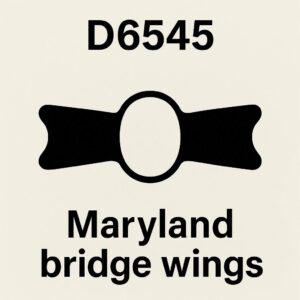
Code D6545: The “Metal” Wing Code
D6545 – Retainer – cast metal, for resin-bonded fixed partial denture
This is the most common code used for a traditional Maryland Bridge.
-
What it covers: This code describes a retainer (the wing) that is fabricated from cast metal. Typically, this is a non-precious metal alloy (like nickel-chromium or cobalt-chromium) or a semi-precious metal.
-
Where the wings are: In this scenario, the wings are metal. They are cemented to the back of the adjacent teeth. Because metal is strong, this allows for a very thin, precise fit.
-
Billing context: If your bridge has two wings (one on each side of the pontic), the dentist will likely bill this code twice—once for the retainer on the mesial side (front side of the gap) and once for the retainer on the distal side (back side of the gap), alongside the pontic code.
Code D6548: The “Ceramic” Wing Code (High Aesthetic)
D6548 – Retainer – ceramic, for resin-bonded fixed partial denture
As dentistry moves toward aesthetic, metal-free solutions, many patients are opting for “zirconia” or “all-ceramic” Maryland Bridges.
-
What it covers: This code describes a retainer (wing) made of ceramic material. These are often milled from zirconia blocks.
-
Where the wings are: These wings are tooth-colored. They offer superior aesthetics because there is no grey metal showing through the tooth. However, they require a slightly different bonding protocol and are often more expensive than metal wings.
-
Billing context: Just like the metal version, this code is billed per retainer.
Code D6540: The Supporting Code
Sometimes, you will see D6540 – Pontic – cast metal, for resin-bonded fixed partial denture on the treatment plan.
-
What it covers: This code covers the artificial tooth (pontic) itself.
-
Why it matters: A complete Maryland Bridge treatment plan usually consists of:
-
1 x D6540 (The Pontic)
-
2 x D6545 (The Wings/Retainers) or 2 x D6548 for ceramic wings.
-
Understanding the Billing Logic: Why the “Wings” Aren’t Separate
It is easy to think that a bridge is just one piece of material. However, from an insurance and laboratory fabrication standpoint, a Maryland Bridge is a complex appliance.
Imagine you are building a custom piece of furniture. You have the main shelf (pontic) and the brackets that hold it to the wall (wings). You wouldn’t just pay for “the shelf”; you pay for the brackets too.
When a dentist sends a prescription to a dental lab for a Maryland Bridge, the lab technician fabricates the pontic and the wings as a single, continuous unit. The coding system reflects this.
Why Insurance Might Question the Code
A common issue patients face is insurance companies denying claims for Maryland Bridges because they expect to see codes for a “Traditional Bridge” (D6740 or D6750).
If a dentist uses D6545 and D6540, the insurance company’s computer system knows exactly what is being proposed: a resin-bonded bridge. If the dentist accidentally uses the codes for a traditional full-coverage crown bridge (like D6740 for porcelain fused to metal crown retainers), the claim will likely be denied because the X-rays will show that the teeth were not prepared for crowns.
Note: The “wings” are specifically defined by the fact that they require minimal tooth reduction. If a dentist has to heavily reduce the tooth structure to make the wing fit, it might no longer qualify as a Maryland Bridge (D6545/D6548) and might instead fall under a different code category.
When Are Multiple “Wing” Codes Used?
One Maryland Bridge usually involves two abutment teeth (the teeth adjacent to the gap). However, sometimes a case is more complex.
-
Single Wing (Cantilever): If the gap is at the very end of the arch (a terminal abutment) or if the bite forces are specific, a dentist may opt for a “cantilever” Maryland Bridge. In this case, there is only one wing. The treatment plan would show:
-
1 x D6540 (Pontic)
-
1 x D6545 (Single Wing)
-
-
Double Wing (Standard): For a gap in the middle of the arch (like a missing lateral incisor), there are usually two wings—one on the tooth in front and one on the tooth behind. The treatment plan shows:
-
1 x D6540 (Pontic)
-
2 x D6545 (Two Wings)
-
-
Triple Unit Bridge: Sometimes, the bridge replaces two missing teeth. In this case, there might be two pontics and two wings (one on each end). The coding would reflect multiple pontics.
Comparative Table: D6545 vs. D6548
Choosing between metal and ceramic wings is often a clinical and aesthetic decision. Here is how the two common “wing” codes compare:
| Feature | D6545 (Cast Metal Wings) | D6548 (Ceramic/Zirconia Wings) |
|---|---|---|
| Material | Non-precious metal alloy, high noble metal | Zirconia, Lithium Disilicate (e.g., e.max) |
| Aesthetics | Metal shows on the back of teeth; may be visible if patient smiles wide | Tooth-colored; blends perfectly with enamel |
| Strength | Extremely high; thin metal is very durable | High strength; requires slightly thicker preparation |
| Bonding | Traditional resin cement; reliable long-term track record | Requires specialized adhesive resin and silane coupling agents |
| Cost to Patient | Generally lower lab fees | Higher lab fees due to material and milling costs |
| Longevity | Excellent; often lasts 10-20 years | Good; newer technology but showing promising longevity |
How to Read Your Treatment Plan for “Wings”
When you receive a treatment plan from your dentist, it can look like a shopping list of codes. To identify the “wings,” look for the D6545 or D6548 entries.
Typically, a treatment plan might look like this:
D0140 - Limited Oral Evaluation
D0210 - Intraoral - Complete Series of Radiographic Images
D6540 - Pontic, cast metal, resin-bonded FPD (Tooth #8) – 1 unit
D6545 - Retainer, cast metal, resin-bonded FPD (Tooth #7) – 1 unit
D6545 - Retainer, cast metal, resin-bonded FPD (Tooth #9) – 1 unit
In this scenario, the two “D6545” entries are the wings. The fee listed next to these codes is the cost for the fabrication and placement of each wing.
Insurance Coverage for Maryland Bridge Wings
Insurance is often the trickiest part of the Maryland Bridge process. Because the “wings” do not involve “full coverage” of the adjacent teeth (like crowns do), some insurance policies classify the Maryland Bridge differently.
The “Missing Tooth Clause”
Many dental insurance plans have a “missing tooth clause.” This means that if the tooth was missing before the insurance policy became active, they will not cover the replacement. This applies to the bridge entirely, regardless of the wing type.
Frequency Limitations
If the code D6545 or D6548 is used, insurance companies often view this as a “major restorative” service. Most plans cover major services at 50% after a deductible, though some PPO plans might cover it at 60% or 80% if it is considered a preferred procedure.
Comparison to Traditional Bridges
Sometimes, patients assume that because a Maryland Bridge is less invasive, it will be cheaper for the insurance company. However, the coding complexity is similar. Insurance companies usually pay a similar allowance for a Maryland Bridge (D6545 + D6540) as they would for a Traditional Bridge (D6740 + D6240) because both are replacing a missing tooth and involve laboratory fabrication.
The Process: How the “Wings” Are Made
Understanding the technical process helps explain why the coding is structured the way it is.
-
Tooth Preparation (The Wings): The dentist prepares the back surfaces (lingual surfaces) of the abutment teeth. This is not aggressive drilling. The dentist creates a slight indentation in the enamel where the wing will sit. This ensures the wing doesn’t feel bulky on the tongue.
-
Impression: A mold is taken of the prepared teeth and the gap. This impression captures the exact shape of the “wing” space.
-
Lab Fabrication:
-
For D6545: The lab pours a stone model, waxes up the wings and pontic, and casts them in metal.
-
For D6548: The lab digitally scans the model (or scans the mouth digitally) and mills a zirconia framework that includes the pontic and the wings as one solid piece.
-
-
Try-In: The dentist tries the bridge in your mouth. They check the fit of the wings against the back of your teeth. If the wings are too tight or too loose, adjustments are made.
-
Bonding: The teeth are isolated (to keep them dry), and the wings are etched and bonded using high-strength adhesive cement. This is a critical step; if moisture contaminates the bond, the wings can fail (debond).
Potential Issues with Wings and Billing
No dental restoration is perfect forever. Maryland Bridges have a specific set of challenges, and understanding these helps you know what to expect if the wings fail.
Debonding (The Wings Come Loose)
The most common issue with a Maryland Bridge is that the wings “debond,” meaning the glue breaks.
-
What happens: The bridge feels loose, or you can wiggle it.
-
Billing for recementation: If this happens, the dentist will use a separate code for recementing the bridge. Usually, this is D6930 (Recement fixed partial denture). Insurance often covers this, but it might be subject to a separate deductible or frequency limitation.
Fracture of the Wings
If you bite into something extremely hard, the metal or ceramic wing can bend or break.
-
Metal Wings (D6545): Usually, metal bends before it breaks. Sometimes, the dentist can repair this in the mouth.
-
Ceramic Wings (D6548): Zirconia is incredibly strong, but if it fractures, the entire bridge usually needs to be remade (new D6540, D6548 codes), as repairing ceramic in the mouth is unreliable.
Frequently Asked Questions (FAQ)
Q1: Is there a specific dental code for just the “wing” if it breaks?
A: No. If a wing breaks, the dentist does not bill for a “new wing.” They must evaluate the remaining structure. If the bridge is salvageable, they might use a repair code (such as D6980 for repair of a fixed partial denture). However, if the wing is the part that broke and the bridge is compromised, the entire restoration usually has to be replaced, meaning the full set of codes (Pontic and Retainers) is billed again.
Q2: My dentist used code D6740 for my bridge. Is that the same as a Maryland Bridge?
A: No. D6740 is for a “Crown – porcelain fused to high noble metal” for a traditional bridge retainer. If your dentist used this code, they are planning to crown the adjacent teeth (grind them down). If you were expecting a Maryland Bridge (with just wings), you should ask why this code was used. It represents a very different (and more invasive) procedure.
Q3: Why is my insurance denying my claim for D6545?
A: There are several common reasons:
-
The Missing Tooth Clause: The tooth was missing before the policy started.
-
Alternate Benefit: Some insurance companies view Maryland Bridges as “experimental” or less durable than traditional bridges. They might downgrade the benefit to that of a removable partial denture (flipper), paying significantly less.
-
Frequency: You may have had a bridge replaced on the same tooth within the last 5 to 10 years (depending on the plan’s frequency limitations).
Q4: Does the “wing” material affect insurance coverage?
A: Generally, insurance companies do not distinguish between metal (D6545) and ceramic (D6548) in terms of coverage allowance if they are both in-network fees. However, if the ceramic version (D6548) has a higher lab fee, the “patient responsibility” (the amount you pay out of pocket) will likely be higher because the insurance company’s maximum allowable fee is often based on the cost of the metal version.
Important Notes for Readers
-
Pre-authorization is your friend: Before starting treatment, ask your dentist to send a pre-authorization (predetermination) to your insurance company. This will explicitly state what they will pay for D6545 (or D6548) and D6540. It is the safest way to avoid surprise bills regarding the wings.
-
Ask about the “Try-In”: Some dentists charge a separate fee for the “try-in” appointment. Ensure you understand if the quoted fee for the bridge codes includes the delivery appointment or if there are additional visit fees.
-
Longevity Expectations: While a traditional bridge might last 15+ years, a Maryland Bridge relies entirely on the bond of the wings. With good oral hygiene and avoiding excessive biting forces (like chewing ice or hard candy), metal wings (D6545) have a track record of lasting 10 years or more. Ceramic wings (D6548) are newer but are proving to be just as reliable with modern bonding agents.
-
Hygiene Matters: The “wings” create a small ledge where the metal or ceramic meets the tooth. It is vital to floss around these areas. Your dentist may recommend special floss (like Super Floss) or a Waterpik to clean under the wings to prevent cavities on the abutment teeth.
Conclusion
Understanding the dental code for Maryland Bridge wings comes down to recognizing that the wings are not a separate entity but are coded as retainers. If you are receiving a metal-based Maryland Bridge, the code to look for on your treatment plan is D6545. If you are opting for a high-aesthetic, metal-free restoration, the code is D6548.
These codes represent the conservative nature of the procedure—preserving your natural tooth structure while securely replacing a missing tooth. By familiarizing yourself with these codes, you can have a more informed conversation with your dentist and your insurance provider, ensuring that your treatment plan is accurate, your billing is transparent, and your smile gets the best care possible.
Additional Resource
For a deeper dive into the official CDT codes and to verify the latest updates, the American Dental Association (ADA) publishes the Current Dental Terminology (CDT) manual. You can find more information on coding standards and official definitions at the ADA’s official website (search for “CDT Code D6545”).
FAQ
Q: What is the difference between D6545 and D6548?
A: D6545 refers to a cast metal retainer (wing) for a resin-bonded bridge. D6548 refers to a ceramic retainer (wing). The main difference is the material; ceramic offers better aesthetics, while metal has a longer proven track record for durability.
Q: Can I just get a code for the wing if it breaks?
A: No, there is no specific code for replacing a single wing. If the wing breaks, the dentist will either use a repair code (D6980) to fix the existing bridge, or if the damage is severe, they will need to replace the entire bridge using the full set of pontic and retainer codes again.
Q: Does insurance cover the wings on a Maryland Bridge?
A: Most dental insurance plans consider the wings (retainers) an integral part of the bridge. They are covered under the “major restorative” category of your plan. However, coverage depends on your specific policy, the presence of a missing tooth clause, and whether a pre-authorization was obtained.
Q: Why did my dentist bill two D6545 codes?
A: If your bridge is replacing a single missing tooth, it likely has two wings (one on the front tooth and one on the back tooth). Each wing is a separate retainer, so each requires its own billing code.
Disclaimer: This article is for informational and educational purposes only. Dental coding can vary by insurance carrier and geographic location. Always consult with your dental insurance provider and your dental office’s billing specialist to confirm coverage and specific coding requirements for your treatment.
Author: Dental Billing & Clinical Writer
Date: March 22, 2026