If you have ever sat in a dentist’s chair, nodded along to a treatment plan, and then later stared at a dental insurance statement wondering what on earth “D1234” actually means—you are not alone.
Dentistry, like medicine, has its own language. While your dentist speaks to you about cavities and crowns, the administrative team speaks to your insurance company using a specific set of numbers and codes. In Canada, the standard for this communication is the CDA Dental Procedure Code List.
This guide is designed to pull back the curtain on those codes. We will explore what they are, how they work, why they matter for your wallet and your health, and how to use them to become a more empowered patient. By the end of this article, you will look at your next dental treatment plan not as a confusing list of abbreviations, but as a clear roadmap for your oral health journey.
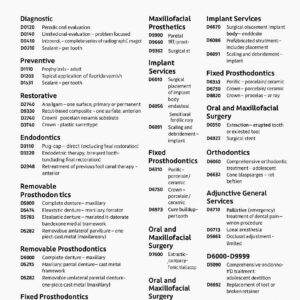
CDA Dental Procedure Code List
What is the CDA Dental Procedure Code List?
At its core, the CDA (Canadian Dental Association) Dental Procedure Code List is the standardized language used by dental professionals across Canada to describe the services they provide to patients. Think of it as the dictionary of dentistry.
Just as every item in a grocery store has a barcode that scans at the register, every dental procedure—from a simple check-up to a complex oral surgery—has a unique five-character alphanumeric code. These codes ensure that whether you are visiting a dentist in Vancouver, Toronto, or Halifax, your dental records and insurance claims use the same terminology.
A Brief History of Standardization
Before the widespread adoption of these codes, dental offices used varying terminology to describe treatments. This created chaos for insurance companies trying to process claims and for patients moving between provinces. The Canadian Dental Association stepped in to create a unified coding system that would:
-
Standardize communication between dentists and insurers.
-
Reduce errors in billing and record-keeping.
-
Provide consistency for patients seeking care across different regions.
Today, the CDA updates this list regularly to incorporate new technologies and procedures, ensuring the dental industry stays current with modern practices.
Who Uses These Codes?
You might assume these codes are only for insurance companies. In reality, several groups rely on them daily:
-
Dentists and Dental Hygienists: They use the codes to document exactly what was done during your appointment. When your dentist notes that you received a “D2331” in your chart, they know instantly that they performed a resin-based composite filling on one surface of a front tooth.
-
Dental Administrative Staff: Office managers and treatment coordinators use the codes to build treatment plans, calculate costs, and submit electronic claims to insurance providers. They are the translators between the clinical work and the financial transaction.
-
Insurance Providers: When an insurance company receives a claim, their systems are programmed to recognize specific codes. They use these codes to determine if a procedure is covered, what percentage is paid, and how much the patient owes.
-
Patients: Ultimately, the patient benefits the most from a clear system. By understanding the codes on your treatment plan, you can verify that the proposed work matches the actual treatment you receive and understand why your insurance paid a certain amount.
How to Read the Code Structure
At first glance, a code like “D4341” might look like random letters and numbers. However, there is a logical structure to it. Understanding this structure is the first step to becoming fluent in dental billing.
The CDA codes typically begin with the letter D (for Dental) followed by four digits. The first digit of the four-digit number usually indicates the category of service.
The Major Code Categories
Here is a breakdown of what the first digit typically represents:
| First Digit | Category | Examples |
|---|---|---|
| 0 | Diagnostic | Clinical examinations, x-rays, and diagnostic imaging. |
| 1 | Preventive | Cleanings (prophylaxis), fluoride treatments, and sealants. |
| 2 | Restorative | Fillings (amalgam and composite/resin), inlays, and onlays. |
| 3 | Endodontics | Root canals and related treatments on the tooth pulp. |
| 4 | Periodontics | Treatments for gums and supporting bone, such as scaling and root planing. |
| 5 | Prosthodontics (Removable) | Dentures and partial dentures. |
| 6 | Prosthodontics (Fixed) | Crowns, bridges, and implant-supported restorations. |
| 7 | Oral & Maxillofacial Surgery | Extractions, biopsies, and surgical procedures. |
| 8 | Orthodontics | Braces, retainers, and alignment treatments. |
| 9 | Adjunctive General Services | Emergency visits, sedation, and other miscellaneous services. |
This categorical structure makes it easy to scan a treatment plan and immediately understand what type of work is being proposed. If you see a code starting with “2,” you know you are looking at fillings. If you see a “7,” you know an extraction is involved.
Decoding Common Procedures: A Detailed Breakdown
Now that we understand the structure, let’s look at the most common codes you are likely to encounter. While there are hundreds of codes in the full list, these are the ones that appear on most patients’ treatment plans.
Diagnostic Codes (0xxxx)
Diagnostic codes are the foundation of every dental visit. Without a proper diagnosis, treatment cannot begin.
D0120 – Periodic Oral Examination
This is the standard “check-up” code. It is used for an examination performed on a patient of record at regular intervals. During this exam, the dentist assesses your existing dental work, looks for new decay, and checks the health of your gums.
D0140 – Limited Oral Examination
This code is used for problem-focused evaluations. If you call your dentist because you have a toothache, the dentist will likely use this code to examine the specific area of concern rather than performing a full comprehensive exam.
D0150 – Comprehensive Oral Examination
This is an in-depth evaluation, typically reserved for new patients or patients who have not been seen in several years. It involves a detailed evaluation of the entire oral cavity, including soft tissues, periodontium, and existing restorations.
D0210 – Intraoral – Complete Series of Radiographs
Often referred to as a “full mouth series” or FMX, this is a set of 14 to 20 x-rays that capture the entire dentition. These are usually taken every 3-5 years to provide a complete baseline of your oral health.
D0270 – Bitewing – Single Film
Bitewing x-rays are the images where you bite down on a small piece of plastic. They are used primarily to detect decay between the teeth (interproximal cavities). A typical set includes two to four bitewings, usually taken annually.
Preventive Codes (1xxxx)
Prevention is the cornerstone of modern dentistry. These codes represent the services aimed at keeping your teeth and gums healthy.
D1110 – Prophylaxis – Adult
This is the standard “dental cleaning” for adults. It involves the removal of plaque, calculus (tartar), and stains from the tooth structures. It is intended to control local irritational factors.
Important Note: If you have active gum disease (periodontitis), a standard cleaning (D1110) is not sufficient. In those cases, your dentist will use periodontic codes (4xxxx) like scaling and root planing.
D1120 – Prophylaxis – Child
This code is identical in function to the adult cleaning but is specifically designated for patients under the age of 14. The distinction helps insurance companies track care for dependent children.
D1206 – Topical Application of Fluoride Varnish
Fluoride varnish is a concentrated form of fluoride applied to the teeth to strengthen enamel and prevent decay. It is a quick, painless procedure recommended for children and adults at high risk for cavities.
D1351 – Sealant – Per Tooth
Sealants are thin, protective plastic coatings applied to the chewing surfaces of the back teeth (molars) to prevent cavities. This code is used per tooth. If you have four molars sealed, you will see the code listed four times.
Restorative Codes (2xxxx)
Restorative codes cover fillings and the repair of damaged teeth. The specifics of the code depend heavily on the material used and the number of surfaces involved.
Amalgam vs. Resin (Composite)
Traditionally, fillings were made of silver amalgam (D2140, D2150). Today, tooth-colored resin-based composites are more common. The codes differentiate between these materials because they have different costs and insurance coverage policies.
-
D2140 – Amalgam – One Surface, Primary or Permanent
-
D2150 – Amalgam – Two Surfaces
-
D2160 – Amalgam – Three Surfaces
-
D2161 – Amalgam – Four or More Surfaces
-
D2330 – Resin-Based Composite – One Surface, Anterior
-
D2331 – Resin-Based Composite – Two Surfaces, Anterior
-
D2390 – Resin-Based Composite – One Surface, Posterior
What is a “surface”?
Teeth have multiple surfaces:
-
Occlusal (O): The chewing surface.
-
Mesial (M): The front side of the tooth (toward the midline).
-
Distal (D): The back side of the tooth (away from the midline).
-
Buccal (B): The cheek side.
-
Lingual (L): The tongue side.
A code specifying “two surfaces” (e.g., D2331) might indicate a filling that covers both the mesial and occlusal surfaces of a front tooth (an MO filling).
Endodontic Codes (3xxxx)
When decay reaches the nerve of the tooth (the pulp), a root canal becomes necessary to save the tooth rather than extract it.
D3310 – Endodontic Therapy, Anterior Tooth (excluding final restoration)
This code covers root canal treatment on an incisor or canine tooth. These teeth typically have a single root, making the procedure more straightforward.
D3320 – Endodontic Therapy, Bicuspid Tooth (premolar)
Premolars usually have one or two roots. This code covers the root canal for those teeth.
D3330 – Endodontic Therapy, Molar Tooth
Molars are the largest teeth in the back of the mouth and typically have three or four roots. This code covers the most complex root canal procedure.
Note: The description often includes “(excluding final restoration).” This means the root canal code covers the cleaning and filling of the tooth’s interior. The crown (prosthodontic code) that goes on top to protect the tooth after the root canal is billed separately.
Periodontic Codes (4xxxx)
Periodontics focuses on the structures that support the teeth: the gums and the bone. These codes are often used for treating gum disease.
D4341 – Periodontal Scaling and Root Planing – Per Quadrant
This is the “deep cleaning” code. Unlike a standard prophylaxis (D1110), scaling and root planing involves cleaning below the gum line to remove bacterial deposits from the root surfaces. It is performed one quadrant (quarter of the mouth) at a time.
D4355 – Full Mouth Debridement
This code is used when a patient has so much plaque and calculus that a proper oral examination is impossible. It is a preliminary cleaning to remove the heavy deposits so the dentist can perform a thorough exam and develop a treatment plan.
D4910 – Periodontal Maintenance
After a patient has completed active periodontal treatment (like scaling and root planing), they enter a maintenance phase. This code represents the ongoing cleanings, typically every 3-4 months, required to prevent the recurrence of gum disease. It is more involved than a standard prophylaxis (D1110) but less intensive than scaling and root planing.
Prosthodontic Codes (5xxxx & 6xxxx)
Prosthodontics is the replacement of missing teeth. Removable prosthetics (like dentures) fall under the 5xxxx codes, while fixed prosthetics (like crowns and bridges) fall under the 6xxxx codes.
D5110 – Complete Denture – Maxillary
This code covers the fabrication and placement of a full upper denture.
D5211 – Mandibular Partial Denture
This code covers a removable partial denture for the lower jaw, which uses clasps to attach to existing teeth.
D2740 – Crown – Porcelain/Ceramic Substrate
This is a common code for a porcelain (tooth-colored) crown. Crowns are used to restore a tooth that is too damaged for a filling.
D2750 – Crown – Porcelain Fused to High Noble Metal
This code is for a crown that has a metal substructure for strength, covered by porcelain for aesthetics. “High noble metal” refers to the gold content in the metal base.
D6240 – Pontic – Porcelain Fused to High Noble Metal
In a bridge, a “pontic” is the artificial tooth that fills the gap. This code is used for each missing tooth that is replaced in a fixed bridge.
Oral Surgery Codes (7xxxx)
Surgery codes cover extractions, biopsies, and other invasive procedures.
D7111 – Extraction, Coronal Remnants – Deciduous Tooth
This code is used for the extraction of a baby tooth that is broken down or decayed.
D7140 – Extraction, Erupted Tooth or Exposed Root
This is the standard simple extraction code for a tooth that is fully visible in the mouth (not impacted).
D7210 – Surgical Extraction of Erupted Tooth
This code is used when an erupted tooth requires the reflection of gum tissue and removal of bone to extract it. This is common for teeth with curved roots or teeth that break during a simple extraction.
D7240 – Extraction, Impacted Tooth – Completely Bony
This is the most complex extraction code, often used for impacted wisdom teeth that are fully encased in bone. This procedure requires surgical exposure and bone removal.
Understanding Dental Insurance and Coding
Knowing what the codes mean is one thing. Understanding how they interact with your insurance plan is another. This is where patients often experience the most confusion.
The Role of the Fee Guide
It is important to understand that the CDA procedure code list is not a price list. It does not dictate how much a dentist can charge for a procedure. Instead, each provincial dental association publishes a Fee Guide (e.g., the Ontario Dental Association Fee Guide).
-
The Code: Tells you what was done (e.g., D2740 – Crown).
-
The Fee Guide: Suggests a price for that code in a specific province.
-
Your Insurance: Typically covers a percentage (e.g., 80%, 50%) of the Fee Guide amount.
Dentists are private business owners. They can choose to charge the fee guide amount, less than the fee guide, or more than the fee guide. If a dentist charges more than the fee guide, your insurance will still only pay up to the fee guide amount, leaving you to pay the difference.
Frequency Limitations
Insurance plans use codes to enforce frequency limitations. Common limitations include:
-
D0120 (Periodic Exam): Usually covered once every 9 or 12 months.
-
D0270 (Bitewing X-rays): Typically covered once every 12 months.
-
D1110 (Prophylaxis): Often covered twice per year (every 6 months).
-
D4341 (Scaling & Root Planing): Usually covered once every 24 or 36 months per quadrant.
If a dentist tries to bill for a code before the frequency limitation has expired, the insurance company will automatically deny the claim.
The Predetermination of Benefits
For major procedures (crowns, bridges, dentures, implants, surgical extractions), your dental office will often send a “predetermination” to your insurance company. This is not a claim for payment; it is a request for the insurance company to review the treatment plan (using the CDA codes) and tell you, in advance, what they will pay.
A predetermination statement will look something like this:
| Code | Description | Submitted Fee | Plan Allowance | Plan Pays (50%) | Patient Estimate |
|---|---|---|---|---|---|
| D2740 | Crown – Porcelain | $1,200.00 | $1,000.00 | $500.00 | $700.00 |
| D2950 | Core Buildup | $200.00 | $180.00 | $90.00 | $110.00 |
This allows you to make an informed financial decision before treatment begins.
Common Billing Scenarios and What to Look For
To help solidify your understanding, let’s walk through a few common patient scenarios and analyze how the codes would appear on a treatment plan.
Scenario 1: The New Patient Visit
*Sarah, a 30-year-old who hasn’t seen a dentist in three years, visits a new office.*
Treatment Plan:
-
D0150 – Comprehensive Oral Examination
-
D0210 – Complete Series of Radiographs
-
D1110 – Prophylaxis – Adult
-
D1206 – Topical Fluoride Varnish
Analysis: This is a standard new patient workup. The comprehensive exam and full mouth x-rays establish a baseline. The cleaning removes accumulated deposits, and the fluoride provides a preventive boost.
Scenario 2: The Deep Cleaning
*John is told he has gum disease (periodontitis) with pockets of 5-6mm. His treatment plan is divided into two appointments.*
Treatment Plan:
-
Appointment 1: D4341 (Scaling & Root Planing) – Quadrant 1 & 2
-
Appointment 2: D4341 (Scaling & Root Planing) – Quadrant 3 & 4
Analysis: Note that John does not receive a D1110 (regular cleaning) during these appointments. The deep cleaning is the treatment. Following these appointments, John will be placed on a schedule for D4910 (Periodontal Maintenance) every three months.
Scenario 3: The Complex Restoration
Maria has a molar that was previously root canaled (D3330) but now needs a crown to protect it.
Treatment Plan:
-
D2950 – Core Buildup, Including Pins
-
D2740 – Crown – Porcelain/Ceramic Substrate
Analysis: The “core buildup” (D2950) is often necessary after a root canal to rebuild the structure of the tooth so there is enough tooth remaining to support a crown. The crown (D2740) is the final restoration. If Maria had insurance, she would likely have to pay for the crown in two appointments: one for the “preparation” and impression, and one for the “seat” or delivery.
Tips for Navigating Your Treatment Plan
Being an informed patient means being an active participant in your dental care. Here are practical tips for using your knowledge of CDA codes to your advantage.
1. Ask for a Printed Treatment Plan with Codes
Don’t just rely on verbal explanations. Ask your dental office for a printed or emailed treatment plan that includes the CDA codes, the procedure description, and the cost breakdown. This gives you a document you can take home and review.
2. Verify Codes with Your Insurance
Before committing to a large treatment plan, call your insurance provider or log into your online portal. Read the codes from your treatment plan to the representative. Ask specific questions:
-
“Is code D4341 covered under my plan?”
-
“What is my frequency limitation for code D2740?”
-
“Does my plan have a deductible that applies to these codes?”
3. Understand “Alternate Benefits”
Sometimes, insurance plans will only pay for the least expensive alternative treatment. For example, if you want a tooth-colored filling (D2330) on a back tooth, but your insurance policy only covers silver fillings (D2160) on posterior teeth, they may only pay the amount they would have paid for the silver filling. You would be responsible for the difference. Knowing the codes allows you to have this conversation proactively.
4. Review Your Explanation of Benefits (EOB)
When your insurance processes a claim, they send an EOB. This document lists the codes billed, what the dentist charged, what the plan allowed, what the plan paid, and what you owe. Review this carefully. If a code on your EOB does not match the treatment you received, contact your dental office immediately.
The Future of Dental Coding
The world of dentistry is constantly evolving, and the CDA code list evolves with it. Staying aware of these trends can help you anticipate what might appear on future treatment plans.
Digital Dentistry Codes
As technology advances, new codes are being introduced for digital services. You may soon see codes for:
-
Intraoral Scanners: Codes that reflect the use of digital impressions rather than traditional putty.
-
3D Printing: Codes for the fabrication of surgical guides for implant placement.
-
Cone Beam CT Scans: Advanced 3D imaging codes for implant planning and complex surgical cases.
The Rise of Implant Codes
Implantology (dental implants) has exploded in popularity. The code list now has a dedicated section for implant-related services, separating the surgical placement of the implant (e.g., D6010 – Surgical Placement of Implant Body) from the restorative crown that goes on top (e.g., D6057 – Custom Abutment and D6060 – Implant-Supported Crown).
Teledentistry
Following the pandemic, remote consultations and teledentistry have become more prevalent. New codes are being developed to allow dentists to bill for virtual evaluations, consultations, and follow-up care, providing more flexibility for patients.
How to Access the Official CDA Code List
If you want to explore the full list for yourself, there are official channels to do so. It is important to use official sources to ensure you are looking at the most current and accurate information.
The Canadian Dental Association does not typically publish the full code list for free public consumption due to copyright and licensing agreements. However, you can access it through:
-
Your Dental Office: Most offices have a printed or digital copy of the current code list and fee guide. They are often happy to show you where a specific code falls in the list.
-
Provincial Dental Associations: Each provincial association (e.g., ODA in Ontario, BCDA in British Columbia) publishes the code list along with the annual fee guide. These are available for purchase by the public, though they are typically intended for dental professionals.
-
Dental Insurance Portals: Many major insurance providers offer searchable databases of dental codes and their coverage policies for their members. This is often the most accessible resource for patients.
Conclusion
Navigating the world of dental care involves more than just brushing and flossing; it involves understanding the business and administrative side of your oral health. The CDA dental procedure code list is the key to unlocking that understanding. It transforms a confusing bill into a clear story about the care you received.
By learning to recognize the categories—from Diagnostic (0xxxx) to Surgery (7xxxx)—and familiarizing yourself with the common codes for cleanings, fillings, and crowns, you equip yourself to ask the right questions. You can verify that your treatment plan matches your insurance coverage, ensure that you are only paying for the work you receive, and ultimately, make better, more informed decisions about your health.
Remember, your dental team is your partner. They use these codes to communicate with your insurer, but they are also there to communicate with you. Do not hesitate to ask for explanations, request printed plans, or compare your treatment plan to your insurance benefits. A little knowledge of the codes goes a long way toward ensuring a smooth, transparent, and stress-free dental experience.
Frequently Asked Questions (FAQ)
Q1: Are CDA codes the same across all of Canada?
Yes, the core list of procedure codes (the names and numbers) is standardized nationally by the Canadian Dental Association. However, the prices associated with those codes vary by province, as each provincial dental association publishes its own fee guide.
Q2: Why is my insurance denying a code that my dentist says is necessary?
There are several reasons. The most common is a frequency limitation (e.g., you already had a cleaning 4 months ago, but your plan only pays for one every 6 months). Another reason is that the code may be considered a “non-insured service” under your specific policy, or the plan may consider the procedure “not dentally necessary.” You should ask your insurance company for the specific reason for the denial.
Q3: Can a dentist use a different code to get my insurance to pay?
This is called “code shifting” and is considered insurance fraud. Dentists must bill the code that accurately reflects the procedure performed. Billing a deep cleaning (D4341) as a regular cleaning (D1110) to get around frequency limitations is unethical and illegal. If you suspect a dentist is doing this, you should be concerned about the integrity of your treatment.
Q4: What does “excluded from fee” or “no charge” mean on my treatment plan?
Sometimes, a dentist may perform a service that is considered part of a larger procedure. For example, the local anesthetic used for a filling is usually “excluded from fee,” meaning the cost is built into the filling code. You will often see a code listed with a $0.00 charge to indicate that the service was provided but is not an additional charge.
Q5: I received a crown. Why does my bill show two different codes?
A crown procedure typically involves two appointments. The first appointment (preparation and impression) is usually billed as the crown code itself (e.g., D2740). The second appointment (cementation or seat) is often billed using a “seat” code (e.g., D2752 – Crown – Seat). Some offices combine the total cost into one line item, while others break it down to show the work done at each visit.
Q6: Where can I find the latest CDA code updates?
The CDA and provincial dental associations release updates annually or biennially. Your dental office will always be using the most current version. For official publications, you can visit the website of your provincial dental association.