If you have just finished your orthodontic treatment—whether it was traditional braces or clear aligners—you are likely entering what many orthodontists call the “retention phase.” This is the most critical part of the journey. You have invested time, money, and effort into straightening your teeth. Now, you need to keep them that way.
One of the most popular and effective ways to do this is with a fixed retainer.
However, if you have recently visited your dentist or orthodontist and received a bill, or if you are trying to understand your insurance Explanation of Benefits (EOB), you might have stared at a list of codes and wondered: What exactly is the dental code for a fixed retainer? Why are there multiple numbers? And why is my insurance covering some parts but not others?
You are not alone. Dental coding is a complex language that bridges the gap between clinical treatment and financial responsibility. It is designed to standardize procedures so that insurance companies, dental offices, and patients are all on the same page. But for the average patient, it can feel like a secret code that needs cracking.
In this comprehensive guide, we will demystify the dental coding system. We will break down exactly which codes are used for fixed retainers, what they mean, how much they typically cost, and how insurance usually handles them. We will also walk you through the process of getting a fixed retainer, common problems to look out for, and how to navigate the billing process if something goes wrong.
By the end of this article, you will feel confident reading your dental invoice and understanding exactly what you are paying for.
What is a Fixed Retainer?
Before we dive into the codes, let’s clarify what we are actually talking about.
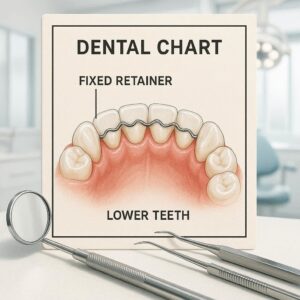
A fixed retainer—often called a permanent retainer or a bonded retainer—is a thin metal wire that is glued (bonded) to the back of your teeth. Unlike a removable retainer that you take in and out, a fixed retainer stays in your mouth 24 hours a day, 7 days a week.
Typically, fixed retainers are used for the lower front teeth (the mandibular anterior teeth) because those are the teeth most prone to shifting after braces. However, they can also be placed on the upper front teeth, though this is less common due to the risk of biting down on the wire and breaking it.
Advantages of a Fixed Retainer
-
Consistency: You never have to worry about forgetting to wear it. It works constantly.
-
Stability: It is excellent for maintaining the position of teeth that were severely crowded or rotated.
-
Aesthetics: Because it is placed behind the teeth (lingual side), it is completely invisible to others.
Disadvantages
-
Hygiene: Flossing can be tricky. You will need special tools like floss threaders or super floss to clean around the wire.
-
Maintenance: The bonding agent can wear down over time. If the wire breaks or comes loose and you don’t notice, your teeth can shift.
-
Lifespan: While marketed as “permanent,” most fixed retainers eventually need repair or replacement after 5 to 10 years.
Now that we understand what the device is, let’s look at how dentists bill for it.
Understanding Dental Coding (CDT Codes)
In the United States, dentists use a standardized set of codes called the Current Dental Terminology (CDT) codes. These codes are published by the American Dental Association (ADA) and are updated annually.
Every procedure a dentist performs—from a simple cleaning to a complex root canal—has a specific code. When your dental office submits a claim to your insurance, they use these codes to describe what work was done.
For fixed retainers, there isn’t just one code. There are usually three codes involved, depending on the stage of treatment. The code changes based on whether the retainer is being placed as part of an ongoing orthodontic case, if it is being placed after orthodontic treatment has ended, or if it is being repaired.
Here are the primary codes you need to know.
The Primary Code: D8680
If you search for “dental code for fixed retainer” on the internet, you will find D8680 more often than any other number.
D8680 is defined by the ADA as: Orthodontic retention (removal of appliances, construction and placement of retainer(s)).
In plain English, this means D8680 covers the entire process of finishing up your orthodontic treatment. It includes:
-
The removal of your braces or aligner attachments.
-
The taking of impressions or digital scans.
-
The fabrication (construction) of the retainer.
-
The fitting and bonding of the retainer to your teeth.
When is D8680 used?
This code is typically used immediately after your active orthodontic treatment ends. If you just had your braces taken off and your orthodontist bonded a wire to the back of your teeth on the same day, they likely billed D8680.
Insurance Implications:
If you had orthodontic insurance coverage (usually a lifetime maximum benefit), D8680 is usually considered the “finishing” part of the orthodontic treatment. If you already used your lifetime orthodontic benefit to pay for your braces, the insurance may pay little to nothing for this code, as it is considered wrapped into the original treatment plan.
The Code for Replacement: D8695
Life happens. Wires break. Bonding fails. Maybe you lost your removable retainer five years after braces, and now your teeth are shifting, and you need a new fixed retainer to hold the line.
In this scenario, the orthodontist or dentist is not finishing up a full course of active treatment (like braces). They are simply replacing a failed appliance.
The code for this is D8695.
D8695 is defined as: Removal of fixed orthodontic appliance for purposes of treatment transfer (not for completion of treatment).
Wait—that definition can be confusing. Let’s clarify.
While the official name sounds like “removal,” in practice, D8695 is often used to bill for the replacement of a fixed retainer when it is not tied to the completion of comprehensive orthodontic treatment. It covers the work involved in:
-
Removing the old, broken, or loose wire.
-
Taking new records (impressions or scans) of the current tooth position.
-
Fabricating a new custom-fit fixed retainer.
-
Bonding the new retainer into place.
When is D8695 used?
This is your code if you go to a dentist five years after braces because your wire broke. It is also used if you are transferring your care. For example, if you move to a new city and your new dentist needs to take over your retention care, they may use D8695 to establish a new retainer.
The Code for Repair: D8696
Sometimes, your fixed retainer doesn’t need to be entirely replaced. Perhaps the wire is fine, but the glue on one tooth has popped off. You can feel the wire poking your tongue, but the wire itself is not bent or broken.
In this case, the dentist doesn’t need to create a whole new appliance. They just need to re-bond it.
The code for this is D8696.
D8696 is defined as: Repair of fixed orthodontic appliance, by report.
This code is used for minor repairs. The “by report” part means that the dentist usually has to submit a narrative (a short explanation) to the insurance company explaining exactly what was done—for example, “re-bonded lower right canine wire.”
When is D8696 used?
If you go in for a check-up and your dentist notices the retainer is loose on one tooth, or if a small section has detached, this is the code they will use to bill for the chair time and materials to fix it.
A Quick Reference Table
To make this easier, here is a comparison of the three main codes you will encounter regarding fixed retainers.
| CDT Code | Procedure Name | What It Actually Means for You | Typical Scenario |
|---|---|---|---|
| D8680 | Orthodontic Retention | Getting your braces off and getting your retainer (fixed or removable) for the first time. | You finished your Invisalign or braces. The ortho removes attachments and bonds the wire. |
| D8695 | Removal/Replacement of Fixed Appliance (Transfer) | Replacing an old or broken fixed retainer. The old wire is taken out, and a brand new one is made. | Your retainer broke after 3 years. You need a completely new wire. |
| D8696 | Repair of Fixed Orthodontic Appliance | Fixing a specific part of the retainer, usually re-gluing a loose section or repairing a small break. | One side of the retainer popped off. The wire is still in good shape; the dentist just re-bonds it. |
The Cost of a Fixed Retainer
One of the biggest concerns for patients is cost. Since insurance coverage for retainers is notoriously tricky, it is essential to understand what you might be expected to pay out-of-pocket.
The cost varies widely based on your geographic location, whether you are seeing a general dentist or an orthodontic specialist, and which code is being billed.
General Price Ranges
-
D8680 (Post-Braces Placement): If you are coming out of active orthodontic treatment, this is often included in the total package price of your braces. If you paid $5,000 for braces, the retainer is part of that fee. If you are adding a fixed retainer after treatment elsewhere, you might pay $250 to $600 per arch (upper or lower).
-
D8695 (Replacement): If you need a brand new fixed retainer years later, expect to pay $300 to $700 per arch. This is usually more expensive than the initial placement because it requires new impressions and fabrication, and it is rarely covered by insurance.
-
D8696 (Repair): This is the most affordable. Depending on how many teeth need re-bonding, you might pay $75 to $200 per visit.
Why the Wide Range in Pricing?
-
Material: Some wires are standard round wires. Others are more advanced braided wires that are stronger and more comfortable. The lab cost varies.
-
Location: A dental office in Manhattan, New York, will have higher overhead costs than a rural town in Ohio. This reflects in the fee.
-
Specialist vs. Generalist: Orthodontists often charge slightly more for retainer work because they specialize in tooth movement and retention, but they may also be faster and more precise.
Insurance Coverage: The Hard Truth
This is where things get confusing for most patients.
Many people assume that because a fixed retainer is a medical necessity to prevent teeth from shifting (which can cause gum disease, wear, and bite issues), insurance should cover it. Unfortunately, dental insurance is structured differently than medical insurance.
Scenario 1: You Just Finished Braces
If you had comprehensive orthodontic insurance (meaning your plan paid a portion of your braces), the D8680 code is usually considered the final step of that process. Most insurance companies will not pay extra for the retainer because they already paid their lifetime maximum toward the braces.
Example: Your insurance had a $1,500 lifetime orthodontic benefit. You used that to pay for your braces. When you finish, the orthodontist bills D8680 for the retainer. The insurance denies it, stating “benefit already exhausted.” The remaining retainer fee is your responsibility.
Scenario 2: You Need a Replacement or Repair Years Later
If you are out of active treatment, your orthodontic benefit is long gone. Most standard dental insurance plans (PPOs) do not cover orthodontic codes (D8680, D8695, D8696) under the “preventive” or “basic” categories. They are often considered “major” services, or they may be excluded entirely.
Important Note: Some modern dental plans offer a separate “orthodontic retention” benefit, but this is rare. Typically, if the code starts with “D8” (orthodontic codes), the plan excludes it unless you specifically have orthodontic coverage.
Tips for Navigating Insurance
-
Ask for a Pre-determination: Before agreeing to a new fixed retainer (especially a replacement), ask your dentist to send a pre-determination to your insurance. This is not a guarantee of payment, but it tells you what the insurance might pay.
-
Check Your Exclusions: Look at your dental insurance booklet. Look for the word “Orthodontics.” If it says “Not Covered” for adults, you will likely pay 100% out-of-pocket.
-
Dental Savings Plans: If you lack insurance, ask your dental office if they offer an in-house membership plan or discount for cash payments. Many offices offer 5-10% off if you pay the day of service.
The Fixed Retainer Procedure: What to Expect
Understanding the clinical process helps you understand why the billing looks the way it does.
Step 1: Assessment
Your dentist or orthodontist will examine the current position of your teeth. If your teeth have shifted significantly since the retainer broke, you may need a “touch-up” orthodontic treatment before a new retainer can be placed. If you try to bond a wire to teeth that are no longer aligned, it will cause pain and likely break quickly.
Step 2: Removal (if applicable)
If you are having a replacement (D8695), the dentist will use a specialized plier to gently peel the old wire off the teeth. They will use a burr (a small drill) to polish off the old adhesive. This step is crucial; if old glue is left behind, it can trap plaque and lead to cavities.
Step 3: Scanning or Impressions
To make a retainer that fits perfectly, the dentist needs a 3D model of your teeth. Traditionally, this was done with goopy alginate impression material. Today, most modern offices use an intraoral scanner (like an iTero or Primescan). The digital scan is sent to a lab, or sometimes printed in-house.
Step 4: Fabrication
The lab technician or in-office printer creates a model of your teeth. They then adapt a metal wire to fit the contours of the back of your teeth. The wire is typically made of stainless steel or a nickel-titanium alloy.
Step 5: Bonding
At your second appointment (or sometimes the same day if the office has a lab), the dentist will:
-
Clean and dry the back surface of your teeth.
-
Etch the enamel to create a rough surface for bonding.
-
Apply a bonding agent (glue).
-
Place the wire and cure it with a blue light to harden the adhesive.
-
Check your bite to ensure you aren’t biting directly on the wire.
Maintaining Your Investment
Because the dental code for a fixed retainer often involves an out-of-pocket expense, you will want to make your retainer last as long as possible.
Hygiene is Key
The biggest risk to a fixed retainer is not the wire breaking—it is the teeth around it rotting. If you cannot floss properly, plaque builds up. This leads to gingivitis and decalcification (white spots) on the teeth.
How to Floss with a Fixed Retainer:
-
Floss Threaders: These look like plastic needles. You thread the floss through the eye, poke it under the wire, and floss normally.
-
Super Floss: This is a pre-cut piece of floss with a stiffened end, a spongy section, and regular floss. It is designed to go under bridges and wires.
-
Water Flosser (Waterpik): While not a replacement for string floss, a water flosser is excellent for blasting food debris out from under the wire and massaging the gums.
Regular Dental Check-ups
You should see your dentist or orthodontist every 6 months. During these visits, they should:
-
Check the integrity of the wire.
-
Check the bond of the glue.
-
Take X-rays to ensure no cavities are forming between the teeth (under the wire).
Signs You Need a Repair (D8696)
If you notice any of the following, call your dentist immediately. Delaying a repair can allow your teeth to shift, making it impossible to simply re-bond the old wire.
-
A slight “tick” or clicking sound when you floss.
-
A poking sensation on your tongue.
-
Visible space between the wire and the tooth.
-
Mobility—you can wiggle the wire with your finger.
Quotations from Dental Professionals
To add perspective, we spoke with two professionals who deal with retainer coding daily.
“The biggest misconception patients have is that D8680 is a ‘retainer code’ that should be covered like a crown or filling. It isn’t. It’s an orthodontic code. If your insurance didn’t cover braces, it almost certainly won’t cover the retainer. We try to be upfront about this, but patients often don’t look at their treatment plan until they get the bill.”
— Sarah J., Dental Billing Coordinator, 15 years experience.
“I tell my patients that a fixed retainer is a ‘lifetime appliance.’ But just like the tires on your car, it needs maintenance. You can’t put a wire on the back of teeth in 2015 and ignore it until 2025 and expect it to be perfect. D8696 (repairs) are routine. If you ignore a loose wire, you will eventually need D8695 (replacement), which is more expensive.”
— Dr. Michael T., Orthodontist, private practice.
Important Notes for Readers
Here are some critical takeaways to keep in mind regarding your fixed retainer and dental codes.
Note 1: The “Lifetime” Myth
Fixed retainers are often called “permanent retainers.” This is a misnomer. They are fixed (meaning you cannot remove them yourself), but they are not permanent. The bonding material weakens over time. Expect to need a repair or replacement every 5 to 10 years.
Note 2: Beware of Upcoding
“Upcoding” happens when a provider bills a more expensive code than the procedure performed. If you have a simple repair (one tooth loose), you should see D8696 on your bill. If you see D8695 (replacement) for a simple repair, ask the office manager why. It might be an error, or there might be a clinical reason (e.g., the wire was deformed) that justifies the higher code.
Note 3: Transferring Care
If you move to a new city and need your retainer maintained, the new dentist may charge you an “establishment” fee (often D8695). They need to take new records to ensure they aren’t liable for any pre-existing issues with the appliance. This is standard practice.
Note 4: FSA/HSA Eligibility
Good news! The costs associated with D8680, D8695, and D8696 are typically eligible for reimbursement from Flexible Spending Accounts (FSA) and Health Savings Accounts (HSA). Keep your receipts. Since these are to prevent the recurrence of a dental condition (malocclusion), the IRS usually considers them qualified medical expenses.
Frequently Asked Questions (FAQ)
1. What is the specific dental code for a fixed retainer on the lower teeth?
There is no specific code that differentiates upper from lower. D8680 is used for retention (including lower fixed retainers) at the end of treatment. D8695 is used for replacement of a lower fixed retainer. The location is noted in the clinical notes, not the code itself.
2. Will my insurance pay for D8680 if I already paid for my braces?
Usually, no. The D8680 code is considered part of the comprehensive orthodontic treatment package. If your insurance paid their portion of the braces, they typically consider the retention phase (retainers) included in that original payment. You may owe the balance if your orthodontist charges a separate retainer fee.
3. My fixed retainer broke. Is it better to repair (D8696) or replace (D8695)?
It depends on the damage. If the wire is intact and only one tooth is loose, a repair is sufficient. If the wire is bent, snapped, or if multiple teeth have shifted, a replacement is necessary to ensure the wire fits passively against the teeth. Your dentist will advise you based on the clinical situation.
4. How often do fixed retainers need to be replaced?
There is no set expiration date, but on average, fixed retainers last between 5 and 10 years. Factors that affect lifespan include your diet (hard foods), oral hygiene, and how well the wire was originally bonded. Regular dental check-ups help extend their life.
5. What happens if I don’t fix a broken fixed retainer?
If you ignore a broken fixed retainer, the teeth that were held in place will begin to shift back to their original positions (relapse). This can happen surprisingly fast—sometimes in a matter of weeks. If the shifting is severe, you may require orthodontic treatment (braces again) to realign the teeth before a new retainer can be placed.
Additional Resources
To further assist you in navigating dental codes and orthodontic retention, here is a reliable external resource:
-
American Dental Association (ADA) – CDT Code Information: For the most up-to-date and official definitions of dental codes, visit the ADA’s website. [Link: https://www.ada.org/en/publications/cdt] (Note: This is an informational link to the governing body that publishes the codes.)
Conclusion
Navigating the world of dental insurance and coding can feel overwhelming, but understanding the “dental code for fixed retainer” is simpler than it seems once you break it down.
If you are finishing braces, you will likely see D8680. If you are replacing an old or broken wire years later, you are looking at D8695. And if you just need a quick fix for a loose wire, D8696 is your friend. Remember that these are orthodontic codes, and most standard dental insurance plans treat them as separate from routine care, meaning you will likely be responsible for a significant portion of the cost.
Your fixed retainer is an investment in the smile you worked hard to achieve. By understanding the billing process, maintaining excellent hygiene, and addressing repairs promptly, you can ensure that your teeth stay straight for decades to come. Always ask your dental provider for a clear treatment plan and cost estimate before any procedure so there are no surprises when the bill arrives.
Disclaimer: This article is for informational purposes only and does not constitute medical advice, billing advice, or a guarantee of insurance coverage. Dental coding varies by region and insurance carrier. Always consult with your dental provider and insurance company for specific billing questions.
Author: Orthodontic Billing & Insights Team
Date: March 24, 2026